- 1,132 pages
- English
- ePUB (mobile friendly)
- Available on iOS & Android
eBook - ePub
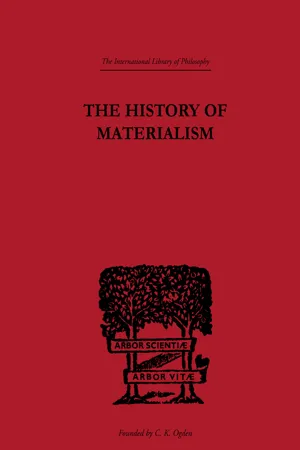
The History of Materialism
About this book
This is Volume I of five in a series on Epistemology and Metaphysics. Originally published in 1865, this book offers the history of materialism and a criticism of its present importance in that period of time, presented in three parts.
Information
History of Materialism Since Kant.
Modern Philosophy.
Chapter I.
Kant and Materialism.
THE pre-eminent position which we have assigned to Kant by the very division of our work stands already in much less need of justification, or even of explanation, than when the first edition appeared, almost eight years ago. It is true, indeed, that the retreat of our philosophical Romanticism in Germany had been settled long before. As a routed army looks around it for a firm point where it may hope to collect again into order, so there was heard everywhere in philosophic circles the cry, ‘Retreat upon Kant!’ Only more recently, however, has this retreat upon Kant become a reality, and it is found that at bottom the standpoint of the great Königsberg philosopher could never have been properly described as obsolete; nay, that we have every reason to plunge into the depths of the Kantian system with the most serious efforts, such as have hitherto been spent upon scarcely any other philosopher than Aristotle.
Misapprehensions and impetuous productiveness have combined in an intellectually active age to break through the strict barriers which Kant had imposed upon speculation. The reaction which succeeded the metaphysical intoxication contributed the more to the return to the prematurely abandoned position, as men found themselves again confronted by the Materialism which at the appearance of Kant had disappeared, and left scarcely a wrack behind. At present we have not only a young school of Kantians in the narrower and wider sense,1 but those also who wish to try other paths see themselves compelled first to reckon with Kant, and to offer a special justification for departing from his ways. Even the factitious and exaggerated enthusiasm for Schopenhauer’s philosophy partly owed its origin to a related tendency, while in many cases it formed for more logical minds a transition to Kant. But a special emphasis must here be laid on the friendly attitude of men of science, who, so far as Materialism failed to satisfy them, have inclined for the most part to a way of thinking which, in very essential points, agrees with that of Kant.
And it is, in fact, by no means strictly orthodox Kantianism upon which we must have laid distinctive stress; least of all that dogmatic turn with which Schleiden thought he could crush Materialism when he compared Kant, Fries, and Apelt with Keppler, Newton, and Laplace, and maintained that by their labours the ideas ‘Soul, Freedom, God,’ were as firmly established as the laws of the stellar world.2 Such dogmatism is entirely foreign to the spirit of the ‘Critick of Reason,’ although Kant personally attached great value to his having withdrawn these very ideas from the controversy of the schools, by relegating them, as utterly incapable as well of positive as negative proof, to the sphere of practical philosophy. But the whole of the practical philosophy is the variable and perishable part of Kant’s philosophy, powerful as were its effects upon his contemporaries. Only its site is imperishable, not the edifice that the master has erected on this site. Even the demonstration of this site, as of a free ground for the building of ethical systems, can scarcely be numbered among the permanent elements of the system, and therefore, if we are speaking of the salvation of moral ideas, nothing is more unsuitable than to compare Kant with Keppler, to say nothing of Newton and Laplace. Much rather must we seek for the whole importance of the great reform which Kant inaugurated in his criticism of the theoretical reason; here lies, in fact, even for ethic, the lasting importance of the critical philosophy, which not only aided the development of a particular system of ethical ideas, but, if properly carried on, is capable of affording similar aid to the changing requirements of various epochs of culture.
Kant himself was very far from comparing himself with Keppler; but he made another comparison, that is more significant and appropriate. He compared his achievement to that of Copernicus. But this achievement consisted in this, that he reversed the previous standpoint of metaphysic. Copernicus dared, “by a paradoxical but yet true method,” to seek the observed motions, not in the heavenly bodies, but in their observers. Not less “paradoxical” must it appear to the sluggish mind of man when Kant lightly and certainly overturns our collective experience, with all the historical and exact sciences, by the simple assumption that our notions do not regulate themselves according to things, but things according to our notions.3 It follows immediately from this that the objects of experience altogether are only our objects; that the whole objective world is, in a word, not absolute objectivity, but only objectivity for man and any similarly organised beings, while behind the phenomenal world, the absolute nature of things, the ‘thing-in-itself,’ is veiled in impenetrable darkness.
For a moment we will deal with this idea. How Kant carried it out does not for the moment concern us; but we must all the more closely consider the question how the position of Materialism is affected by this new standpoint.
The end of the First Book showed us the German school philosophy entangled in a serious controversy with Materialism. The favourite image of the hydra, from which two new heads always spring forth when the demigod has struck off one, is anything but suitable to the drama which is unfolded to the unprejudiced spectator of these struggles. Materialism does indeed receive each time a blow that it cannot parry; it is ever the same carte that always strikes home, however clumsily it may often be dealt. Consciousness cannot be explained out of material movements. However conclusively it is shown that it is entirely dependent upon material changes, the relation of external movement to sensation remains inconceivable, and the more light is thrown upon it only a more glaring contradiction is revealed. But next we observe that all the systems that are brought to oppose Materialism, whether they are called after Descartes, Spinoza, Leibniz, Wolff, or after our old friend Aristotle, contain precisely the same contradiction, besides, it may be, a dozen worse ones. When we come to reckon with Materialism, everything comes to light. We here leave entirely out of view what advantages the other systems may perhaps possess in their profoundness, in their relations with art, religion, and poetry, in brilliant divinations and stimulating play of mind. In such treasures Materialism is poor; but it is just as poor in those gross fallacies or hair-splitting sophisms which help the other systems to their so-called truths. In the contest with Materialism, where what is wanted is proof or refutation, all the advantages of profoundness can give no help, and the hidden contradictions are brought to light.
We have, however, made the acquaintance in many forms of a principle against which Materialism has no weapons, and which, in fact, leads us on beyond this way of thinking to a higher view of things. At the very outset of our task we were met by this principle when we saw Protagoras pass beyond Demokritos. And again, in the last era which we treated, we find two men differing in nationality, modes of thought, calling, faith, and character, who nevertheless both abandoned the foundation of Materialism upon the same point—Berkeley the bishop, and D’Alembert the mathematician. The former looked upon the whole world of phenomena as one great delusion of the senses; the latter doubted whether there exists outside us anything corresponding to what we suppose we see, We have seen how angry Holbach grows over Berkeley without being able to refute him.
There is one province of exact physical inquiry that prevents contemporary Materialists from perversely turning away from the doubt as to the reality of the phenomenal world, that is the physiology of the sense-organs. The astonishing progress made in this field, of which we must later speak again, seems expressly calculated to confirm the Pythagorean proposition that man is the measure of things. When it has once been demonstrated that the quality of our sense-perceptions is entirely conditioned by the constitution of our organs, we can no longer dismiss with the predicate “Irrefutable but absurd” even the hypothesis that the whole system also, into which we bring our sense-perceptions—in a word, our whole experience—is conditioned by an intellectual organisation which compels us to feel as we do feel, to think as we do think, while to another organisation the very same objects may appear quite different, and the thing in itself cannot be pictured by any finite being.
In fact, the idea that the phenomenal world is only the distorted copy of another world of real objects runs through the whole history of human thought. Among the thinkers of ancient India, as well as among the Greeks, is found in many forms the same fundamental idea, which, in the shape given to it by Kant, is now suddenly compared to the achievement of Copernicus. Plato believed in a world of ideas, the eternal and perfect types of earthly phenomena. Kant calls him the foremost philosopher of the intellectual, and Epikuros, on the other hand, the foremost philosopher of the sensible. How much, however, Kant’s relation to Materialism differs from that of Plato is clear from the fact that Kant devotes a special eulogy to Epikuros, because in his conclusions he has never transcended the limits of experience, while, e.g., Locke, “after having derived all the conceptions and principles of the mind from experience, goes so far in the employment of these conceptions and principles as to maintain that we can prove the existence of God and the immortality of the soul—both of them objects lying beyond the limits of possible experience—with the same force of demonstration as any mathematical proposition.” 4
On the other hand, Kant differed no less decidedly from those philosophers who content themselves with proving that the phenomenal world is a product of our ideas. Protagoras made himself at home in this phenomenal world. He completely gave up the idea of an absolute truth, and based his whole system on the proposition that that is true for the man which seems to him true, and that good which seems to him good. The object of Berkeley, in his contest against the phenomenal world, was to get fresh air for distressed faith, and his philosophy stops where his real aim appears. The sceptics entirely content themselves with shattering all fancied truth, and doubt not only the world of ideas and the phenomenal world, but, in fact, the unconditional validity of the laws of thought. And yet it was a sceptic who, by a violent shock, threw our Kant out of the paths of German Scholasticism, and brought him into that direction in which, after thinking and labouring for years, he reached the goal announced in his immortal ‘Critick of Pure Reason.’ If we wish to get a clear grasp of Kant’s fundamental idea, without analysing the whole structure of his system, our way leads through David Hume.
Hume is fully entitled to rank with the series of English thinkers denoted by the names of Bacon, Hobbes, and Locke; nay, it is a question whether the first place among them all is not due to him. Sprung from a noble Scotch family, he was born at Edinburgh in 1711. As early as 1738 appeared his work upon ‘Human Nature,’ written during a visit to France in complete and studious leisure. Only fourteen years later did he devote himself to those historical studies to which he owes a great part of his fame. After various occupations, he became at length Secretary of Embassy in Paris; finally, Under Secretary of State. To us Germans, who, by a philosopher, through involuntary association of ideas, understand a professor standing with raised finger before his chair, it must necessarily appear striking that among the English philosophers there have been so many statesmen; nay, what is almost more remarkable, that in England the statesmen are sometimes philosophers.
Hume, in his way of thinking, stands as close to Materialism as a so decided sceptic ever can. He stands on the ground prepared by Hobbes and Locke. He sometimes explained the origin of error, without, however, attaching much value to the hypothesis, by means of a faulty conduction in the brain, in which he imagines all notions to be localised. For that weak point of Materialism which the Materialists themselves know not how to protect, Hume has found a sufficient defence. In admitting that the transition from movement in space to perception and thought is inexplicable, he points out that this inexplicableness is by no means peculiar to this problem. He shows that exactly the same contradiction attaches to all relations of cause and effect. “Place one body of a pound weight on one end of a lever, and another body of the same weight on another end, you will never find in these bodies any principle of motion dependent on their distances from the centre, more than of thought and perception.”5
Our modern mechanical science would perhaps object to this; but let us remember that all the progress of science has not solved, but only pushed further back, the difficulty to which Hume refers. If we consider two ultimate molecules of matter, or two heavenly bodies, when the motion of the one influences that of the other, we shall be able to account admirably for all the rest, but the relation of the attractive power which brings about the connection to the bodies themselves is concealed under the incomprehensibleness of every single change in nature. It is true that we have not in this way explained the passage of movement in space into thought, but we have shown that this inexplicableness can form no argument against the dependence of thought upon motion in space. The price paid by Materialism for this defence is, indeed, not less than that which the Devil in the legend demands for his aid. The whole cause of Materialism is for ever lost by the admission of the inexplicableness of all natural occurrences. If Materialism quietly acquiesces in this inexplicableness, it ceases to be a philosophical principle; it may, however, continue to exist as maxim of scientific research. This is, in fact, the position of most of our modern ‘Materialists.’ They are essentially sceptics; they no longer believe that matter, as it appears to our senses, contains the last solution of all the riddles of nature; but they proceed in principle as if it were so, and wait until from the positive sciences themselves the necessity arises to adopt other views.
Still more striking, perhaps, is Hume’s kinship with Materialism in his keen polemic against the doctrine of personal identity, of the unity of consciousness, and the simplicity and immateriality of the soul.
“There are some philosophers who imagine we are every moment intimately conscious of what we call our self (in German philosophy, ‘das Ich’); that we feel its existence and its continuance in existence, and are certain, beyond the evidence of a demonstration, both of its perfect identity and simplicity….
“Unluckily all these positive assertions are contrary to that very experience which is pleaded for them; nor have we any idea of self, after the manner it is here explained…. For my part, when I enter most intimately into what I call myself, I always stumble on some particular perception or other, of heat or cold, light or shade, love or hatred, pain or pleasure. I never can catch myself at any time without a perception, and never can observe anything but the perception. When my perceptions are removed for any time, as by sound sleep, so long am I insensible of myself, and may truly be said not to exist.” If any one has a different notion of himself, Hume cannot reason with him. “He may, perhaps, perceive something simple and continued, which he calls himself, though I am certain there is no such principle in me. But setting aside some metaphysicians of this kind, I may venture to affirm of the rest of mankind that they are nothing but a bundle or collection of different perceptions, which succeed each other with an inconceivable rapidity.” 6
The delicate irony which is here directed against the metaphysicians elsewhere hits the theologians. That Hume’s views are quite inconsistent with the immortality of the soul in the theological sense need not be said. Nevertheless, he sometimes amuses himself by the malicious observation that all the arguments for the immortality of the soul would have just as much force on his view as on the ordinary assumption of the simplicity and identity of the soul.
That this was the man who produced so profound an impression upon Kant, whom Kant never names but with the utmost respect, must at once place Kant’s relation to Materialism in a light other than that in which we are usually willing to regard it. Decided as Kant is in his opposition to Materialism, still this great mind cannot possibly be numbered with those who base their capacity for philosophy upon a measureless contempt for Materialism.
“Physical science will never discover to us the internal constitution of things, which is not phenomenon, yet can serve as the ultimate ground of explanation of phenomena; but it does not require this for its physical explanations. Nay, even if such grounds should be offered from other sources (for instance, the influence of immaterial entities), they must be rejected, and not used in the course of its explanations; for these explanations must only be grounded upon that which, as an object of sense, can belong to experience, and be brought into connection with our real perceptions, according to the laws of experience.”7
Kant, in a word, fully recognises two ways of thinking—Materialism and Scepticism—as legitimate steps towards his critical philosophy; both he regards as errors, but errors that were necessary to the development of knowledge. He admits that the former, by reason of its intelligibleness, may become dangerous for the mass of people, while the latter, by reason of its difficulty, will remain confined to the schools; but as to a purely scientific judgment, both he regards as equally respectable, while, however, the preference belongs to Scepticism. There is no philosophical system to which Kant did not occupy a more negative attitude than to these two. The ordinary Idealism, in particular, stands in the sharpest opposition to Kant’s ‘transcendental’ Idealism. In so far as it attempts to prove that the phenomenal world does not show things to us as they are in themselves, Kant agrees with it. As soon, however, as the Idealist will teach us something as to the world of pure things, or even set this knowledge in the position of the empirical sciences, he cannot have a more irreconcilable opponent than Kant.
A hasty reviewer had found “higher Idealism” in Kant’s ‘Critick.’ This appeared to Kant much as if he had been charged with “higher absurdity,” so entirely was he misunderstood. We must admire the moderation, and at the same time the keenness, of the great thinker when he replies by setting down two propositions, whch even to the blindest must throw a gleam of light into the essence o...
Table of contents
- Cover
- Half Title
- Title
- Copyright
- TRANSLATOR’S PREFACE
- FREDERICK ALBERT LANGE: BIOGRAPHICAL NOTES
- AUTHOR’S PREFACE TO THE SECOND [AND LATER] EDITIONS
- TABLE OF CONTENTS
- First Book. HISTORY OF MATERIALISM UNTIL KANT.
- Second Book. HISTORY OF MATERIALISM SINCE KANT.
- Preface to the Second Book [as Postscript],
- Index
Trusted by 375,005 students
Access to over 1.5 million titles for a fair monthly price.
Study more efficiently using our study tools.
Frequently asked questions
Yes, you can cancel anytime from the Subscription tab in your account settings on the Perlego website. Your subscription will stay active until the end of your current billing period. Learn how to cancel your subscription
No, books cannot be downloaded as external files, such as PDFs, for use outside of Perlego. However, you can download books within the Perlego app for offline reading on mobile or tablet. Learn how to download books offline
Perlego offers two plans: Essential and Complete
- Essential is ideal for learners and professionals who enjoy exploring a wide range of subjects. Access the Essential Library with 800,000+ trusted titles and best-sellers across business, personal growth, and the humanities. Includes unlimited reading time and Standard Read Aloud voice.
- Complete: Perfect for advanced learners and researchers needing full, unrestricted access. Unlock 1.5M+ books across hundreds of subjects, including academic and specialized titles. The Complete Plan also includes advanced features like Premium Read Aloud and Research Assistant.
We are an online textbook subscription service, where you can get access to an entire online library for less than the price of a single book per month. With over 1.5 million books across 990+ topics, we’ve got you covered! Learn about our mission
Look out for the read-aloud symbol on your next book to see if you can listen to it. The read-aloud tool reads text aloud for you, highlighting the text as it is being read. You can pause it, speed it up and slow it down. Learn more about Read Aloud
Yes! You can use the Perlego app on both iOS and Android devices to read anytime, anywhere — even offline. Perfect for commutes or when you’re on the go.
Please note we cannot support devices running on iOS 13 and Android 7 or earlier. Learn more about using the app
Please note we cannot support devices running on iOS 13 and Android 7 or earlier. Learn more about using the app
Yes, you can access The History of Materialism by F.A. Lange in PDF and/or ePUB format, as well as other popular books in Philosophy & Philosophy History & Theory. We have over 1.5 million books available in our catalogue for you to explore.