Originally published in 1962, Land Economics Research brings together papers presented at a symposium in Nebraska in 1961 which deal with ideas, theories and suggestions in land economics to encourage problem-solving in American land issues. This report draws on all types of land, all situations and all economics problems related to land issues. This title will be of interest to students of Environmental Studies and Economics as well as professionals.
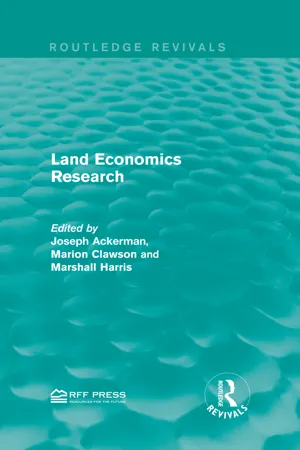
- 270 pages
- English
- ePUB (mobile friendly)
- Available on iOS & Android
eBook - ePub
Land Economics Research
1
Future Land Use and Tenure Problems Requiring Research
by Marion Clawson*
Research, particularly social science research, is oriented toward the future, Man studies problems with an eye to their solution and, given the time required to do research and to translate it into action, this inevitably means that the problems research can cope with will be those of the future rather than those of the present. In coping with a problem, Man brings to bear on it more than the results of past organized research -- past informal experience, folk lore and tradition, his own personal predilections and hunches, and a vast array of other tools. Yet in the long run he is more dependent upon past research than often he realizes; and as our economy and culture grow more complicated, so must the tools of analysis grow more formal and more sophisticated.
It is true that many scholars study the past, and even the present, insisting they are interested in knowledge for its sake alone, without thought of its direct applicability to current or future "practical" problems. Yet even such scholars seek knowledge of past events and past processes so as to understand better what has happened, and from this to understand better what is happening and may happen in the same or closely related fields. More commonly, research in the social sciences as applied to land and other resource problems is rather directly concerned with applicability to current real life problems. Whether "problem" oriented or organized around particular resources, areas, or methods of research, it often has a high utilitarian content.
Social science research in agricultural and other land problems has mostly been concerned with processes and changes under way but as yet incomplete. The study of landlord-tenant relationships in a particular area, for instance, deals with a situation in which there are both landlords and tenants with contractual arrangements between them which are or may be in process of change to different sets of arrangements. Research on land matters has typically consisted of studying what is and how it arose, often carrying the analysis forward into what may be or what should be in the future. Most such research is pragmatic and utilitarian in method and in purpose; both the individual researcher and the society which supports him financially want "results" that seem usable.
To emphasize the forward-looking and utilitarian aspects of land research does not argue against theoretical and abstract studies. Sometimes, especially in this relatively advanced society in which we live, the "roundabout" production process is as productive in social science research as it is in factory production processes. Simple problems may yield to simple tools, but they hardly deserve the attention of our best researchers; more complicated problems are likely to demand more sophisticated approaches, and the basic job of the advanced researcher may be to fashion concepts and tools which he or others may later apply to a more direct solution of significant current problems.
With these thoughts in mind, this paper seeks to give some idea of the land use and tenure problems that research in land economics may be called upon to solve, or to help solve, over the next decade or two. The discussion is intended to list some of the main problems, without necessarily including all of them. It certainly cannot give a standard of judgment as to the urgency of research needs in each field and subfield.
Demand Factors for Land
The economist usually finds it convenient to group social and economic changes under the two broad headings of "demand" and "supply," recognizing at the same time that each affects the other to a substantial degree. We shall employ this usual grouping. Among the many demand forces affecting land use and tenure, we shall briefly describe four: population changes, income changes, leisure, and transportation. Others might be mentioned, but their influence has been either less or similar to the effect of these four. It is unnecessary for our present purpose to attempt a quantitative measure of the relative importance of each; we may suppose that it differs, according to the particular use of land.
The combined effect of these four factors in the past has been a greatly increased demand for the products or uses of land. The prospects for the future are that the same factors will further increase the demand for these same products and uses. This does not necessarily mean an increase in demand for land as a productive factor. The products and uses of land are produced not only by land, but also by labor, capital, and management combined with land. As we shall see in the following section, supply relationships may change so much as not to increase the demand for land, although the demand for the products and uses of land is increasing rapidly. Changes in the demand and supply situation are almost sure to lead to changes in the most desirable land tenure relationships.
Throughout our history, the economy and society of the United States have been dynamic, subject to change and growth. This dynamism can be expressed quantitatively in such matters as numbers of the total population, gross national product, and the like; but, perhaps more importantly, it also finds expression in attitudes toward change and toward life in general. For the purposes of this book, we need not make precise estimates of future economic and social factors -- to do so might lead us astray, in focusing on the details and the precise figures of such projections. Instead, we can perhaps better focus on the broad changes under way, with only some idea of the general magnitudes involved and then consider what these may mean to researchers. For some types of research, of course, specific projections or forecasts are basic, and should be made as carefully as possible.
A major social and economic trend of the past, virtually certain to continue into the future, has been steady and rather rapid growth in total population. From less than 4 million at the first Census in 1790, we have increased to almost 180 million in 1960; two major intermediate landmark dates and figures are 76 million in 1900 and 151 million in 1950. Between 1950 and 1960 we added almost as many people as were found in the nation at the time of the Civil War. The drama of immigration from the Old World to the New and the settlement of the frontier have thrilled both the serious student and the television fan, but must reluctantly be passed over here. What is often overlooked is that the rate of population growth declined steadily and to a major extent from early decades, when it was about 3 per cent annually, to the decade of the 1930's, when it was not much over .05 per cent annually. The rate of population growth has since increased, but not to new highs, as much popular literature states or suggests, but rather to figures comparable to the period from 1910 to 1930, or about 1.7 per cent annually. The source of growth has largely shifted from immigration to domestic births; declining death rates and resulting longevity have been major factors also. The really unusual aspect of American demographic experience has been the major reversal in trend of birth rates; downward for a century or more, the rate has turned upward and possibly stabilized at a new and higher level in the past 20 years.
Barring catastrophic war, total population in the United States will almost certainly continue to increase for the next generation or longer. The unpredictable variable will continue to be birth rates. Population projection has a woeful list of failures to record for the past 30 years or so.1 For our present purpose it is not necessary to make a precise projection or forecast for any future date. Estimates of 300 to 325 million people in the year 2000 have been made and can be logically defended; estimates for intermediate dates, consistent with these long-run estimates, can also be made. If population growth has some relationship to the base population at any given date -- as the historical record for humans in the United States and as experience for other animals seem to suggest -- then we may expect the annual increase in numbers of persons to be larger and larger as the years go by, although the annual percentage increase might remain constant or even decline.
All other factors equal, more people demand more products and uses from land than do fewer people. The increases in demand may be either more or less than proportionate to the changes in total numbers of people, and they may vary from one product or use to another. All other factors have not remained constant in the past and are unlikely to do so in the future; the effect of other factors may either enhance or moderate the effect of population change upon demand. But population changes of the magnitude we have experienced and of the magnitude that seem imminent for the next generation, must have a major effect upon the demand for the products and uses of land. Moreover, such increases in demand -- such comparative "crowding" -- cannot but have major effect upon land institutions also.
Growth in total numbers of persons is accompanied by a vast geographic redistribution. The westward shift is well known. The weighted center of U. S. population, which in 1790 was 28 miles due east of Baltimore, has moved almost exactly due west along the 39th degree of latitude at an average rate of nearly 40 miles per decade, until in 1960 it was about the center of Illinois. A further westward shift is highly probable; California may shortly become the most populous state. A shift to the southwest and to the southeast is also evident, and probably will continue. On the other hand, relatively large other regions or areas have lost population in the past, and some areas or regions will either lose or gain but little in the future. Population growth rates are highly diverse within our country, and will fall with greatly different impact upon land in different regions.
Accompanying these major regional shifts has been a profound shift from country to city. From a rural nation, we have become an urban one. In 1790, only 5 per cent of the people were urban on the basis of today's definitions; as late as 1910, we were half urban and half rural; today we are two-thirds urban, and by 2000 we will be over 80 per cent urban. These shifts from country to city not only measure a change in the occupational structure of our country, but a profound change in the mode of life. Many of today's urban adults are rural in upbringing, but the younger generation has no such rural background. Many of our social values and much of our governmental structure are based upon this rural origin and dominance and have not yet made the adjustments to our new population pattern. Our land institutions have lagged behind social changes. Future shifts in population will also have heavy differential effects upon demand for land and land use. New institutional arrangements for land and water seem essential to meet the greater urbanization of the future.
Other population changes, such as the rise in numbers of old persons, the changing age distribution generally, and the rise in amount of education, may in specific circumstances affect land use and the institutions governing land use; but an attempt merely to catalogue them here would involve more detail than is necessary.
Another basic economic trend over the past has been the rise in real income per capita. This trend has been less regular than that in total population; depressions and booms have led to widely varying rates of growth, and price fluctuations have concealed or at least partly obscured the changes in real income that have taken place. Nevertheless, over the past 100 years or so the average rate of annual increase in real income per capita seems to have been rather steady, at slightly less than 2 per cent. Since 1850 or thereabouts, when our first reasonably reliable data begin, there has certainly been a profound change in average annual family income and all that this implies in terms of daily life. A century ago, most of our people lived on the land, with most of their income going into the basic necessities of life -- food, shelter, and clothing -- in a manner not too different from the situation in moderately undeveloped countries elsewhere in the world today. Perhaps we do not yet have a fully affluent society, but certainly the lot of the average man in the United States today represents a near-utopia in the perspective of world history.
The trend toward higher real incomes per capita will surely continue, barring catastrophic war. The only real argument will relate to the rate of growth -- whether it shall be 1 per cent, or 2 per cent, or more annually. These differences in annual growth rate amount to very great differences in total in a generation, of course. A per capita income in 2000 of roughly double today's level has been estimated by many scholars in this field. It is not necessary to estimate a rate precisely, for our purpose, nor to indicate the basis upon which the rate rests.
As average per capita incomes have risen and promise to rise further, it appears that the disparity in incomes among individuals has narrowed somewhat and may do so further -- at the least, the disparity in incomes among individuals has not grown greater. As average incomes have risen, a larger proportion of the average income has been available for discretionary spending, because the requirements for the basic necessities of life have not increased proportionately.
Past and prospective increases in real income per capita have magnified the demand effects of increased total population. People with more income to spend demand more products and services from land, not equally for all land. The income elasticity for the various products and services of land varies, but for few does it appear negative. As average per capita incomes rise, we may demand less wheat and a few other agricultural commodities; but we are likely to demand more beef and other products capable of being produced on the same land. We shall almost certainly require much more recreation with high incomes than low ones. The urban dwellers of the future may demand relatively large areas of land for both daily living and for recreation, in large part because they can afford it. The kinds of institutions people will support, demand, or participate in may also depend in part upon their income situation.
Among the many other aspects of the total society and economy of the future, perhaps only two need brief mention at this point. One is the rise in leisure. Average work week of the working population has decreased from 70 hours in 1850 to less than 40 hours today; we have cut the work week from 6 or even 7 days to 5 or fewer days, reduced the typical workday from 10 or 12 hours to 8 or fewer hours, and instituted the paid vacation as a typical privilege of all workers, while at the same time lengthening its average duration. These trends are likely to continue. We have estimated total leisure in the year 2000 at more than double what it was in 1950. The real question is how much future leisure will take the form of fewer workdays per week, fewer work hours per day, or longer paid vacations; the consequences for land use, especially for recreation, are great. There has also been a rise in the numbers and percentage of persons not in the labor force today, but who would have been there a generation ago.
The other major trend has been the improvement in means of transportation, the lowering of the real costs of moving persons and goods, and the consequent enormous increase in movement of persons and to a lesser extent of goods, over the past several decades. Not only have costs of transportation declined relative to the average person's ability to pay them, but the speed of transportation has increased greatly, thus making possible major savings in...
Table of contents
- Cover
- Title
- Copyright
- Original Title
- Original Copyright
- Preface
- Contents
- PART I. SCOPE, PROBLEMS, AND OBJECTIVES
- PART II. THEORETICAL CONSIDERATIONS
- PART III. PROCEDURAL FRAMEWORK
- PART IV. PROGRAM AND ORGANIZATION
Trusted by 375,005 students
Access to over 1.5 million titles for a fair monthly price.
Study more efficiently using our study tools.
Frequently asked questions
Yes, you can cancel anytime from the Subscription tab in your account settings on the Perlego website. Your subscription will stay active until the end of your current billing period. Learn how to cancel your subscription
No, books cannot be downloaded as external files, such as PDFs, for use outside of Perlego. However, you can download books within the Perlego app for offline reading on mobile or tablet. Learn how to download books offline
Perlego offers two plans: Essential and Complete
- Essential is ideal for learners and professionals who enjoy exploring a wide range of subjects. Access the Essential Library with 800,000+ trusted titles and best-sellers across business, personal growth, and the humanities. Includes unlimited reading time and Standard Read Aloud voice.
- Complete: Perfect for advanced learners and researchers needing full, unrestricted access. Unlock 1.5M+ books across hundreds of subjects, including academic and specialized titles. The Complete Plan also includes advanced features like Premium Read Aloud and Research Assistant.
We are an online textbook subscription service, where you can get access to an entire online library for less than the price of a single book per month. With over 1.5 million books across 990+ topics, we’ve got you covered! Learn about our mission
Look out for the read-aloud symbol on your next book to see if you can listen to it. The read-aloud tool reads text aloud for you, highlighting the text as it is being read. You can pause it, speed it up and slow it down. Learn more about Read Aloud
Yes! You can use the Perlego app on both iOS and Android devices to read anytime, anywhere — even offline. Perfect for commutes or when you’re on the go.
Please note we cannot support devices running on iOS 13 and Android 7 or earlier. Learn more about using the app
Please note we cannot support devices running on iOS 13 and Android 7 or earlier. Learn more about using the app
Yes, you can access Land Economics Research by Joseph Ackerman,Marion Clawson,Marshall Harris in PDF and/or ePUB format, as well as other popular books in Economics & Environmental Economics. We have over 1.5 million books available in our catalogue for you to explore.