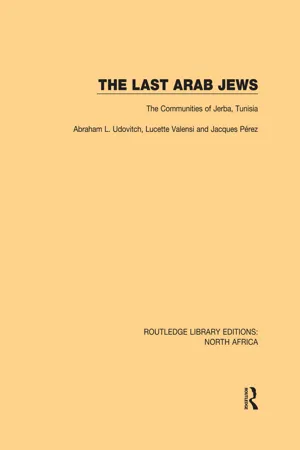
The once numerous and vital Jewish communities of Morocco, Algeria and Tunisia have disappeared, succumbing during the past century to the assimilating temptations of French culture, or, more recently, to the pressures of migration. Only the two communities of the island of Jerba still remain. Only they have succeeded in maintaining and reproducing their religious and social institutions, in adjusting to the new realities around them while preserving intact their cultural, communal identity. This lavishly-illustrated book, first published in 1984, portrays the life and history of two Jerban Jewish villages and explores the paradoxes of their continuity. How and why are they so fully Jewish while, at the same time, so thoroughly embedded in their Muslim, North African environment? Although its focus is one small ethnic group, the implications of this study extend to the broad subject of relations between Arabs and Jews in modern times.
eBook - ePub
The Last Arab Jews
The Communities of Jerba, Tunisia
- 188 pages
- English
- ePUB (mobile friendly)
- Available on iOS & Android
eBook - ePub
The Last Arab Jews
The Communities of Jerba, Tunisia
About this book
Information
4
The Rhythm of Time Being Jewish, A Full Time Activity
Blessed art Thou, O Lord our God, King of the Universe, who divides the holy from the profane, Light from darkness, Israel from the nations, The seventh day from the six other days of work. Blessed art Thou, O Lord, who divides the holy from the profane.
The Havdalab (distinction) prayer, recited at the conclusion of the Sabbath.

Time as a Parameter of Identity
Time, like other cultural elements, traces a line which separates Muslims from Jews. Each group has its own calendar, its own names for the months and its own count for the years. In the year 1401 of Islam, the Jews were in 5741 (1981-82). Since the colonial period, the Christian calendar and system of dating have been added to the two others and continue to regulate administrative and civic celebrations. While retaining a knowledge of its neighbor’s important moments, each group lives according to its own calendar.
From the Islamic calendar, the Jews are familiar with the five prayers which punctuate the day, the solemn observance of Friday and the great festivals of the annual cycle. They feel uneasy about the month of pilgrimage since, so they say, people come back from it with less tolerance for the Jews than they had when they left. During the month of Ramadan, they observe the slowing down of life during the day, its intensity at night and the increased consumption of food. In symmetrical fashion, the Muslims recognize the important moments of the Jewish cycle: the Sabbath, when the Jews close their shops, dress differently and do not smoke; and the gieat festivals, which the Muslims name according to the meals associated with them. ‘Id et-tmar, the festival of fruit, is the New Year because of its association with the consumption of fruit and new dates; ‘Id ed-djaj, the festival of poultry, is Yom Kippur; ‘Id el-ftira, the festival of unleavened bread, designates Passover, and ’Id el-qli, the festival of roasted seeds, designates Shavu’oth.
Each group recognizes only the outward ritual manifestations of the other’s practices without really understanding their underlying meaning. They note whatever has a bearing on communications between Jews and non-Jews, since exchanges between them have to be adapted to these two rhythms of time. The Muslim calendar is strictly lunar whereas that of the Jews is luni-solar. The Muslim year has 12 months, each consisting of either 28 or 29 days, so that the sequence of months does not correspond to the rhythm of the seasons. The Jewish years has twelve months consisting of 29 or 30 days, and every two or three years a thirteenth month readjusts the lunar to the solar cycle, and consequently, to the agrarian cycle. Festivals, therefore, recur every year at the same season.
While the two groups divided the year differently, the week, the days and their lesser subdivisions are held in common and are designated by the same names. However, these measurements, identical in quantity, do not have the same properties, the same qualities. The prohibitions, prescriptions and practices which are attached to every moment are not the same; in a word, the social uses of time vary according to which group one belongs to.
The Muslims, like the Jews, divide the day into two parts: the first is the night, the second, the day. The Jews greet the beginning of the day at the synagogue, with the maariv evening prayers after which they return home for the night. The night is filled with a religious atmosphere. A blessing precedes and follows the family meal. Before they go to bed, the men recite the shema — the profession of faith, and the final prayer which accompanies a man at his death. When the believer wakes up, he renders thanks to God, with the prayer modeh ani, for having given him back his life, for its is believed that the soul of a sleeping man returns to the Eternal One. During the night, dreams are the medium through which God sends His messages, with the family’s dead, or well-known deceased rabbis who consistently appear in white clothing, acting as intermediaries. These are instructions which must be obeyed. Night is therefore the moment in which communication with the Invisible can take place. Night ends just as it began, in the synagogue, where the men gather for the shaharit prayer.
Following the shaharit prayer, each person sets out on his daily tasks. This is the time when secular activities and interaction with non-Jews take place. In the middle of the day, the men return home to have their meal, without any detours to the synagogue. This non break is a recent custom, made possible by the motorbike and the automobile. Before these means of transportation were introduced, no one went home for the mid-day meal. Either you brought it with you from home, or else a messenger gathered all the lunches from the households of the Hara and brought them to the market of Houmt Souk. You could also have lunch at one of the inexpensive kosher eating-houses at Houmt Souk which have now disappeared. In any case, lunch is still a less important and less copious meal than dinner. It is eaten quickly, and does not involve a gathering of the entire family.

Participation in the rituals is universal and recognizes no hierarchy. Here, a mechanic leads the morning services.
At the end of the day, after work, the men once again converge on the synagogue, where the minha (late afternoon) prayer is linked to the ma‘ariv of the following day. The men’s lives and itineraries are therefore regularly balanced between two opposite directions: from the synagogue to the home at night, the time and place of the sacred; and from the synagogue to the market during the day, the time and place of the secular (figure 8).
Within the week, there is the same opposition between ordinary days and festive days. In years gone by, when many Jews worked “in the ghaba,” that is, outside of the two Haras, they were absent from Sunday until Thursday, but returned and spent the rest of the week in the Hara. Secular activities and secular space were therefore clearly separated from the time spent in the sacred space. Within the home itself, this opposition is expressed by a choreography in three movements: random, from Sunday until Wednesday; feverish and noisy, on Thursday and Friday; and slow and silent on the Sabbath. Beginning on Thursday, shopping is done for the Sabbath and the synagogues are cleaned. On Friday, people rush about to clean the house, to cook, to bathe, to finish all the preparations on time. They cross the courtyard a hundred times in every direction, and kiss the mezuzot on the thresholds that many times. Before sundown, the dead are honored. In the houses and synagogues, candles are lit for the community’s dead, for the great rabbis, and for

Torah reading during a weekday.

Figure 8 Daily itinerary.

In the synagogue, conversation at dusk between the minha and ma‘ariv services.

Friday afternoon fever: every family carries its Sabbath meal to the communal oven.
the deceased members of one’s own family. At last, the women rest at the threshold of their houses, while the men congregate around a public cistern near the entrance to the Hara and await the sound of the shofar. From a rooftop, the shofar is sounded first to call for the suspension of all activity; and then again, ten minutes later, to announce that the Sabbath is about to begin.
After a service in the synagogue, the men exchange greetings of shabbat shalom, “Sabbath of peace,” and go home. Calm and quiet settle on the streets of the two villages. In the houses, celebrations are beginning. As in all observant Jewish households the world over, the linen and the dishes have a special sparkle on this evening. The bread made by the mother of the family has an unaccustomed flavor; the blessings over the wine, the bread and the herbs have a special seriousness. Kabudshabbat, the honor of the Sabbath, requires abundance. The couscous, the main dish of the evening meal, laden with several kinds of meat, is richer than the one prepared for weekdays. The main dish of the meal which follows the prayer of Saturday morning is the tfina arisha, wheat cooked overnight in the communal oven with meat or fish and garnished with eggs hardened in the oven. Invariably, all the Jewish families of Jer’oa prepare and eat identical dishes on the Sabbath. When they are able to, they send a sack of wheat to their absent relatives so that they too can enjoy a similar ritual meal with the same ingredients in Paris, Marseilles or Tel Aviv.
Sabbath is the day for ostentation, for preening and for displaying one’s best clothing. Friday night is the recommended time for conjugal union, and the women prepare themselves by putting on their best clothes, and by covering themselves with perfumes and jewels.
Saturday is the day of prayer and meditation, when the men spend several hours in and around the synagogues. In the early morning, each of them, wrapped in his prayer shawl, goes to his preferred synagogue. There is no order or hierarchy in the use of space. In each synagogue, one of the congregants — and not necessarily the same one every week — leads the service. After the profession of faith, they pronounce the silent benedictions facing in the direction of Jerusalem. The prayer leader repeats the benedictions out loud, while the congregation proclaims as a chorus, “Blessed be He, blessed be His name.” This recitation is followed by the most solemn moment of the services: the removal of the scrolls of the Torah from the ark. Members of the congregation vie for the privilege of carrying the Torah scrolls from the ark. It is one of several mitzvot which are sold to the highest bidder at an “auction” during the services. The congregation passes before the holy ark in procession. The ark is opened and the scrolls are removed and paraded around the synagogue before being set down on the bimah, the raised platform in the center of the synagogue. After the weekly portion is read, the ceremony culminiates when the Torah scroll is lifted above the heads of the congregation which shouts in chorus: “Here is the Torah which God set before Moses and the people of Israel.”

“Remember the Sabbath day, to keep it holy. Six days you shall labor, and do all your work; but the seventh day is a Sabbath to the Lord your God, on it you shall not do any work.” (Exodus 20:8-11)

A trayful of breads baked in the communal oven for the Sabbath; each loaf bears the family’s distinctive mark.
Before returning the scrolls to the ark, the weekly epistle of the chief rabbi is read to the congregants. The conclusion of the Torah ceremony is followed by a musaf, or additional service — a brief prayer service reserved for Sabbaths and major festivals after which the congregation disperse to their homes to bless the bread and wine and to take the Saturday meal.
This ceremony which — except for the reading of the rabbi’s proclamations and of the “additional” service — is repeated in shortened form on Mondays and Thursday, is common to all Jewry. Jerba stands out here only because of the participation of every adult male of the community. They gather once again in the afternoon to read, study, or at least to chat in the shade of the synagogues until the minha prayer. After the ma‘ariv, the Sabbath ends just as it began, with exchanges of greetings, shavu’a tov, a good week.

Every week, on the eve of the Sabbath, and every month, on the eve of the new moon, women light candles in the memory of the dead.
Saturday is the day of lemma, of gatherings in houses, in the streets, in the synagogues. A sadness suffuses the heart when, once the blessing for the end of Sabbath has been pronounced, a week of lonely work and of worldly activities begins.
All of this seems to be regulated in a very uniform fashion. Doesn’t it become boring to repeat the same actions over and over? Not at all. Everyone, knowing the score by heart, takes pleasure in performing according to his talent or his virtuosity, and is happy simply to excel in that which is required by custom. Not innovation, but perfection in applying the norm is the prized quality. Observing the Sabbath to its last detail remains, together with adherence to the dietary laws and those prohibiting intermarriage, one of the three major prescriptions which no Jerban Jew would transgress.
Like the day and the week, the year also contains alternating high and low points in the intensity of ritual activity. The year is marked by two great cycles of three weeks each. One begins with the Jewish New Year in the autumn, and the other with the spring. At these times, absent members of the family return to the ancestral home and, from the initial preparations for the festival until their concluding ceremonies, the full energies of the household are mobilized.
The Calendar for the Year 5739
From the annual cycle to the single day, the observance of time is for Jews one of the means of ascription to their own group and of demarcation from those who order their lives according to another rhythm. On the subject of the dates of new moons, or of the festivals and of all the gestures which they involve, Jerban Jews are infallible. Nonetheless, a printed guide of the year’s events is published annually on a single large sheet of paper and is posted in every synagogue. We reproduce here the calendar for the year 5739 (1978-79) (figure 9).

Figure 9: The calendar of the year 5739.
This calendar begins by showing the symbolic value of the year, obtained by changing its numbers into letters, and then finding an appropriate Biblical verse which announces what the year promises. “Yes, says 5739,1 will send you the prophet Elijah.”
The text informs us that this is a regular year, numbering twelve months and fifty Saturdays — fifty Sabbaths — on which all the activities which we have described will be repeated. Then comes the list of the twelve Jewish months of the year, from Tishri through Elul, with the dates of the major festivals as well as the minor holidays. Another section of the calendar gives the dates of the new moons. What does that involve? For the men, a special prayer; for the women, lighting candles and taking a day’s vacation from their normal work. There is another section, which has a different series of divisions of the year: the tekufot, the beginning of which marks the transition from one season to the next. This is a critical period, as moments of passage always are, entailing the rotation of the angels who stand guard over the water. During this chan...
Table of contents
- Cover
- Half Title
- Title
- Copyright
- Original Title
- Original Copyright
- Preface to the Series
- Contents
- Acknowledgments
- Dedication
- Preface
- A Long History
- Symbols of Identity
- Communal Life «Building a Wall around the Torah»
- The Rhythm of Time Being Jewish, a Full Time Activity
- Ahl al-Kitāb People of the Book
- Merchants and Craftsmen
- Pilgrimage to Jerba
- Epilogue
- Images of Jerba
- Sources and Bibliography
- Glossary
Trusted by 375,005 students
Access to over 1.5 million titles for a fair monthly price.
Study more efficiently using our study tools.
Frequently asked questions
Yes, you can cancel anytime from the Subscription tab in your account settings on the Perlego website. Your subscription will stay active until the end of your current billing period. Learn how to cancel your subscription
No, books cannot be downloaded as external files, such as PDFs, for use outside of Perlego. However, you can download books within the Perlego app for offline reading on mobile or tablet. Learn how to download books offline
Perlego offers two plans: Essential and Complete
- Essential is ideal for learners and professionals who enjoy exploring a wide range of subjects. Access the Essential Library with 800,000+ trusted titles and best-sellers across business, personal growth, and the humanities. Includes unlimited reading time and Standard Read Aloud voice.
- Complete: Perfect for advanced learners and researchers needing full, unrestricted access. Unlock 1.5M+ books across hundreds of subjects, including academic and specialized titles. The Complete Plan also includes advanced features like Premium Read Aloud and Research Assistant.
We are an online textbook subscription service, where you can get access to an entire online library for less than the price of a single book per month. With over 1.5 million books across 990+ topics, we’ve got you covered! Learn about our mission
Look out for the read-aloud symbol on your next book to see if you can listen to it. The read-aloud tool reads text aloud for you, highlighting the text as it is being read. You can pause it, speed it up and slow it down. Learn more about Read Aloud
Yes! You can use the Perlego app on both iOS and Android devices to read anytime, anywhere — even offline. Perfect for commutes or when you’re on the go.
Please note we cannot support devices running on iOS 13 and Android 7 or earlier. Learn more about using the app
Please note we cannot support devices running on iOS 13 and Android 7 or earlier. Learn more about using the app
Yes, you can access The Last Arab Jews by Abraham L. Udovitch,Lucette Valensi,Jacques Perez in PDF and/or ePUB format, as well as other popular books in Social Sciences & Regional Studies. We have over 1.5 million books available in our catalogue for you to explore.