eBook - ePub
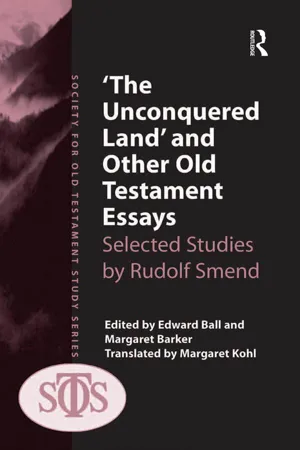
'The Unconquered Land' and Other Old Testament Essays
Selected Studies by Rudolf Smend
- 296 pages
- English
- ePUB (mobile friendly)
- Available on iOS & Android
eBook - ePub
'The Unconquered Land' and Other Old Testament Essays
Selected Studies by Rudolf Smend
About this book
This final book published in the Ashgate SOTS monograph series collects together for the first time in English translation a selection of important essays on central themes and texts in Old Testament criticism and exegesis by Rudolf Smend, one of the world's most eminent senior scholars in the field. The essays focus on key topics such as Moses, covenant, history, Old Testament theology, the state, Elijah, Amos, and major movements in the history of the discipline over the past three centuries. All are marked by penetrating exegetical and critical insight as well as by an unrivalled knowledge of the history of Old Testament scholarship, and many of them have already made highly-respected and influential contributions. Their publication will serve to make the range and vitality of Smend's work more widely known to English-speaking readers.
Information
1 Moses as a Historical Figure
DOI: 10.4324/9781315551845-2
It is an honour and a pleasure for a biblical theologian to talk to a historically interested audience. It is true that he is also a historian, though his subject and approach do not precisely place him at the centre of the historians’ guild. The sacred history which is his concern, much though it may have lost in sacredness, is still somewhat marginal; and whatever occasionally filters through from its domain or, even more, attracts attention, is not always calculated to win it respect. Strauß’s Life of Jesus (1835), Babel and Bible (1902), The Bible as History (1955, the German title being literally ‘And the Bible was right after all!’), Jesus of Qumran (1993) – this series seems to show only one thing: how far we can sink. But after all there are not just bestsellers and ‘affairs’. There is serious work as well, and this evening I should like to introduce you to a small excerpt from it. Whether you are prepared to describe what I am presenting as serious historical work, or even as historical work that deserves to be taken seriously – that must be left to you to decide.
I
A particular characteristic, perhaps even a peculiarity, not only of the subject but of the method too must certainly be put down to the fact that here we are dealing with sacred (or once sacred) history. Talking about the now classic efforts invested in the most important subject in this sector, the eighteenth and nineteenth century’s ‘quest for the historical Jesus’, its historiographer Albert Schweitzer once said somewhat grandiloquently that the problem it posed is without analogy in historical studies: no historical school ever promoted it, every method of historical research breaks down in the face of the complexity of the conditions with which it was faced, and consequently it had to create its method for itself. But there was no clear method. The only method was ‘to experiment continuously, starting from specific pre-suppositions’.1 Schweitzer’s words, which must already be taken with a pinch of salt, can very well be transferred, with an additional pinch, to Moses research, for – as is hardly surprising in view of the relationship between the subjects – this research sees itself faced with similar problems, and has taken a path which is in some respects comparable, and occasionally actually parallel.
Where this path has led was expressed succinctly by one of today’s most stimulating Old Testament scholars in a standard book of reference: ‘The quest for the historical Moses is a futile exercise. He now belongs only to legend.’2
At the end of this path, the learned hare greets a tortoise called Voltaire, who has already been sitting there for more than two hundred years. He has long since declared that the history of Moses was a legend, using arguments for the most part borrowed from Bolingbroke and others; the many inconsistencies, the whole permeated by miraculous events and cruelty, and the additional circumstance that the non-biblical sources do not mention Moses at all. And as far as the Bible is concerned: Voltaire avows that he believes that it was indeed Moses who wrote his five books because the synagogue and church say so, and he accepts their infallibility. That is plain enough.3
If the same thing is said in the eighteenth century and the twentieth, it still does not have to be the same. What the Enlightenment saw sporadically and in broad terms has since then been subjected to treatment with the ever more refined instruments of historical biblical criticism. It has therefore attained much greater certainty, but – ought we to say: unfortunately? – has also arrived at a completely different uncertainty. In order to see what the factual problems are, we must therefore follow the tracks of our hare, or at least the main stages of its progress, without being able to follow its deviations.
At first most of them remain where they are, in genuine or pretended peace. As late as 1822 a Protestant professor and churchman could still write a book entitled Moses, as he depicts himself in the five books of his history.4 If, following Jewish and Christian tradition, Moses can be held to be the author of the first five books of the Bible, the historian can draw to his heart’s content on an authentic source. He then has some material for a biography of Moses and with the necessary appropriate generalization is able to draw a portrait of him as the type he would like to see him as, and wishes to bring before his readers, usually following a long, ultimately biblical tradition: he is the lawgiver or the founder and leader of his people; he is the initiator of a religion, a priest or prophet; or he is one of these, or a man who unites in himself several of these types; or he is another figure still. This is incidentally something which can still be done, by leaving biblical criticism on one side and by going further and further beyond it. To pick out only three prominent examples belonging to our own day: Winston Churchill, Sigmund Freud, and Thomas Mann presented Moses under aspects which are not difficult to guess in all three cases, and in doing so they made only a highly selective use of the results of biblical criticism.5 In Freud, Moses is in the end murdered, needless to say through an act of parricide committed by the Israelites. In origin he was an Egyptian belonging to the group around Akhenaten, whose monotheism he passed on to the Israelites.
Where the murder is concerned, Freud appealed to a well-known Old Testament scholar of his own day, who was known for his twists and turns,6 but he also varied the sombre suspicion Goethe put forward in his Noten und Abhandlungen zu besserem Verständnis des West-östlichen Divans: that Joshua and Caleb, Moses’ servants, ‘had thought it right to dispatch him in the wake of the many unhappy ones whom he had sent on before him, in order to bring the matter to a close’.7
The beginning is less macabre than this end, and here Freud belongs to a widespread tradition which is represented in German classicism not by Goethe but by Schiller, in his 1790 treatise about the mission of Moses.8 At that time and for over a hundred years it had been increasingly customary to trace back Moses’ laws to Egyptian models – thus reversing the ancient postulate of Jewish and Christian apologetics that what is Mosaic and Israelite is prior to what is Egyptian and Greek. In this way the Enlightenment could fit early Israel with tolerable plausibility into the general course of history without undue recourse to supernatural revelation. Curiously enough, in the nineteenth century it was this of all things that was used against the growing biblical criticism in the most rabid apologetics: the link with Egypt seemed to guarantee that there was a monotheistic religion in Israel from the beginning – the fact that it was an import from the enemy country, in however modified a form, was the price that was paid.9 An end was put to this wishful thinking by biblical criticism on the one hand and, on the other, through the acquaintance with the ancient Egyptian sources which began with the decipherment of the hieroglyphs. Since that time, contrived connections such as that between Akhenaten’s monotheistic sun cult and Moses (I have already mentioned Freud), or even Joseph (Thomas Mann), have been shown to have no foundation in tradition history, in history as a whole, or in the history of religion. The same is true of the idea (which Schiller shared) that the young Moses had been initiated into the Egyptian mysteries. This notion, spun out of a passage in the Acts of the Apostles in the New Testament (7.22) and one in the Vita Mosis (I, 5, §23ff.) of the Jewish-Hellenistic writer Philo of Alexandria, is in line with the penchant in vogue at the end of the eighteenth century for Freemasonry and other hermetic lore, including the (still undeciphered) hieroglyphics; but historically it is totally improbable.
II
I have already indicated that what we know about Moses has increasingly become a not-knowing. The history of Moses research consists of a succession of subtractions.10
The first of these subtractions touches everything which contradicts probability and natural laws, that is, above all, the miracles. Here the biblical wording is often left as it is, but in order to rescue the story of creation, for example, each of its days is replaced by a thousand years (since after all the Psalmist tells us that ‘a thousand years are in thy sight as a yesterday…’11); the miraculous rescue of the Israelites at the Red Sea is put down to allegedly normal natural phenomena; and the influence which emanates from the Ark of the Covenant is explained by saying it was an electrifying machine. In this way it was possible to arrive at a complex of events which might if necessary be called possible. This could go together with the theory, derived from classical philology, about a ‘mythical’ way of thinking in the ‘childhood’ of the human race.12 The historian’s task is then to ‘demythologize’ the ancient narratives, to use a modern catchword.
This procedure soon came up against resistance. In 1807 Wilhelm Martin Leberecht de Wette maintained in his ‘Criticism of the Mosaic History’13 that it is impossible to extract history from myth. Myth is not history dressed up in a different garb. It is religious poetry without any historiographical intention, and is designed to be interpreted in that light. The usual ‘critical divestment method’14 leaves nothing behind it, but destroys the whole. It offends both taste and religion. ‘History’, de Wette therefore demanded ‘should renounce this part of its field’.15
From ...
Table of contents
- Cover Page
- Half-title Page
- Series Page
- Title Page
- Copyright Page
- Dedication Page
- Table Of Contents
- Editor’s Preface
- Place of Previous Publication
- Abbreviations
- Introduction: Rudolf Smend
- 1 Moses as a Historical Figure
- 2 The Ten Commandments
- 3 The Covenant Formula
- 4 Elements of Historical Thinking in the Old Testament
- 5 The Unconquered Land
- 6 The Place of the State in the Old Testament
- 7 The Biblical and the Historical Elijah
- 8 The Word of Yahweh to Elijah: Thoughts on the Composition of 1 Kings 17-19
- 9 Amos’s No
- 10 ‘The End Has Come’: An Amos Saying in the Priestly Code
- 11 Eating and Drinking: A Piece of Worldliness in the Old Testament
- 12 Lowth in Germany
- 13 De Wette and the Relationship between Historical Biblical Criticism and Philosophical System in the Nineteenth Century
- 14 Post-critical Scriptural Interpretation
- 15 Trends. Old Testament Scholarship in the Twentieth Century: A Retrospect
- Index of Biblical References
- Index of Authors
Trusted by 375,005 students
Access to over 1.5 million titles for a fair monthly price.
Study more efficiently using our study tools.
Frequently asked questions
Yes, you can cancel anytime from the Subscription tab in your account settings on the Perlego website. Your subscription will stay active until the end of your current billing period. Learn how to cancel your subscription
No, books cannot be downloaded as external files, such as PDFs, for use outside of Perlego. However, you can download books within the Perlego app for offline reading on mobile or tablet. Learn how to download books offline
Perlego offers two plans: Essential and Complete
- Essential is ideal for learners and professionals who enjoy exploring a wide range of subjects. Access the Essential Library with 800,000+ trusted titles and best-sellers across business, personal growth, and the humanities. Includes unlimited reading time and Standard Read Aloud voice.
- Complete: Perfect for advanced learners and researchers needing full, unrestricted access. Unlock 1.5M+ books across hundreds of subjects, including academic and specialized titles. The Complete Plan also includes advanced features like Premium Read Aloud and Research Assistant.
We are an online textbook subscription service, where you can get access to an entire online library for less than the price of a single book per month. With over 1.5 million books across 990+ topics, we’ve got you covered! Learn about our mission
Look out for the read-aloud symbol on your next book to see if you can listen to it. The read-aloud tool reads text aloud for you, highlighting the text as it is being read. You can pause it, speed it up and slow it down. Learn more about Read Aloud
Yes! You can use the Perlego app on both iOS and Android devices to read anytime, anywhere — even offline. Perfect for commutes or when you’re on the go.
Please note we cannot support devices running on iOS 13 and Android 7 or earlier. Learn more about using the app
Please note we cannot support devices running on iOS 13 and Android 7 or earlier. Learn more about using the app
Yes, you can access 'The Unconquered Land' and Other Old Testament Essays by Margaret Barker, Edward Ball in PDF and/or ePUB format, as well as other popular books in Theology & Religion & Ancient History. We have over 1.5 million books available in our catalogue for you to explore.