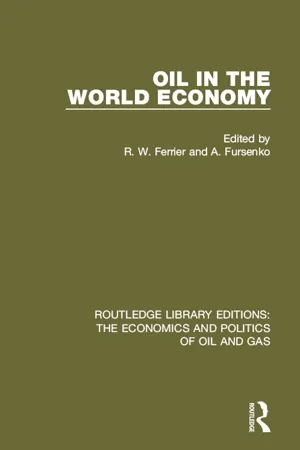
This book discusses the oil industry and its impact on the world economy in the twentieth century. It examines the importance of oil in different sectors, from 1900-1973 and stresses the relevance of oil as a factor in modern economic history not only in national terms but also within an international context. The book includes chapters on American policy towards developing economies in the first half of the 20th century; the policy of Russian oil exports in the 20s and 30s; the financing of the German and French oil industries; and the role of oil in the Japanese economy, a major industrial country without oil resources. On the international front, the book covers the impact of the Middle East national oil companies, the effect of oil on the developing countries of South Ameirca and the relevance of the oil crisis of 1973.
- 142 pages
- English
- ePUB (mobile friendly)
- Available on iOS & Android
eBook - ePub
Oil In The World Economy
Session two
National aspects
Chapter five
Oil and the evolution of US policy towards the developing areas, 1900–1950: an essay in interpretation
The 1920s and 1930s were a watershed in relations between the United States and the world’s underdeveloped areas. At the outset of the period the United States exercised firm stewardship of a host of nations in and around the Caribbean, held a few colonial outposts in the Pacific and a presence in China, and was virtually invisible elsewhere. The Roosevelt Corollary to the Monroe Doctrine was in full force, with its presumption that
brutal wrongdoing, or an impotence which results in a general loosening of the ties of civilized society, may finally require intervention by some civilized nation, and in the Western Hemisphere the United States cannot ignore this duty.1
By the late 1930s the American sphere of influence had expanded to include most of the Western Hemisphere, yet the Roosevelt Corollary had been expressly disavowed. US military power was exerted sparingly and the sovereignty of local rulers was generally respected. Outside the Western Hemisphere both American diplomacy and American business were well established, bordering on predominant. The seeds of the post-war era, with its American-supervised decolonization, had been sown.
This chapter examines the process by which American policy towards the underdeveloped world evolved from a pale Caribbean image of classical European imperialism to a new form of Good Neighbourliness, focusing on American oil policy, one of the most contentious areas of north-south diplomacy in the period. Its purpose is not to give an overview of American foreign oil policy in the Twentieth century, nor to unearth new primary sources, only to explore the geopolitical and economic origins of the shift in American policy. It is simply the attempt of a political scientist to examine an important analytical puzzle in US foreign policy, the shift from a form of gunboat diplomacy in which national power and private economic interest seemed to coincide, to a new pattern in which the automatic and direct diplomatic defence of private business faded and even disappeared.
The previous pattern
The prevailing American attitude before about 1925 towards those parts of Africa, Asia, and Latin America in which there was any US presence at all can fairly be characterized as assuming that the strategic interests of the United States and the economic interests of American citizens abroad were so closely linked that an attack on one immediately endangered the other. Whether strategic concerns were driven by economic interest, or economic interests guided by strategic action – whether trade followed the flag or the flag followed trade – the flag, trade, and the dollar were closely linked in the eyes of policy makers, traders, and investors.
The general extension of US military, political, and economic influence into the Caribbean region is a well-known story. Well before the Spanish-American war, there was a broad consensus among both American strategic and economic thinkers that control of the inevitable trans-isthmian canal was vitally important to the United States. Once the canal route was secured it was even more obvious that, as then-Secretary of War Elihu Root put it in 1905:
The inevitable effect of our building the Canal must be to require us to police the surrounding premises. In the nature of things, trade and control, and the obligation to keep order which go with them, must come our way.2
Deeds followed words, and by the end of the First World War the Caribbean region was unquestionably a sphere of American military and economic predominance. Direct politico-military control was exercised at one time or another over Puerto Rico, Cuba, the Dominican Republic, Haiti, Nicaragua, Honduras, and of course Panama; American troops intervened twice in Mexico; and the threat of force served to cement American influence where force itself was not used.
The other underdeveloped area to which American concern extended was east Asia, especially the Philippine colony and China. Partly this was out of necessity: by 1900 most of the rest of Asia and Africa was already behind colonial walls, while South America was a nearly-unchallengeable British preserve. Partly, too, American interest in the China market was long-standing, dating back practically to the founding of the Republic. In any case, by the turn of the century the United States government was aggressively insisting upon its rights to equal access to Chinese economic opportunities, most notably in Secretary of State John Hay’s famous Open Door Notes of 1899 and 1900. Here American military power was of little use, faced with the equal or superior forces of other interested powers, and US economic interests were also in most regards weaker than the European, Russian, and Japanese competitors. Yet the United States did succeed in becoming one of the crowd in China, even if it was a somewhat less equal partner than, say, Great Britain or Japan.
In this American emulation of classical European imperialism, overseas investment in petroleum was of some significance, although it was only during and after the First World War that it became a major diplomatic concern. For one thing, the US Navy did not commit itself to an oil-burning fleet until 1913; for another, American domestic oil production seemed more than sufficient until the First World War produced fears of imminent shortages. Overseas investments by US oil firms rose from $224 million in 1908 to $604 million in 1919 and $1.3 billion in 1929, going from 14 to 18 per cent of total American foreign direct investment. Before 1910 most of the foreign investment was in distribution networks: by 1919 foreign production had become important, and by 1929 some 58 per cent of American overseas oil investments were in Latin America, primarily in and around the Caribbean, while another 14 per cent were in other areas of Asia and Africa.3
American government policy towards petroleum paralleled its more general attitude towards the strategic centrality of overseas American economic activity. Where American oilmen were predominant and the region was deemed strategically important, as in the Caribbean, the US government aggressively defended the position of American oil investors against hostile local attackers and sought to limit or exclude rival European oilmen. Where the Europeans held the whiphand, as in the Middle East and the Dutch East Indies, the US government pushed insistently for the admission of American petroleum companies on a footing at least equal to that of the colonial power’s firms.
The most important area of American petroleum activity until after the Second World War was the Caribbean region, especially Mexico and Venezuela. In this region, petroleum was included in the more general government belief that foreign (i.e. non-American) economic activities represented both a security and an economic hazard. The State Department thus championed American petroleum enterprise with great vigour. It fought what it perceived as a tilt towards British oil interests on the part of some of Mexico’s revolutionary governments. In the early 1920s, it supported American oilmen in Venezuela against the Anglo-Dutch interests that originally dominated that country’s petroleum. American diplomats pushed the Colombian government in the late 1920s to favour American oilmen; similar efforts were exerted in Peru and Argentina. And, in a series of 1918 notes to his chargé in Costa Rica that summarized the most extreme version of this ‘Closed Door’ policy, Secretary of State Lansing responded to the news that a British group was negotiating for oil exploration rights by insisting:
[The] Department considers it most important that only approved Americans should possess oil concessions in the neighborhood of the Panama Canal. Amory concession does not appear to meet these requirements. Use best efforts to carry into effect this policy.4
The aggressive American policy met with extraordinary success. Between 1912 and 1922, crude oil production by American companies in the Western Hemisphere (not including the United States) went from 25,905 to 417,130 barrels per day (bpd). Just as important, the share of the American oil companies in total non-US Western Hemisphere crude production went from under 50 per cent in 1912 to over 76 per cent at its 1922 peak; the relative increase was entirely at the expense of the Anglo-Dutch companies. By the mid-1920s, however, the United States had begun to relax some of its earlier exclusionary policies, in large part in return for European agreement to open their colonial doors to some American oilmen.5
After the First World War, indeed, American diplomats and oilmen, concerned about the apparent depletion of American reserves, attempted to break into promising areas that were under the ‘protection’ of European rivals. American worries were inflamed by a string of threatening European assertions, including the impolitic remarks in 1920 of a prominent English banker that:
America before very long will have to purchase from British companies, and to pay for in dollar currency in progressively increasing proportion, the oil she cannot do without and is no longer able to furnish from her own states.… With the exception of Mexico, and to lesser extent Central America, the outer world is securely barricaded against an American invasion in force. There may be small, isolated allies, but there can never be a massed attack. The British position is impregnable.6
The British position in the Eastern Hemisphere – along with that of the Dutch and French – might have seemed impregnable in 1920, but it was soon to be successfully challenged by the United States. The American attack on colonial and semi-colonial preferences focused on the Middle East and the Netherlands East Indies.
Most of the promising oil properties of the Middle East were indeed in British hands, either as part of the territories mandated to the British by the League of Nations or as more general spheres of British influence. Throughout the region, from Palestine to Kuwait and from Mesopotamia to Persia, US oil companies found themselves unable to operate. Despite British dissimulation on the point, there was clearly a conscious policy to reserve the region to the Anglo-Persian Oil Company and Royal Dutch Shell, with some French participation allowed. In Holland’s East India colony, a similar policy of excluding American firms was pursued.
The United States government fought British, French, and Dutch exclusion of American oilmen on two fronts. First, the US government protested vigorously to the European states involved that their policies were clear violations both of generally accepted Open Door principles and of such international agreements as the League of Nations mandates and the Treaty of Sèvres, which disposed of the Ottoman Empire. The principles involved were less than clear, since the United States had been pursuing something less than an Open Door in the Western Hemisphere, and the US had refused both to join the League and to sign the Turkish peace treaty. Second, and more pointedly, the US government began refusing oil leases on federal land to firms from countries deemed ‘nonreciprocating’, most prominently to Royal Dutch Shell.
Under relentless American pressure, the British, French, and Dutch gradually gave way. As has been indicated, in the process the Americans relaxed some of their opposition to Anglo-Dutch oil activity in Latin America, but it was probably the more specific American pressure that forced the door open. In July 1928 the Dutch and US governments reached formal agreement on American access to the petroleum of the Netherlands East Indies. In the same month, the famous Red Line Agreement gave an American group a share of the Anglo-Dutch-French-Gulbenkian monopoly in the former Ottoman Empire. In Kuwait, Romania, Persia, and elsewhere, American oilmen were permitted some degree of access. The principled American stand on the Open Door in petroleum lasted precisely as long as it took for American oilmen to be let in. Once this aim was accomplished, the US was perfectly content to see the door slam shut.
From 1890 until the 1920s, then, the pursuit and growth of American political and economic influence in the underdeveloped world followed a more or less coherent and unified pattern to which overseas petroleum policy conformed. A strict and direct relationship was drawn by policy makers between American overseas economic and geostrategic influence. Where possible, as in the Caribbean region, the United States appropriated to itself what power and wealth was available. Where other colonial nations had beaten the Americans to the punch, as in the Middle East and the Dutch East Indies, the US government used its ample powers of persuasion to force closed doors open long enough for American oilmen to enter.
The pattern transformed
If American policy towards the underdeveloped areas up to the 1920s could be graphically represented as a smoothly rising curve, indicating ever-tightening control over such regions within the American sphere as the Caribbean and ever-deeper intrusions into such rival spheres as the Middle East, during the late 1920s and 1930s the curve began to behave in most unaccustomed ways. The United States government appeared to release its hold on areas previously within its grip, and more generally to remove itself from the business of stimulating and accompanying American private investors abroad. By no means did the State Department abandon the overseas American business community, but the levels and automaticity of mutual support and encouragement were quite drastically reduced. In petroleum diplomacy especially, ...
Table of contents
- Cover Page
- Half Title page
- Title Page
- Copyright Page
- Original Title Page
- Original Copyright Page
- Contents
- List of tables and figures
- List of editors and contributors
- Introduction
- Global aspects
- National aspects
- Index
Trusted by 375,005 students
Access to over 1.5 million titles for a fair monthly price.
Study more efficiently using our study tools.
Frequently asked questions
Yes, you can cancel anytime from the Subscription tab in your account settings on the Perlego website. Your subscription will stay active until the end of your current billing period. Learn how to cancel your subscription
No, books cannot be downloaded as external files, such as PDFs, for use outside of Perlego. However, you can download books within the Perlego app for offline reading on mobile or tablet. Learn how to download books offline
Perlego offers two plans: Essential and Complete
- Essential is ideal for learners and professionals who enjoy exploring a wide range of subjects. Access the Essential Library with 800,000+ trusted titles and best-sellers across business, personal growth, and the humanities. Includes unlimited reading time and Standard Read Aloud voice.
- Complete: Perfect for advanced learners and researchers needing full, unrestricted access. Unlock 1.5M+ books across hundreds of subjects, including academic and specialized titles. The Complete Plan also includes advanced features like Premium Read Aloud and Research Assistant.
We are an online textbook subscription service, where you can get access to an entire online library for less than the price of a single book per month. With over 1.5 million books across 990+ topics, we’ve got you covered! Learn about our mission
Look out for the read-aloud symbol on your next book to see if you can listen to it. The read-aloud tool reads text aloud for you, highlighting the text as it is being read. You can pause it, speed it up and slow it down. Learn more about Read Aloud
Yes! You can use the Perlego app on both iOS and Android devices to read anytime, anywhere — even offline. Perfect for commutes or when you’re on the go.
Please note we cannot support devices running on iOS 13 and Android 7 or earlier. Learn more about using the app
Please note we cannot support devices running on iOS 13 and Android 7 or earlier. Learn more about using the app
Yes, you can access Oil In The World Economy by R. W. Ferrier,A. Fursenko in PDF and/or ePUB format, as well as other popular books in Economics & Business General. We have over 1.5 million books available in our catalogue for you to explore.