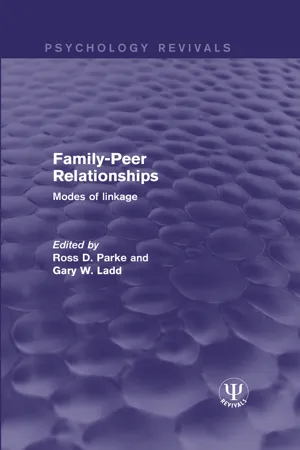
Originally published in 1992, this volume provided an up-to-date overview of recent research concerning the links between family and peer systems. Considerable work in the past had focused on family issues or peer relationships, but these systems had typically been considered separately. This volume bridges the gap across these two important socialization contexts and provides insights into the processes that account for the links across the systems – the ways in which the relationships between these systems shift across development. In addition, the variations in the links between family and peers are illustrated by cross-cultural work, studies of abused children, and research on the impact of maternal depression. In short, the volume provides not only a convenient overview of recent progress at the time but lays out an agenda for future research.
eBook - ePub
Family-Peer Relationships
Modes of Linkage
- 458 pages
- English
- ePUB (mobile friendly)
- Available on iOS & Android
eBook - ePub
About this book
Information
Introduction and Overview
Chapter One
Themes and Theories: Perspectives on Processes in Family–Peer Relationships
Gary W. Ladd
University of Illinois
University of Illinois
Children's experiences within the family and the peer group have occupied a position of central importance in recent research on human development. During the past two decades, important advances have been made within both fields of inquiry. For example, recent studies of family processes and parenting have produced important findings concerning the impact of adult-child relations on child socialization and development. In the field of peer relations, researchers have begun to achieve a better understanding of how agemates influence children's personalities, social behaviors, and cognitions.
Progress in research on family and peer relations has also brought about an interest in the relations or linkages between the two domains. Previously, researchers interested in family relations have studied children's peer relations primarily as a means of indexing the putative effects of targeted family processes or alterations (e.g., fathering, divorce, authoritarian vs. permissive parenting). However, more recently, researchers interested in families have broadened the scope of their theories to include the interface between family and peer relations. In particular, they have become interested in understanding how families influence children's peer relations and competence, and they have begun to search for the mechanisms that may be responsible for such effects.
Similar developments can be observed in past research on children's peer relations. In early studies, researchers attempted to describe the types of relationships children formed with peers and the ways in which these relationships changed with age. Later, interest in the processes of relationship formation and maintenance gave rise to studies of the correlates of popularity in peer groups, and the features of friendships between pairs of children. Findings from these investigations led many investigators to conclude that children's success in peer relations was a function of their social competence, or requisite skill at initiating and maintaining social ties with agemates. Not surprisingly, this hypothesis spurred an interest in the origins of children's social competence, and a search for antecedents within the family.
Pathways between the Family and Peer Systems
To explore potential relations between the family and peer systems, investigators have begun to construct and evaluate models of the "pathways" through which families influence children's peer relations, and vice versa. Pathways, as conceptualized here, refer to processes that may impinge on the child in one context (e.g., family relations), and to the mechanisms or mediating variables that may be responsible for transmitting the effects of such processes to another context (e.g., peer relations). At present, the effects of families on children's peer competence are thought to travel through either "direct" or "indirect" pathways (see Parke, MacDonald, Beitel, & Bhavnagri, 1988). Activities or processes that parents engage in as a means of controlling or enhancing their children's skills and relationships with peers are viewed as direct pathways. In contrast, aspects of family life or operations that do not directly impinge on children's peer relations (e.g., parents' disciplinary or parenting styles, the marital relationship) are often construed as indirect pathways.
For many investigators, the concept of an indirect pathway also implies that the family's effect on children's peer relations is mediated through some intervening child outcome. For example, both Pettit and colleagues (e.g., Pettit, Dodge, & Brown, 1988; Pettit, Harrist, Bates, & Dodge, 1991) and Hart, Ladd, and Burleson (1990) have hypothesized that parental disciplinary styles affect children's problem-solving skills and reasoning, which, in turn, influence the quality of their peer relations. It is made clear in subsequent chapters that many other types of mediating variables are being investigated, including aspects of the child's cognitive processing, emotions and emotional regulation, mental representations of relationships, and self-efficacy.
It is also important to recognize that evidence from recent studies, including several reported in this volume, illustrates that the pathways from family to peer relations may transmit both positive and negative effects. On the one hand, children may learn important skills or competencies within the family that can be transferred or generalized to the peer group. On the other hand, adverse family circumstances and relations may also serve as a staging area for child incompetence and maladjustment.
The concept of a pathway also implies a particular direction of effect. Contemporary research, including most of the work reported in this volume, has been based almost entirely on "family effect" models, or pathways in which the direction of effect travels from family (or parent) to child. It is important to recognize, however, that a convincing case can be made for exploring pathways that traverse the opposite direction of effect. It seems probable that the events that children encounter in the peer culture will, at times, spill over into family life, and precipitate certain reactions (perhaps some of the same processes we now view as potential causes within the family). In the long run, we may find that the greatest explanatory power is achieved with models that permit us to consider both types of pathways, or even bidirectional effects.
Identifying and Mapping Significant Pathways
Families are complex, and many of the processes that occur in this system may directly or indirectly affect the quality of children's peer competence and relations. Therefore, progress toward an understanding of the linkages between the family and peer systems depends, in part, on the types of pathways researchers choose to investigate.
Within the past few years, researchers have targeted a broad range of family features and characteristics as possible correlates and antecedents of children's social competence. For organizational purposes, these characteristics can be grouped into three major domains (cf. Ladd, 1991); (a) indirect influences: family relations, interactions, perceptions, and environments; (b) direct influences: families as teachers and organizers; and (c) variations on family-peer relationships. Within each of these domains, investigators have developed models that are designed to represent potential pathways or linkages between the family and peer systems. It is important to consider these perspectives, both as conceptual foundations for research on family-peer relations, and as background for the content of this book.
Indirect Influences: Family Relations, Interactions, and Environments
Relationships among family members, the cognitive and behavioral processes that evolve from family life, and the characteristics of the family environment may have an important bearing on the development of children's social skills and competence in peer relations. Generally, researchers have taken the perspective that these features of the family operate as indirect influences on children's peer relations.
Attachment. Many researchers view the parent-child relationship and parenting as important precursors for later social development. Research on the child's attachment status has figured prominently in this literature, and many studies have been conducted to determine whether the quality of the early parent-child relationship has important consequences for the child's later relationships with peers. Although perspectives on the attachment construct vary and have evolved over time (Ainsworth, 1973; Bowlby, 1969; Sroufe, 1983; Sroufe& Fleeson, 1986), two key propositions have served as a stimulus for research on family-peer linkages (see Cohn, Patterson, & Christopoulos, 1991). The first is that secure parent-child attachments, which may grow out of sensitive-responsive caretaking (Belsky, Rovine, & Taylor, 1984), help children to develop the autonomy and confidence needed to explore and develop relationships with others, including peers. Conversely, insecure attachments (i.e., insecure-avoidant or insecure-resistant patterns as identified in Ainsworth's strange situation) appear to have their origins in less sensitive parenting or inconsistent responsiveness from caretakers (see Ainsworth, Blehar, Waters, & Wall, 1978; Belsky, 1984; Lamb, Thompson, Gardner, & Charnov, 1985) and are thought to deprive children of the emotional and social resources needed to negotiate later relationships with peers. A second key proposition is that the attachment relationship serves as a "template" for the child's later relationships because children infer "working models," or expectations about the self and others (i.e., value of the self to others, likely responses of others to the self), from their experiences with the parent. Once internalized, these working models may affect children's behavior and success in future relationships. For example, securely attached children may develop working models that lead them to expect peers to be warm, nurturing, and responsive. As a result, they may be more likely than children with insecure attachment histories to initiate peer interactions and respond to peers' overtures in a cooperative and confident manner.
Evidence linking early attachment patterns to the quality of children's peer relations in preschool can be found in a number of recent studies. Several investigations reveal that, whereas children who are securely attached during the first and second years tend to be more engaging, sociable, and cooperative with preschool peers, children with insecure attachment histories tend to become more withdrawn or negative in this context (e.g., Easterbrooks & Lamb, 1979; Pastor, 1981; Waters, man, & Sroufe, 1979). Other studies show that securely attached children, when compared to their insecurely attached counterparts, tend to display higher levels of positive affect in peer interactions (LaFreniere & Sroufe, 1985), better peer relationships (i.e., well liked by peers; LaFreniere & Sroufe, 1985; Park & Waters, 1989), and fewer behavior problems (Erickson, Sroufe, & Egeland, 1985).
Although less is known about the relation between attachment and children's peer relations in middle childhood or adolescence, there is some evidence to suggest that the potential effects of attachment status generalize beyond early childhood (see Cohn et al., 1991). Lewis and Feiring (1989) found that boys who were securely attached as infants tended to have more male friends at age 9 than did insecurely attached boys. No relation emerged, however, for girls in this sample. Other studies suggest a relation between later manifestations of attachment (i.e., attachment assessed in early to middle childhood) and children's peer competence. Similar to the findings reported by Lewis and Fiering (1989), Cohn (1990) found that boys who displayed secure attachments following kindergarten were more competent in their peer relations during Grade 1 than their insecurely attached counterparts. By comparison, insecurely attached boys were viewed by peers as less likeable and more aggressive.
Thus, there is a growing evidence of a relation between attachment and children's competence in peer relations. Further research on this pathway is needed, however, to understand the significance of working models, which are hypothesized to mediate the linkage between initial attachment relations and later peer relations. It may also be useful to parse the attachment construct into more specific relationship processes, and investigate how specific aspects of the parent-child relationship affect children's social learning and competence (cf. Eckerman & Stein, 1983; Parke et al., 1988). Another issue that remains to be addressed is the possibility that variation in attachment, and therefore its potential outcomes, are reflective of underlying or inherited child dispositions, such as sociability or temperament (cf. Lamb & Nash, 1989).
Also, most of the research on attachment relations has been conducted with mothers and children, often to the exclusion of the potential role of fathers. Findings from a recent investigation by Patterson, Kupersmidt, and Griesler (1990) suggest that children's relationships with their fathers may also play an important role in the development of peer competence. In this study, peer-rejected children reported feeling less companionship and affection from their fathers than did children in other sociometic groups (e.g., peer-neglected children). Moreover, this relation was even more apparent for peer-rejected children who were also aggressive.
Child-Rearing Styles and Parent-Child Interaction. Research has shown that many of the behaviors, values, and attitudes parents display in child-rearing situations are correlated and can be combined into typologies. Drawing on models developed by Becker (1964) and Baumrind (1973), Maccoby and Martin (1983) have classified research on parenting styles along two primary dimensions: warmth (e.g., responsive vs. unresponsive) and control (e.g., demanding vs. undemanding). Four typologies emerge from this two-dimensional scheme: authoritarian (i.e., more demanding than responsive), authoritative (i.e., demanding but also responsive), indulgent (i.e., more responsive than demanding), and indifferent-uninvolved (i.e., undemanding and unresponsive).
Although there is some evidence to suggest that these typologies, or aspects of parenting styles, are associated with the quality of children's peer relations, few detailed models have been proposed to account for this linkage. However, as Putallaz and Heflin (1990) have recently observed, a number of propositions have been advanced to explain the impact of parenting styles on child behavior, and some of these pathways may help to explain how children develop competencies that transfer to peer relations. For example, parents' child-rearing styles may provide children with models for affiliative behaviors and skills, or foster expectations about relationships that generalize to the peer group. Other provisions, such as parental warmth and responsiveness, may influence children's emotional needs and thus determine their ability to trust and care about others (e.g., peers).
The research on parenting styles shows that authoritarian parenting is associated with a variety of problematic peer outcomes for children. Parents who rely on authoritarian or power-assertive styles tend to have children who are more aggressive, withdrawn, or dominated by peers (Baldwin, 1948; Baumrind, 1967; Patterson, 1982). Indulgent parenting styles, especially when permissiveness toward aggression is included in this pattern, appear to forecast children's aggressive reputations in the peer group (Olweus, 1980). In particular, this research suggests that preexisting aggressive dispositions in children may be exacerbated in families where parents fail to i...
Table of contents
- Cover
- Title
- Copyright
- Original Title
- Original Copyright
- Dedication
- Contents
- Acknowledgments
- PART I INTRODUCTION AND OVERVIEW
- PART II INDIRECT INFLUENCES: FAMILY RELATIONS, INTERACTIONS, AND ENVIRONMENTS
- PART III DIRECT INFLUENCES
- PART IV VARIATIONS ON FAMILY–PEER RELATIONSHIPS
- Author Index
- Subject Index
Trusted by 375,005 students
Access to over 1.5 million titles for a fair monthly price.
Study more efficiently using our study tools.
Frequently asked questions
Yes, you can cancel anytime from the Subscription tab in your account settings on the Perlego website. Your subscription will stay active until the end of your current billing period. Learn how to cancel your subscription
No, books cannot be downloaded as external files, such as PDFs, for use outside of Perlego. However, you can download books within the Perlego app for offline reading on mobile or tablet. Learn how to download books offline
Perlego offers two plans: Essential and Complete
- Essential is ideal for learners and professionals who enjoy exploring a wide range of subjects. Access the Essential Library with 800,000+ trusted titles and best-sellers across business, personal growth, and the humanities. Includes unlimited reading time and Standard Read Aloud voice.
- Complete: Perfect for advanced learners and researchers needing full, unrestricted access. Unlock 1.5M+ books across hundreds of subjects, including academic and specialized titles. The Complete Plan also includes advanced features like Premium Read Aloud and Research Assistant.
We are an online textbook subscription service, where you can get access to an entire online library for less than the price of a single book per month. With over 1.5 million books across 990+ topics, we’ve got you covered! Learn about our mission
Look out for the read-aloud symbol on your next book to see if you can listen to it. The read-aloud tool reads text aloud for you, highlighting the text as it is being read. You can pause it, speed it up and slow it down. Learn more about Read Aloud
Yes! You can use the Perlego app on both iOS and Android devices to read anytime, anywhere — even offline. Perfect for commutes or when you’re on the go.
Please note we cannot support devices running on iOS 13 and Android 7 or earlier. Learn more about using the app
Please note we cannot support devices running on iOS 13 and Android 7 or earlier. Learn more about using the app
Yes, you can access Family-Peer Relationships by Ross D. Parke, Gary W. Ladd, Ross D. Parke,Gary W. Ladd in PDF and/or ePUB format, as well as other popular books in Psychology & Developmental Psychology. We have over 1.5 million books available in our catalogue for you to explore.