This invaluable collection of information provides an in-depth guide to the regional dimension of the politics and economy of this vast and complex country. Incomparable in its coverage, which includes a detailed chronology for India as a whole, a bibliography, contact details for leading officials, and an historical account and economic survey for each of the twenty-nine states and seven territories, it supplies the reader with a more complete understanding of India as a whole.
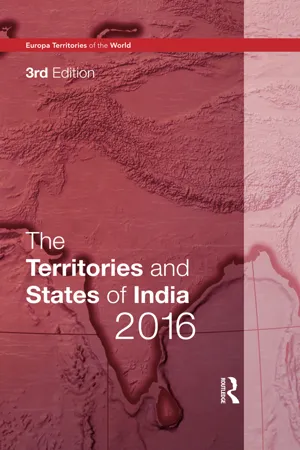
- 440 pages
- English
- ePUB (mobile friendly)
- Available on iOS & Android
eBook - ePub
The Territories and States of India 2016
About this book
Information
Introduction
The Centre and the States: Evolution of a Union
India today can claim to be the world’s largest federation. Since shortly after independence in 1947 it has been divided into a number of states (currently numbering 29), each with its own legislative assembly and ministry. There are in addition six ‘union territories’, which owe their special status to history or geography, and the National Capital Territory of Delhi, created in 1991, which was formerly a union territory. Each state is proud of its language and traditions, and competes with its neighbours in economic development and social welfare. Yet in no other federal system does the central Government have as much reserve power as in India, where the President of the Union, acting on the advice of the Prime Minister, can dismiss an elected state government and where the Parliament holds the power to alter state boundaries. Tensions and conflict between the central Government (‘the Centre’) and state governments have been a recurrent feature of Indian politics. Especially in the regions away from the Hindi-speaking north, regional discord can be translated into demands for greater freedom from central control in the name of language and historical tradition. In some cases, these have been dynamic struggles with beneficial results for economic and social change, but in others they have had the opposite effect, with important development schemes delayed, or with damaging hostility to people from other parts of the country. As India moves steadily towards becoming the world’s most populous country, its future prospects will depend critically on the ability to resolve the tensions of federalism, to utilize its resources to the full, and to find ways to bring all regions into the mainstream of development.
The ambiguities that characterize the current situation have a long history. Jawaharlal Nehru, India’s first prime minister following the end of colonial rule, often spoke eloquently about the country’s fundamental unity, which he considered to be grounded—despite all the barriers created by caste and religion—in cultural practices of diversity and tolerance. Even so, there were always other voices within the broad nationalist movement that either placed greater stress on local identities or, conversely, saw India in more monolithic terms. Since 1947 the gradual assertion of Indian power in the world, together with the impact of nationally orientated educational and cultural institutions (popular cinema, for example), has generally led to a growing sense of Indian unity. Yet these same factors have often led India’s citizens to become just as aware of their identities as members of regional cultural traditions and, in some cases, to become less tolerant of religious or linguistic minorities. There is no necessary conflict between these layers or levels of identity, but they make the task of political control and leadership more complex.
The present-day territory of the Republic of India had never been under unified political control before the colonial period, although there were periods when strong dynasties had ruled over extended areas, notably when the Mauryan emperors dominated the whole of northern and central India in the third and fourth centuries BC, and again in the 16th and 17th centuries AD, when the Mughal emperors did the same. Both had penetrated the southern and eastern parts of the subcontinent as well, but never brought the whole under central control. The Mauryan Ashoka and the Mughal Akbar fitted Nehru’s paradigm of Indian rulers, recognizing and respecting diversity as the basis of their imperial rule. At other times political order was provided on a regional basis, sometimes on a large scale, sometimes not. Day-to-day social life was regulated by the complex hierarchies of caste and religion. Throughout India the imperatives of dharma, or the observance of duty, provided a common framework, yet each region, each district, even each village, had its own understanding of these issues. A constant interplay between the different levels of the system provided opportunities for change and movement. Caste, for example, was not as immutable a category as some commentators used to imagine. Language was an important element of unity in diversity. While Sanskrit had been the language of the major religious texts of Hinduism, by the medieval period spoken languages in northern India, while retaining their Sanskrit origins, had diverged markedly. In the south, Tamil and other Dravidian languages had always been separate from Sanskrit, although there were many cultural and religious connections with other parts of India.
The Colonial Origins of Indian Federalism
The British originally dominated India through the East India Company, a commercial entity the servants of which, such as Robert (later Lord) Clive, could simultaneously be soldiers, civil servants and traders. Political strategy was driven by economic considerations, so that by the mid-19th century the company controlled some areas directly, but ignored others. After the defeat in 1857–58 of the so-called Indian Mutiny (more accurately a large-scale rebellion involving not just Indian troops but many others alienated by the intrusion of European power), the British Government took over direct control through a Viceroy, usually a senior figure from London. However, the political patchwork created by the East India Company remained broadly intact. The three large provinces or presidencies of Bengal (based in Calcutta—now Kolkata, West Bengal), Madras (now Chennai, Tamil Nadu) and Bombay (now Mumbai, Maharashtra) each included a number of quite distinct linguistic and cultural groupings. In Bombay, for example, Gujarati and Marathi speakers formed the two largest groups, but the presidency also included Sindhi and Kannada speakers. Linguistic differences were reinforced by other cultural markers, and further complicated by others, religious affiliations in particular. Apart from the presidencies, which dated back to the early days of Company rule, there were other provinces created over time—for example, Punjab, which was seen as a defensive bulwark in the north-west. Interspersed with British territories were the so-called princely states, covering in total approximately one-third of the land area. For administrative purposes each province was divided into several divisions and then into districts, which were the basic units of local administration.
British administrative policy was driven first and foremost by security concerns. How was a population of nearly 300m. (in 1901) to be controlled and a recurrence of the 1857 revolt avoided? How was an empire to be defended against rival imperialist powers, originally the French and then, from the mid-19th century, tsarist Russia? Whatever measures were adopted had to be reasonably inexpensive, as India was expected to cover its own administrative costs as well as to provide an economic benefit to British trading and industrial interests. British policy depended upon a core of British soldiers and administrators who, in turn, led Indian troops and junior officials. A carefully created ideology of empire provided a framework in which the loyal subjects of the Queen-Empress (or King-Emperor) could be accommodated, while ‘disloyal’ elements could be isolated and controlled. Much recent research has shown both how fabricated and artificial the situation was and how much passive resistance existed, even from those who apparently benefited most. Nevertheless, the British Raj survived for nearly 90 years after 1858.
The Raj was thus characterized on the one hand by a high degree of centralization and on the other by a willingness to leave many things well alone. Centralization was summed up above all in the creation of the Indian Civil Service, an elite body never more than 1,500 strong, which held almost all the senior positions in the Government of India and in the provinces, and filled most of the district officer posts as well. Although some Indians were able to gain entry through a rigorous, competitive examination, it was only in the last few years before independence that they entered in any numbers. This was even more the case for the officer corps in the army. However, the typical Indian village could go for years without seeing a single representative of the Raj, and most Indians’ experience of government was restricted to the local tax collectors or the local police, whose sometimes oppressive activities the district officer, perforce, had to ignore. Integral to British rule was a series of assumptions about the nature of Indian civilization. India was seen as a set of cultural practices based on religious identity, rather than as a potential nation state along European lines. Government policy was, therefore, designed to go with the grain of differences, such as those between Hindu and Muslim, Brahmin and so-called ‘Untouchable’, or between different linguistic and regional groups. Whatever opportunities existed during the colonial period for government employment or representation were handed out on the basis of these perceived differences. The United Kingdom’s final statement on India came with the 1935 Government of India Act, which, if it had come into full effect, would have created a federation, but with final authority firmly in the hands of the Viceroy. Although the 1935 Act was based on colonial boundaries, new provinces were created for Sindh (now part of Pakistan) and Orissa (now Odisha), to meet strong local demands.
As Indian nationalism emerged in the late 19th century, it was precisely this understanding of difference that was challenged as a deliberate policy of ‘divide and rule’. Looking back to a golden age before imperial incursions, a new generation of writers identified an Indian tradition of statehood that was just as valid as the European model. Prominent figures within the Indian National Congress party, such as Bal Gangadhar Tilak, extolled the virtues of rulers like Shivaji (a Hindu prince and founder of the Maratha kingdom), who had confronted the Mughals in the 17th century. Mahatma Gandhi, whose ideas dominated the Congress in the years immediately before independence, disowned the glorification of violence, but, nevertheless, argued as strongly as anyone for Indians’ right to freedom. He also recognized regional traditions and in 1920 reorganized the Congress largely on the basis of language, thus rejecting the patchwork of administrations created by the British. Gandhi linked his hopes for a free India to a reconstruction of society and economy based on the village.
Independence and the Constitution
Indian independence in 1947 was achieved by negotiation, on the one hand with the British and on the other with the Muslim League. The latter, under the leadership of Muhammad Ali Jinnah, had rejected the Congress view of Indian nationhood, arguing that secular ideals were simply cloaks for Hindu majoritarianism, and insisting upon the partition of the country, which precipitated migration and bloodshed on a large scale. The erstwhile provinces of Punjab and Bengal were both divided along religio-communal lines as part of the partition process, and the two new nation-states immediately came into conflict over the fate of the principality of Jammu and Kashmir in the far north of the subcontinent, a region that mirrored the whole subcontinent in the complexity of its society, but where, in simple terms, a Hindu dynasty ruled over a Muslim majority. Nehru became Prime Minister of independent India, while Gandhi, after valiant efforts to stop the violence, was assassinated by a Hindu who believed in a monolithic India and blamed him for ‘appeasing’ the Muslim minority. The new state of Pakistan was forced to endure its own internal contradictions, which led, in 1971, to a further division into Pakistan and Bangladesh (the eastern part of old Bengal, which had been known as East Pakistan since independence), thus appearing to confirm the belief that the subcontinent was best ruled as a federal unit. Nevertheless, India needed to decide what form a federation should take, and how much to retain of the centralized structure created during the colonial period.
From 1947 to 1949 the Indian Constituent Assembly deliberated on the shape of the constitution. It was agreed at an early stage that it would be federal in character, and the document that came into effect on 26 January 1950 begins with the words ‘India shall be a Union of States’. However, the British had handed over a single political entity and the idea that units within it might want to go their own way was deeply worrying for the authors of the Constitution. Therefore, many safeguards were built in to maintain the integrity and strength of the central Government in New Delhi, the national capital. Drawing on colonial practice, the Government appointed its own governors in the states. Although these were expected to play a figurehead role, they could, if necessary, following the precedent of the 1935 Act, be used to rule a state directly for periods of six months at a time, under Article 356 of the Constitution. This is popularly known as ‘President’s Rule’. The financial levers of power were kept firmly at the Centre, and the division of revenue sources ensured that the states would always be in deficit and dependent on recurrent grants from the Union authorities. Again drawing on the 1935 Act, the powers of government were allocated to three ‘lists’, central (Union), state and concurrent. Defence and foreign affairs were allocated to the Centre, while local government, primary education and many other matters of daily concern for citizens were allocated to the states. Important areas of economic policy were either allocated to the Centre or were placed on the Concurrent List. States and the Centre could both...
Table of contents
- Cover
- Half Title
- Title
- Copyright
- Foreword
- Acknowledgements and Explanatory Notes
- Contents
- Abbreviations
- PART ONE Introduction
- PART TWO Surveys
- PART THREE Select Bibliography
- PART FOUR Indexes
Trusted by 375,005 students
Access to over 1.5 million titles for a fair monthly price.
Study more efficiently using our study tools.
Frequently asked questions
Yes, you can cancel anytime from the Subscription tab in your account settings on the Perlego website. Your subscription will stay active until the end of your current billing period. Learn how to cancel your subscription
No, books cannot be downloaded as external files, such as PDFs, for use outside of Perlego. However, you can download books within the Perlego app for offline reading on mobile or tablet. Learn how to download books offline
Perlego offers two plans: Essential and Complete
- Essential is ideal for learners and professionals who enjoy exploring a wide range of subjects. Access the Essential Library with 800,000+ trusted titles and best-sellers across business, personal growth, and the humanities. Includes unlimited reading time and Standard Read Aloud voice.
- Complete: Perfect for advanced learners and researchers needing full, unrestricted access. Unlock 1.5M+ books across hundreds of subjects, including academic and specialized titles. The Complete Plan also includes advanced features like Premium Read Aloud and Research Assistant.
We are an online textbook subscription service, where you can get access to an entire online library for less than the price of a single book per month. With over 1.5 million books across 990+ topics, we’ve got you covered! Learn about our mission
Look out for the read-aloud symbol on your next book to see if you can listen to it. The read-aloud tool reads text aloud for you, highlighting the text as it is being read. You can pause it, speed it up and slow it down. Learn more about Read Aloud
Yes! You can use the Perlego app on both iOS and Android devices to read anytime, anywhere — even offline. Perfect for commutes or when you’re on the go.
Please note we cannot support devices running on iOS 13 and Android 7 or earlier. Learn more about using the app
Please note we cannot support devices running on iOS 13 and Android 7 or earlier. Learn more about using the app
Yes, you can access The Territories and States of India 2016 by Europa Publications in PDF and/or ePUB format, as well as other popular books in Politics & International Relations & American Government. We have over 1.5 million books available in our catalogue for you to explore.