![]()
Introducing Debates in Nordic Gender Studies, Introducing Differences Within
CECILIA ÅSBERG & MALIN RÖNNBLOM
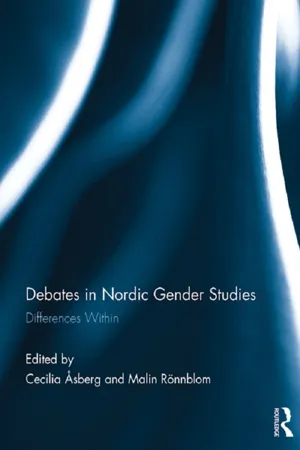
This book, Debates in Nordic Gender Studies: Differences Within, delivers a selection of juxtaposed position papers, original articles and think pieces that highlight and expand the horizons of the present Nordic heritage of feminist and gender research. While we now are celebrating more than two decades of academic institution-based women's studies, feminist theorizing and gender research in Denmark, Finland, Iceland, Norway and Sweden, this volume foregrounds recent cutting edge developments in the imagined intellectual community of this Nordic research area.
Debates in Nordic Gender Studies: Differences Within showcases recent transformations in Nordic Gender Studies with a focus on transnational theorizing and turn-taking conversations. Forming an overview and a temporally situated vademecum [a guide, walk-with-me, introduction] with entry points into recent dialogues, the introductory texts collected here are intended for Nordic and international students, Ph.D. candidates and teachers specializing in gender studies or related areas of interdisciplinary humanities and social sciences. These shorter texts independently or in small sets have already been proven instrumental in doctoral training and in undergraduate and graduate class rooms; this volume collects them thematically and facilitates their ready accessibility.
At the intersection of debates within the international field of gender studies, political transformations in the five Nordic countries, and a changing academia, a recognizable yet diverse landscape within Nordic feminist and gender research has emerged. Distinct schools of thought, focus areas or specific problem formulations, as well as discernable empirical and theoretical approaches can be detected across the Nordic universities. At the same time, varying political research climates, institutional support and funding across countries and universities have produced an uneven terrain. Targeted funding for gender research has also become less frequent, a development that risks impoverishing our scholarly field. In addition, the introduction of New Public Management in the university sector, including the increasing demand to produce research that can be commodified, has made the endeavour of critical research more challenging. In spite of these trends, feminist and gender scholarship in the transnational-Nordic context is not merely surviving but thriving. Keeping the non-conformist and critical edge, feminist scholars continue to pave way for novel and relevant scholarship in creative ways.
Internationally, the work of many feminist scholars from dominantly Anglophone countries is object to extensive dissemination at the same time as feminists from the Nordic countries struggle to get their work known. This has to do of course to a large degree to English as the lingua franca of international scholarship, but nothing what so ever to do with the Nordic countries lagging behind research-wise or not having well-established Gender Studies centres and programs. This is why a volume like this one is so important, and why as a scholarly journal NORA: Nordic Journal of Feminist and Gender Research takes on such an imperative role. The vibrant contributions from Nordic and key inter-national scholars within this book are in fact essential reading for anyone in need of accessible yet condensed guidance on key discussion points such as post-constructionism and new materialism, neoliberal academia and interdisciplinarity, the role of critical gender theory and posthumanism, as well as significant debates and differences within Nordic Gender Studies of today.
Dialogues across and beyond an imagined Nordic community
Cross-cutting themes and ongoing theoretical dialogues that are specifically rooted in the entangled politics of this collection's Nordic location are here summarized and commented. We find for instance conversations, standpoints and turn-taking dialogues about the affordances and limits of intersectionality, the neo-liberal welfare state, about the downside to social constructionist takes that render the body or nature into a blank slate for cultural inscription, or about feminist inclusions, exclusions and the research field's recent exposure.
As pointed out in the inaugural think piece by internationally recognized feminist theorist Elizabeth Grosz, feminist theory has a promising future as it is bound up with change and linked to previous and continuing feminist knowledge struggles. Grosz asks us to re-think temporality, notions of generational shifts and turns, to re-think our focus on the past and the present, in order to engage with multiple feminist futures that do not necessarily extend in that straight line we often call progress. Feminist theory, she argues, directs itself to questions of change in ways that are out of its time, that are untimely. This untimeliness, she argues, has several senses: the time of feminist theory may not yet fully have arrived, yet it also retains an interdependent relation to its present patriarchal pasts. Feminist theory remains hopeful as it leaps “into a future it does not control through finding something untimely in the patriarchal present and past.” (Grosz, this volume). These musings incited a Scandinavian response from Nina Lykke, international professor of Gender Studies, who in turn argues for the timeliness of the already ongoing work in post-constructionism. By giving these debates its various shapes and labels—such as new materialism or posthuman feminisms—feminist scholars have brought a crucial intellectual awareness of materiality, embodiment, and non-human natures to social theory. In the context of this new-found post-constructionist excitement, European Gender Studies icon and Finnish feminist professor Harriet Silius, in turn, cautions against forgetting about important previous feminist work. This debate is given a different angle by Merete Lie, a Norwegian professor of Interdisciplinary Studies of Culture and Gender. She provides a shaking depiction of a media debacle that portrayed gender researchers as devoid of common-sense and with little factual (that is, authoritatively scientific) understanding of the body. These four initial think pieces exemplify and exhilarate ongoing transnational-Nordic conversations in feminist and gender research. Such turn-taking extends out to you, the imagined community of readers and prospective feminist theorists of this volume.
In this book, we follow debates that both anchor and ground issues locally and widen the theoretical horizon of the field. For instance, the second section brings into conversation texts that deal with the politics of representation after the welfare state, the neo-nationalist, androcentric and white supremacist trends in Nordic politics and feminist compliance and resistance strategies to neo-liberal governmentality. The last two text sections deal in depth with new materialisms in circulation, animals as the others of feminist theory, and emerging feminist forms of the posthumanities, but also with what it means to do feminist scholarship today. Nordic feminist and gender scholars work simultaneously, yet differently, on several fronts to theorize and enact the futures we want to see.
Here, as within the journal NORA: Nordic Journal of Feminist and Gender Research from where the papers are selected, we treat “the Nordic” of Nordic Gender Studies in a pragmatic-descriptive way as an “imagined community,” much in the same vein as political anthropologist Benedict Anderson famously described the nation. The imagined community of Nordic gender and feminist research stands always open to intervention at the same time as we remain acutely aware of the trans-national flows in our field. As Gabriele Griffin and Rosi Braidotti pointed out in 2002, “the discursive flow in Women's Studies, the migration of knowledge, occurred along very distinctive and one- way lines, from West to East, from the Anglo-American alliance to (the rest of) Europe” (2002:2) The knowledges produced and circulated in our field, as in many others, are internationally dominated by the United States and the United Kingdom. By bringing these position papers and think pieces into the conversation, we hope to unsettle this directionality from Anglo-American scholars to the margins of the European North. In other words, we aim to short-circuit any easy closure.
![]()
TAKING TURNS
A new format for NORA, Taking Turns is an open forum for brief and rapid assessments of changes emerging in the field, and its discontents. In this series, we invite Nordic as well as non-Nordic scholars to present their take on contemporary challenges for feminist scholarship and gender research. The first contribution is written by a well known feminist theorist, Professor Elizabeth Grosz. An Australian philosopher, living and working in the USA, Professor Grosz has published a wide range of work on, for instance, sexual difference and corporeality, space and time, Charles Darwin and Gilles Deleuze. Here she provides us with perspectives on the practice of feminist theorizing and on the necessity for us to return to materiality once more, to material forces, and to the issues of the biological.
The Untimeliness of Feminist Theory
ELIZABETH GROSZ
Department of Women's and Gender Studies, Rutgers, The State University of New Jersey, New Brunswick, NJ, USA
Feminist theory has an auspicious future. It is a future bound up with change. It is no doubt linked in various ways to feminist struggles and feminist knowledges produced by previous struggles and knowledges; but it also involves a continual reassessment of what constitutes feminism and what effects feminism can hope to produce. One of the central questions of contemporary feminist theory as it faces a changing future, as it directs itself to the question of change, should be about what is untimely, what is out of its time. Something is untimely, out of its own time, either through its being anachronistic, which is another way of saying that it is not yet used up in its pastness, it still has something to offer that remains untapped, its virtuality remains alluring and filled with potential for the present and future (this is precisely what a good deal of feminist theory has directed itself to: re-reading the past for what is elided, repressed, unutilized, or unconscious in it). Or something is untimely not only to the extent that exerts forms of the past in the present, but perhaps more interestingly and in less secure and predictable mode than an exploration and revivification of the past is the Nietzschean and Bergsonian leap into the future without adequate preparation in the present, through becoming, a movement of becoming-more and becoming-other, which involves the orientation to the creation of the new, to an unknown future, what is no longer recognizable in terms of the present. Nietzsche proclaimed that he was modern only because he was Greek: his modernism consisted in his untimeliness, in the ways in which he reactivates a past in the present to bring about a new future. Feminist theory too is able to undertake this revivifying activity: it too is able to leap into a future it does not control through finding something untimely in the patriarchal present and past.
While there is a tremendous amount of fascinating research in the broad area of feminist theory, it is almost entirely (with some exceptions) devoted to an analysis of the past and the present. Feminist theory began as an analysis of the ways in which knowledges discriminated against women and helped to develop and perpetuate harms done to women, both conceptually and materially; it emerged through a recognition of the inadequacy of existing models to explain women's positions in the past and their potential for change in the present and future. Its primary focus has always been empirical and concrete, theorizing about how and why events, practices, knowledges, texts are forms of expression of patriarchal power relations. As someone trained in a discipline that radically departs from the empirical and the concrete—philosophy–my own interest has always been in the abstract and the non-determinable, not in what has been and is, but in what could be but does not yet exist. My own research focus is conceptual rather than empirical, not because the empirical has no place, but because, without a conceptual frame, the empirical has no value, no context, no power, it simply is. The empirical is given without some understanding of how it comes to be, without some assessment of its historicity and its potential to be otherwise. Only a framework, a context, which explains the forces that produce its givenness, can also show how it may be undone, or made differently. Although the value of the abstract and the non-determinable has diminished dramatically over the last decade or more in feminist studies, since the heady days of French feminism's ascendancy in the 1980s and 1990s, its conceptual and political tasks are not yet accomplished. In spite of the celebration of the end of theory, the end of post-modernism, the end of abstraction, this death is prematurely announced and may have to be delayed further.
Given that theory is not dead, not dead yet, feminism must direct itself to change, to changing itself as much as to changing the world. It must direct itself to that most untimely and abstract of all domains—the future, and those forces which can bring it into existence. There are a series of central questions that have yet to be adequately asked, questions that do not have a clear-cut answer or solution but continue to be posed and require some feminist mode of address. These are not questions for all of feminism: for those concerned with solutions, with pressing empirical problems, these are no doubt an idle luxury. Nevertheless, they need to be posed somewhere, in some feminist conceptual space, if feminist theory is to develop into a discipline, a body of theory, a movement able to adequately address the real in all its surprising complexity.
I will contain myself here to three such questions, beginning with the most general and abstract.
1. We need to return to the question of materiality one more time. Materialism has infused feminism for the last thirty to forty years, largely through the influence of Marxism and psychoanalytic theory. We need to return to the question of matter, its forms, nature, and capacity, in order to address the direct objects of feminist investigation—the differences between men and women, for men and women, all subjects, are material objects. While materialism has directed our focus to questions of the body, the body still remains elided and covered by representation. Feminist theory has allowed the body to enter discourse, but only, ironically, through its reduction to discourse. The materiality of the body and of discourse only recedes further into the background without being adequately explained. If we take materialism and its forms and varieties, including its infusion with the incorporeal and the immaterial, as the object of feminist investigation, there are at least two other questions that emerge as central:
2. If the living body is the object of feminist investigation, then materialism entails something like a return to questions of biology and of biological existence that have been so carefully bracketed out of most feminist research. Even if feminism remains committed to constructionism, a project I no longer believe is viable, it is nonetheless bound to rethink biological questions. This does not mean, of course, that feminists must have a non-critical or outside relation to those disciplines devoted to the study of biology, to accept as truth that which biology in its theoretical naivety takes as the truth; rather, it means that biological discourses have not yet had adequate feminist intervention, have not yet been strongly enough disturbed by the questioning of feminist theory. And feminist theory has protected and insulated itself from any incursions into biology through the fear indeed paranoia surrounding the question of essentialism, though biology is one of the few disciplines able to adequately contest essentialism. The field of biology, opened up through the dramatic eruption of Darwin's writings as psychology was opened up through Freud's, is now ready for feminist re-readings, for feminist interventions from within, rather than critiques from without. Biological forces of evolution, the later, unpredictable emergence of higher-order complexity through the elaboration of an earlier, lower-order potential, is a resource that feminist theory can no longer afford to ignore. There are of course a number of feminists, some of whom were trained in the natural sciences, and many of whom were not, who have begun just such research (not only the more well known feminist theorists of science, Evelyn Fox Keller, Anne Fausto-Sterling, Patricia Gowaty, and Sarah Hrdy, but also feminist cultural theorists, such as Elizabeth A Wilson, N. Katherine Hayles, Catherine Waldby, and Greit Vandermassen), but the material bases of the body's development (as male, as female, as raced, sexed, and historically encultured) need to be more urgently and directly addressed.
And 3. If we take materialism seriously, we are interested not only in material objects, but also in material forces, which, while they may be imperceptible in themselves, are discernable through their effects on objects. While I am not suggesting, for example, a feminist interrogation of the theory of gravity, I do think that it is necessary for feminist theory to look at certain forces, universal forces, that it has ignored for some time, for these are the unspoken assumptions of feminist politics and struggle. Primarily I am thinking of the force of temporality, which, while it has been assumed in most feminist discourses, and especially those oriented to history, is rarely addressed or the object of direct analysis. To the extent that our work relies on and makes assumptions about the nature of the past and present, and to the extent that all radical politics is implicitly directed towards bringing into existence a future somehow dislocated from the present, our very object and milieu is time. We need to address these assumptions about the nature of time and its role in political (and biological) struggle, but to some extent this is itself only possible if we also address the cosmological and ontological elements that temporality entails.
These questions clearly do not address or solve any concrete, real, down-to-earth struggles; yet while they seem to by-pass or side-step feminists' most direct concerns, they cannot be ignored either, because it is partly by being irrelevant, untimely, and dislocated, by being abstract, that the new is brought into existence, that creation and invention insert their surprise into the everyday and the concrete, that change is adequately understood. While it is important for many of us to have our eyes clearly focused on the real crises women face every day, it is equally important that some feminist theorists address what is most abstract and useless, what is most speculative and cosmological, in order that transformation, upheaval, and change become conceivable. We allow this freedom (from concrete usefulness, from timeliness) to feminist artists; we now need to grant it to feminist theorists as well.
![]()
TAKING TURNS
An open forum for brief and rapid assessments of changes emerging in the field, and its discontents, Taking Turns invites Nordic and non-Nordic scholars to present their take on contemporary challenges for feminist scholarship and gender research. In this issue, we welcome Dr Phil. Nina Lykke, Professor of Gender and Culture, and Director of the Centre for Gender Excellence (GEXcel) at Linköping University. Professor Lykke has published widely on feminist theory, cultural studies, and feminist ...