Connecting words and phrases are essential for discussion, clarity and fluency in any language. French is particularly reliant on connecting language: also and in fact have around 15 equivalent words and expressions in French.
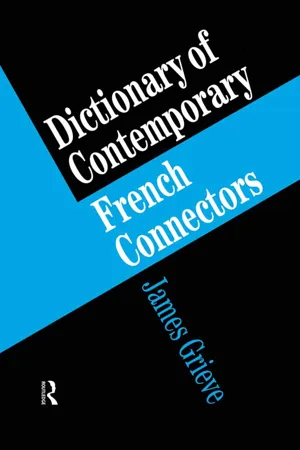
This is the first French-English dictionary to focus on this fascinating and crucial part of the language. The dictionary presents nearly 200 full entries in alphabetical order, including: de plus; et ce; or; c'est dire que; en fait; au total; voila.
Entries define, discuss and exemplify the whole range of connecting language in French. 2000 examples add further clarity and are chosen from a wide range of registers and mainly contemporary prose.
- 544 pages
- English
- ePUB (mobile friendly)
- Available on iOS & Android
eBook - ePub
A Dictionary of French Connectors
About this book
Information
Dictionary
à ceci près que*
This structure usually functions as an inter-assertional connector, being most often placed first in a phrase dépendante – in probably fewer than 20 per cent of cases is it found inside the sentence, after a comma. Whether linking two sentences or two parts of a single sentence, it always introduces a statement which slightly restricts the scope of a main clause. The most common variant is à cela près que.
The connector functions in the semantic field of à peu près and other expressions in which the combination à… près marks a difference, a shortfall, an exception. It could often be replaced by sauf que. It introduces a minor objection, a shade of difference; it puts a finer point upon something. Quite often this finer point is put upon a comparison of two things which are seen first as like then as less like. An author discussing certain French critics, having identified a particular defect in Sainte-Beuve, goes on to make a similar point about Thibaudet, which he then modifies: Ily a chez Thibaudet un défaut du mêmegenre, à ceci près qu’il a moins de méchanceté et plus d’ingéniosité verbale que Sainte-Beuve. An article about a Paris street sees it first as similar to others, then defines a dissimilarity: Une petite rue semblable à des milliers d’autres petites rues. À ceci près qu’elle possède une histoire. What precedes often contains words like même chose, comparer or comme: Une équipe organisée comme un véritable Samu. À ceci près qu’il n’y a pas de gyrophares. l Bremner a composé quelque chose comme des Brandebourgeois modernes. A ceci près que leurs thèmes sont des chansons des Beatles.
à cela près que
Dictionaries continue to give à cela près as the paradigmatic form, which may have been the case in real usage at some past period. But à ceci près predominates nowadays. This evolution, if that is what it is, consists with the rule said to be observed in the usage of the démonstratifs lointain et prochain:
Les formes en -ci annoncent ce qui suit (fonction cataphorique), et les formes en -là rappellent ce qui précède (fonction anaphorique).
(Grevisse, 1988: 1059)
But it puts this structure at variance with two others containing cela, cela dit and cela étant: in both of them, spoken usage seems to favour the form with ceci and written usage the form with cela.
Variants
The demonstrative pronoun may be replaced by a noun expressing the idea of a minor restriction or disparity such as nuance, particularité or exception plus a definite article or a demonstrative adjective: à ce détail près que, à la différence près que, à cette parenthèse près que. An essay on the Socialist governments of the 1980s says they exercised power de la même façon que leurs prédécesseurs,au style près (Duverger, 10). A discussion of the proposal to route the new A89 motorway down the valley of the Isle makes two points, one of them that people living in the Gironde favour the idea, the other that people living in the neighbouring départements do not:
Ce tracé présenterait le triple avantage de délester du trafic poids lourds la RN 89 saturée, d’irriguer la vallée de l’Isle, pôle économique en péril, et de ne point empiéter sur le vignoble. Solution quasi idéale aux yeux des Girondins. À cette nuance près cependant qu’elle élude un aspect du dossier cher aux Périgourdins voisins.
A concession–objection type of link is made evident between the two points, underlined in this instance by cependant. In this function, toutefois is also common. In such contexts, where the connector functions as a more pointed form of mais, it could sometimes be replaced by seulement. And when what precedes is a negative structure in the same sentence, it is at times replaceable by si ce n’est (que).
Other variants are constructed with avec, either in the form avec ceci que or with nouns: Avec cette différence, toutefois, que…; Avec des nuances d’un pays à l’autre…; Avec cette particularité que…; Avec cette restriction que….
Main clause following
Almost always the main clause precedes the restriction and the connector functions anaphorically. Occasionally that order is inverted and the connector, first in the sentence, restricts what follows, as in this extract from an essay on the survival into our own day of certain discriminatory attitudes towards women common in the nineteenth century:
Quel âge avez-vous? Dix-huit ans? Vous avez donc encore cinq ou six ans pour être aimée, huit ou dix pour aimer vous-même, et le reste pour prier Dieu, dit Musset à la capricieuse Marianne.
À cela près que les étapes, de nos jours, sont un peu plus longues, les choses n’ont peut-être pas tellement changé.
(Giroud, 386)
English has no neat equivalent for this connector. Its function would be served by ‘except that’ or ‘with the difference that’ – except that neither of these would commonly be placed at the beginning of a sentence as a complement to a main clause in the sentence before. However, they could restrict a main clause following them in the same sentence, as in the last example.
admettons*
This is one of the less frequently used concessives, a set of which certes may be seen as the model. Like others, such as bien sûr, oui or soit, it is adapted from a word which has as its primary function to affirm, to agree, to certify. Also like them, in conceding agreement with a preceding proposition, it can foreshadow a counter-argument, frequently introduced by mais, which will have the effect of overruling the concession. More sceptical in tone than most of the others, this one expresses less agreement with what precedes than they do. It merely entertains a hypothesis and is closer to peut-être or si l’on veut. It accepts a point provisionally, while hinting doubt about it – after all, the verb admettre que is sometimes followed by a subjunctive. An example comes from a discussion of the principle of whether public funds should be spent on church schools:
Selon Mgr Ducourtray, archevêque de Lyon: «L’enseignement catholique est un service public, il est normal qu’il y ait des fonds publics pour ce service public.» Admettons. Mais que penser alors des directives de l’épiscopat aux responsables de l’enseignement catholique selon lesquelles, «dans la perspective d’une nouvelle évangélisation», la mission des écoles chrétiennes consiste à apprendre aux enfants «à vivre en fils de Dieu»? Est-ce bien là la mission d’un service public? Les fonds publics doivent-ils être affectés à ce genre d’activité?
That example is typical of two features of the usage of this connector: it usually stands as a sentence in itself; and what follows it, the objection to the concession, is often framed as a question. Sometimes it is also preceded by a question. All three of these features can be seen in the following example, taken from an article discussing the relativity of human measures of time:
L’an 1994 aura commencé samedi à zéro heure, qui en douterait? Et pour tant, cette évidence est pour le moins trompeuse. C’est ainsi que, décalage horaire aidant, les Australiens de Sydney fêtent la Saint-Sylvestre avec neuf heures d’avance sur nous et les Américains de Los Angeles avec neuf heures de retard. Un détail? Admettons. Mais que dire, alors, des musulmans pratiquants qui, eux, se considèrent à la mi-1414, et célébreront leur «nouvel an» (l’hégire) le 10 juin? Quant aux juifs, leur année 5754 a débuté le 16 septembre.
Variants
An occasional variant for this concessive is accordons-le. In the following example, taken from a discussion of the need to protect Salman Rushdie against the threat of murder by Islamists, the writer first accepts the standard view, then defines a dissatisfaction with it:
L’Occident doit montrer qu’il n’est prêt à céder ni sur le droit ni sur les principes fondateurs de ses démocraties, et tout le reste, pourrait-on dire, est littérature.
Une telle position, accordons-le, ne manque pas de cohérence […].
Et pourtant cette argumentation, pour nécessaire qu’elle soit, n’en est pas pour autant, me semble-t-il, suffisante.
(Scarpetta, 2)
A different mode, with que, can introduce an objection which is not cancelled out by anything following. In this example, the writer combines it with néanmoins to sum up a review of two dictionaries, the Grand Larousse and the Trésor de la langue française, which he finds valuable – but less valuable than they might be because they draw on sources which are too literary:
Il reste que, tels quels, ces répertoires sont des instruments de travail indispensables. Ne nous plaignons donc pas que la mariée soit trop belle. Admettons néanmoins qu’en sacrifiant à l’excès à la beauté ces ouvrages perdent un peu d’efficacité.
(Wagner, 134)
However, the objection introduced by this mode can also be cancelled, by a following mais, say, as in this extract from Camus’s discussion of whether the death penalty is a punishment commensurate with the crime of murder:
Admettons qu’il soit juste et nécessaire de compenser le meurtre de la victime par la mort du meurtrier. Mais l’exécution capitale n’est pas simplement la mort. Elle est aussi différente, en son essence, de la privation de vie, que le camp de concentration l’est de la prison.
(Camus, 1965:1039)
In English, ‘admittedly’, ‘granted’, ‘true’, ‘to be sure’ or ‘of course’ could sometimes serve as equivalents. In some contexts, ‘that’s as maybe’ or ‘all right, for the sake of argument’ would be preferable.
ainsi*
Aspects of this connector may be slightly problematical for some speakers of English. Basically a demonstrator of the validity of a point, it has two main functions: while confirming what precedes, it introduces an explanation or an example of it. It can be difficult, possibly pointless, to say which of these functions is being served by ...
Table of contents
- Cover
- Half Title
- Title Page
- Copyright Page
- Dedication
- Table of Contents
- Acknowledgments
- Preamble
- Some common functions
- Some English structures
- Explanatory notes
- Dictionary
- A selection of sources used
- End-list
Trusted by 375,005 students
Access to over 1.5 million titles for a fair monthly price.
Study more efficiently using our study tools.
Frequently asked questions
Yes, you can cancel anytime from the Subscription tab in your account settings on the Perlego website. Your subscription will stay active until the end of your current billing period. Learn how to cancel your subscription
No, books cannot be downloaded as external files, such as PDFs, for use outside of Perlego. However, you can download books within the Perlego app for offline reading on mobile or tablet. Learn how to download books offline
Perlego offers two plans: Essential and Complete
- Essential is ideal for learners and professionals who enjoy exploring a wide range of subjects. Access the Essential Library with 800,000+ trusted titles and best-sellers across business, personal growth, and the humanities. Includes unlimited reading time and Standard Read Aloud voice.
- Complete: Perfect for advanced learners and researchers needing full, unrestricted access. Unlock 1.5M+ books across hundreds of subjects, including academic and specialized titles. The Complete Plan also includes advanced features like Premium Read Aloud and Research Assistant.
We are an online textbook subscription service, where you can get access to an entire online library for less than the price of a single book per month. With over 1.5 million books across 990+ topics, we’ve got you covered! Learn about our mission
Look out for the read-aloud symbol on your next book to see if you can listen to it. The read-aloud tool reads text aloud for you, highlighting the text as it is being read. You can pause it, speed it up and slow it down. Learn more about Read Aloud
Yes! You can use the Perlego app on both iOS and Android devices to read anytime, anywhere — even offline. Perfect for commutes or when you’re on the go.
Please note we cannot support devices running on iOS 13 and Android 7 or earlier. Learn more about using the app
Please note we cannot support devices running on iOS 13 and Android 7 or earlier. Learn more about using the app
Yes, you can access A Dictionary of French Connectors by James Grieve in PDF and/or ePUB format, as well as other popular books in Languages & Linguistics & French Language. We have over 1.5 million books available in our catalogue for you to explore.