- 256 pages
- English
- ePUB (mobile friendly)
- Available on iOS & Android
eBook - ePub
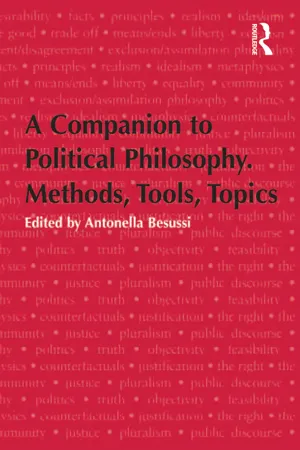
A Companion to Political Philosophy. Methods, Tools, Topics
About this book
This book offers a comprehensive overview of the key concepts and issues of contemporary political philosophy, providing an essential reference work for scholars and advanced students. It is structured in three parts, covering methodological issues; tools and argumentative strategies employed by political philosophy; and concepts and topics key to the discipline. Expert authors from around the world have written twenty chapters in a consistent and engaging style. Each chapter is thoroughly cross-referenced allowing students to appreciate how methodological issues relate to each other, and how methodology and argumentative tools affect the way substantial issues are addressed. The chapters are supplemented by further reading lists and selected bibliographies to aid further research. The companion will be required reading for masters and post-doctoral students, providing them with the appropriate tools for approaching political philosophy in a more thoughtful way, and showing how substantive topics are addressed within different perspectives and paradigms. The companion also provides upper-level undergraduates with a sophisticated introduction to the relevant problems and challenges political philosophy addresses.
Information
Methods
Chapter 1
Philosophy and Politics
Preliminary
What is the relation between philosophy and politics? In what sense, and for what purposes, can political questions be considered philosophical questions? In other words, what are we talking about when we talk about ‘political philosophy’?
It is difficult to answer similar essentialist questions univocally. In the very first scene in which philosophy operates politically – the Platonic scene – two attempts to answer the question are possible to detect already. Indeed, the ‘Socratic ideal’ describes both a political and a philosophical conception of the relationship between philosophy and politics. In the political account, philosophy’s work starts from the common sense of a given tradition. Philosophy is committed to systematizing and critically reviewing inarticulate beliefs and rudimentary intuitions to transform them into competent judgements. The philosopher is a critical citizen who points out consistencies and inconsistencies of claims and thoughts from within the city/the community, by measuring the performance of a context against its own constitutive criteria only. Comparisons are not to be made with abstract and ideal worlds. In the philosophical account, on the contrary, philosophy has the ambition to rule a recalcitrant city from outside and its political success implies the deep revision of familiar experiences. Here, the philosopher looks for constraints, background conditions, justificatory criteria, which are more demanding than the contextual ones for she is concerned with assessing the desirability of a given world as if she did not inhabit it.
The very metaphor of ‘gadflying’ around a lazy horse, through which the Platonic story sums up the peculiar vocation of a research tradition, confirms the problematic relationship between philosophy and the city (Apo 30e–31a). The metaphor suggests that the philosophical attitude towards politics is practical since it aims at producing effects. However, the effects will be different depending on which impulse prevails, whether it is the inventive and transcendental impulse, which puts philosophy in tension, even in an antagonistic tension, with politics or whether, on the other hand, it is the interpretive and situated impulse, which requires philosophy to settle, albeit without deference, in a world of shared meanings. The research tradition concerned with addressing political facts philosophically exemplifies both impulses, sometimes combining them, sometimes contrasting them. The unsatisfactory outcomes of an essentialist approach meant to define what the philosophical concern with political facts is, can be overcome by trying to record what the philosophical concern does in facing up specific political circumstances and problems. In what follows, this will be shown in the context of the contemporary debate, in which the philosophical concern with politics assumes specific forms, meanings and styles, recovering from a latent period. Such a recovery assumes different paradigmatic patterns. All these patterns make it clear that the philosophical ambitions of political philosophy are neither descriptive nor limited to observation and explanation: they are irreducibly evaluative. What this means will be specified in the following pages. For now it suffices to say that the problem is to make evaluative statements authoritative.
The philosophical treatment of political questions involves the appeal to some form of advocacy. Evaluating means taking a stand on how things should or must be. Hence, it requires criteria to distinguish good from bad, right from wrong. Since it cannot be satisfied with recording facts and with delivering an ordered and clear account of them, evaluation exceeds description, observation and explanation. Evaluation must weigh facts, judge them, decide what to change and what to keep, but it must do it on the basis of the distance between what is there and what should be there. It must evaluate facts by granting some sort of validity, meaningfulness and credibility to its conclusions in order for them not to be reduced to arbitrary statements. The point, in short, is that a philosophically competent evaluation of political facts does not need to be scientific in order to be theoretically meaningful.
Scientism vs. Evaluation
In the years after the Second World War, one could have diagnosed the death of political philosophy as an intellectual enterprise (Laslett 1956). This would not be a kind of natural death. Theory must be discredited before it can appear superfluous. This can be traced back to a scientistic frame, considered the only authoritative model of knowledge for natural and empirical science, with responsibility for the discredit of theoretical reasoning to be found in various quarters. Showing a downright infatuation with the scientific model of knowledge, scientism denies authoritativeness to philosophy and, more generally, to social sciences claiming they both fail to properly record how the world is.
The disqualification of the philosophical concern with political facts originates from two concurring and radical readings of Max Weber’s argument about the scientific unreliability of evaluative claims (Weber 1904/1949). One reading denies the cognitive status of evaluative statements with reference to an emotivist meta-ethical orientation, according to which moral judgements express just subjective feelings and attitudes. The other denies the meaningfulness of evaluative statements with reference to the requirements of a neo-positivist philosophy. They are radical readings since, in both cases, the idea that evaluative statements are not scientifically reliable is developed to delegitimize their function and meaning for research activities. Such a conclusion is absent in Weber’s argument. Weber denies the equivalence between the cognitive purposes of social sciences and those of natural sciences without endorsing any thesis about the cognitive status of evaluative statements and without drawing, from their non-scientific character, any judgement concerning their irrelevance. In short, Weber is neither an emotivist nor a positivist. Nevertheless, his insistence on the methodological difference between factual and evaluative statements is certainly the source of a conceptual trend according to which the philosophical concern with political facts is suspect. Factual statements deal with observable facts, whose truth is objectively verifiable while evaluative statements respond to facts without being able to objectively justify the way they do it. Then the philosophical concern with political facts may coincide, at most, with a set of non-testable assumptions about the congruence, or incongruence, between how things are and how things should be.
In Weber’s reasoning, however, the methodological distinction between description and evaluation is only meant to deny scientific status to evaluations. Indeed, since a scientific approach must rely on verifiable statements, namely on neutral descriptions of facts, political philosophy is not a scientific theory. The departure from observable facts required by evaluation, indeed, jeopardizes neutrality, namely the ability to objectively detect convergences and divergences between what is and what should be. If social sciences do not stick to facts, they will risk being affected by what practitioners believe, or wish the facts to be. To avoid such risk, social sciences must produce outcomes that any competent observer can recognize as correct descriptions of ascertainable facts. This does not mean that values, intended as understandings of what is desirable and what is not, are irrelevant for scientific research. Rather, values seem crucial in deciding what is worth knowing and which problems are worth addressing. Values select questions and interests, and thus provide a sense of orientation in the undifferentiated flow of phenomena. The pursuit of scientific objectivity does not require an attitude of moral indifference. The choice about what to know is an evaluative responsibility that cannot be scientifically settled.
Since whether something is true or false is independent from whether it is valuable, the scientific ethos requires that the need to know is satisfied impartially, in a way that is neutral with respect to the desires which set such a need in motion. This Weberian conclusion remains ambiguous: it affirms the necessity of evaluative orientation and denies the theoretical nature of evaluative practices at the same time (Portis 1983: 41–42). Imposing a strict interpretation of the models of legitimate knowledge which coincides with the models either of natural and empirical sciences or with those of formal disciplines, such as logic and mathematics, neo-positivism drastically overcomes Weber’s ambiguity and combines it with emotivism. It holds that any theoretical approach unable to satisfy similar standards is illegitimate because it is possible to theoretically address only what is true by definition, or by description. The final result is that evaluative statements have no theoretical dignity.
The argument of such outcome is secured by two moves. First, the argument distinguishes between the cognitive content of a statement – which coincides with its descriptive content – and its non-descriptive meaning – which coincides with the expression of emotional attitudes of approval/disapproval. (Stevenson 1937). Evaluative statements do not describe facts, they signal what the speakers like/dislike, what gratifies/offends them, what excites/annoys them. Lacking descriptive content, the language of evaluation lacks cognitive content. In short, evaluative statements are equated to rude gestures, to screaming, and crying, or to sermons and slogans. Second, the argument shows that only statements expressing verifiable meanings are respectable in scientific terms and legitimately say something meaningful about the world. Meaningfulness is connected to the form of statements and it depends either on their empirical content, or on their ability to satisfy the logical criteria of language analysis. Therefore, evaluative statements are meaningless either because they assume there is something that cannot be grasped through experience, or because they are syntactically flawed. For this reason evaluative statements should be qualified as pseudo-statements or as metaphysical assertions, which lack any theoretical content and which confuse between having an attitude towards the world and knowing the world. Such a confusion is bound to produce disastrous results in both areas: ‘Metaphysicians are musicians without musical ability.’ (Carnap 1959: 80). A theoretical approach does not address ‘metaphysical’ assertions to reject them. It disregards them because, following Hume, it upholds they ‘contain nothing but sophistry and illusion’ (Ayer 1959: 10).
In contrast to Weber’s case, in the positivist-emotivist framework there is no awareness about the internal tensions of the framework itself. The criterion of meaningfulness, which disqualifies evaluative statements, is itself an evaluative criterion, and, hence, it is meaningless if the criterion is valid (Gabriel 2003: 33). Yet it is precisely by virtue of its radical character that such an approach produces pervasive effects on the delegitimization of evaluative practices. Philosophical concerns in general, and the philosophical concern with politics in particular, are then frozen by a kind of impossibility theorem. Political philosophy reduces its ambitions and is committed merely to clarifying concepts. It engages in a grammar of political language with the aim of cleaning it up from ‘metaphysical’ scum, so that it can reproduce the ethics of adhesion to facts typical of scientific practices (Weldon 1953). Such a downturn is what Laslett describes as the death of political philosophy. He is clearly hinting at the atrophy of some properties which are vital for political philosophy’s existence.
Philosophy and Politics: Why
Laslett’s observation implies that a lively political philosophy could not be framed within a scientistic model, for it would make political philosophy itself theoretically irrelevant. However, for such a thesis to be justified, it is necessary to defend the meaningfulness of theoretical claims that exceed questions of fact, and thus to reject the idea that verifiability is the only criterion apt to decide whether a statement is meaningful or not. Isaiah Berlin (1962) endorses this strategy in a well-known contribution aimed at claiming that, given the irreducible and specific character of the questions it allows to raise, the philosophical concern with politics is irrepressible. It is significant that the argument starts from the defence of philosophical concern as such, in opposition to scientistic approaches which qualify it as cognitive nonsense.
The point is that, though they are connected to unequivocal methods for finding out responses, empirical questions – which can be answered through observation and inference – and formal questions – which can be answered through logic and deduction – do not cover all possible and relevant cognitive questions. The questions philosophy allows us to raise do not come with unequivocal methods of resolving, nor can they aspire to achieve definitive answers. Moreover, they cannot rely on a basic agreement about the concepts at stake or on reducing disagreement to empirical and logical differences. However, if philosophical questions coincide with essentially indeterminate questions, they risk being considered residual and, hence, identified with all those questions whose formulation does not specify how to solve them. The key to countering such a difficulty lies in identifying philosophical questions with questions which are ‘obstinately’ committed to evaluation. On the basis of such an identification, Berlin examines the way philosophical concerns affect politics. The philosophical concern raises questions that are beyond the scope of empirical investigation and that focus on the reasons why political words can have illocutionary force. (‘These are words in the name of which orders are issued, men are coerced, wars are fought, new societies are created and old ones destroyed ...’, Berlin: 1962: 7) Why can political words do things and enforce things to be done? How can one justify what political words prescribe, namely what to do and what not to do? On what conditions must these prescriptions be considered authoritative?
These questions are the peculiar expression of the philosophical concern with politics, which can be traced back to the need for a criterion of significance for political assertions different from, and not reducible to, verifiability. Such a criterion coincides with normative validity. With respect to ‘should-questions’, the point is to determine whether, when, and why a political statement displays a justifiable prescriptive value; to clarify how a political statement should be expressed and what requirements it should fulfil. The condition of possibility for the exercise of such evaluative tasks is the presence of a radical disagreement about what the criterion for meaningfulness of normative validity requires. Such a disagreement divides political philosophers when they dispute the value of plural, more or less compatible, normative options, against the background of political conflict. There is room for the philosophical concern with politics when there is more than one preferred or preferable option, or more than one despised or despicable option and when there is no unequivocal method for assessing the desirability, or undesirability, of the different options (see Pluralism).
Philosophy and Politics: How
The philosophical concern with politics expresses itself by testing, absent an agreement on their meaning, the validity of evaluative statements. The more the disagreement assumes controversial forms and the more a shared framework is unstable, the greater the challenge for philosophy. Yet the answers philosophy provides will be diverse and conflicting because the questions it addresses do not allow determined and conclusive solutions. Accordingly, Berlin’s argument suggests two important distinctive features of the philosophical treatment of political facts. First, it determines philosophy’s particular relevance in critical circumstances. On a political level, critical circumstances correspond to the dissolution of shared understandings, to disorder, conflict, and injustice. On the contrary, from a theoretical standpoint such circumstances indicate a disparity between the problems to be addressed and the tools available to solve them (Norberg 2011). Second, the argument outlines the inevitability of disagreement between political philosophies about what it means to operate theoretically under critical circumstances. It is a disagreement about the criteria for evaluation and about how to interpret evaluative tasks. This class of disagreements is especially evident in the contemporary debate, which begins with the recovery of political philosophy after the latent period following scientistic delegitimization. Such a debate is animated by divergent theses about what guarantees the meaningfulness of evaluative statements, that is by alternative conceptions of normativity. The disagreement also concerns conflicting views about whether and how it is desirable to reduce all kinds of evaluations to rule-oriented evaluations, and by different interpretations about the meaning and application of political concepts.
The tradition of political philosophy is basically the story of an endless disagreement about recurring problems. Specifically, this inconclusive character explains why scientistic approaches deny the meaningfulness of evaluative statements to make any contribution to a cognitive theorisation about politics, on the grounds that they cannot be tested effectively. A political statement, in fact, can be tested empirically, or on the basis of its logical consistency, if it is treated as a factual or formal assertion. Scientistic approaches try to reduce the philosophical concern with politics along similar lines. They shift the focus from how one thinks about, decides upon, or judges political facts, to how political facts are, to what can be meaningfully said about them in a scientific sense. Therefore, the question of the proper relation a theoretical approach should have with political facts comes to the fore. To address such a question means to critically rethink the positivistic dualism between facts and values, which considers evaluative abstinence a necessary condition for any cognitively significant contribution. The aim is to question, in various ways, the inhibitory effects such an abstinence has on normative theories.
In order to defend the meaningfulness of evaluation, it is necessary to redefine in non-scientistic terms the aspiration for objectivity. Since from a scientistic standpoint objectivity is understood as the property of descriptive statements certified by observable facts, the philosophical concern with politics requires, on the one hand, a rejection of the equivalence between objectivity and description. On the other hand, it requires a challenge to the simplistic view about the factual domain that makes such an equivalence possible (Putnam: 2002). It may be useful to distinguish more clearly both aspects of the problem. A description is objective when it represents objects in a way that is cognitively independent from any observer. Thus, the question is whether it is not only possible, but also desirable to evaluate objects (political facts) in a similarly way. Alternatively, the question concerns what kind of cognitive dependence between evaluations and evaluators is possible and desirable (see Objectivity).
Moving on to the conception of the factual domain which, according to Putnam, ‘does all the philosophical work’ (2002: 21) in the dualistic view of positivism, it is worth noting that descriptive objectivity is connected to a highly-selective representation, which merely records those aspects of political facts that can be expressed in empirical language. What is at stake in the confrontation between descriptions and evaluations is not faithfulness to facts, but different views about the selective criteria that grant such a faithfulness. From within the framework of the philosophical ...
Table of contents
- Cover Page
- Dedication
- Title Page
- Copyright Page
- Contents
- List of Contributors
- Editor’s Preface
- PART 1 METHODS
- PART 2 TOOLS
- PART 3 TOPICS
- Index
Trusted by 375,005 students
Access to over 1.5 million titles for a fair monthly price.
Study more efficiently using our study tools.
Frequently asked questions
Yes, you can cancel anytime from the Subscription tab in your account settings on the Perlego website. Your subscription will stay active until the end of your current billing period. Learn how to cancel your subscription
No, books cannot be downloaded as external files, such as PDFs, for use outside of Perlego. However, you can download books within the Perlego app for offline reading on mobile or tablet. Learn how to download books offline
Perlego offers two plans: Essential and Complete
- Essential is ideal for learners and professionals who enjoy exploring a wide range of subjects. Access the Essential Library with 800,000+ trusted titles and best-sellers across business, personal growth, and the humanities. Includes unlimited reading time and Standard Read Aloud voice.
- Complete: Perfect for advanced learners and researchers needing full, unrestricted access. Unlock 1.5M+ books across hundreds of subjects, including academic and specialized titles. The Complete Plan also includes advanced features like Premium Read Aloud and Research Assistant.
We are an online textbook subscription service, where you can get access to an entire online library for less than the price of a single book per month. With over 1.5 million books across 990+ topics, we’ve got you covered! Learn about our mission
Look out for the read-aloud symbol on your next book to see if you can listen to it. The read-aloud tool reads text aloud for you, highlighting the text as it is being read. You can pause it, speed it up and slow it down. Learn more about Read Aloud
Yes! You can use the Perlego app on both iOS and Android devices to read anytime, anywhere — even offline. Perfect for commutes or when you’re on the go.
Please note we cannot support devices running on iOS 13 and Android 7 or earlier. Learn more about using the app
Please note we cannot support devices running on iOS 13 and Android 7 or earlier. Learn more about using the app
Yes, you can access A Companion to Political Philosophy. Methods, Tools, Topics by Antonella Besussi in PDF and/or ePUB format, as well as other popular books in Philosophy & Political Philosophy. We have over 1.5 million books available in our catalogue for you to explore.