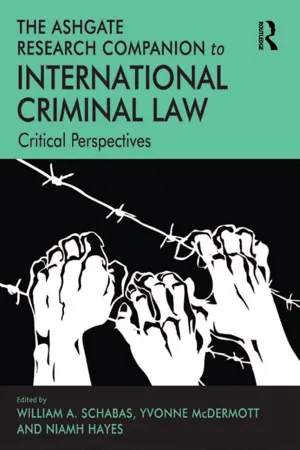
eBook - ePub
The Ashgate Research Companion to International Criminal Law
Critical Perspectives
- 554 pages
- English
- ePUB (mobile friendly)
- Available on iOS & Android
eBook - ePub
The Ashgate Research Companion to International Criminal Law
Critical Perspectives
About this book
International criminal law is at a crucial point in its history and development, and the time is right for practitioners, academics and students to take stock of the lessons learnt from the past fifteen years, as the international community moves towards an increasingly uni-polar international criminal legal order, with the International Criminal Court (ICC) at the helm. This unique Research Companion takes a critical approach to a wide variety of theoretical, practical, legal and policy issues surrounding and underpinning the operation of international criminal law as applied by international criminal tribunals. The book is divided into four main parts. The first part analyses international crimes and modes of liability, with a view to identifying areas which have been inconsistently or misguidedly interpreted, overlooked to date or are likely to be increasingly significant in future. The second part examines international criminal processes and procedures, and here the authors discuss issues such as victim participation and the rights of the accused. The third part is a discussion of complementarity and sentencing, while the final part of the book looks at international criminal justice in context. The authors raise issues which are likely to provide the most significant challenges and most promising opportunities for the continuing development of this body of law. As international criminal law becomes more established as a distinct discipline, it becomes imperative for international criminal scholarship to provide a degree of critical analysis, both of individual legal issues and of the international criminal project as a whole. This book represents an important collective effort to introduce an element of legal realism or critical legal studies into the academic discourse.
International Crimes and Modes of Liability
1
Sisyphus Wept: Prosecuting Sexual Violence at the International Criminal Court
It would be churlish, even in a book devoted to critical analyses of the subject, not to acknowledge that international criminal prosecutions are an incredibly complex and eye-wateringly difficult undertaking. Establishing jurisdiction and admissibility; selecting defendants or specific incidents for prosecution; conducting investigations, often via translators and frequently several years after the relevant events occurred, in situations of ongoing conflict or fraught post-conflict societies; identifying the most appropriate charges and modes of liability; balancing disclosure requirements with the need to protect vulnerable victims and witnesses; obtaining custody of a suspect: none of these are simple tasks, and all have the potential to act as lightning rods for criticism or as pressure points for any errors or weaknesses in the case. In some respects, international prosecutors are faced with a thankless task. No matter what they do, someone somewhere is waiting to tell them they have done it wrong, or not enough.
In many ways, an examination of an international tribunal’s efforts to prosecute sexual violence provides a microcosm of the successes, failures and challenges of all its international criminal prosecutions. The failure to charge even a single count of rape at the Nuremberg trial is emblematic of the International Military Tribunal’s deeply compromised position in relation to offences for which the victorious Allied powers, specifically the Soviet Union, did not exactly have clean hands.2 The Yugoslavia Tribunal grappled with some initial strategic and investigative hurdles,3 but went on to establish by far the most robust and least dysfunctional body of prosecutions for sexual violence of all the modern international tribunals, a description which could equally be applied to that Tribunal’s broader reputation. The Rwanda Tribunal’s marquee judgment on rape as an international crime, in the Akayesu case, was achieved almost despite itself given that the original indictment had not contained any sexual violence charges,4 and an analysis of its prosecutorial strategy reveals a series of problems inherited from its original investigations and a disconcerting tendency to drop rape charges wholesale in exchange for a guilty plea.5 The Special Court for Sierra Leone established some fascinating legal precedents, such as identifying and defining the crime against humanity of forced marriage,6 but was constrained by a limited range of defendants and a catastrophic decision to exclude all evidence of sexual violence from one of the cases for procedural reasons.7
Despite their individual foibles, the accumulated efforts of modern international criminal tribunals to prosecute sexual violence had tremendous normative and substantive impact. For the first time, rape and sexual violence were acknowledged as war crimes, crimes against humanity and even constituent elements of the crime of genocide; perhaps more importantly, in practical terms, the ad hoc tribunals showed through literal trial and error that successful prosecutions of sexual violence as an international crime could be achieved, even in the context of the inherent systemic difficulties attendant on any international criminal investigation or prosecution.8 These achievements were hard won, and when the Rome Statute came into force in July 2002, hopes were high that the first permanent international criminal tribunal would capitalise and advance on them.9 Unfortunately, in the decade since, the rock which had been so painstakingly hauled up the hill by prosecutors and practitioners in the other international criminal tribunals was permitted to tumble back to square one, as the International Criminal Court under Luis Moreno-Ocampo regressed in both strategy and practice and competent, focussed prosecutions of sexual violence became depressingly scarce once again. This regression was not confined to this category of crimes alone, as one of the International Criminal Court’s defining features in its initial years was an obstinate failure to learn from the accumulated practice of previously established international criminal tribunals. Several key institutional dysfunctions are revealed by an examination of the ICC’s record in relation to sexual violence, and one can only hope that they may be acknowledged and addressed by Fatou Bensouda, the newly elected Chief Prosecutor, as she begins the slow process of rolling the stone, once more, up the hill.
I. Prosecutorial Strategy at the ICC
From one perspective, prosecutors at the International Criminal Court began their work at a distinct advantage. Although the Court’s open-ended jurisdiction did not allow for the same degree of immersion in and familiarity with the ethnic and factual aspects of a specific conflict that prosecutors at the ICTY and ICTR were gradually able to develop, the Rome Statute did contain the broadest range of provisions on gender-based crimes of any international criminal tribunal to date. This not only included the most expansive enumeration of sexual and gender-based crimes of any tribunal,10 but also codified institutional and staffing requirements to ensure that sexual and gender-based violence were prioritised within the work of the Court.11 In addition, the Rules of Procedure and Evidence contained a number of evidentiary concessions to mitigate some of the problematic issues which have traditionally dogged domestic prosecutions for sexual and gender-based violence, such as the exclusion of evidence relating to the prior sexual conduct of the victim and a waiver of the requirement for corroboration of testimony relating to sexual violence.12
A. The Lubanga Trial, Or How Not to Conduct an International Criminal Prosecution
With such a substantial head-start in terms of substantive law and procedure, and the emergence of the Democratic Republic of the Congo (famously referred to by Margot Wallstrom as ‘the rape capital of the world’)13 as the ICC’s first Situation country following a self-referral by its Government,14 one would have been forgiven for expecting sexual violence to feature heavily in the Court’s initial investigations and indictments. However, despite the fact that ICC investigators uncovered preliminary evidence of rape, torture and enslavement in the first 18 months of their initial investigations in the DRC, the Office of the Prosecutor instructed them to pursue evidence relating only to the conscription and use of child soldiers.15 The decision of the Prosecutor to so drastically limit the charges sought against the ICC’s first accused, Thomas Lubanga Dyilo, and to confine the prosecution exclusively to the war crime of the recruitment, conscription and use of child soldiers,16 was the subject of intense criticism from academics, practitioners and NGOs.17 Perhaps the Prosecutor merely wanted a small, simple first case to get the Court off the starting blocks; it is worth remembering that the Yugoslavia Tribunal was similarly berated for prosecuting Duško Tadić, a low-level (albeit astonishingly sadistic) detention camp guard, as its first trial. However, the seniority of the ICC’s first defendant was not the contentious issue. Thomas Lubanga was alleged to have been the President of the Union of Congolese Patriots (UPC) and the commander in chief of its notorious armed military wing, the Forces Patriotiques pour la Libération du Congo (FPLC). Even a cursory familiarity with the operation of such militia groups in the eastern DRC would give rise to incredulity that the Prosecutor should choose to voluntarily confine his scrutiny to its activities in relation to child soldiers alone.18
As it transpired, the absence of sexual violence charges was only the first in a cavalcade of questionable strategic choices made by the Prosecutor in relation to the Lubanga case, which exposed serious systemic issues in prosecutorial strategy and practice at the ICC. The case almost ended before the trial even began, following the imposition of a stay of proceedings by the Pre-Trial Chamber in June 2008, as a result of the Prosecution’s inability to disclose potentially exculpatory material to the Defence which had been obtained pursuant to confidentiality agreements under Article 54(3)(e).19 While the impasse in question was ultimately resolved20 – at the cost of severely damaged relations with the relevant information providers, including the UN – the Prosecutor should never have found himself in such a potentially fatal predicament to begin with. The text of Article 54(3)(e) itself stipulates that evidence obtained on condition of confidentiality may be used ‘solely for the purpose of generating new evidence’, but the Office of the Prosecutor under Mr Ocampo took a far more expansive approach to the rule, apparently misinterpreting it as providing carte blanche to obtain extensive second-hand information first and unilaterally decide on its potentially exculpatory nature later.
Far from using Article 54(3)(e) cautiously and sparingly to obtain so-called ‘lead evidence’ only, as was envisaged in the Statute, the Office of the Prosecutor admitted in the Lubanga case that it had acquired more than half its evidence by means of confidentiality agreements,21 and was excoriated by Judge Steiner in the Katanga case for similar profligacy:
At the outset, the Single Judge notes the considerable number of documents (1632 according to the last indication given by the Prosecution on 25 April 2008) that the Prosecution has collected pursuant to article 54(3)(e) of the Statute, and that, according to the Prosecution, ‘were considered to be relevant’ for the present case. In the view of the Single Judge, this is particularly notable because the present case is confined to the crimes allegedly committed during one attack against one village on a single day.
The Single Judge finds this considerable number of documents to indicate that the Prosecution is not resorting to article 54(3)(e) of the Statute only in exceptional or limited circumstances, but rather is extensively gathering documents under such provision.
This practice, in the view of the Single Judge, is at the root of the problems that have arisen in the present case, as well as in the case of the Prosecutor v. Thomas Lubanga Dyilo, with regard to the disclosure to the Defence.22
Former practition...
Table of contents
- Cover Page
- Half-Title Page
- Title Page
- Copyright Page
- Table of Contents
- List of Abbreviations
- List of Cases
- Notes on Contributors
- Preface
- Introduction
- Part I: International Crimes and Modes of Liability
- Part II: The International Criminal Process
- Part III: Complementarity and Sentencing: A Discussion
- Part IV: International Criminal Justice in Context
- Index
Trusted by 375,005 students
Access to over 1.5 million titles for a fair monthly price.
Study more efficiently using our study tools.
Frequently asked questions
Yes, you can cancel anytime from the Subscription tab in your account settings on the Perlego website. Your subscription will stay active until the end of your current billing period. Learn how to cancel your subscription
No, books cannot be downloaded as external files, such as PDFs, for use outside of Perlego. However, you can download books within the Perlego app for offline reading on mobile or tablet. Learn how to download books offline
Perlego offers two plans: Essential and Complete
- Essential is ideal for learners and professionals who enjoy exploring a wide range of subjects. Access the Essential Library with 800,000+ trusted titles and best-sellers across business, personal growth, and the humanities. Includes unlimited reading time and Standard Read Aloud voice.
- Complete: Perfect for advanced learners and researchers needing full, unrestricted access. Unlock 1.5M+ books across hundreds of subjects, including academic and specialized titles. The Complete Plan also includes advanced features like Premium Read Aloud and Research Assistant.
We are an online textbook subscription service, where you can get access to an entire online library for less than the price of a single book per month. With over 1.5 million books across 990+ topics, we’ve got you covered! Learn about our mission
Look out for the read-aloud symbol on your next book to see if you can listen to it. The read-aloud tool reads text aloud for you, highlighting the text as it is being read. You can pause it, speed it up and slow it down. Learn more about Read Aloud
Yes! You can use the Perlego app on both iOS and Android devices to read anytime, anywhere — even offline. Perfect for commutes or when you’re on the go.
Please note we cannot support devices running on iOS 13 and Android 7 or earlier. Learn more about using the app
Please note we cannot support devices running on iOS 13 and Android 7 or earlier. Learn more about using the app
Yes, you can access The Ashgate Research Companion to International Criminal Law by Yvonne McDermott,Yvonne Mcdermott, William A. Schabas,William Schabas, William A. Schabas in PDF and/or ePUB format, as well as other popular books in Law & Criminal Law. We have over 1.5 million books available in our catalogue for you to explore.