- 396 pages
- English
- ePUB (mobile friendly)
- Available on iOS & Android
eBook - ePub
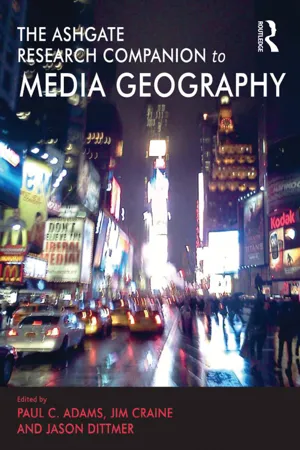
The Routledge Research Companion to Media Geography
About this book
This Companion provides an authoritative source for scholars and students of the nascent field of media geography. While it has deep roots in the wider discipline, the consolidation of media geography has started only in the past decade, with the creation of media geography's first dedicated journal, Aether, as well as the publication of the sub-discipline's first textbook. However, at present there is no other work which provides a comprehensive overview and grounding. By indicating the sub-discipline's evolution and hinting at its future, this volume not only serves to encapsulate what geographers have learned about media but also will help to set the agenda for expanding this type of interdisciplinary exploration. The contributors-leading scholars in this field, including Stuart Aitken, Deborah Dixon, Derek McCormack, Barney Warf, and Matthew Zook-not only review the existing literature within the remit of their chapters, but also articulate arguments about where the future might take media geography scholarship. The volume is not simply a collection of individual offerings, but has afforded an opportunity to exchange ideas about media geography, with contributors making connections between chapters and developing common themes.
Media
1
Photography
Introduction: An Oakland Bus Stop
Photography, at its most powerful, is a geographic medium unparalleled in shaping perceptions of place (van Gelder and Westgeest 2011). Whether viewed on a computer screen, in a gallery, through the pages of a book, or at a classroom lecture, photographic images of locations, near and far, can seem real and unmediated. They can transport people across vast distances of time and space.
This was made clear to me in early August 2010 at a bus stop in Oakland, California. I had just finished the first of a two-day oral history interview with Richard Misrach for the Smithsonian’s Archives of American Art (Misrach 2010a). As a way to help prepare for our discussion the following day, Misrach – an environmental photographer whose large-scale prints of bombing sites in the Nevada desert, petrochemical plants in Louisiana, and beaches in Hawaii have earned him international acclaim – lent me an advance copy of a forthcoming book. Destroy This Memory is large, measuring 15” x 11,” with the horizontal spine across the top, and printed at the highest possible quality in full color (Figure 1.1). Reading the book is like holding a slice of a museum in your hands with the pictures seeming to leap out from the page.
But that’s not putting it quite right. It’s more like a window through which viewers jump into another place – in this instance, post-Katrina New Orleans during the immediate months after the 2005 hurricane. Waiting for the bus back to Berkeley, I leafed through the photo book, lingering over every page, as the embattled city came into clear focus. New Orleans, through Richard Misrach’s lens, was unpeopled – not one person is seen in the 70 images – but the human impact on the devastated environment was immediate and loud. Seeing the landscape meant hearing it, too, as the words of local residents appeared at the center of each uncaptioned picture. Spray-painted messages in bright red, violet-blue, deep carrot orange, and ghost white gave voice to frantic pleas for help, stories of traumatic loss, and angry indictments. Although Misrach (2010b) let the words of residents speak for themselves with no interpretative text, he arranged the graffiti-laced photographs in a distinct narrative, beginning with despair (“help” and “fuck, fuck, fuck”) moving on to defiance (“I have a gun” or “to SOB that looted me I will kill you”) to gallows humor (“yard of the month” and “yep, Brownie, you did a heck of a job”) to a concluding, existential note (“what now?” “broken dreams,” “destroy this memory”). The effect on viewers is haunting.
And affective. Emotions of confusion, sympathy, frustration, and anger are ones that I heard expressed at the Oakland bus stop. Within minutes, more than a dozen fellow passengers, also waiting for the F bus, joined me in studying Misrach’s photographs. Sitting next to me and looking over my shoulder, they took turns thumbing through the photo book as I held it, stopping at every page, reading aloud its provocative words, and seeing the wounded landscapes on which they were written. My bus stop companions offered shrewd, at times conflicting interpretations of the photographs’ meanings: some knew little about the hurricane and were astonished that such disaster could be wrought by natural forces, while others remembered it well and were chilled by what they saw to be indictments against governmental ineptitude. It was made clear to me that there was no single right way to read these visual images. But also clear is that, for everyone that afternoon at the small corner in Oakland, we were somehow having contact with a place and a time that affected us in profound and surprising ways. We were responding to the thereness of photography.

Figure 1.1 Cover to Richard Misrach’s Destroy This Memory, 2010
Source: Richard Misrach
The Thereness of Photography
So was Roland Barthes, when he looked at a nineteenth-century photograph of the Alhambra in Granada, Spain. “This old photograph touches me,” he wrote, “it is quite simply there that I should like to live.” The experience that Barthes (1981: 38, 84) describes – the sense that he is looking directly at a slice of geographic reality, “an immediate presence to the world” – is foundational to the medium. And it’s not just among astute semiologists like Barthes that photographs exert the power of place. The most democratic of the geographic media, photography speaks an accessible language that’s both multivalent and open to anyone who pauses to look at what’s there.
8220;Thereness is a sense of the subject’s reality, a heightened sense of its physicality, etched sharply into the image,” writes Gerry Badger (2010: 17). “It is a sense that we are looking at the world directly, without mediation.” Badger is describing the often-noted aura of machine objectivity that hangs over photographs, despite the subjective nature of both taking a picture and manipulating its visual qualities. It’s often easy to forget, when looking at photographs, that one is looking at a mediated reality instead of reality itself. Marita Sturken and Lisa Cartwright (2001: 17) call this the myth of photograph truth and note that “although we know that images can be ambiguous and are easily manipulated or altered … much of the power of photography still lies in the shared belief that photographs are objective or truthful records.”
This constant tension between photography and reality – a slippery relationship at once straightforward and enigmatic – can be found at the extreme ends of the photographic spectrum: from modest snapshots emerging from a Brownie camera or cell phone to the most serious “art” photographs. Walker Evans (1974: 95), himself a master of the art, recognized that even the most modest and banal postcards, produced as they often are “as a routine chore by heaven knows what anonymous photographer,” can be a “well-nigh perfect record of place.” Such photographs can simultaneously present evidence and evoke a magical quality that evades definition – resulting in a complex set of feelings and associations specifically because of the allegiance with thereness.
What’s more, the thereness of photographs means that such visual images “don’t only show us things, they do things. They engage us optically, neurologically, intellectually, viscerally, physically” (Heiferman 2012: 16). For my bus stop companions, photographs of Katrina-wracked New Orleans demanded our scrutiny and interpretation, as they promoted conversation, stimulated thought, and shaped at least one person’s understanding of the unnatural metropolis. Conceiving photographs this way, on the one hand, helps move beyond an unproductive impasse within human geography, where “representation” is counterposed to something called “practice” or “performance.” As an agent of change, feeling, and affect, photography’s active role in the practices and performances of everyday life makes it an especially important geographic medium (Abel 2012).
On the other hand, recognizing the thereness of photography suggests something about geography. As Felix Driver (2003: 227) argues, the idea that geography is a particularly visual discipline has a long history and “isn’t simply the product of heightened anxiety about the politics of vision in recent cultural theory. For centuries, indeed, practitioners of the art of geography have been engaged in developing languages and techniques to capture what the eye could or should see in a landscape.” Photography emerged in the nineteenth century as an ideal instrument for geographic research and education, evolving from lantern slides and stereographic views to 35 mm slides and PowerPoint presentations (Figure 1.2). So successful has the camera been to visualize a slice of the world that, as Tuan (1979: 413) astutely observes, “in the classroom, a geography lecture without slides is as anomalous as an anatomy lecture without bones.”
Sometimes, as Gillian Rose (2003: 216; cf. Driver 2003; Matless 2003; Ryan 2003) observes, the photograph shown as a lecture slide “becomes the real,” the photographs “confirm the truth of our words.” This is an important point, and one that must be emphasized. It also should be extended beyond the geography classroom and become an initial point of departure for all photographic/geographic studies – namely, the recognition of the dual existence of photographs as physical objects and compelling imagery. Before a photograph can function as a representation of any kind, it begins its life as a three-dimensional thing, which has “volume, opacity, tactility, and a physical presence in the world” (Batchen 1997: 2). One might push this general observation even further to assert that a photograph’s material form (whether a gelatin silver print or the bytes of a digital file), no less than the image it bears, is fundamental to its function as an object that carries social and cultural meaning.
This essential observation is easy to overlook, especially when viewing photographs of visually arresting imagery. As Elizabeth Edwards and Janice Hart (2004: 2) argue, “the prevailing tendency is that photographs are apprehended in one visual act, absorbing image and object together, yet privileging the former.” While image content – what is depicted in a photograph – remains the principle interest of most viewers, much is lost if we leave it at that. It’s worth considering, for example, this 1938 image of an isolated farm in the Texas panhandle by the American photographer Dorothea Lange (Figure 1.3). At one level, it offers evidence of the sort of vernacular structures and agricultural patterns that have long fascinated cultural geographers. Pushing a bit further, a geographer might take notice of the abandonment of the dwelling and the particularly neat rows of contour-plowed land surrounding it. Such descriptions, as important as they are, neglect the fact that Lange’s Texas photograph is a mediated representation that performs cultural work.

Figure 1.2 Children in a Geography Class Viewing Stereoscopic Photographs, 1908. Photographer unknown
Source: Library of Congress Prints and Photographs Division, Underwood and Underwood Collection, LC-USZ62-90216
An approach to this photograph that is aware of its thereness begins with its status as a material object. It would, furthermore, acknowledge that Lange created this image with a specific agenda in mind, that it served her and other’s interests in competing ways. Finally, it would recognize that, over the years, the material object has circulated widely as different viewerships have seen it in multiple contexts. As a key member of President Franklin Roosevelt’s Farm Security Administration (FSA), Lange was commissioned to photographically document the social and economic relationships of American agricultural labor during the Great Depression. She became a severe critic of that system, using her photographs to expose its structural inequalities. This becomes evident only when the photograph’s full caption, as Lange intended it, is matched to the image itself: “Tractored Out: Power farming displaces tenants from the land in the western dry cotton area, Childress County, Texas Panhandle. June 1938.” Far from a value-neutral picture of a Texas landscape, Lange’s photograph simmers with indignation and moral conviction (Spirn 2009).

Figure 1.3 Dorothea Lange, Tractored Out. Power farming displaces tenants from the land in the western dry cotton area, Childress County, Texas Panhandle, 1938.
Source: Library of Congress Prints and Photographs Division, US Farm Security Administration/Office of War Information, LC-USF34-T01-018281-C
Image makers like Dorothea Lange seductively deployed the thereness of photography to stake her claims about the troubled and uneven nature of American capitalist development. Other photographers may also strive to present a visual argument, but, like Trevor Paglen, are simultaneously concerned with the slippery relationship between photography and what is depicted. Trained as a geographer and a photographer, Paglen recognizes a contemporary suspicion of representation – “the days of believing that there’s something out there in the world that can be transparently represented by a photograph or image are over” – at least in the realm of critical theory and the art world (quoted in Stallabrass 2011: 8). But rather than either retreating to pure abstraction or eschewing the visual altogether, he embraces the performative act of photography. Indeed, for Paglen photography is all about exploring limits – limits of visibility, representation, knowledge, and democratic society. Each photograph he takes can be regarded as a record of political performance as he insists on his right to bring his camera to public space and document what is otherwise invisible.
And it is the generally invisible – and purposefully so – that intrigues Paglen and compels him to document the hidden spaces of military power. He has taken thousands of photographs of the “black world” – the covert defense projects and infrastructure that has grown exponentially since the Bush administration’s 2001 declared War on Terror. In some cases, he uses high-end optical lenses designed for astronomical photography to document secret military bases in the United States. In others, he makes use of data generated by amateur satellite watchers to track and photograph classified spacecraft in the earth’s orbit. “Nine Reconnaissance Satellites over Sonora Pass” from 2008 (Figure 1.4) is an example of the latter series and presents viewers with an immediate and interesting contradiction. With its striking, multicolored symmetrical lines set against the deep black background, the photograph is a four-hour time-lapse exposure of the northern sky over the Sierra Nevada. It at once belongs to the art world,1 but its full significance only becomes apparent when considering the social process that went into making it. For the artist, it is an exposé of the “legal ‘nowhere’ that nourishes the worst excesses of power” (Paglen 2010: 276). Making the “nowhere” of covert operations into a somewhere through the troubled yet continued relevance of photography’s thereness is what gives Paglen’s work its geographic immediacy and political relevance.

Figure 1.4 Trevor Paglen, Nine Reconnaissance Satellites over Sonora Pass, 2008
Source: Trevor Paglen; Altman Siegel, San Francisco; Metro Pictures, New York; Galerie Thomas Zander
The photographic work of Trevor Paglen, Dorothea Lange, and Richard Misrach point to something else – namely, that it behooves geographers to pay close attention to the work of photographers. This point is picked up by James R. Ryan (2003: 235), who notes that “geographers have tended to see the work of visual artists as merely illustrative of textual ideas or, at best, something to be deconstructed from a distance.” Instead, he argues that there is much to be gained from a sustained dialogue between these two spheres. A sustained dialogue must, by definition, narrow the conversation to give it substance and depth, especially so with this ubiquitous, accessible medium. What makes photography – defined by its close, thorny connection with reality – ideal to enlist for politics and to illustrate things, also makes it elusive and easy to underestimate (Hoelscher 2012). A case-study perspective, one that engages critically with images and sociocultural context, would seem to offer the most direct route to photography’s thereness.
In the following sections, I explore the possibilities of such a dialogue between geography and photography by closely examining the geographic lenses of one photo agency – Magnum Photos. Not only does Magnum – now in its seventh decade – offer a range of approaches and ways of handling the medium, it also has a distinctly geographic way of seeing and visually describing the world. Because photographs so seamlessly enter the relationship between observer and material reality, they have become “a functioning tool of the geographic imagination,” write Schwartz and Ryan (2003: 3). The relationship becomes even more interesting when considering the work of photographers, like many associated with this particular photo agency, whose specific objective is to create visual records that actively shape perceptions of place. Exploring something of Magnum’s geographical imagination sheds light on how geography and photography can be mutually entwined to the benefit of each.
The Geographical Imagination of a Photo Agency
In 1947, in the wake of the Second World War’s unprecedented destruction, four of the most prominent photographers to cover that shattering event had a unique idea: to form a photographic cooperative that would allow for the creation and dissemination of visual images unencumbered by the constraints of for-profit photojournalism.2 The experience of the war and its aftermath called into question the very foundation of Western civilization and its traditional means of conveying visual information. The resulting organization – Magnum Photos – has since become one of the modern world’s most influential photographic communities, producing images of great diversity and distinction that have been viewed the world over.
It has been long understood that for Henri Cartier-Bresson, photography was a temporal matter. The decisive moment, he famously said, is the “simultaneous recognition, in a fraction of a second, of the significance of an event.” But it was also, for this Magnum founder, a spatial concern: “the [re]discovery of the world around us” (Cartier-Bresson 1952: n.p.). Sometimes those worlds embody excruciating pain and at other times exuberant joy; they can exhibit breathtaking beauty or bleak unsightliness. Regardless of what they look like, photogr...
Table of contents
- Cover Page
- Half Title Page
- Title Page
- Copyright Page
- Contents
- List of Figures and Tables
- Notes on Contributors
- Introduction: Geographies of Media
- Part I Media
- Part II Places
- Part III Spaces
- Index
Trusted by 375,005 students
Access to over 1.5 million titles for a fair monthly price.
Study more efficiently using our study tools.
Frequently asked questions
Yes, you can cancel anytime from the Subscription tab in your account settings on the Perlego website. Your subscription will stay active until the end of your current billing period. Learn how to cancel your subscription
No, books cannot be downloaded as external files, such as PDFs, for use outside of Perlego. However, you can download books within the Perlego app for offline reading on mobile or tablet. Learn how to download books offline
Perlego offers two plans: Essential and Complete
- Essential is ideal for learners and professionals who enjoy exploring a wide range of subjects. Access the Essential Library with 800,000+ trusted titles and best-sellers across business, personal growth, and the humanities. Includes unlimited reading time and Standard Read Aloud voice.
- Complete: Perfect for advanced learners and researchers needing full, unrestricted access. Unlock 1.5M+ books across hundreds of subjects, including academic and specialized titles. The Complete Plan also includes advanced features like Premium Read Aloud and Research Assistant.
We are an online textbook subscription service, where you can get access to an entire online library for less than the price of a single book per month. With over 1.5 million books across 990+ topics, we’ve got you covered! Learn about our mission
Look out for the read-aloud symbol on your next book to see if you can listen to it. The read-aloud tool reads text aloud for you, highlighting the text as it is being read. You can pause it, speed it up and slow it down. Learn more about Read Aloud
Yes! You can use the Perlego app on both iOS and Android devices to read anytime, anywhere — even offline. Perfect for commutes or when you’re on the go.
Please note we cannot support devices running on iOS 13 and Android 7 or earlier. Learn more about using the app
Please note we cannot support devices running on iOS 13 and Android 7 or earlier. Learn more about using the app
Yes, you can access The Routledge Research Companion to Media Geography by Paul C. Adams,Jim Craine in PDF and/or ePUB format, as well as other popular books in Social Sciences & Geography. We have over 1.5 million books available in our catalogue for you to explore.