- 766 pages
- English
- ePUB (mobile friendly)
- Available on iOS & Android
eBook - ePub
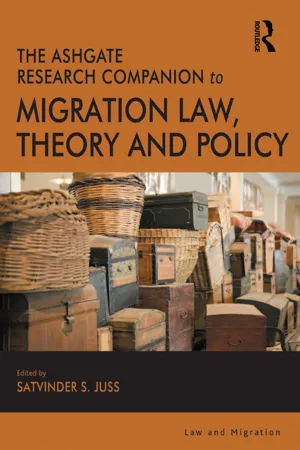
The Ashgate Research Companion to Migration Law, Theory and Policy
About this book
The Ashgate Research Companion to Migration Law, Theory and Policy complements the already successful Ashgate series Law & Migration, established in 2006 which now has a number of well-regarded monographs to its credit. The purpose of this Companion is to augment that Series, by taking stock of the current state of literature on migration law, theory and policy, and to sketch out the contours of its future long-term development, in what is now a vastly expanded research agenda. The Companion provides readers with a definitive and dependable state-of-art review of current research in each of the chosen areas that is all-embracing and all-inclusive of its subject-matter. The chapters focus on the regional and the sub-regional, as well as the national and the global. In so doing, they aim to give a snap-shot that is contextual, coherent, and comprehensive. The contributors are both world-renowned scholars and newer voices and include scholars, practitioners, former judges and researchers and policy-makers who are currently working for international organisations.
PART I
THE REFUGEE IN EUROPE’S FREE MOVEMENT REGIME
1
The ‘New Europe’ and the ‘European Refugee’: The Subversion of the European Union’s Refugee Law by its Migration Policy1
Introduction
What choice do we have? National or European – formulated this way we are presented with the tyranny of two choices. The third, that we need be neither but can aspire to a genuine internationalism that knows neither ‘state’ or ‘continental limits’, stands marginalized, ridiculed as pathetically utopian, the idea of the dreamer. Be a realist, accept the terms you are offered and if you are on the outside of ‘Europe’ looking in, then show why we should accept you rather than them.3
Far from serving to transcend or undermine the excesses of the nation state, the European project has merely resulted in ‘more of the same’ on a far grander scale. As Rogers Brubaker has lamented, despite the promise of a ‘post-national’ reinvention of itself, ‘[t]he future displayed recently by Europe to the world, however, looks depressingly like the past’.4 The Schengen Agreement of 1985 may have started European countries on the path to the abolition of all national frontiers, culminating in the 1992 Single European Act, which carved out a commitment among Member States to invent a borderless Europe in which capital, goods and persons could move freely. But the spoils this extravagant, top-down scheme to recreate Europe promised to deliver were argued to necessitate the erection of the greatest of all frontiers at the outer borders of the Union. These borders are not themselves set in stone. Rather, ‘[t]he borders of Europe lie wherever those with power choose to put them and cast them in concrete and barbed wire’.5 And so, since the inception of what we might call the ‘New Europe’, we have seen the borders of this appropriated continent expand further and further east, gradually encompassing in its exclusive folds Central and Eastern European countries. And in their inclusion, new members were told that they must now exclude. The task of policing the European Union’s borders has thus moved eastwards as its membership has grown in that direction. The well-rehearsed justification for heightened policing of Europe’s external borders is one based on a perceived need for ‘flanking measures’ designed to provide increased security for Europeans and their way of life on the inside. European states, the bureaucrats have long iterated, in opening themselves up from the inside, make themselves vulnerable to penetration by all manner of transnational ills from the outside, not least criminals, drugs, terrorists and illegal immigrants.6 For ‘the idea of Europe requires an idea of “non-Europe”, an idea of the “other”’.7 And so it was, in the age-old, tried-and-tested method of nation building, that the European Union made itself and its Europeans with the help of an excluded ‘other’.
The ‘other’ who forms the focus of this chapter is the refugee, the potential ‘European refugee’ – defined here as an individual who might flee her country in search of protection, and find sanctuary in Europe. It is of course impossible to speak of refugees as though they comprise a category of like individuals with like experiences. Indeed, there is ‘no commonality to the refugee experiences, save the experience of displacement’.8 And thus in speaking of refugees here, the mindset is one of acknowledging ‘the resilience of the refugee, but is also sensitive to the relative specificities of refugee experiences along a number of markers such as race, ethnicity, and gender’.9 The refugee is an ‘other’ that serves unfailingly to remind us of ‘the arbitrariness and contingence of identity borders and boundaries’.10 At present, the ‘New Europe’, as postulated above, cannot be reminded enough of the contingency of its own existence and practices of exclusion. No ‘pre-existing “Europe” [exists] that legitimizes the development of the European Union’, 11 nor therefore its exclusion of ‘non-Europeans’. It is precisely with Europe’s exclusion of the European refugee in the making and maintaining of itself that this chapter is concerned. Intrinsic to the making of itself has been the abolition of internal frontiers, and paramount to the maintaining of itself has been Europe’s fortification of its external borders. In examining European refugee law and its interaction with European migration policy, this chapter asks what the result of these processes has been for the identity of the European refugee.
Just as its Member States have long promised, and to some extent practised, the protection of refugees, the European Union made a similar commitment to do so in the course of its initial expression of its intention to construct a Common European Asylum System (CEAS). Thus, at Tampere in 1999, the European Council agreed
to work towards establishing a Common European Asylum System, based on the full and inclusive application of the Geneva Convention, thus ensuring that nobody is sent back to persecution, i.e. maintaining the principle of non-refoulement.12
Its features were to include ‘in the short term’
a clear and workable determination of the State responsible for the examination of an asylum application, common standards for a fair and efficient asylum procedure, common minimum conditions of reception of asylum seekers, and the approximation of rules on the recognition and content of the refugee status. It should also be completed with measures on subsidiary forms of protection offering an appropriate status to any person in need of such protection.13
And ‘in the longer term Community rules should lead to a common asylum procedure and a uniform status for those who are granted asylum valid throughout the Union’.14 The Union’s CEAS project has advanced some way since Tampere and comprises not only directives on the topics of procedures, 15 reception16 and qualification17 stipulated above, but a number of proposed, recast directives on these topics that are presently being negotiated in the Council and Parliament.18
With each of its legislative outputs, the Union has dutifully declared itself to be acting in accordance with the 1951 Geneva Convention Relating to the Status of Refugees and the 1967 New York Protocol (the Refugee Convention). This chapter, in being concerned with the identity of the European refugee, focuses on the European Union’s Qualifications Directive in which we find the Union definition of a refugee. A reading of the Qualifications Directive might indeed allow us to conclude that the Union does, at least on paper, conform to international refugee law obligations. In fact, on paper, the Qualifications Directive appears to go further than the Refugee Convention in delimiting its scope of protection, for example in its recognition of non-state actors as being capable of persecution. Before turning to consider in detail the Qualifications Directive, its effectiveness in the context of the Union’s wider migration policy, and the exclusionary effect of the interaction between the Union’s migration policy and its refugee law on the European refugee, it is worth considering ‘who is a refugee’ under international law.
The 1951 Refugee Convention: Who is a Refugee?
Legal categories are artificial and historically contingent in that they do not neutrally represent natural or predefined groups of persons, but instead construct them. These categories are created by interested elites, and in particular with regard to the legal category of the refugee, it is the host states themselves, the potential protectors and cost bearers of that protection, that determine its form. In constructing the refugee definition, states ‘problematize’ the refugee ‘other’ ‘to produce and stabilize the field of the refugee as a field wherein it becomes possible to engage in the politics of identity construction on an ongoing basis’.19 The refugee ‘figure’, in Soguk’s terms, ‘appears at the intersections of power relations’ and ‘the site of the refugee … becomes a site of modern statecraft’.20 In this way, refugee law and in particular its making and remaking is a practice crucial to nation building in its creating ‘a point of reference for the rearticulation of state sovereignty’.21 This is no less so at the international and the European level than at the national level. Thus, despite the prominence of legal categories in vitally affecting the lives of refugees, in the course of their analysis, their contingency and interest-serving artificiality must be borne in mind.
The primary legal source of international protection for those seeking refuge is the 1951 Refugee Convention. Before examining the Convention definition of a refugee, it may be useful to explore the intuitive and conceptual dimension of the term. Goodwin-Gill writes that ‘implicit in the word “refugee” lies an assumption that the person concerned is worthy of being, and ought to be, assisted, and, if necessary, protected from the causes and consequences of flight’.22 The use of the term refugee suggests some preconceived idea of a person who is envisaged as deserving of protection; we know what a refugee looks like before she has arrived. The definition of a refugee is thus formulated on the basis of a contrived image of an individual deserving of protection. During the Second World War a great many individuals fled across borders in order to escape certain harms. When it came to the task of creating a general definition of a refugee during the negotiations on the Refugee Convention, this was moulded to fit those already on states’ territories. Categories were formulated of ‘existing refugees, while the general criterion of persecution or fear of persecution, neither narrow nor excessively restricted … was considered broad enough for post-Second World War and future refugees’.23 The drafters of the Convention therefore had a clear idea of who they wanted to fall within the scope of the refugee definition.
States have always preferred to make clear to whom they are willing to provide protection and from what. Traditionally, the essential quality of a refugee was seen to be her presence outside her own country as a result of political persecution.24 However, by the end of the Second World War it had become apparent that persecution could take place on a number of grounds other than one’s political opinion and the definition of a refugee was widened to include grounds of persecution such as race and religion. This is demonstrated in the definition of a refugee eventually settled upon in the 1951 Refugee Convention, which states that a refugee is a person who
owing to a well-founded fear of being persecuted for reasons of race, religion, nationality, membership of a particular social group or political opinion, is outside the country of his nationality and is unable, or owing to such fear, is unwilling to avail himself of the protection of that country; or who, not having a nationality and being outside the country of his former habitual residence as a result of such events, is unable or, owing to such fear is unwilling to return to it ….25
Recognition as a refugee therefore requires an individual to have crossed an international border and to have suffered some sort of discriminatory human rights breach. Proof of persecution alone is not sufficient to establish refugee status; the threat to the individual’s life or liberty must have a discriminatory impact on the basis of her ‘race, religion, nationality, membership of a social group or political opinion’.26 Though the term ‘persecution’ is not itself defined, certain types of harm have traditionally been seen as falling within its scope of meaning while others have not. For example, individuals fleeing poverty are not generally considered deserving of asylum. Traditionally, the dominant discourse has considered that ‘[t]he solution to their problem, if any, lies more within the province of international aid and development, rather than in the institution of asyl...
Table of contents
- Cover Page
- Title Page
- Copyright Page
- Contents
- List of Contributors
- Foreword by Dr Volker Türk
- Preface
- Part I: The Refugee in Europe’s Free Movement Regime
- Part II: Safeguarding the Safety and Security of Refugees
- Part III: The Responsibility to Protect Displaced Populations
- Part IV: Emerging Paradigms of Legal Protection
- Part V: Encampment, Detention and the Coercive Treatment of Asylum-Seekers
- Part VI: Migrant Workers, Skilled Labour and the Control of Human Mobility
- Part VII: Transnational Migration, Citizenship and the Modern State
- Index
Trusted by 375,005 students
Access to over 1.5 million titles for a fair monthly price.
Study more efficiently using our study tools.
Frequently asked questions
Yes, you can cancel anytime from the Subscription tab in your account settings on the Perlego website. Your subscription will stay active until the end of your current billing period. Learn how to cancel your subscription
No, books cannot be downloaded as external files, such as PDFs, for use outside of Perlego. However, you can download books within the Perlego app for offline reading on mobile or tablet. Learn how to download books offline
Perlego offers two plans: Essential and Complete
- Essential is ideal for learners and professionals who enjoy exploring a wide range of subjects. Access the Essential Library with 800,000+ trusted titles and best-sellers across business, personal growth, and the humanities. Includes unlimited reading time and Standard Read Aloud voice.
- Complete: Perfect for advanced learners and researchers needing full, unrestricted access. Unlock 1.5M+ books across hundreds of subjects, including academic and specialized titles. The Complete Plan also includes advanced features like Premium Read Aloud and Research Assistant.
We are an online textbook subscription service, where you can get access to an entire online library for less than the price of a single book per month. With over 1.5 million books across 990+ topics, we’ve got you covered! Learn about our mission
Look out for the read-aloud symbol on your next book to see if you can listen to it. The read-aloud tool reads text aloud for you, highlighting the text as it is being read. You can pause it, speed it up and slow it down. Learn more about Read Aloud
Yes! You can use the Perlego app on both iOS and Android devices to read anytime, anywhere — even offline. Perfect for commutes or when you’re on the go.
Please note we cannot support devices running on iOS 13 and Android 7 or earlier. Learn more about using the app
Please note we cannot support devices running on iOS 13 and Android 7 or earlier. Learn more about using the app
Yes, you can access The Ashgate Research Companion to Migration Law, Theory and Policy by Satvinder S. Juss in PDF and/or ePUB format, as well as other popular books in Law & International Law. We have over 1.5 million books available in our catalogue for you to explore.