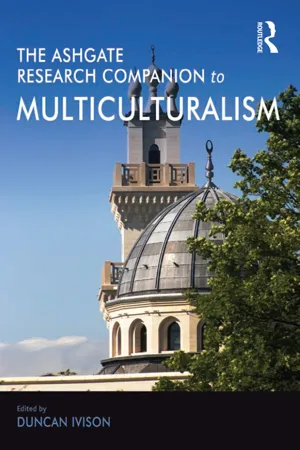
- 342 pages
- English
- ePUB (mobile friendly)
- Available on iOS & Android
eBook - ePub
The Ashgate Research Companion to Multiculturalism
About this book
The Ashgate Research Companion to Multiculturalism brings together a collection of new essays by leading and emerging scholars in the humanities and social sciences on some of the key issues facing multiculturalism today. It provides a comprehensive and cutting-edge treatment of this important and hotly contested field, offering scholars and students a clear account of the leading theories and critiques of multiculturalism that have developed over the past twenty-five years, as well as a sense of the challenges facing multiculturalism in the future. Key leading scholars, including James Bohman, Barbara Arneil, Avigail Eisenberg, Ghassan Hage, and Paul Patton, discuss multiculturalism in different cultural and national contexts and across a range of disciplinary approaches. In addition to contributions, Duncan Ivison also provides a comprehensive Introduction which surveys the field and offers an extensive guide to further reading. This is a key volume for anyone interested in multiculturalism and its political premise.
Information
1
Introduction:
Multiculturalism as a Public Ideal
Introduction
Multiculturalism is an awkward term. Some suggest it merely restates the very problem it is meant to resolve; others that it should be abandoned altogether. But what would it mean to abandon multiculturalism? And not just the phrase or concept, but the attitudes, beliefs and practices associated with it?
However inelegant a word, the concept of multiculturalism now occupies a central place in the public culture of Western liberal democracies and increasingly in global political discourse too. Some of the fundamental ideas associated with multiculturalism underlie a remarkable shift in approaches to minority rights that have occurred over the past 25 years in domestic and international law. Multiculturalism has also become a central topos in modern social and political theory, as well in the contemporary social sciences more generally. There is no question that there has been a fundamental shift in our thinking about the nature of ethnic and cultural diversity.
One thing the ‘multicultural turn’ in political theory has done is put cultural and ethnic diversity at the centre of contemporary debates. It broke up the explicit (and often implicit) monoculturalism at the heart of many of the dominant ways of conceiving of modern statehood and citizenship. It brought to the fore various occluded aspects of the way nation-building often presumed a cultural uniformity that legitimated harmful modes of assimilation, or was indifferent to the aspirations of minorities. Even more recently, multicultural ideas have spread to debates over the nature of global justice and the search for global norms of human rights and redistributive justice.
This volume seeks to bring together some of the leading and emergent scholars working on multiculturalism from a range of different disciplines and approaches – including philosophy, political science, sociology and anthropology. One general background against which the book is set is the rise of multiculturalism as an increasingly global political ideal, and yet also a sense of unease about many of its consequences. The book is divided into three thematic sections: ‘foundations’, ‘challenges’ and ‘alternatives’. Each author was asked to provide a distinctive angle and response to the question they were posing, but also to provide enough background so that someone coming to these issues for the first time would be able to situate the argument in a broader context. What I want to do in this chapter is introduce some of the main themes of the book. But I also want to identify some of the key ideas and questions at the heart of multiculturalism understood as distinctively public ideal.
Three Logics of Multiculturalism
First of all, what do we mean by multiculturalism? Even here there is argument, as we might expect. But for the general purposes of this book, multiculturalism refers to a broad array of theories, attitudes, beliefs, norms, practices and policies that seek to provide public recognition of and support for accommodation of non-dominant ethnocultural groups. The nature of these non-dominant groups will vary: some may be immigrant minorities (including refugees), others will be ‘historically settled’ minorities such as national minorities (e.g. the Quebecois) or indigenous peoples. These differences are important, as we shall see. However, what is distinctive about multicultural approaches to social and cultural diversity – and especially liberal multiculturalism – is the aim is to go beyond the protection of basic civil and political liberties associated with liberal citizenship to forms of differentiated citizenship that allows groups to express their distinct identities and practices (Kymlikca 1995b; 2001; 2007b; and Chapters 2, 3 and 4 of this volume). Some of these measures include the recognition and support of minority languages, exemptions from generally applicable laws and the recognition of ‘inherent rights of self-government’ (for indigenous peoples). This means debates about multiculturalism inevitably involve deeper claims about not only the vexed question of culture, but also the nature of freedom, equality, democracy and justice.
It is important to acknowledge an immediate problem with this broad conception of multiculturalism. As this book makes clear, the prospects for multiculturalism, as well as what it means (in theory and practice), can vary from place to place. This is particularly true when comparing attitudes towards multiculturalism in many parts of Western and Eastern Europe, in North, Central and South America, in Australasia, and also increasingly in Africa and Asia. Some of this is to do with different facts on the ground (e.g. different patterns of immigration), and some to do with different histories of settlement and forms of nation-building. So context is crucial; although we can pick out certain broad elements that most forms of (liberal) multiculturalism share, there will also always be important differences. In Canada and Australasia, for example, ‘multiculturalism’ is not generally used to refer to the situation of indigenous peoples and many indigenous groups resist the extension of the concept multiculturalism to cover their claims. This is because there is a prior question about the legitimacy of the state that remains to be addressed for indigenous peoples (Turner 2006; Ivison 2002). Their situation is clearly not akin to recent migrants. Elsewhere, however, such as in Latin America, ‘multiculturalism’ is often used to refer to the claims of indigenous peoples as opposed to immigrant groups.
I want to identify three broad ‘logics’ of multiculturalism that will serve as a general framework for the discussion in this chapter, as well as in the book as a whole. They don’t define any particular doctrine, but rather represent three general modes of understanding the nature of multiculturalism.
The first logic is protective or communitarian multiculturalism. Here the basic idea is that the central point of any form of public recognition or accommodation of an ethnocultural group is to preserve the cultural integrity and authenticity of its way of life. This is often accompanied by a reified sense of culture, which is reduced to a discrete set of ‘traditional’ practices said to be at the heart of the group’s identity. Thus in order to protect the individuals you must preserve the group and that means protecting the culture. The right to preserve one’s cultural authenticity is assumed then to preclude others from making judgments about the practices involved, including appealing to universal standards of justice or human rights. The legitimacy of the exercise of authority within these groups, along with the consequences of various internal practices for the well-being of its members, are matters for the group to decide and no one else. This links multiculturalism closely to forms of communitarian political thought (e.g. Van Dyke 1982; see also Kymlicka 2001).
The next logic is liberal multiculturalism, which has been far and away the most prominent in recent political theory. There are many variations of this form of multiculturalism, which will be explored in the chapters below. However, the basic idea is this: multiculturalism is justified as an approach to accommodating and protecting diversity on the grounds that it promotes liberal values such as equality, autonomy, toleration or equal respect. Thus, although it may well allow a degree of cultural preservation or protectionism, that isn’t the central aim or telos of this approach. Cultural preservation will be a function of the degree to which it helps promotes liberal ends.
Liberal multiculturalism is also universalist in orientation: the value of autonomy or equality is said to be valuable for everyone, whatever their cultural background. Thus, those practices that undermine a person’s autonomy, or basic human rights, are not supposed to be entitled to protection or accommodation. Moreover, liberal multiculturalism aims explicitly at transforming current social and political arrangements, and especially the cultural dimensions of these arrangements. It seeks to transform the way dominant majorities have treated minorities within their boundaries, as well as the way minority groups have conceived of their claims. It seeks to transform the identities and practices of both minority and majority groups in line with liberal-democratic norms of anti-discrimination, equality and basic human rights. It aims to do so through the distribution of targeted rights and resources for minorities. This includes ensuring minorities enjoy the fair value of their basic civil and political liberties, but also providing differentiated rights tailored to the specific circumstances of the groups in question. Of course, the liberal multiculturalist accepts that simply imposing liberal democratic practices on certain groups is often unjustified and also impractical. But ultimately, illiberal practices (whether embraced by minorities or majorities) – defined in relation to certain key liberal principles – ought be transformed. More controversially, some cultural practices (those which are more ‘liberal’) are clearly seen to be better than others. Liberal multiculturalism is superior to any form of monoculturalism (liberal or otherwise) because – so the argument goes – it increases the range of choices and options available to individuals.1 This means diversity isn’t valuable in itself, as it might be for the biologist, but because it is correlative with liberty and is crucial for the development of autonomy.
The third logic of multiculturalism is neither protective nor liberal but what we might call imperial. Imperial multiculturalism is essentially a new version of the hierarchical and/or racialized modes of political order that it was supposed to have displaced. As a framing device, it provides a critical lens through which the various relations of power that operate via forms of liberal government can be analysed (Foucault 1991, 2007). Critics of multiculturalism are often concerned with the limits of multicultural toleration and accommodation, and especially the practical consequences of ‘really existing liberal multiculturalism’. In particular, they point to the ways in which liberal accommodation is essentially conditional: cultures that qualify for rights are assumed to be homogenous and bounded (even as the liberal state is pluralized), and minorities are not expected to challenge the basic legitimacy of the state as well as live up to preconceived notions of what a ‘good migrant’ or ‘indigenous person’ is supposed to be like. Liberal legal pluralism, on this reading, is basically a means of re-subordinating marginal groups within a legal system that leaves their substantive disadvantage intact. Liberal pluralism might be subtle and less heavy-handed than earlier forms of colonialism, but liberal multicultural government (understood in the broadest sense of the term) is basically continuous with it (Day 2000; Povinelli 2002; see also Chapters 11, 13 and 14 this volume). Even more broadly, insofar as imperial multiculturalism puts power at the heart the analysis, it raises questions about the way in which ‘minorities’ and ‘majorities’ are defined and produced in the first place. Who is the ‘we’ that tolerates ‘them’ and what are the underlying assumptions about who or what can be accommodated and why? What are the ontological presuppositions of multicultural theory today? (See Chapter 4 this volume.)
Each of these logics picks out a distinctive strand of both the academic and public discourse surrounding multiculturalism. I think we can identify different clusters and interweavings of these strands in various contexts. There can be harder and softer versions of all three. For example, one can find forms of protective liberal multiculturalism amongst scholars for whom cultural difference is the crucial variable in identifying and addressing disadvantage. Within this quadrant there are then any number of variations: some modes of protective liberalism license greater intervention in cultural practices to promote liberal ends; others almost none, save for the right to exit. Some liberals base their arguments on the value of autonomy, others on toleration. An analysis of imperial liberal multiculturalism, on the other hand, might focus on the conditions surrounding multicultural citizenship. Or it might question the very ontology of liberal conceptions of ‘minorities’ and ‘majorities’ in general.
A crucial question for the study of multiculturalism in the humanities and social sciences is this: what or who is the proper subject of multiculturalism – individuals, groups, cultures, peoples? Are we seeking to protect various cultural, linguistic or ethnic groups and their practices just because human beings value them? Or are we seeking to promote a greater diversity of cultures, languages and ethnic groups in order to provide a richer set of choices and experiences for individuals? Both perspectives presuppose that protecting cultures is often valuable, but for different reasons. One could easily believe in the former without embracing the latter. I might grudgingly accept that there are different minority groups that deserve minority rights without thinking the world is a better place because they exist. For example, I might think an extant societal culture in some given place should be accommodated, even if it doesn’t have all that much internal diversity and doesn’t add much to my choice set either. This is very different from thinking that multiculturalism is valuable because it provides a much richer set of options for individuals to choose and learn from.2 Taking up one or the other of these perspectives will have important consequences for what you think the possibilities and limits of multiculturalism are.
The Rise of Liberal Multiculturalism
As I mentioned above, liberal multiculturalism has been one of most influential forms of multiculturalism over the last twenty years. The history of the emergence of this cluster of ideas is complex and can’t be told in any detail here (see Kymlicka 1989a, 1995b, 2001, 2007b). It’s clear that the rise of multiculturalism is connected in various ways to the emergence of the discourse of human rights after World War II, and of a heightened ‘rights consciousness’ in general. What is striking about the period immediately following the enactment of the Universal Declaration of Human Rights in 1948, however, is that minority rights were generally frowned upon as a device for protecting vulnerable individuals and groups. Part of this was driven by straightforward realpolitik, and the desire of powerful nation-states to ensure they wouldn’t be threatened by secessionist claims, or be forced to recognize minorities within their own borders. But it also stemmed from a principled argument that suggested that the best way to realize individual freedom and equality was through the protection of individual rights, not group rights.
Going back even further, liberalism’s approach to diversity has it roots in the seventeenth century and the response to the chaos and strife of the wars of religion in northern Europe (Rawls 1993). In this context, ideas of toleration, the separation of church and state and the idea of the state being ‘neutral’ between different faiths, emerged as ways of dealing with deep social and political diversity (see Chapter 5 this volume). Allowing individuals the right to freedom of conscience in the private sphere, the right to associate with whom they pleased, all the while remaining subject to the judgment of the magistrate in matters of public concern, seemed to provide a framework for mitigating the consequences of deep disagreement over religion and morality. Note that this meant the justification of religious liberty (and religious toleration) was based, ultimately, on the value it has for individuals,3 and as something that should be extended to all (or at least all Christians, in the first instance) as a matter of mutual respect.
Another aspect of the liberal approach to diversity is a link between the protection of basic civil and political liberties and equality. If everyone is fundamentally equal and owed equal respect, then the best way of realizing equality is to ensure people’s basic rights are respected and they are able to live their lives by their own lights (consistent with the rights of others to do likewise). Diversity is best promoted and protected by allowing individuals to exercise their freedom as they see fit, regulated by a liberal theory of justice. Recognizing ‘special rights’ or ‘group rights’, according to this line of argument, would either break with equality – properly understood – or be redundant. If immigrants or national minorities have been badly treated then this has more to do with a failure to live up to liberal principles than it is evidence for the introduction of cultural rights (Barry 2001; Scheffler 2007; see the discussion in Chapter 3).
The standard liberal response to religious diversity emphasized the neutrality of the state, equal treatment in terms of non-discrimination and the privatization of religious belief as a matter of individual conscience. Multicultural political thought did not reject these ideas outright so much as subject them to critique and reconstruction from the point of view of very different kinds of groups and claims. Although religious diversity remains an important issue, the scope of diversity has been radically extended. It is not only claims by religious minorities that need to be addressed, but also those by cultural and ethnic groups, racial groups, national groups, linguistic minorities, as well as those based on gender, sexuality and disability. The suggestion that liberal democratic states like the United States or Canada were somehow ethnoculturally neutral was taken to be patently false: The history of the way boundaries were drawn, the way symbols were chosen and used in the public culture, the dominance of English as a national language (at least in the US), among other things, all pointed beyond neutrality (Kymlicka 2007a: 33–34).
One way to see these developments goes like this: If the struggle for equal citizenship throughout the nineteenth and twentieth centuries involved extending the rights of citizenship to encompass a greater number of people, as well as across a broader range of entitlements (civil, political, social and economic), then the demand for multicultural citizenship was simply the next step along this path. It does not entail a break with liberal citizenship, so the argument goes, but rather the logical extension of it in modern conditions of deep diversity.
In considering the range of claims for recognition, it should be immediately clear that what might be appropriate in one case ...
Table of contents
- Cover Page
- Half-Title Page
- Title Page
- Copyright Page
- Table of Contents
- List of Contributors
- 1 Introduction: Multiculturalism as a Public Ideal
- Part I Foundations
- Part II Challenges
- Part III Alternative Perspectives
- Bibliography
- Index
Trusted by 375,005 students
Access to over 1.5 million titles for a fair monthly price.
Study more efficiently using our study tools.
Frequently asked questions
Yes, you can cancel anytime from the Subscription tab in your account settings on the Perlego website. Your subscription will stay active until the end of your current billing period. Learn how to cancel your subscription
No, books cannot be downloaded as external files, such as PDFs, for use outside of Perlego. However, you can download books within the Perlego app for offline reading on mobile or tablet. Learn how to download books offline
Perlego offers two plans: Essential and Complete
- Essential is ideal for learners and professionals who enjoy exploring a wide range of subjects. Access the Essential Library with 800,000+ trusted titles and best-sellers across business, personal growth, and the humanities. Includes unlimited reading time and Standard Read Aloud voice.
- Complete: Perfect for advanced learners and researchers needing full, unrestricted access. Unlock 1.5M+ books across hundreds of subjects, including academic and specialized titles. The Complete Plan also includes advanced features like Premium Read Aloud and Research Assistant.
We are an online textbook subscription service, where you can get access to an entire online library for less than the price of a single book per month. With over 1.5 million books across 990+ topics, we’ve got you covered! Learn about our mission
Look out for the read-aloud symbol on your next book to see if you can listen to it. The read-aloud tool reads text aloud for you, highlighting the text as it is being read. You can pause it, speed it up and slow it down. Learn more about Read Aloud
Yes! You can use the Perlego app on both iOS and Android devices to read anytime, anywhere — even offline. Perfect for commutes or when you’re on the go.
Please note we cannot support devices running on iOS 13 and Android 7 or earlier. Learn more about using the app
Please note we cannot support devices running on iOS 13 and Android 7 or earlier. Learn more about using the app
Yes, you can access The Ashgate Research Companion to Multiculturalism by Duncan Ivison in PDF and/or ePUB format, as well as other popular books in Scienze sociali & Antropologia. We have over 1.5 million books available in our catalogue for you to explore.