- 578 pages
- English
- ePUB (mobile friendly)
- Available on iOS & Android
eBook - ePub
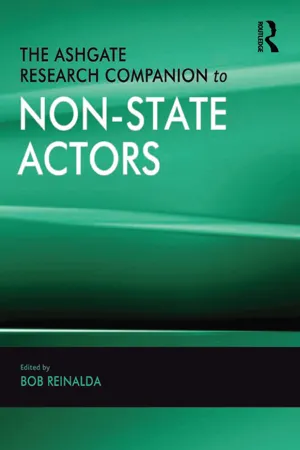
The Ashgate Research Companion to Non-State Actors
About this book
How do non-state actors matter in international relations? This volume recognizes three types of non-state actor: non-governmental organizations (NGOs), intergovernmental organizations (IGOs) and transnational corporations. It illustrates how they play roles alongside nation-states and are interrelated in matters of international regulation and coordination. After an introductory part on current qualitative and quantitative sources, this comprehensive collection of state-of-the-art essays is comprised of four main thematic parts: Part II examines actors other than governments, such as transnational religious actors, business representatives and experts, and also parliamentarians and agencies set up by IGOs. Part III studies the perceptions and understandings in political philosophy, international law and international relations theory. It questions concepts used (civil society, NGO, governance) and covers the limitations to be kept in mind. Part IV analyses the nature and impact of non-state actors. Chapters discuss processes within international bureaucracies (diplomacy, dynamism, bureaucratic power, contribution to democracy) and the quintessence of deliberation and decision making within NGOs and IGOs and of implementation, accountability and dispute settlement. Part V studies specific worlds of non-state actors: humanitarian aid, human rights, security, the North-South divide, health, trade and environment. Accessible and articulately written, The Ashgate Research Companion to Non-State Actors is aimed at a wide readership of scholars and practitioners in international relations.
Information
INTRODUCTION AND SOURCES
1
Non-State Actors in the International System of States
Bob Reinalda
This volume recognizes three types of non-state actor: non-governmental organizations (NGOs), intergovernmental organizations (IGOs) and transnational corporations (TNCs), which all play roles alongside nation-states (represented by governments) and which are interrelated in matters of international regulation and coordination. Although IGOs are created and controlled by states, their role and status have developed beyond that of being their ‘agents’. Having an agency of its own may result from the activities and authority of the IGO’s secretariat and the roles within the organization played by representatives of NGOs and private business as well as experts. After an overview of this volume, the remainder of this chapter puts the three types of non-state actor in a long-term time perspective by tracing their origin, evolution and interplay as parts of what international relations scholars call the international system of states. It looks upon the territorial state as a historical process, in which non-state actors have achieved their place as well, even if nation-states remain internationally dominant actors.
This Volume
This volume consists of five parts – introduction and sources; actors other than governments; perceptions and understanding; nature and impact; and separate worlds – with state-of-the-art articles about various aspects of non-state actors in the international system.1
The first part reveals three useful current sources: the Yearbook of International Organizations, the Palgrave Dictionary of Transnational History and the United Nations (UN) Intellectual History Project. Elizabeth Bloodgood in Chapter 2 raises awareness of the growing areas of quantitative analysis and the various data sources available, with the Yearbook as the most prominent quantitative source on IGOs and NGOs. She also discusses older and recent research based on these sources. Chapter 3 by Thomas Davies provides an introduction to the emerging discipline of transnational history with reference to the Palgrave Dictionary, which contains entries on transnational actors, processes and ideas. As illustration he uses the example of the historical study of peace activism. Chapter 4 by Francis Baert gives a critical assessment of the UN Intellectual History Project, which studied how ideas spread across time and space in 15 monographs, in order to get a better understanding of the role of the UN as both an object and a subject of the diffusion of ideas such as ‘global solidarity’, ‘environmental sustainability’ and ‘human development’.
The second part examines some actors other than governments. Chapter 5 by John Madeley and Jeffrey Haynes discusses various Christian and Islamic religious actors. These are an international NGO (the World Council of Churches), an IGO (the Organization of the Islamic Conference), a church that claims universal authority and is located in a city state which participates in international forums (the Roman Catholic Church in Vatican City) and a loose network of groups of militants who reject the values, norms and rules of the existing international order and that is commonly referred to as a terrorist organization (al-Qaeda). Chapter 6 by Karsten Ronit goes into the regulation of TNCs at international level and the ways in which TNCs influence intergovernmental policy making, often with business interest associations as their key vehicles rather than as single TNCs. These business associations are NGOs, despite the fact that they represent profit-driven actors. In Chapter 7 Angela Wigger focuses on the specific role of legal and economic experts in the field of competition policy, linking the role of experts to the structure-agency debate in international relations theory from a neo-Gramscian perspective. In Chapter 8 Andrés Malamud and Stelios Stavridis analyse the international roles of parliamentarians, such as parliamentary diplomacy (mainly focused on conflict prevention and peace building) and the empowerment of representative bodies of regional IGOs, in which governments meet a different type of actor who contributes to the functioning and legitimacy of these regional organizations. Chapter 9 by Martijn Groenleer examines the emergence of European Union (EU) agencies which are not established by an agreement among member states (generally referred to by the Yearbook of International Organizations as emanations, a relatively large but barely studied category of international organizations), but which manage their own affairs to various extents and play a key role in linking different levels of, in this case, regional governance.
The third part discusses various perceptions and understandings of non-state actors. A first group of chapters includes perceptions in liberal political philosophy, international law and international relations theory. In Chapter 10 Geoff Gordon and Roland Pierik provide an overview of liberal theories of political philosophy, with the work of philosophers such as John Locke, Immanuel Kant, Jürgen Habermas and John Rawls underscoring the enduring role of private actors in the national and international public spheres. In Chapter 11 Anna-Karin Lindblom focuses on the status of NGOs in international law (definition, rights, obligations, roles before international courts and tribunals), but she also touches on rules, cases and practices concerning the individual, TNCs and IGOs in international relations. The development of the role and status of IGOs in international law illustrates how international law has adapted to actors other than states (the only actors enjoying the full range of rights and obligations under international law) and gradually has begun to embrace them. In Chapter 12 Joel Oestreich places the study of IGOs in the wider context of international relations theory, by asking why and how IGOs ‘matter’ in world politics. He maps the general inattentiveness to IGOs and carefully investigates the main paradigms: IGOs exist in realism but lack any moral agency; IGOs facilitate cooperation between states in liberal theories but still remain expressions of state interests; and the actions of an IGO’s staff are taken seriously by constructivism, which allows IGOs more agency than realism and liberalism do because IGOs also shape state identities and their logic of action. Chapter 13 by Rafael Biermann introduces an emerging research programme, which studies the structure and processes of inter-organizational relations (IORs), i.e. the interaction between governmental organizations, IGOs, NGOs and public-private partnerships.
A second group of chapters in this third part on perceptions and understandings deals with concepts and limitations. In Chapter 14 Norbert Götz discusses the buzzwords ‘civil society’ and ‘NGO’, which represent the core of what is commonly associated with non-state actors, as ‘far from unproblematic concepts’. He illustrates this by going into their conceptual history and their actual development during the last 200 years and by reviewing the research literature. In Chapter 15 Martin Koch discusses the meaning and theoretical approaches of ‘global governance’, a rather vague term that meets the absence of a highest authority in the international system of states (‘world government’) and the simultaneous awareness that an increasing number of global problems in many policy areas requires cooperation between different state and non-state actors. He describes the interwoven roles IGOs, NGOs and what he calls ‘expertise organizations’ (holding special knowledge) play and raises the question of the legitimacy of this global governance. In Chapter 16 Dennis Dijkzeul and William DeMars examine the limitations of IGOs and NGOs from the perspectives of international relations theory and management studies. They focus on recent realist, liberal and constructivist accounts of these limitations which promise to transcend the general inattentiveness to international organizations of much of the earlier literature.
A first group of chapters in the fourth part on ‘nature and impact’ focuses on processes within, or related to, international bureaucracies. Chapter 17 by Brian Hocking analyses the emergence of a ‘multistakeholder’ diplomacy, with diplomacy being redefined through the emergence of more complex patterns in which states, IGOs and a broad range of non-state actors (business, NGOs, celebrities) interact within the context of evolving rules and norms of behaviour. He shows how the structures and processes of state-based diplomacy are adapting to change and shifting from hierarchical to network principles. Chapter 18 by Yves Schemeil describes IGOs as cognitive, integrative and innovative organizations when put under stress. To illustrate their dynamism and resilience in a world of persisting state power and rising non-state actors he first discusses the constraints affecting them as bureaucracies in a changing environment and then weighs their assets, abilities and relative endowments against the challenges they face. In Chapter 19 Steffen Bauer and Silke Weinlich describe the main characteristics of international bureaucracies and define them as non-state actors. They review the key theoretical approaches to how to study these bureaucracies, i.e. principal–agent approaches and sociological institutionalism, and provide empirical illustrations in the fields of international environmental governance and security. In Chapter 20 Sabine Saurugger notices a replacement in the EU since the early 2000s of the terms ‘interest groups’ and ‘NGOs’ by the term ‘organized civil society’. While research on interest group participation in the decision-making processes of the EU and its predecessors treated the question of democracy only implicitly, she makes the role of EU citizen participation explicit and reviews existing literature dealing with the potential contribution of interest groups and NGOs to improve the EU’s democratic character.
A second group of chapters in the fourth part on ‘nature and impact’ deals with the phases of agenda setting, deliberation and decision making within NGOs and IGOs. In Chapter 21 Liesbet Heyse opens the black box of NGO decision making by presenting three types of decision-making process (consequential, appropriate and garbage can) and three levels of explanation (individual, intra-organizational and environmental). While most research on NGO decision making has dealt with the first and third levels, her chapter focuses on the intra-organizational level and links the analysis to current discussions about NGO performance and accountability. Chapter 22 by Jutta Joachim takes a closer look at the ways in which NGOs influence the various phases of the policy cycle in the UN (agenda setting, deliberation, decision making and renewed deliberation after receiving the results of monitoring procedures), as well as the ways in which IGOs have an impact on NGOs. Chapter 23 by Yves Beigbeder reviews how member states have perceived the effectiveness of the UN and how the many reform proposals between 1969 and 2007 have added to deliberation and decisions, but have not produced substantial change that is satisfactory to all parties. This debate is unfinished and topical, given the changes taking place in the power relations between various groups of member states.
A third group of chapters in this fourth part on ‘nature and impact’ deals with implementation, accountability and dispute settlement. Chapter 24 by Thomas Conzelmann looks at reporting and peer reviews among states as specific monitoring tools in the implementation of global accords. Despite limitations these tools have become a significant aspect of global governance, in which international bureaucracies and NGOs play roles as well, as is illustrated by the procedures of the World Trade Organization (WTO), the African Union and the Organization for Economic Cooperation and Development. Chapter 25 by Steve Charnovitz explores the concept of accountability of IGOs and NGOs (he offers a unified theory for both) by raising questions such as ‘why accountable?’, ‘to whom?’ and ‘what are the differences between the two kinds of organization?’. He examines how accountability can be measured and discusses the concept of an accountability gap, explaining that organizations that exercise power need more accountability than those that do not. He provides a list of best practices for accountability, discerning between internal accountability mechanisms (to its own governance structure) and external mechanisms (to stakeholders in its environment). Chapter 26 by Eric De Brabandere deals with the increase in legal dispute settlement mechanisms based on international law and the expanding involvement of individuals and corporations in dispute settlement in the areas of human rights and foreign direct investment. As most international legal disputes are still settled through diplomatic rather than legal means, the claim made by international relations theory that the proliferation of dispute settlement mechanisms has resulted in the judicialization of international dispute settlement seems an overestimation, except in the case of international economic and international investment law.
The fifth part then analyses various ‘separate worlds’, in which states and non-state actors have their own patterns of cooperation and disagreement. A first group of chapters discusses the worlds of humanitarian aid, human rights and global security. Chapter 27 by Wolf-Dieter Eberwein explains how the humanitarian system is embedded in an international legal framework which almost all states have subscribed to, with governments and IGOs defining the politics of humanitarian aid and NGOs delivering most of the emergency relief. The chapter reviews the tensions between theory and practice as well as the profound changes that have occurred since the end of the Cold War. Chapter 28 by Anja Mihr explores the developments NGOs have experienced in the human rights world, in which IGOs such as the UN and EU have incorporated and included NGOs in their daily work. She analyses how during the first post-Cold War decade and as an effect of the 11 September 2001 events (9/11) human rights NGOs have moved from being critical watchdogs and advocates to being private partners for governments and IGOs as operational and functional actors. Carolyn Stephenson, who in Chapter 29 discusses the evolution of international security concepts in the UN and regional security systems, shows another trend by analysing how during the post-Cold War era NGO activities related to the UN, despite a restriction on consultative status to economic and social affairs, have widened the areas of focus to include security, often through reframing security issues as human rights issues.
A second group of chapters discusses the North–South divide. Chapter 30 by Moushumi Basu analyses the development aid world as seen from the South, with aid given by non-state actors far exceeding that given by states. However, the fact that IGOs and NGOs are the sources does not mean that aid provided by them is less susceptible to (Northern) national interests. Diana Mitlin in Chapter 31 illuminates the changing approaches and experiences of NGOs working to address the needs and interests of the urban poor over the last 30 years. Building on ideas about civil society from Antonio Gramsci and Manuel Castells, she recognizes three approaches used by NGOs (radical, professional and aligned). The main trends she found are towards greater engagement with a range of stakeholders and working with diverse strategies, with an increasing engagement with the state as a driving force for these changes.
A final group of chapters in the part on separate worlds deals with health, trade and the environment. Peter Hough in Chapter 32 examines the growth and evolution since the mid nineteenth century of IGOs, NGOs and TNCs concerned with global health issues. The World Health Organization remains at the centre of the global health world, as it has developed an independent and global perspective through its epistemic community of experts and serving doctors. Chapter 33 by Dirk De Bièvre and Marcel Hanegraaff discusses the relationship between NGOs and the international trade regime. They found a striking stability in the presence of organized business at WTO Ministerial Conferences and a great fluctuation in coming and going NGOs. Despite environmental issues figuring more prominently on the negotiation agenda, the participation of environmental NGOs has steadily declined over time, while development NGOs have consistently attended meetings in ever growing numbers, even though the importance of development issues on the agenda has declined. Chapter 34 by Lars Gulbrandsen, Steinar Andresen and Jon Birgir Skjærseth argues that the role of NGOs in environmental governance is strongly related to the authority and competence of states. Their three models of rule making (multinational, supranational and transnational) are illustrated by three cases (whaling, emission trading systems and social and environmental certification), which show a declining role for states and an increasing one for NGOs when moving from multinational to supranational and transnational rule making.
The remainder of this chapter discusses the three types of non-state actor as parts of the development of the nation-state.
The Westphalian State in Historical Perspective
From ancient times until the Middle Ages (from around 3500 BC to 1500 AD) various international systems existed around civilizations such as those in China, Egypt or Mesopotamia. The demise of the Roman Empire resulted in Europe in various ‘successor states’ which managed to exist as a patchwork of surviving empires and weak ‘states’ with overlapping and competing authorities (Buzan and Little 2000: 243-5), but also in innovations. The rise of the North Italian city-states in the fifteenth century contributed to modern diplomacy by establishing permanent consular posts, with permanent diplomacy as a European characteristic by the end of the seventeenth century. The Hanseatic League (1265-1669) of Northern European harbour cities was defensive (against common enemies, particularly pirates) as well as cooperative in order to overcome trade barriers. It can be considered a historical prototype of international organization, albeit an isolated phenomenon in its time. International relations scholars a...
Table of contents
- Cover Page
- Half Title page
- Series Page
- Title Page
- Copyright Page
- Contents
- List of Figures and Tables
- List of Contributors
- Part I Introduction and Sources
- Part II Actors Other than Governments
- Part III Perceptions and Understanding
- Part IV Nature and Impact
- Part V Separate Worlds
- Bibliography
- Index
Trusted by 375,005 students
Access to over 1.5 million titles for a fair monthly price.
Study more efficiently using our study tools.
Frequently asked questions
Yes, you can cancel anytime from the Subscription tab in your account settings on the Perlego website. Your subscription will stay active until the end of your current billing period. Learn how to cancel your subscription
No, books cannot be downloaded as external files, such as PDFs, for use outside of Perlego. However, you can download books within the Perlego app for offline reading on mobile or tablet. Learn how to download books offline
Perlego offers two plans: Essential and Complete
- Essential is ideal for learners and professionals who enjoy exploring a wide range of subjects. Access the Essential Library with 800,000+ trusted titles and best-sellers across business, personal growth, and the humanities. Includes unlimited reading time and Standard Read Aloud voice.
- Complete: Perfect for advanced learners and researchers needing full, unrestricted access. Unlock 1.5M+ books across hundreds of subjects, including academic and specialized titles. The Complete Plan also includes advanced features like Premium Read Aloud and Research Assistant.
We are an online textbook subscription service, where you can get access to an entire online library for less than the price of a single book per month. With over 1.5 million books across 990+ topics, we’ve got you covered! Learn about our mission
Look out for the read-aloud symbol on your next book to see if you can listen to it. The read-aloud tool reads text aloud for you, highlighting the text as it is being read. You can pause it, speed it up and slow it down. Learn more about Read Aloud
Yes! You can use the Perlego app on both iOS and Android devices to read anytime, anywhere — even offline. Perfect for commutes or when you’re on the go.
Please note we cannot support devices running on iOS 13 and Android 7 or earlier. Learn more about using the app
Please note we cannot support devices running on iOS 13 and Android 7 or earlier. Learn more about using the app
Yes, you can access The Ashgate Research Companion to Non-State Actors by Bob Reinalda in PDF and/or ePUB format, as well as other popular books in Politics & International Relations & Peace & Global Development. We have over 1.5 million books available in our catalogue for you to explore.