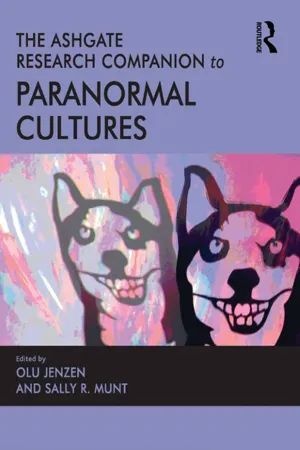
eBook - ePub
The Ashgate Research Companion to Paranormal Cultures
- 492 pages
- English
- ePUB (mobile friendly)
- Available on iOS & Android
eBook - ePub
The Ashgate Research Companion to Paranormal Cultures
About this book
Despite the much vaunted 'end of religion' and the growth of secularism, people are engaging like never before in their own 'spiritualities of life'. Across the West, paranormal belief is on the rise. The Ashgate Research Companion to Paranormal Cultures brings together the work of international scholars across the social sciences and humanities to question how and why people are seeking meaning in the realm of the paranormal, a heretofore subjugated knowledge. With contributions from the UK and other European countries, the USA, Australia and Canada, this ground-breaking book attends to the paranormal as a position from which to critique dominant forms of knowledge production and spirituality. A rich exploration of everyday life practices, textual engagements and discourses relating to the paranormal, as well as the mediation, technology and art of paranormal activity, this book explores themes such as subcultures and mainstreaming, as well as epistemological, methodological, and phenomenological questions, and the role of the paranormal in social change. The Ashgate Research Companion to Paranormal Cultures constitutes an essential resource for those interested in the academic study of cultural engagements with paranormality; it will appeal to scholars of cultural and media studies, popular culture, sociology, cultural geography, literature, film and music.
Information
Part I
Paranormal Epistemologies
What does it mean to talk about epistemologies of the paranormal? It is not surprising that a volume such as this, which explores paranormal culture, is concerned with the nature and scope of knowledge and our understanding of the para normal. Epistemology questions to what extent things can be known, how they are known, and what limits that knowledge. Knowledge is perhaps the a priori fascination of the paranormal, and yet, as the paranormal exists outside of the known limits of space and time, it is, in philosopher Kant’s terms, unknowable. However, as Esther Peeren (this volume), elaborating on Foucault (1997: 181), suggests, the paranormal
can be considered as a discursive practice that forms “groups of objects, enunciations, concepts, or theoretical choices” through which specific forms of knowledge – as savoir rather than connaissance – are generated.
Knowledge rather than know-how, knowledge rather than understanding (savoir versus connaissance), where the paranormal is concerned, suggests that we know more about it than we can understand it. But we would like to understand how to have more knowledge of it, this mystery that we seem to ‘know’.
Jeffrey J. Kripal has defined the paranormal as ‘the sacred in transit from the religious and scientific registers into a parascientific or “science mysticism” register’ (2010: 9). He evokes here how the paranormal is epistemologically paired with science and religion as systems of thought, sharing commonalities yet also serving to demarcate the boundaries of these fields by constituting what lies beyond or exists on the outside. The science/parascience delineation has historically been, and is still, intensely invested in. As a case in point, Mikita Brottman’s (2009) history of the connections between psychoanalysis and the paranormal gives insight into the disciplinary angst this connection caused at a time when psychoanalysis sought to establish itself as a field with scientific credentials. Sigmund Freud had doubts about such integration of psychoanalysis into the realm of science, but for others associating themselves with the field, this was crucial. Brottman notes:
Although, in public, Freud worked hard to keep the boundaries of psychoanalysis distinct from the occult, in private ... he often expressed his beliefs that the occult was inextricable from psychoanalysis, which he believed, in order to be efficient, had to embrace those manifestations of thought and emotion normally excluded from rational, scientific study. (2009: 473–4)
Later in life Freud expressed regret that he had needed to make such epistemological pathway choices – career choices, essentially – and therefore had not explored parapsychology as much as he would have liked to (Brottman 2009). The case of Freud illustrates the tense nature of scientific ‘border control’ and the stakes involved.
In Phantasmagoria, Marina Warner explored how ethereality has been intrinsic to the logic of the imagination, producing great technological innovation, but concomitantly modern media and communications technologies have stimulated an increased ‘fear of soul-theft’ (2006: 380). Warner concurs with Sarah Kember that ‘the subject responds defensively with fantasies of boundary reinforcement, or alternatively, disembodiment’ (1998: viii). And so we find that postmodernity and its accompanying digital technologies have augured the spirit, not abjured it.
In Haunted Media (2000), Jeffrey Sconce explained how telecommunications and electronic media can create unease, producing anxieties that were formerly attached to the world of spirits. ‘Even ghosts require media’, pronounces Martin Harries:
If we recall Marshall McLuhan’s formulation, media are extensions of the self. Small wonder, then, that we talk with ghosts via media: the medium speaks with that thing, the ghost, that exists only in its extensions. So, to revise, ghosts especially require media. The bodiless need extensions to speak. Smaller wonder, then, that ... the language of media and the language of ghosts so often mix. (Harries 2010: 22)
The supernatural, scientific, technological and fantasy discourses continue to commingle and infuse. Think of the early supernatural beliefs that circulated around photography – compare them now with claims for artificial intelligence. The first internet theorists perceived a formal link between the World Wide Web and the paranormal. Seeing in technology a form of spiritual transcendence was a cultural trend observed by ‘cyber guru’ Erik Davis in TechGnosis in 1998: ‘Magic too is a myth but myths shape our machines into meanings’ (1999 [1998]: 189). The following year Margaret Wertheim published The Pearly Gates of Cyberspace (1999), in which she argues that we have created a new immaterial space of being that is of profound psychosocial significance. The invention of the internet offers us parallel identities and existences often paradoxical to our meaty selves: it produces ‘cyber-souls’ that live on, digitally, after our bodies die (see also Pitsillides et al. 2013 and Walter et al. 2011). Andrew Herman and Thomas Swiss noted that the internet was a ‘space of magic’ representing a ‘re-enchantment of the world’:
Magic, for better or for worse, pervades the Web – both as a material and symbolic practice of identity transformation, but also as the mythic representation of this transformation. (Herman and Swiss 2000: 2)
These authors were writing about the form, before the subsequent saturation of the internet by paranormal content that (like sex) bloomed and flourished exponentially, anarchic and eccentric.
In temporal terms, a strict dichotomy between modern science, technology and reason, and medieval magic, myth and spirit is simply unsustainable: queer Austrian philosopher Ludwig Wittgenstein (1922) saw continuities of magic suffusing the language we speak now, arguing that we inhabit a hybrid world consisting of both epochs, thoroughly enmeshed.1 Avery Gordon argued that new times bring new forms of ghosts:
Of one thing I am sure: it’s not that the ghosts don’t exist. The postmodern, late-capitalist, postcolonial world represses and projects its ghosts or phantoms in similar intensities, if not entirely in the same forms, as the older world did. (Gordon 1997: 12, emphasis in original)
Sconce (2000: 192) makes the argument that popular occult fiction precedes ‘contemporary theoretical musings on electronic media and postmodern culture’, an argument that can be extended beyond his specific concern of the media, to include a broader range of epistemological and ontological debates. For example, the acclaimed HBO TV series Carnivàle (2003–2005) introduces a number of overlapping forms of paranormal discourse and features in particular the displaced paranormal, which perhaps epitomises the paranormal in its postmodern form. The travelling carnival at the heart of the story provides a transient, marginal and transgressive space for the figuring of the paranormal. The radical otherness of paranormally gifted characters, such as the hero Ben, who can perform healings and bring people back from the dead, is displaced onto their stage personas as tricksters, quacks, mesmerisers, fortunetellers and magicians. Variably their psychic abilities are dressed up as ‘tricks’ that claim authenticity yet are also enjoyed simply as a spectacle. This tableau provides a smoke screen that camouflages their actual paranormal abilities. By displacing the paranormal, moving in and out of different performances, the series creates a continuum of the paranormal; a staging that works to diffuse otherness and momentarily unmoor the verifying frameworks of real/unreal, authentic/spoof. It is a wilful play on the various discursive frameworks we enlist to produce the paranormal.
We approach the paranormal through forms of knowledge, whether magical, religious, technological, empirical, aesthetic or spiritual and in doing so we seek both knowledge and understanding – savoir and connaissance. For contributors to this volume, engaging with discourses of the paranormal involves looking beyond the intellectual disciplines that have longstanding – albeit fraught – relations to the paranormal. Thinking beyond the natural sciences, psychology and religion, and broadening their perspective to include folklore, arts, entertainment, wellbeing and other ‘creative trajectories that paranormal belief can take’ (Partridge), these authors, in what follows, find ways in which the paranormal can challenge conventional epistemes.
In this volume, our authors consciously and productively move away from antagonistic approaches that tend to presume epistemological oppositions, seeking instead to understand the many different functions of the paranormal in various settings. Of course, there might be other understandings of what epistemological explorations of the paranormal may entail, such as finding paranormal ‘truth’, although this is not directly our concern here. The companion is, however, interested in the cultural work that belief, scepticism or forms of liminality perform in specific social settings.
The notion of paranormal epistemologies could also be taken to pertain to knowledges arrived at through paranormal practices, for example by Art History, as explored in Jennifer Fisher’s chapter (Part III), which considers how a painting might have hidden knowledges woven through it like layers of paint. Christopher Partridge comments that such knowledges are desirable, not least because they are empowering:
experiences of the unseen, endowment with occult gifts, and the gnostic ability to interpret the arcane are empowering ... those who, for a variety of reasons, feel a lack of agency, acquire the ability to construct meaning, to make sense of their world.
Often engagements with the paranormal bring with them challenges to mainstream fields of knowing such as ‘privileged knowledge’ (Partridge), by arriving at different levels and from different perspectives. Most widely discussed is how the paranormal, as Grim suggests, is positioned as a ‘violation of the laws of nature as understood at a particular time’ (2010: 577). In other words, the paranormal ‘carries an indexical reference’ (ibid.) to a body of knowledge that is historically contingent. This idea persistently underpins some thinking on the paranormal: that it is speculative, or knowledge in the making, the dimension of the ‘yet to be understood’ (cf. Randi in Jinks 2011: 3). We may think of this as epistemological liminality, one that both sceptics and non-sceptics have invested in. Similarly, terminology associated with the paranormal, such as pseudo-science, hauntology, the uncanny, the supernatural and the occult, can signify kinds of epistemological liminality. Ghosts, spirits, spectres… contemporary philosophy has been full of such things – in Heidegger, Wittgenstein, Derrida, Levinas, to name but a few. In the main, such writers pose figurative hauntologies, for symbolic ghosts litter the ground of high culture. With the paranormal there is an alluring opportunity to think, as Kripal once stated in an interview, ‘in terms of paradox rather than binary logic’ (Schneider 2011).
Attending to the social and historical particularities of how the paranormal is produced as cultural text, Christopher Partridge points out that specific cultural patterns contextualising contemporary paranormal belief are related to the wider context of the ‘subjective turn’ in Western contemporary society, which
situates the self within a cultural environment shaped by an openness to the possibility of the supernatural, a climate conducive to a growth of interest in the paranormal …
He also alerts readers to the importance of both folklore and popular culture as ‘significant area[s] of enquiry as an agent of contemporary enchantment’, a vein of research that several chapters in this volume address in various ways, by engaging with popular culture leisure pursuits and texts such as TV, novels and online storytelling as well as contemporary formations of folklore through their oral, written and increasingly digital imprint.
It is simply not possible to speak of ‘paranormal belief’ as a singular category (see Bader et al. 2010 and Jinks 2011). Paranormal cultures demonstrate great diversity and discordancy. Research on the multidimensional nature of paranormal belief shows stratified and complex areas of paranormal epistemologies. People believe in different things and the diversity shows quite clearly that with a multitude of disharmonious beliefs comes a multitude of epistemologies. Some of those epistemologies are traced by Andrea Molle and Christopher D. Bader in their discussion of how the paranormal forms part of a global flow of popular cultural influences, as in the case of the impact of US paranormal fictions and leisure on paranormal cultural practices and understandings in Italy. Similar to Hill’s argument of the increasing commercialisation of the paranormal, they argue that the popular paranormal has been packaged into a ‘product’ that can not only ‘be easily experienced by a wide variety of people’ but also exported to other countries, to global consumers. Like John Harvey, they pick up on a democratisation trend within cultures of the paranormal. Both ghosthunting subcultures and cryptozoology have undergone a similar process, which forms part of the packaging of paranormal experiences as widely available, accessible and mediated. Herein lie epistemological changes to how the paranormal is knowable. Following up on how such packaging has enabled an international take-up of US paranormal lore, they trace its rise in Italy. In the case of Italy, they note an epistemological shift from a paranormal that was primarily discursively linked to Catholicism and its historical religious practices, to a paranormal that extensively draws on US popular culture, instigated by the hit TV show The X-Files (1993–2002).
Sceptics contribute greatly to the production of paranormal discourse. William J. Dewan’s anthropological research on a community of sceptics in Albuquerque, New Mexico, USA ‘examine[s] the social role of disbelief and its impact on popular conceptions of the paranormal’. A closer look at sceptical cultures perhaps unsurprisingly reveals struggles over ‘authentic knowledge’. Dewan refers to Morton Klass’s (1995) theorising of a ‘“scientistic religion” that, in contemporary Western societies, stands in opposition to competing approaches to knowledge’ to capture the reformist impulse that impels sceptics’ movements. For example, in his interview material Dewan discerns how science educators are positioned to ‘“rescue” Western culture from the “darkness” of irrationality’.
Freud (1990 [1919]) argued that the uncanny was based on that momentary feeling when what is familiar is made strange. (And also the opposite – realising that what one has categorised as strange in fact is familiar to oneself or even ‘part of’ oneself or one’s world.) These occurrences create terrible uncertainty. Early readers of Mary Shelley’s Frankenstein (1818), confronted with the automaton-cum-human monster, would have reacted so, and we continue to experience the uncanny effects of technology. John Potts and Edward Scheer in Technologies of Magic suggest that technology ‘generates its own doubles and produces its own phantoms’ (2006: xvii). As Justin Sausman says, ‘electrical science generates, rather than destroys, ghostly affects’ (2010: 50): extraordinary electric lamps cast harsh illumination and hard, unnatural shadows; sound recordings disturb with the sense of hearing a singing voice emanating from a wooden box from a person now known to be dead; machines work unaided without human intervention; a disembodied radio or telephonic voice travels through vast invisible spaces without the drag of time. Film and television are particularly haunting: square frames filled with enormous or tiny screen ghosts, plump with colour. We adjust to these splendidly magical technologies as children, rapidly becoming inured to their wonder.
John Harvey’s chapter illustrates through an exploration of the ‘interaction, exchange and transition between spirit and technology’ in photography and audiography how media technologies and the paranormal are intertwined. The epistemology of the photographic image, he demonstrates, draws on perceptions of how the preceding crystal ball and other paranormal paraphernalia functioned. As Sconce (2000) has also discussed in his book on electronic media and the paranormal, popular responses to new media technologies include a rich lore of spiritualist imaginings. ‘The spirits are in and of the camera’, Harvey notes, which means that they have evolved in correlation with technologies. Ever eager to communicate, spirits appear to seek ‘clearer, more fluid and efficient means of information transfer between embodied and disembodied consciousness’. Ubiquitous media technologies of today have, he shows, brought a ‘democratisation of encounter’ and potentially anyone can be a ‘mediator between life and death’.
Paul Cowdell maps the figuring of the ghost as resonating ‘representations of ghosts in popular culture’ but also as multisensory. Ghosts variably take the form of smells, presences, sightings, light, movement, and so on. Drawing on fieldwork into ghost belief, Cowdell notes a ‘widespread dynamism of thought and discussion’ that encompasses both the abstract and the recognisable, the formulaic and atypical, in generic but at the same time highly personal shapes. Cowdell shows that the ‘white-sheeted figure’ of popular culture, although now ascribed a largely comical function, nevertheless continues to operate symbolically as a point of reference in paranormal discourse. He notes that respondents engaged wittingly with ‘existing stereotypes [of apparitions] … whilst using them for their own purposes’ and from this he articulates how signs, such as the white-sheeted ghost, can act as ...
Table of contents
- Cover Page
- Half Title Page
- Title Page
- Copyright Page
- Contents
- List of Figures
- List of Tables
- Dedication
- Notes on Contributors
- Acknowledgements
- Introduction
- Part I Paranormal Epistemologies
- Part II The Paranormal and Social Change
- Part III Paranormal Phenomenologies
- Bibliography
- Index
Trusted by 375,005 students
Access to over 1.5 million titles for a fair monthly price.
Study more efficiently using our study tools.
Frequently asked questions
Yes, you can cancel anytime from the Subscription tab in your account settings on the Perlego website. Your subscription will stay active until the end of your current billing period. Learn how to cancel your subscription
No, books cannot be downloaded as external files, such as PDFs, for use outside of Perlego. However, you can download books within the Perlego app for offline reading on mobile or tablet. Learn how to download books offline
Perlego offers two plans: Essential and Complete
- Essential is ideal for learners and professionals who enjoy exploring a wide range of subjects. Access the Essential Library with 800,000+ trusted titles and best-sellers across business, personal growth, and the humanities. Includes unlimited reading time and Standard Read Aloud voice.
- Complete: Perfect for advanced learners and researchers needing full, unrestricted access. Unlock 1.5M+ books across hundreds of subjects, including academic and specialized titles. The Complete Plan also includes advanced features like Premium Read Aloud and Research Assistant.
We are an online textbook subscription service, where you can get access to an entire online library for less than the price of a single book per month. With over 1.5 million books across 990+ topics, we’ve got you covered! Learn about our mission
Look out for the read-aloud symbol on your next book to see if you can listen to it. The read-aloud tool reads text aloud for you, highlighting the text as it is being read. You can pause it, speed it up and slow it down. Learn more about Read Aloud
Yes! You can use the Perlego app on both iOS and Android devices to read anytime, anywhere — even offline. Perfect for commutes or when you’re on the go.
Please note we cannot support devices running on iOS 13 and Android 7 or earlier. Learn more about using the app
Please note we cannot support devices running on iOS 13 and Android 7 or earlier. Learn more about using the app
Yes, you can access The Ashgate Research Companion to Paranormal Cultures by Olu Jenzen, Sally R. Munt, Olu Jenzen,Sally R. Munt in PDF and/or ePUB format, as well as other popular books in Social Sciences & Cultural & Social Anthropology. We have over 1.5 million books available in our catalogue for you to explore.