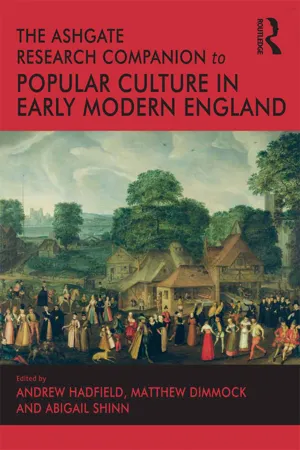
The Ashgate Research Companion to Popular Culture in Early Modern England is a comprehensive, interdisciplinary examination of current research on popular culture in the early modern era. For the first time a detailed yet wide-ranging consideration of the breadth and scope of early modern popular culture in England is collected in one volume, highlighting the interplay of 'low' and 'high' modes of cultural production (while also questioning the validity of such terminology). The authors examine how popular culture impacted upon people's everyday lives during the period, helping to define how individuals and groups experienced the world. Issues as disparate as popular reading cultures, games, food and drink, time, textiles, religious belief and superstition, and the function of festivals and rituals are discussed. This research companion will be an essential resource for scholars and students of early modern history and culture.
eBook - ePub
The Ashgate Research Companion to Popular Culture in Early Modern England
- 400 pages
- English
- ePUB (mobile friendly)
- Available on iOS & Android
eBook - ePub
The Ashgate Research Companion to Popular Culture in Early Modern England
About this book
Information
Key Issues
1
Recovering Speech Acts
In the beginning was the word – that is, the spoken word. In the early modern period, anyone with even the most basic familiarity with the Bible knew that the world had been brought into being by an act of speech: ‘God said, Let there be light: and there was light’ (Genesis 1:3). In one of the most famous textual emendations of the Renaissance, Erasmus had translated the Greek word logos (John 1:1) into Latin as ‘sermo’ rather than ‘verbum’ in order to emphasise that the divine Word was a spoken utterance, not merely a tacit concept in the mind of God.1 Even the written word of scripture was perceived in oral terms as a form of divine speech: thus John Donne could declare in a sermon that ‘the Scriptures are God’s Voyce; the Church is his Eccho; a redoubling, a repeating of some particular syllables, and accents of the same voice’.2 In that sense God’s sermo, his original speech act, had never died away but was constantly repeated whenever the scriptures were read or preached.
At its intellectual heart, therefore, early modern culture was an oral culture. This had repercussions well beyond theology. To early modern political theorists, it was speech that distinguished man from the animals and made human society possible. Man was a social creature, wrote the Dutch philosopher Hugo Grotius, and it was to gratify this innate desire for society that ‘he alone among animals possesses a special instrument, speech’ (sermo, the same word that Erasmus had used).3 Thomas Hobbes extolled speech as:
the most noble and profitable invention of all other … whereby men register their Thoughts; recall them when they are past; and also declare them one to another for mutuall utility and conversation; without which, there had been amongst men, neither Common-wealth, nor Society, nor Contract, nor Peace, no more than amongst Lyons, Bears, and Wolves.4
All social and political relationships were, fundamentally, speech relationships, forming what was called ‘civil conversation’ (the term ‘conversation’ in this period having a broader application than it does today, referring not just to verbal exchanges but to the whole sphere of social interaction and behaviour), and could again be seen as echoes of God’s original speech act, as Hobbes made clear in the opening pages of Leviathan when he likened the pacts and covenants that comprised the body politic to ‘that Fiat, or the Let us make man, pronounced by God in the Creation’.5
We are still profoundly, if unconsciously, influenced by these ideas: for example, we tend to assume that speech is primary, writing secondary (this, famously, being one of the ‘phonocentric’ or ‘logocentric’ assumptions that Derrida sought to deconstruct). At the same time we no longer live in such an intensely speech-dominated world, and the early modern tendency to think of the world in oral terms, or through oral metaphors, no longer comes so naturally to us. It is telling that Grotius’s Victorian editor William Whewell translated ‘sermo’ as ‘language’, missing the particular emphasis on spoken language.6 In short, we think of language where the early modern period thought of speech: and there is now a substantial body of scholarship which seeks to explain how the spoken word, heard with the ear rather than read with the eye, lost its distinctive place in the early modern sensorium. This profound cultural change, conveniently symbolised by the invention of printing and the spread of literacy, was expounded by Marshall McLuhan in The Gutenberg Galaxy (1962) and, less oracularly, by McLuhan’s pupil Walter Ong in Orality and Literacy (1982).7 Briefly put, Ong’s argument was that ‘writing restructures consciousness’ by transferring speech from the oral/aural into the new sensory world of vision. Oral discourse requires the presence of a speaker and a listener, whereas written words can be detached from their context. Speech unites people in groups, whereas reading and writing are solitary and introspective activities. Oral recitation is capable of endless variation and enlargement, whereas written texts are stable and permanent, fixed in visual space and giving the impression (or illusion) of closure and completeness.
It is hard to tell this story of the transition from orality to literacy except as a story of loss and absence. For the cultural theorist Michel de Certeau it was a story of the death of God, experienced as the inability to hear God’s voice speaking in the Scriptures:
Before the ‘modern’ period, that is, until the sixteenth or seventeenth century, this writing (Holy Scripture) speaks. The sacred text is a voice … For reasons analyzed elsewhere, the modern age is formed by discovering little by little that this Spoken Word is no longer heard … The voice that today we consider altered or extinguished is above all that great cosmological Spoken Word that we notice no longer reaches us: it does not cross the centuries separating us from it. There is a disappearance of the places established by a spoken word, a loss of the identities that people believed they received from a spoken word.8
The study of the past thus becomes an act of aural recovery, summed up in Stephen Greenblatt’s ringing declaration: ‘I began with the desire to speak with the dead.’9 This has particular resonance for the study of popular culture, because of the way that the world of ‘the people’ has so often been associated with oral culture and tradition, in contrast to the literate culture of the élite. From the nineteenth-century antiquarians who sought to salvage a disappearing tradition of folksongs and folktales to the twentieth-century historians who sought to write ‘history from below’ by recovering the silenced voices of ordinary people, much of the impetus for the study of popular culture has come from a powerful sense of the world we have lost.
Yet the cultural divide between orality and literacy no longer commands universal assent. The idea of the ‘great divide’ may be applicable to oral cultures encountering written texts for the first time, but makes less sense when applied to early modern societies where orality and literacy co-existed. It cannot easily accommodate the practice of reading aloud, a crucial means for the illiterate to gain access to written and printed texts but one which, as Joyce Coleman points out, has tended to be neglected because it occupies a ‘historical and conceptual middle space’ between the two poles of orality and literacy.10 Ong is careful to qualify suggestions of a ‘great divide’ by stressing that the transition from orality to literacy was a gradual process occurring over centuries, but there is a deep-seated problem with his characterisation of the oral elements of early modern rhetoric and prose style as an ‘oral residue’ carried over into an otherwise literate culture. Oral and literate culture were so inseparably joined together in this period that it makes little sense to think of one as a diminishing residue inside the other. In many respects oral culture was actually strengthened by literate culture, as in the case of ballad-singing, which seems to have been reinvigorated in the later sixteenth century by the wider circulation of written and printed ballad texts. The still more schematic idea that an ‘age of the ear’ gave way to an ‘age of the eye’ has been challenged by numerous studies showing the continuing importance of the spoken word and suggesting, as Daniel Woolf has argued, that early modern culture was perfectly capable of maintaining a ‘perceptual equilibrium’ between sight and hearing.11 Indeed, many contemporaries rated hearing as the more discriminating of the two senses: early modern playwrights, for example, preferred to think of themselves as writing for an educated ‘audience’ rather than mere ‘spectators’.12
It was not uncommon in early modern England for social differences to be expressed in terms of speech differences: witness the distinction drawn by William Harrison in his Description of England between the ‘great silence’ at the tables of the gentry and the ‘babbling’ among their social inferiors.13 Reconstructing the evidence of popular speech can therefore be a helpful way to approach the concept of popular culture. In order to make sense of this evidence, however, we need to abandon the binary opposition between the old (pre-modern) world of orality and the new (modern) world of literacy. It is perfectly true that by the early modern period, the written and printed word had penetrated to every level of English society, so that it is virtually impossible to identify a pure oral tradition untouched by print. But this does not mean that the spoken word was in irreversible decline. The most extensive and authoritative treatment of the subject has concluded that oral and literate culture were joined together in a dynamic and reciprocal relationship, ‘each feeding in and out of the other to the development and nourishment of both’.14 This requires us to think about oral culture in a radically different way. What might a history of oral culture and popular speech look like if we rid ourselves of the pervasive influence of the world we have lost, and stopped thinking of the spoken word as a faint echo that can only be recovered by reading between the lines of the written sources? This chapter is an attempt to answer that question.
Studying the Oral through the Written
‘How does one study speech acts some two to four hundred years after the event?’ asks Peter Burke, rightly describing this as a somewhat presumptuous task. ‘It is clear that historians with this kind of interest must resign themselves not only to studying the oral through the written, but also to investigating the language of ordinary people via records made, for the most part, by members of the cultural élite.’15 As Burke points out, this is a particular problem for historians of popular culture, because of the partial and selective reporting of popular speech in written and printed sources. But it is a problem that confronts historians in studying any text that purports to be a transcript of the spoken word. In many cases there are grounds for suspecting that the text has either been garbled in transmission (as in the case of the ‘bad quartos’ of Shakespeare, widely thought to have been reconstructed from memory) or been revised for scribal or print publication, and in either case may be very different from what was originally said. In any case there are aspects of oral delivery such as gesture and tone of voice (actio and pronunciatio in early modern rhetoric) that simply cannot be captured in a written transcript.
The records of the early Stuart Parliaments are a case in point. These are fuller and more detailed than the records of any other representative assembly before the late eighteenth century. MPs knew they were discussing issues of major political and constitutional importance, and took pains to keep a careful record, with the result that the official Commons Journal can be supplemented by a large number of private diaries kept by individual members. We should therefore be in a very good position to reconstruct what was said in the course of debate. In practice, however, these different accounts ...
Table of contents
- Cover Page
- Title Page
- Copyright Page
- Contents
- List of Figures
- Notes on Contributors
- Acknowledgements
- Introduction: Thinking About Popular Culture In Early Modern England
- Part I: Key Issues
- Part II: Everyday Life
- Part III: The Experience of the World
- Index
Trusted by 375,005 students
Access to over 1.5 million titles for a fair monthly price.
Study more efficiently using our study tools.
Frequently asked questions
Yes, you can cancel anytime from the Subscription tab in your account settings on the Perlego website. Your subscription will stay active until the end of your current billing period. Learn how to cancel your subscription
No, books cannot be downloaded as external files, such as PDFs, for use outside of Perlego. However, you can download books within the Perlego app for offline reading on mobile or tablet. Learn how to download books offline
Perlego offers two plans: Essential and Complete
- Essential is ideal for learners and professionals who enjoy exploring a wide range of subjects. Access the Essential Library with 800,000+ trusted titles and best-sellers across business, personal growth, and the humanities. Includes unlimited reading time and Standard Read Aloud voice.
- Complete: Perfect for advanced learners and researchers needing full, unrestricted access. Unlock 1.5M+ books across hundreds of subjects, including academic and specialized titles. The Complete Plan also includes advanced features like Premium Read Aloud and Research Assistant.
We are an online textbook subscription service, where you can get access to an entire online library for less than the price of a single book per month. With over 1.5 million books across 990+ topics, we’ve got you covered! Learn about our mission
Look out for the read-aloud symbol on your next book to see if you can listen to it. The read-aloud tool reads text aloud for you, highlighting the text as it is being read. You can pause it, speed it up and slow it down. Learn more about Read Aloud
Yes! You can use the Perlego app on both iOS and Android devices to read anytime, anywhere — even offline. Perfect for commutes or when you’re on the go.
Please note we cannot support devices running on iOS 13 and Android 7 or earlier. Learn more about using the app
Please note we cannot support devices running on iOS 13 and Android 7 or earlier. Learn more about using the app
Yes, you can access The Ashgate Research Companion to Popular Culture in Early Modern England by Andrew Hadfield,Matthew Dimmock,Abigail Shinn in PDF and/or ePUB format, as well as other popular books in Historia & Historia británica. We have over 1.5 million books available in our catalogue for you to explore.