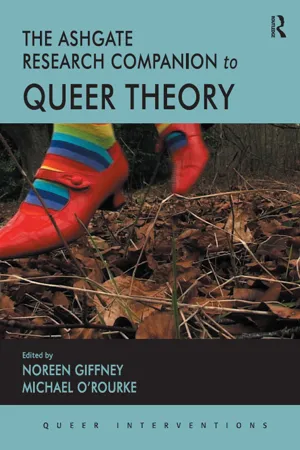
This interdisciplinary volume of thirty original essays engages with four key concerns of queer theoretical work - identity, discourse, normativity and relationality. The terms 'queer' and 'theory' are put under interrogation by a combination of distinguished and emerging scholars from a wide range of international locations, in an effort to map the relations and disjunctions between them. These contributors are especially attendant to the many theoretical discourses intersecting with queer theory, including feminist theory, LGBT studies, postcolonial theory, psychoanalysis, disability studies, Marxism, poststructuralism, critical race studies and posthumanism, to name a few. This Companion provides an up to the minute snapshot of queer scholarship from the past two decades and identifies many current directions queer theorizing is taking, while also signposting several fruitful avenues for future research. This book is both an invaluable and authoritative resource for scholars and an indispensable teaching tool for use in the classroom.
eBook - ePub
The Ashgate Research Companion to Queer Theory
- 558 pages
- English
- ePUB (mobile friendly)
- Available on iOS & Android
eBook - ePub
The Ashgate Research Companion to Queer Theory
About this book
Information
Part I Identity
1 On Being Post-Normal: Heterosexuality after Queer Theory
DOI: 10.4324/9781315613482-2
Unwelcome Excesses
You probably already know the story: in the early 1990s, academic and activist lesbian and gay studies had become co-implicated with (or, some would say, co-opted by) poststructuralist analysis and radical social constructionism; ‘identity politics’ takes it on the chin; the word ‘queer’, which has ‘torque’ and ‘twist’ in its etymological background, is itself torqued and twisted, promoted from slur to affirmation, productively reworked into a transitive, transformative verb, and the infinitive phrase ‘to queer’ emerges to take on a newly performative ‘labor of ambiguating categories of identity’ (Berlant and Warner 1995, 345). Thus ‘queer’ gets queered into ‘theory’.
But in what ways could ‘theory’ itself – as a disparate set of denaturalising, defamiliarising, or otherwise identity-disturbing discourses loosely gathered into a general ‘project of creative abrasion’ (Hall 2003, 71) – be considered queer or queering? Was ‘theory’ itself already implicitly queer, desedimenting – ‘recurrent, eddying, troublant … relational and strange’ (Sedgwick 1993a, xii) – even before being explicitly queered by queer theory? Was ‘theory itself’ already not exactly itself, not exactly identical with itself, even before ‘queer’ – taken as ‘an identity category that has no interest in consolidating or even stabilising itself’, taken as ‘less an identity than a critique of identity’, taken as ‘a site of permanent becoming: utopic in its negativity … curv[ing] endlessly toward a realisation that its realisation remains impossible’ (Jagose 1996, 131; Edelman 1995, 345) – brought out the specifically sexual dimensions of theory’s anti-identitarian tendencies? In terms of their mutual hostility to identity, their joint strategies of de-naturalisation, their persistent ‘questionings and abrasions of normality’ (Hall 2003, 54), could ‘theorising’ and ‘queering’ not be considered roughly analogous or coaxial activities? So that ‘the challenge of queer theorisation … [would be] to return to those “sites of becoming”, and more importantly unbecoming, wherein identity is temporarily constructed, solidified, and then threatened or rendered inadequate in its explanatory power’ (Hall 2003, 109)?
If your answer to this thick swarm of questions is even a provisional ‘well, yes, maybe … sort of’, then another, perhaps more pesky query may light upon you: to wit, can simply reading (queer) theory turn a reader who isn’t lesbian, gay, bisexual or transgendered into some ‘sort of’ a ‘queer’? Assuming the possibility of juicing up the erotic acts of reading and writing with a sufficient charge of creatively abrasive energy, can merely reading (queerly written) theory – as opposed to actually f***ing ‘queerly’ – transform or provoke an otherwise heterosexual or ‘straight’ subject, who has never come with, into, onto or even in the vicinity of a person of his or her own sex, into becoming what Eve Sedgwick might call one of ‘those other people who vibrate to the chord of queer without having much same-sex eroticism’ (1993b, 13)? Can the jouissance of reading theory itself, by itself, beside itself, catch the otherwise straight reader up in what Sedgwick calls ‘the open mesh of possibilities, gaps, overlaps, dissonances and resonances, lapses and excesses of meaning where the constituent elements of anyone’s gender, of anyone’s sexuality aren’t made (or can’t be made) to signify monolithically’ (1993a, 8)?1 And has theory not performed this miraculous excess of meaning by virally spreading the good news that no one’s sexuality or gender can be made to signify monolithically because signification itself cannot be monolithically made, because signification itself is never exactly itself – thanks to what Jacques Derrida calls the ‘non-self-identity’ (1978, 297) of the sign, the irreducible difference between the sign and the referent, the word and the thing – and because of the radical unavailability of any such ‘thing’ as sexuality or gender or selfhood outside of signification, the constitutive failure of any such supports as centre, nature or essence at all?2
In my own work I have attempted, admittedly without much success, to bring these queries to bear on the question of how and why a ‘straight intellectual’, thinly disguised as myself, might engage with, relate to or otherwise end up (upended) in queer theory (Thomas 2000; 2002; 2008). I will attempt to address that question again here, again without much hope of success, without even a clue as to what ‘success’ in regard to this topic – the essence-free but norm-laden identity of something like the ‘straight queer’, the straight queered in and by theory, a figure at once ‘at odds’ and inevitably ‘at evens’ with the normal – could possibly mean. For what could critical ‘success’ amount to here, given, on the one hand, the inadequate explanatory power of even an oppositional identity (at, one hoped, politically useful, anti-homophobic odds), and, on the other, the very real possibility that any attempt to subversively resignify the figure of the straight (as) queer will only reinscribe and reinforce the very ‘regimes of the normal’ (Warner 1993, xxvi) that the resignified straight had aspired to join ‘really queer’ queers in resisting (back again at seemingly futile evens)?3 And yet, even with the odds so heavily against ever finally fatally dislevelling the even plane of straight regimentation, much less one’s own apparently undisownable place of privilege within it, this straight will continue, here, again, along these recursive lines, perhaps utopically, certainly negatively, realising only the impossibility of realisation, hoping this time not to succeed but, in Samuel Beckett’s worstward words, only to ‘fail again’, though perhaps this time to ‘fail better’ (1983, 7).
For, shameful truth be told, I am actually far less interested in participating in the ‘success’ of meaning than I am in proliferating its dissonant resonances, its abject lapses and excess, its figurative abortion. And given this preference – an oddly sexual preference – kindly allow me to describe an odd (and perhaps also oddly sexual) thing that happened recently when I was reading Annette Schlichter’s essay ‘Queer At Last? Straight Intellectuals and the Desire for Transgression’, which critiques my own less than successful efforts at becoming uneven. At one adumbrating juncture in this essay, before pointing out the ‘insufficiency’ of my ‘textual performance of twisted straightness’ (2004, 553), Schlichter refers to ‘the specter of the queer heterosexual (especially in its male version) as an indication of the queer project’s perversion [sic] of social and political identities and their relations to power’ (2004, 547). Schlichter cites Suzanna Danuta Walters, who ‘reads the straight male sexual radical affiliated with queer discourse as a symptom of “the problematic implication of a queer theory dissociated from a gay and lesbian identity”‘ and who thinks that the ‘“deconstruction of identity politics … might have some merit, but it can also, in the world of academia as well as in other social spaces, become the vehicle for co-optation: the radical queer theorist as married heterosexual”’ (Walters 1996, 842, cited in Schlichter 2004, 547). Schlichter then cites Teresa de Lauretis, who ‘mockingly evokes the straight queer to describe the unwelcome excesses of a postmodern critical project’ (2004, 547, emphasis added). Here’s De Lauretis (who first coined the term ‘queer theory’ in the feminist journal differences in 1991 and then denounced it in the same journal three years later as ‘a conceptually vacuous creature of the publishing industry’ [De Lauretis 1994, 297]):
The discourse on sexuality has moved from the impossibility of a feminine identity theorised by feminists since the late 1970s, to the alleged ‘subversion’ of gender identity in queer/lesbian studies, to the literal becoming-male of lesbian PoMo. An announced collection of essays on ‘queer theory and the subject of heterosexuality’ declares itself ‘straight with a twist’. Who knows, by next year’s [1995] MLA, we may be reading something like ‘Lesbian Heterosexuality: The Last Frontier’. (De Lauretis 1997, 47, cited in Schlichter 2004, 547)
Never mind for the moment the ‘contempt-prior-to-investigation’ that animates dismissing an intellectual endeavour for its title rather than for its then yet to be published content (I suppose that once you’ve decided in advance on the conceptual vacuity of a creature still slouching to be born there’s no need to delay judgement upon reading). And never mind the hindsight that the editor of the announced collection (yours untruly) would have been wise to place a cautious question-mark at the end of the first part of its title to indicate the intended interrogative possibility rather than the perceived flat declaration. No, the odd thing, the funny thing – maybe the queer thing, maybe not (who am I to say?) – occurred when I beheld the words unwelcome excesses in Schlichter’s lead-in to De Lauretis and realised that I am not only more interested in excess than ‘success’: I am also, perhaps perversely, more invested in excess than I am in being welcomed.4
Brief History of a Faint Spectre
My own perverse cathexes notwithstanding, note that in the history of queer theory the unwelcome ‘specter of the queer heterosexual’ sprang up, at least as a conjectural figure, pretty much from the get-go – that is, at the very historical moment when queer theory first began to dissociate itself from lesbian and gay identity politics. Having noted that De Lauretis first high-profiled the term ‘queer theory’ in 1991, we can also acknowledge the somewhat lower-profiled circulation in London in the same year of an anonymously authored pamphlet called ‘Queer Power No’, which declares that ‘Queer means to f*** with gender. There are straight queers, bi-queers, tranny queers, lez queers, fag queers, SM queers, fisting queers’ (cited in Sullivan 2003, 44). In 1992, San Francisco Queer Nation activist Karl Knapper opines that ‘queerness is about acknowledging and celebrating difference, embracing what sets you apart. A straight person can’t be gay, but a straight person can be queer’ (cited in Kauffmann 1992, 20). In 1993, Eve Sedgwick, ‘herself a straight writer of queer scholarship’ (Schlichter 2004, 548) publishes Tendencies, from which I have already quoted. Also in 1993, in Making Things Perfectly Queer, Alexander Doty mentions ‘cases of straight queerness, and of other forms of queerness that might not be contained within existing categories’ (1993, xvii). In (again) 1993, Judith Butler brings out Bodies That Matter, which in the chapter called ‘Critically Queer’ offers the phrasing that first (or ‘at last’) activated my own impulse toward ‘straight-queer’ affiliation: here Butler writes of the word ‘queer’ as a ‘discursive rallying point’ for a number of socio-political sexual subjects, including, last and least, ‘straights for whom the term expresses an affiliation with antihomophobic politics’ (1993, 230).
Still again in 1993 (it was a very queer year), Michael Warner, introducing Fear of a Queer Planet, writes that ‘The preference for “queer” represents, among other things, an aggressive impulse of generalisation; it rejects a minoritising logic of toleration or simple political interest-representation in favour of a more thorough resistance to regimes of the normal’ (1993 xxvi). In their 1998 essay ‘Sex in Public’, Lauren Berlant joins Warner to suggest that some varieties of heteroerotics may resist normative regimentation. The authors distinguish, that is, between, on the one hand, heterosexuality as a loosely lubricated set of interactions among bodies and pleasures and, on the other, and more dryly, heteronormativity as ‘the institution, structures of understanding, and practical orientations that make heterosexuality not only coherent – that is, organised as a sexuality – but also privileged’. If heteronormativity thus defined is ‘a concept distinct from heterosexuality’, then some ‘forms of sex between men and women might not be heteronormative’ (1998, 565 n. 2). In a somewhat similar vein, Leo Bersani, in his 1995 book Homos, writes not of queerness but of what he calls ‘homo-ness’ as an ‘anti-identitarian identity’ (1995, 101) and as ‘a mode of connectedness to the world that it would be absurd to reduce to sexual preference’ (1995, 10). Though Bersani considers homosexuality to be a ‘privileged vehicle’ for homo-ness, he considers the latter to be ‘relevant to love between the sexes’ (1995, 147), involving a ‘mobility’ that ‘should create a kind of community … that can never be settled, whose membership is always shifting … a community in which many straights should be able to find a place’ (1995, 9).
In the essay ‘Straight with a Twist’ (first published in Genders in 1997) I suggest as provisional participants in this shifting community the non-breeding or child-free heterosexual married couple who conscientiously object not to children as such but rather to what Lee Edelman, in No Future, calls the ideological figure of ‘the Child’. For...
Table of contents
- Cover Page
- Halftitle Page
- Series Page
- Title Page
- Copyright Page
- Table of Contents
- Dedication
- List of Contributors
- Acknowledgements
- Introduction: The ‘q’ Word
- PART I IDENTITY
- PART II DISCOURSE
- PART III NORMATIVITY
- PART IV RELATIONALITY
- Index
Trusted by 375,005 students
Access to over 1.5 million titles for a fair monthly price.
Study more efficiently using our study tools.
Frequently asked questions
Yes, you can cancel anytime from the Subscription tab in your account settings on the Perlego website. Your subscription will stay active until the end of your current billing period. Learn how to cancel your subscription
No, books cannot be downloaded as external files, such as PDFs, for use outside of Perlego. However, you can download books within the Perlego app for offline reading on mobile or tablet. Learn how to download books offline
Perlego offers two plans: Essential and Complete
- Essential is ideal for learners and professionals who enjoy exploring a wide range of subjects. Access the Essential Library with 800,000+ trusted titles and best-sellers across business, personal growth, and the humanities. Includes unlimited reading time and Standard Read Aloud voice.
- Complete: Perfect for advanced learners and researchers needing full, unrestricted access. Unlock 1.5M+ books across hundreds of subjects, including academic and specialized titles. The Complete Plan also includes advanced features like Premium Read Aloud and Research Assistant.
We are an online textbook subscription service, where you can get access to an entire online library for less than the price of a single book per month. With over 1.5 million books across 990+ topics, we’ve got you covered! Learn about our mission
Look out for the read-aloud symbol on your next book to see if you can listen to it. The read-aloud tool reads text aloud for you, highlighting the text as it is being read. You can pause it, speed it up and slow it down. Learn more about Read Aloud
Yes! You can use the Perlego app on both iOS and Android devices to read anytime, anywhere — even offline. Perfect for commutes or when you’re on the go.
Please note we cannot support devices running on iOS 13 and Android 7 or earlier. Learn more about using the app
Please note we cannot support devices running on iOS 13 and Android 7 or earlier. Learn more about using the app
Yes, you can access The Ashgate Research Companion to Queer Theory by Noreen Giffney, Michael O'Rourke, Noreen Giffney,Michael O'Rourke in PDF and/or ePUB format, as well as other popular books in Social Sciences & Anthropology. We have over 1.5 million books available in our catalogue for you to explore.