- 432 pages
- English
- ePUB (mobile friendly)
- Available on iOS & Android
eBook - ePub
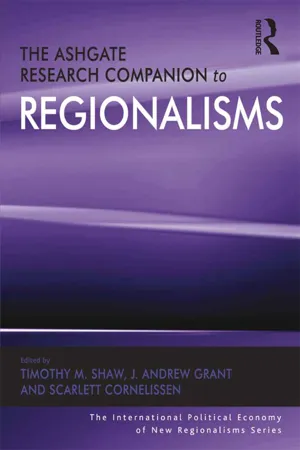
The Ashgate Research Companion to Regionalisms
About this book
EU studies increasingly recognize the salience of new regional insights. Hence, this collection of original essays provides a broad overview of regionalism, together with detailed analyses on the construction, activities, and implications of both established and emerging examples of formal political and economic organizations as well as informal regional entities and networks. Aimed at scholars and students interested in the continuing growth of regionalism, The Ashgate Research Companion to Regionalisms is a key resource to understanding the major debates in the field. Organized into three main sections, this volume deals with a wide range of issues covering the following important research areas: -Section one covers theoretical and methodological approaches to the study of established and formal regionalism, emerging and informal regionalism, inter-regionalism, and levels of regionalism. -Section two provides detailed case-studies of established and formal regionalisms: EU, NAFTA, ASEAN, SAARC, OAS, MERCOSUR, AU, ECOWAS, and SADC. -Section three offers case-studies that investigate emerging and informal regionalisms in Oceania, the Arab League, BRICSAM, and the Commonwealth(s) as well as thought-provoking chapters on micro-regional processes evident in spatial development initiatives, transnational gangs, transfrontier conservation areas, and the migration-conflict nexus in natural resource sectors. With the study of regionalism becoming an increasingly important part of politics, international relations, development, and global studies courses, this comprehensive volume is a valuable addition for classroom use.
Information
1
Introduction and Overview: The Study of New Regionalism(s) at the Start of the Second Decade of the Twenty-First Century
Timothy M. Shaw, J. Andrew Grant, and Scarlett Cornelissen
For a long period the study of regions and regional orders occupied a small if not insignificant place in international relations theory and scholarship. Now we have … books which argue that regions are central to our understanding of world politics. (Acharya 2007, 629)
In the 1980s and 1990s, globalization and internationalization fused, and that fusion manifested itself in the growth of porous regions …. World politics is now shaped by the interaction between porous regions and America’s imperium …. The United States plays the central role in a world of regions. (Katzenstein 2005, 24–5, 42–3)
the plurality of regions … going beyond a state-centred approach involves recognition that other non-state actors also develop regional projects. (Bøås, Marchand, and Shaw 2005, 6)
Introduction
Analyses, as well as the policies and practices of ‘regionalism(s)’, are enjoying a renaissance. A variety of scholars from a diversity of analytical perspectives and existential regions seeks to capture and project heterogeneous forces both advancing and restraining regionalism at the turn of the present decade. This Companion is symptomatic of the development and promise of the burgeoning field, which has been transformed from ‘first-wave’ formal, Eurocentric/European studies in the 1960s and 1970s (Cantori and Spiegel 1970) to comparative, global contrasts in what may be considered a ‘second wave’ (Wunderlich 2007, 4–5) over the last three decades.1 Revisionist laments at the end of the first decade of the new millennium (see Acharya 2007; Acharya and Johnston 2007) now seek to establish a conceptual ‘breakwater’ against the expanding breadth and scope of second-wave analyses.
Söderbaum and Shaw (2003) co-edited an initial Reader on the ‘regionalisms’ field near the start of this decade. Notably, the field has become even more comprehensive and diverse in the intervening eight years with an emphasis on non-state actors (see Deacon et al. 2009; Walker and Thompson 2008; Yeates 2007; Clarke and Jennings 2007), inter-regionalisms (Gaens, Jokela, and Limnell 2009; Gaens 2008; Wunderlich 2007) and micro-regionalisms (Söderbaum and Taylor 2008; Grant 2008). This scholarly development is pushing the boundaries of the regionalisms literature, and represents, arguably, the embryonic stages of a ‘third wave’ in the field.
Yet, as expansive as the field has become and as voluminous the number of studies, it remains beset by rather stark divisions. These are determined by differential approaches as well as divergent scholarly, ontological, and epistemological positions on elemental aspects such as the nature and parameters of ‘regionality’, the relationship between globalisation and regionalism, and the contrasts and significance of the formal and informal sources of regions. Despite a number of recent analyses (discussed below) that have cogently illustrated new regionalism’s promising precepts – drawing our attention to the multiplicity and multilayered character of regions and emphasising the importance of non-state actors and spaces – the main theoretical implications of ‘new’ regionalisms still seem to bypass many contemporary (and conventional) studies of regions (see for example the special issue on regions in Review of International Studies, edited by Fawn 2009). The orthodoxy of the state as the principal builder and shaper (or dismantler) of regions remains central in many of these studies, as reflected in Acharya’s 2007 review article and 2007 co-edited collection with Johnston.
This Companion both provides a state-of-the-art review of regionalisms – old and new – and seeks to transcend the unhelpful analytical schisms that have generally been maintained in regionalism studies as a whole. We advance a new regionalisms agenda, which emphasises the overtly formal as well as informal nature of regions, paying attention to state and non-state constituents and processes, and covering both established and emerging regional entities. While comprehensive, the coverage is not exhaustive: out of necessity, a selection of case studies has been made. Yet, through the review of established political blocs and emerging regional forms – shaped, for example, through the creation of export processing zones (EPZs), inter-regional and intra-regional flows of migrants, and ecological border regions – we hope to illustrate overlapping processes of formal and social institutionalisation and the discursive practices that underpin them. We address some of the pressing theoretical questions that have been raised in relation to regional studies of late, posing questions that examine the role of variegated capital and capitalisms in producing regional outcomes; the way in which regionalisation reflects or reinforces territorial fragmentation and/or reconstitution in the era of globalisation; and the cognitive dynamics that underlie the making of regions (on the latter, see for example Bach 2008). In short, we juxtapose new regionalisms with emerging discourses about emerging economies/societies/powers (Pieterse and Rehbein 2009).
New Regionalisms Defined and Defended
the new regionalism literature challenged the rationalist bias of neo-liberal institutionalism. Compared to the earlier regional integration literature, the literature on ‘new regionalism’ viewed regionalism to be a more multifaceted and comprehensive phenomenon taking into account the role of both state and non-state actors, as well as a whole range of political, economic, strategic, social, demographic and ecological interactions within regions. It shifted the focus away from formal institutions toward studying informal sectors, parallel economies and non-state coalitions. (Acharya and Johnston 2007, 9–10)
This introductory chapter reflects on ‘new regionalisms’ as an analytical and applied response to: (i) uneven globalisations – not just economic and strategic but also cultural, ecological, and technological; (ii) the proliferation of states, especially small and weak ones; and (iii) the rise in the number of non-state actors, both private companies and civil societies (Bøås, Marchand, and Shaw 2005). Given our own connections, field research experiences, participatory observations – as well as limitations – we especially privilege insights from Africa (Dunn and Shaw 2001; Grant and Söderbaum 2003) and the Caribbean (Byron 2004; Farrell 2005; Girvan 2006; Jessen 2008; Pantin 2005), which might inform a variety of analytical approaches – uni-disciplinary as well as inter-disciplinary – and policies, non-state as well as inter-state. With that said, we also bring in the two ‘sides’ of an increasingly divergent world: the ‘emerging economies’ (BRICs: Brazil, Russia, India, and China) on the one hand, and the ‘fragile’ states on the other (Cooper, Antkiewicz, and Shaw 2006 and 2007; Shaw, Cooper, and Antkiewicz 2007).
We seek to advance analyses within the burgeoning ‘new regionalisms’ genre without being overly partisan or defensive (Bøås, Marchand, and Shaw 1999 and 2005), despite the critique of Acharya (2007), Acharya and Johnston (2007), and oversight by Fawn (2009). Indeed, no singular perspective arising from the continuing discourse can claim an ontological monopoly on insights (Katzenstein 2005, 6, 41; Schulz, Söderbaum, and Ojendal 2001; Söderbaum and Shaw 2003). Notably, this framework remains innovative as it marks its tenth anniversary, having coalesced in the late 1990s (Hettne, Inotai, and Sunkel 2000a and 2000b). The relative ‘youth’ of this approach notwithstanding, the ‘new regionalisms’ literature has already made contributions to policy development as well as to a set of overlapping perspectives such as development and security studies, regional and global governance, comparative area and global studies – not to mention the ‘disciplines’ of international relations and comparative politics, and the ‘sub-disciplines’ of international organisation and international political economy. We return to this discussion in the final section of the chapter.
In its novel and plural version, the ‘new regionalisms’ approach has also extracted fruitful discourses around ‘civil society’ and private companies, regional ‘development triangles’, the ‘informal sector’, and the illegal. First, the former pair of non-state actors can be found at all levels, from the local to the global, with our emphasis being on a variety of intermediate regional levels and dimensions. In other words, the dyadic relations are evident from regional non-governmental organisations (NGOs) and transnational corporations (TNCs) to regional brands, franchises, logistics, supply chains, support sectors, and the like.
Second, development triangles can vary in scale from micro-levels through meso-levels to macro-levels. For instance, there are over 3,000 EPZs located in 120 countries, some with cross-border features. Many of these EPZs are found in parts of Asia such as the Chinese triangle involving China, Taiwan, and Hong Kong. Perhaps the most established and familiar is the Singapore–Johore–Riau (SIJORI). Other development triangles have been created in the past decade, such as the Brunei Darussalam–Indonesia–Malaysia–Philippines East ASEAN Growth Area (BIMP–EAGA) and Central Asia Regional Economic Cooperation (CAREC). Hundreds of EPZs are in the planning stages, and are expected to be in operation by 2020.2
Third, the ‘informal’ may be traced to the work of Keith Hart (1973) on employment in Ghana in 1971, which informed the set of International Labour Organisation (ILO) employment commissions in the 1970s. However, this work focused exclusively on the national level rather than recognising the ubiquity and fluidity of the regional dimensions to informal labour as economies rise and fall. In the African context, recent ‘new urban studies’ have expanded much of the thinking on the growth of informal economies across national borders. Aside from a few exceptions (see for example Bach 1999; Iheduru 2003; Dunn and Hentz 2003; Shaw et al. 2003; Söderbaum and Taylor 2003 and 2008), the ‘informal’ perspective has not been extensively developed in the field of international relations (IR). Although at one end of a spectrum, the informal cannot be separated or isolated from either the formal or the illegal. In turn, as we suggest towards the end of this chapter, such heterogeneous regionalisms challenge traditional ‘club’ diplomacy and favour innovative, ‘network’ diplomacy (Heine 2006), or ‘public’ diplomacy (Cooper 2008).
From Older Regionalisms
This overview chapter is also informed by a mix of existential and conceptual developments, some of which were recently presented, from a largely realist, institutionalist, and Asian perspective (characteristic of the last decade of the last century), by Amitav Acharya (2007). The former includes the proliferation of states since the end of bipolarity – now nearly 200, of which approximately 50 are ‘small’ and another roughly 45 are non-independent (Baldacchino 2006). The recognition of the BRICs following the rise then fall – if not demise – of the newly industrializing countries (NICs) and the reverberations of the terrorist attacks of 9/11 and 7/7, and parallels in myriad other atrocities ranging from Bali to Madrid to Mumbai, represent a significant challenge to the argument that the state is the sole actor worth examining.
Hence the focus here is on lessons from/for the global South and other ‘emerging regions’ rather than the classic case of Europe alone. The contributors to this volume draw upon the analytical as well as the applied, the collective as well as the personal, in their work. Such a perspective is compatible with the dozen original comparative regional analyses of globalisation presented in Bowles and colleagues (2007). The earlier period and focus was influenced by a parallel perspective, which in turn reflected a nuanced version of dependencia – subordinate state systems – advanced in the case of pre-majority rule Southern Africa by Larry Bowman (1968).
This revisionist reflection unashamedly exploits previous collaborative work with a range of colleagues, none of whom should be blamed for our misinterpretations here. In turn, it seeks to go beyond such collaboration, informed by learning in the Caribbean and elsewhere in part through association with the Centre for International Governance Innovation (CIGI)3 concentrated around the two ends of the inter-state spectrum: small states (Cooper and Shaw 2009) and emerging economies (Cooper, Antkiewicz, and Shaw 2006 and 2007). Likewise, UNU–CRIS (United Nations University Institute on Comparative Regional Integration Studies) and the European Centre for Development Policy Management (ECPDM)4 have begun to play an invaluable analytical and educational role, especially between the expanding European Union (EU) and reformist African Union (AU).
We also seek to go beyond the classical comparative perspective of Peter Katzenstein (2005) in his insightful descriptive history of Germany and Japan in post-war European and East Asian regional development within the US ‘empire’. In particular, his notion of ‘porous’ regions is instructive:
A regionalism made porous by globalization and internationalization remains available for processes that create even larger regions, illustrated since the mid-1990s by the enlargements of NATO, the EU, and ASEAN. (Katzenstein 2005, 21)
Happily, Katzenstein’s magnum opus puts a variety of regionalisms into the mainstream – such as culture, economy, identity, society, technology – yet he avoids more critical references to, say, varieties of capitalism or differences between established Northern TNCs and burgeoning companies in the South (Goldstein 2007). He also does not explore the role of conflict, gender, and informal or illegal forces in regionalism. In addition, he focuses on regional development in the North, with little reference to the global South.
Katzenstein’s approach is reflective of a long-standing preoccupation in regional studies with the very formal processes of institutionalisation in the North (with the EU regarded as the leadi...
Table of contents
- Cover Page
- Half Title Page
- The International Political Economy of New Regionalisms Series
- Title Page
- Copyright Page
- Contents
- List of Tables, Figures and Boxes
- List of Acronyms
- Notes on Contributors
- Part I
- Part II
- Part III
- List of Websites
- Author Index
- Subject Index
- The International Political Economy of New Regionalisms Series
Trusted by 375,005 students
Access to over 1.5 million titles for a fair monthly price.
Study more efficiently using our study tools.
Frequently asked questions
Yes, you can cancel anytime from the Subscription tab in your account settings on the Perlego website. Your subscription will stay active until the end of your current billing period. Learn how to cancel your subscription
No, books cannot be downloaded as external files, such as PDFs, for use outside of Perlego. However, you can download books within the Perlego app for offline reading on mobile or tablet. Learn how to download books offline
Perlego offers two plans: Essential and Complete
- Essential is ideal for learners and professionals who enjoy exploring a wide range of subjects. Access the Essential Library with 800,000+ trusted titles and best-sellers across business, personal growth, and the humanities. Includes unlimited reading time and Standard Read Aloud voice.
- Complete: Perfect for advanced learners and researchers needing full, unrestricted access. Unlock 1.5M+ books across hundreds of subjects, including academic and specialized titles. The Complete Plan also includes advanced features like Premium Read Aloud and Research Assistant.
We are an online textbook subscription service, where you can get access to an entire online library for less than the price of a single book per month. With over 1.5 million books across 990+ topics, we’ve got you covered! Learn about our mission
Look out for the read-aloud symbol on your next book to see if you can listen to it. The read-aloud tool reads text aloud for you, highlighting the text as it is being read. You can pause it, speed it up and slow it down. Learn more about Read Aloud
Yes! You can use the Perlego app on both iOS and Android devices to read anytime, anywhere — even offline. Perfect for commutes or when you’re on the go.
Please note we cannot support devices running on iOS 13 and Android 7 or earlier. Learn more about using the app
Please note we cannot support devices running on iOS 13 and Android 7 or earlier. Learn more about using the app
Yes, you can access The Ashgate Research Companion to Regionalisms by J. Andrew Grant, Timothy M. Shaw in PDF and/or ePUB format, as well as other popular books in Social Sciences & Politics. We have over 1.5 million books available in our catalogue for you to explore.