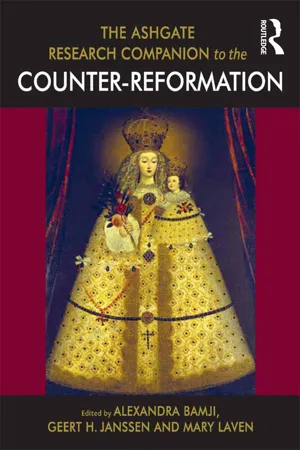
eBook - ePub
The Ashgate Research Companion to the Counter-Reformation
- 512 pages
- English
- ePUB (mobile friendly)
- Available on iOS & Android
eBook - ePub
The Ashgate Research Companion to the Counter-Reformation
About this book
'In the last two decades, the history of the Counter-Reformation has been stretched and re-shaped in numerous directions. Reflecting the variety and innovation that characterize studies of early modern Catholicism today, this volume incorporates topics as diverse as life cycle and community, science and the senses, the performing and visual arts, material objects and print culture, war and the state, sacred landscapes and urban structures. Moreover, it challenges the conventional chronological parameters of the Counter-Reformation and introduces the reader to the latest research on global Catholicism. The Ashgate Research Companion to the Counter-Reformation presents a comprehensive examination of recent scholarship on early modern Catholicism in its many guises. It examines how the Tridentine reforms inspired conflict and conversion, and evaluates lives and identities, spirituality, culture and religious change. This wide-ranging and original research guide is a unique resource for scholars and students of European and transnational history.
Information
PART I
Conflict, Coexistence and Conversion
1
Tridentine Catholicism
The problem of Trent as a ‘Tale of Two Councils’
The historiography surrounding the significance of the Council of Trent (1545–63) presents a particular challenge; even before the Council fathers hurried away from the freezing city in December 1563, the event had become the subject of myth-making. In the intervening 450 years the Council has come to represent – particularly amongst historians of Roman Catholicism – everything that is valued or abhorrent about organized, ‘official religion’. The fateful decision, taken by the papacy within a year of the Council’s conclusion, not to publish the full (or even edited) proceedings (or acta), notoriously left the way open for the Venetian Servite friar Paolo Sarpi to compose his warts-and-all Istoria del concilio tridentino – ‘the Iliad of our times’ – which was printed in London in 1619 to avoid censorship.1 By attempting to rebut Sarpi chapter-and-verse (yet without being allowed to quote in extenso from the Council papers which by then had been carefully collected together and were closely guarded in the papal archives), the official response of the Jesuit Pietro Sforza Pallavicino, first printed in two folio volumes (1656–57), merely served to draw attention to the rhetorical brilliance of Sarpi’s argument.2 As is well known, the complete publication of the Conciliar acts had to await the dawn of the twenty-first century, with the appearance of the final volume of the comprehensive edition sponsored by the Görres Gesellschaft in 2001 precisely 100 years after the first.3 It is one of the ironies of historiography that the conclusion of this magnificent monument to scholarship came about long after interest in its contents had peaked. There were three reasons for this. Firstly, this series of volumes both made possible, and then continued after the completion of, what is by far the most authoritative historical account of the Council, that by the German Catholic priest, Hubert Jedin (1900–80), which was first published between 1949 and 1975 (only the first two volumes of which are available in English translation).4 Secondly, Jedin’s work was of a thoroughness, range and level of detail to close down discussion rather than open it up. (In this respect, the complex arrangement of the Görres Gesellschaft edition of the Conciliar acts, which is anything but chronological, has compounded the problem). Thirdly, the echoes of the event which has done most to shape the agenda of those researching Roman Catholicism of the later Middle Ages and early modern period since the 1960s – the Second Vatican Council (1962–65) – were fast receding.
Something of the degree to which this latter Council has shaped the historiography of the earlier one may be seen from looking at the way in which the adjective ‘Tridentine’ had become detached from what actually happened at Trent and attached, instead, to such central aspects of devotional practice as the daily liturgy of the offices. In actual fact, the revised editions of the relevant office books, beginning with the Roman breviary in 1568, were accomplished independently of the Council by reform commissions which were under the direct authority of the pope.5 However, owing to such influential twentieth-century historians of liturgy as Josef Jungmann and Theodor Klauser, Trent came to be identified with rigid unification (Einheitsliturgie) and pedantic rubricism. The former scholar, in his account of pastoral liturgy published in English to coincide with the opening of the Second Vatican Council in 1962 at which he served as an expert (peritus), went so far as to adopt the term Geschichtslosigkeit (literally ‘the state of the absence of history’) to describe the reformed liturgy.6 Such writing has had the effect of extending the life of the myth of the Council of Trent as a monolithic, unified event which froze Roman Catholicism for almost exactly four hundred years, until the thaw heralded by Vatican II (1962–65). One historian has gone so far as to date the dawn of the new age not to the Council itself but to the very day when Pope Paul VI brought the liturgical ancien régime to a close and celebrated the first mass in the vernacular on 7 March 1965.7
As we now approach the fiftieth anniversary of Vatican II, and the 450th of the closing of the Council of Trent, two recent books by the Jesuit scholar John O’Malley, who was himself an eyewitness of some of the events which unfolded in Rome in the early 1960s, enable us finally to break the spell of what has become a distorting ‘Tale of Two Councils’.8 To begin with, O’Malley has avoided the usual trap of failing to forget the future. Fundamental to O’Malley’s success here is his understanding of the essential incommensurability of Trent with Vatican II. For him, the canons and decrees of the former belong to the legislative-judicial tradition carried out by university men trained in scholasticism, as exemplified by that masterpiece of measured intellectual poise and balance that is the 16 chapters followed by 33 canons expounding the orthodox Roman Catholic doctrine of justification. By contrast, the documents of Vatican II belong, according to O’Malley, to the poetic-rhetorical tradition in which a tireless effort at definition has been replaced by an equally energetic desire for dialogue. Here a rhetorical rather than a dialectical style was required. In contrast to the Council of Trent, where bishops were presented as enforcers of discipline, the deliberations and documents of Vatican II celebrated collegiality and horizontal relationships, not just between church members but to all men and women of goodwill.9
A corollary to this recognition of the different ‘language games’ being played at Trent and Vatican II is O’Malley’s determination to reclaim the reality of the ‘Council of Trent’ from the myth of ‘Trent’.10 This leads him to consider not only what business was actually conducted at the Council, as opposed to subsequent acts and decisions which became identified as features of ‘Tridentine’ Roman Catholicism, but also to consider what was not there. O’Malley contends that on several of the key issues which really mattered to those fighting on the frontline of a confessionally divided Europe – such as communion in both kinds, a vernacular liturgy, clerical celibacy and the veneration of saints – the fathers meeting at Trent either sidestepped or plain fudged their decisions. In the last case, for example, they rushed through a decree – which did little more than restate Nicaea II (787 CE) – in the closing days of the Council only owing to concerted pressure from the French party of bishops under the powerful leadership of the Cardinal of Lorraine, for whom iconoclasm was (quite literally) a burning issue. Moreover, on the subjects of confraternities and missions – both of which were core to the reinvigorated practice and identity of Roman Catholicism post-Trent – the Council had absolutely nothing of substance to say (except to observe that bishops had the right to conduct visitations of confraternities and that the latter were bound to submit an annual report of their administration).11 Nor did Trent include any explicit pronouncements on papal authority, even as the reform of such vitally defining areas of religious practice as the revision of the breviary, missal and other liturgical books as well as the drafting of the catechism and of a new Index of prohibited books was left to the complete discretion of the pope. Finally, O’Malley has emphasized just how limited the agenda of Trent actually was despite its relative length. In the standard edition of collected ecumenical councils, Trent’s 139 pages are only surpassed by Vatican II with its 315-page length.12
Under ‘doctrine’, attention was focused overwhelmingly on rebutting the Lutheran doctrine of justification by faith alone and Luther’s denial of the divine institution of the seven sacraments. This might explain why in contrast to the relentless point-by-point retort offered by the Lutheran Martin Chemnitz in his four-volume Examen Concili Tridentini (1565–73), Calvin’s single treatise attacking the Council, the Acta synodi tridentinae cum antidoto of 1547, is rather perfunctory and, aside from a French translation, was never reprinted.13 For example, there was nothing in the decrees and canons of Trent on the Resurrection, the Trinity, the Incarnation or even on the Immaculate Conception since none of these areas of dogma were under attack. Under ‘reform’, attention was focused almost exclusively on the episcopate and secular clergy. The papacy was kept off the agenda with remarkable success by the legates. The actual providers of much of the preaching and hearing of confession the length and breadth of the Roman Catholic world – members of male religious orders such as the Jesuits and the mendicants – were seen negatively as a threat to episcopal autonomy. So just how relevant was the Council to the making of Roman Catholicism as a world religion in the century or so after its closure?
Never pure – a different approach to Tridentine Catholicism
The American historian of science Steven Shapin entitled the introductory chapter to his essay collection, Never Pure: ‘Lowering the tone in the History of Science: a noble calling’.14 Shapin, together with Simon Schaffer, has been closely associated with a revisionist approach to the history of science in which an essentially internalist, decontextualized, Whig narrative of successive ‘eureka moments’ has been replaced by an attempt to study science ‘as if it was produced by people with bodies, situated in time, space, culture and society … [who were] struggling for credibility and authority’ (to borrow the subtitle to Never Pure). Elsewhere, I have argued for the need for a similar approach to ‘Tridentine Catholicism’:
It is high time we stopped arguing what label to use when describing it – i.e. what it was and, instead, ask ourselves what it did (what cultural work did it undertake and what are the active verbs we can use to describe the processes by means of which Roman Catholicism became this planet’s first religion.15
In other words, ‘Tridentine Catholicism’ needs to be understood less as an abstract noun (or here as a noun phrase) but rather as a concrete verb.
Although it is now much rarer than it once was to encounter the kind of blatant anti-Catholic prejudice that could animate major historians as ideologically diverse as Christopher Hill and Hugh Trevor-Roper, the very battle over the rebranding of the Counter-Reformation in the more recent past has itself reflected a persistent unease amongst Roman Catholics themselves about how to apologize/account for/justify/explain this period of their faith’s past.16 Even the light touch of John O’Malley, in his beautifully crafted Trent and All That, cannot disguise the lingering desire for Roman Catholic authors of early modern Catholicism to put their hands up to say: ‘Don’t forget us. We too played our part in the emergence of the modern world’!17 Here the very term ‘early modern Catholicism’ is a giveaway. A particularly prominent example of this ‘we too-ism’ may be found in a volume co-edited by two of Europe’s most eminent Roman Catholic sc...
Table of contents
- Cover Page
- Title Page
- Copyright Page
- Contents
- List of Illustrations
- List of Contributors
- Acknowledgements
- Introduction
- PART I CONFLICT, COEXISTENCE AND CONVERSION
- PART II CATHOLIC LIVES AND DEVOTIONAL IDENTITIES
- PART III IDEAS AND CULTURAL PRACTICES
- PART IV RELIGIOUS CHANGE
- Index
Trusted by 375,005 students
Access to over 1.5 million titles for a fair monthly price.
Study more efficiently using our study tools.
Frequently asked questions
Yes, you can cancel anytime from the Subscription tab in your account settings on the Perlego website. Your subscription will stay active until the end of your current billing period. Learn how to cancel your subscription
No, books cannot be downloaded as external files, such as PDFs, for use outside of Perlego. However, you can download books within the Perlego app for offline reading on mobile or tablet. Learn how to download books offline
Perlego offers two plans: Essential and Complete
- Essential is ideal for learners and professionals who enjoy exploring a wide range of subjects. Access the Essential Library with 800,000+ trusted titles and best-sellers across business, personal growth, and the humanities. Includes unlimited reading time and Standard Read Aloud voice.
- Complete: Perfect for advanced learners and researchers needing full, unrestricted access. Unlock 1.5M+ books across hundreds of subjects, including academic and specialized titles. The Complete Plan also includes advanced features like Premium Read Aloud and Research Assistant.
We are an online textbook subscription service, where you can get access to an entire online library for less than the price of a single book per month. With over 1.5 million books across 990+ topics, we’ve got you covered! Learn about our mission
Look out for the read-aloud symbol on your next book to see if you can listen to it. The read-aloud tool reads text aloud for you, highlighting the text as it is being read. You can pause it, speed it up and slow it down. Learn more about Read Aloud
Yes! You can use the Perlego app on both iOS and Android devices to read anytime, anywhere — even offline. Perfect for commutes or when you’re on the go.
Please note we cannot support devices running on iOS 13 and Android 7 or earlier. Learn more about using the app
Please note we cannot support devices running on iOS 13 and Android 7 or earlier. Learn more about using the app
Yes, you can access The Ashgate Research Companion to the Counter-Reformation by Alexandra Bamji, Geert H. Janssen, Mary Laven, Alexandra Bamji,Geert H. Janssen,Mary Laven in PDF and/or ePUB format, as well as other popular books in Theology & Religion & Early Modern History. We have over 1.5 million books available in our catalogue for you to explore.