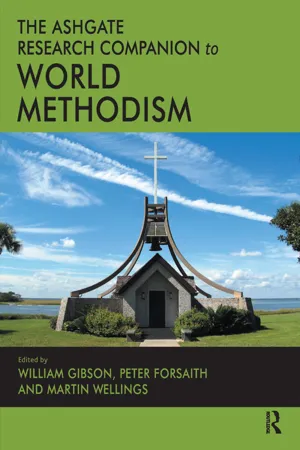
eBook - ePub
The Ashgate Research Companion to World Methodism
- 550 pages
- English
- ePUB (mobile friendly)
- Available on iOS & Android
eBook - ePub
The Ashgate Research Companion to World Methodism
About this book
As a religious and social phenomenon Methodism engages with a number of disciplines including history, sociology, gender studies and theology. Methodist energy and vitality have intrigued, and continue to fascinate scholars. This Companion brings together a team of respected international scholars writing on key themes in World Methodism to produce an authoritative and state-of-the-art review of current scholarship, mapping the territory for future research. Leading scholars examine a range of themes including: the origins and genesis of Methodism; the role and significance of John Wesley; Methodism's emergence within the international and transatlantic evangelical revival of the Eighteenth-Century; the evolution and growth of Methodism as a separate denomination in Britain; its expansion and influence in the early years of the United States of America; Methodists' roles in a range of philanthropic and social movements including the abolition of slavery, education and temperance; the character of Methodism as both conservative and radical; its growth in other cultures and societies; the role of women as leaders in Methodism, both acknowledged and resisted; the worldwide spread of Methodism and its enculturation in America, Asia and Africa; the development of distinctive Methodist theologies in the last three centuries; its role as a progenitor of the Holiness and Pentecostal movements, and the engagement of Methodists with other denominations and faiths across the world. This major companion presents an invaluable resource for scholars worldwide; particularly those in the UK, North America, Asia and Latin America.
Information
PART I
Introduction
1
Introduction
The Complexity of Methodism
The publication of a research companion to world Methodism invites some explanation. This collection of essays seeks to capture some of the complexity of the phenomenon of Methodism, and does so by harnessing the talents of scholars from diverse disciplinary backgrounds. Historians, theologians, liturgists, scholars of business, material culture, literature and music provide insights into the character and development of world Methodism. The complex interdisciplinary picture that emerges from these essays is entirely appropriate, for Methodism, like many other churches and denominations, is itself complicated and multi-layered, and suffers from the reductionist urge to simplify and uncomplicate. Accounts of Methodism could be supplied which concentrate solely on its narrative history from a society within the Church of England in Oxford in the 1730s to a worldwide church with millions of adherents in 2011. Its theology could be reduced to a version of the Bebbington ‘quadrilateral’ – though perhaps in the case of Methodism that quadrilateral would consist of a present-centred Wesleyan rhombus of calling, conversion, conscience and cross. Methodist popular culture could be condensed into the hagiography of John Wesley and an emphasis on souvenirs and commemorative crockery. Local studies, biographies, sociology and the plethora of fashionable disciplinary ‘studies’ can all lend a hand in reducing Methodism to a two-dimensional form of religion. But this is not what this volume seeks to provide.
It is important at the outset to be clear about what is meant here by ‘Methodism’ and, equally, what is not. In at least what is now regarded as the movement’s first half century, dating its genesis from around 1730, ‘Methodist’ was a term of mild ridicule used of those whose religious behaviour, usually termed ‘enthusiasm’, seemed excessive. If this was a popular usage, it had specific reference to individuals and groups linked to a number of leading personalities, most notably George Whitefield, the Countess of Huntingdon and the brothers John and Charles Wesley. Moreover, during this time the Methodists were essentially (although not universally) part of the national Church of England and any sense of forming separate denominations was generally denied. It should also be recognised that ‘Methodist’ was a term coined and applied by others, which was only reluctantly accepted by participants.
The Calvinistic Methodism of Whitefield, Howell Harris (in Wales) and Lady Huntingdon did not develop the sort of social and theological adaptability that David Hempton has so clearly demonstrated was a feature of Wesleyan Methodism.1 Nor, despite its strongly evangelical roots, did it sustain a sense of missionary urgency in the way Wesleyan Methodism did. Its identity remained closely focused on the communities in which it had thrived in the eighteenth and nineteenth centuries and in which it saw revivals and revivalism as a continuous process rather than as a prelude to global evangelism. The separateness of Calvinistic Methodism from Wesleyanism should not be surprising given that its roots lay more firmly in the soil of Reformed theological traditions than the Arminian principles of the Wesleys. The editors therefore have seen Calvinistic Methodism as much more akin to the Reformed tradition and best considered as such.
The Methodism which concerns this volume, then, is that which traces its roots back to the activities of the Wesleys in what has also become known as the evangelical movement, but which through the nineteenth century developed into a global phenomenon. From the start Methodism was untidy and ambiguous. It sought to exist within an established church which had settled parish boundaries, episcopal authority and a range of legal and doctrinal constraints. For such an emotive, enthusiastic and earnest endeavour Anglican constraints were unlikely to do other than chafe and snap. They did in the 1780s and 1790s, leaving Methodism to complete the process of forming itself into a discrete church. Methodism in varying degrees sought lay involvement in its organisation and worship which elevated ‘heart religion’ above articles of faith and a settled liturgy. Consequently it carried untidiness and ambiguity into the world of independence from Anglicanism. Was it radical or conservative in its political as well as its social and spiritual gospel? Was it ecumenical in outlook or competitive and antagonistic towards other churches? Was it a force for the freeing of women, slaves, ethnic and other minorities from the shackles that society had made for them? Was it emotionally indulgent or demanding? Was it a force for godly discipline or spiritual excess? Did it promote ‘respectable’ values of hard work and aspiration or was it sympathetic to those who lacked such values? These, and many other questions, have concerned scholars of Methodism. But for the most part there is no single answer to such questions and Methodism and its scholars have had to accommodate a ‘both/and’ response to them, rather than ‘either/or’. This makes for complexity, but it also gives world Methodism a rich interior which defies reduction to simplicities and platitudes.
The expansion of Methodism was not a matter of physics; it did not result in spiritual entropy – rather the opposite. As Methodism expanded to North America and then to Asia, Latin America, Africa and beyond, it became more variegated and diverse. This is perhaps a feature of religious expansion which Methodism shares with Catholicism, Anglicanism and other churches. Yet a founding feature of Methodism, its syncretic spiritual and ecclesiological inflection, was a particularly attractive quality. While Methodism had central truths, they were comprehensive in character and allowed Methodism to accommodate the different cultural settings into which it expanded. The same features that made Methodism accessible in the late eighteenth and early nineteenth centuries in the industrial towns in the North of England, and later in the expanding states of America, made it equally so in the plains of Asia and the plateaus of Africa. Of course as a human endeavour it employed and exploited opportunism and determination as much as, if not more than, other churches, but it did so from a fortified position of conviction and certainty which fuelled its missionary enterprise. This evangelicalism was at the heart of Methodism and a key element in Methodist identity. And it determined the character of much Methodist activity; there were few, if any, Methodist meetings which did not – in good times and adversity – set themselves the goal of spreading the word of God beyond the confines of its immediate society and country. The experience of conversion felt by so many Methodists, as well as the intensity of the emotional pull of its worship, were feelings that had to be shared alongside the spiritual call of its teachings about God, Christ and salvation.
A factor in the success of Methodism has been the forms and movements in which it has popularly spread across the developing world, particularly holiness and pentecostalism. The rudimentary class distinction identified by some scholars that middle classes were attracted to ‘traditional’ Methodism and working classes to holiness and pentecostalism resulted in an enormous growth of the latter in the developing world. Pentecostalism became a religious form for the poor partly because it required little formal education, relying instead on vital piety.2 In contrast, in Europe, and perhaps North America, Methodism has become a religiously normative institution which increasingly resembles other Christian denominations, and it has shared in the decline that has affected such groups. In the developing world it has retained its freshness and emotional intensity through the incorporation of holiness and pentecostalism. In these places John Wesley’s experience in Aldersgate provides a potent model for inner spirituality and Methodist hymns give a harmonious setting. The processes of urbanisation and industrialisation in the developing world emulate those in Britain and America in which Methodism achieved its greatest successes, and it is unsurprising that the same population shifts and transformations see a similar desire to lay down spiritual roots. But the multivalent character of Methodism has given fresh impetus from the adoption of holiness and pentecostalism into indigenous forms of Methodism. The fragmentation of Methodism has happened in Latin America and elsewhere as much as it did in early nineteenth century Britain. There are more than fifteen separate denominations in Brazil which are Wesleyan in origin.
The Primacy of John Wesley
The hold of John Wesley over the organisation he founded is a remarkable feature of world Methodism. The desire to read Wesley’s words has meant that his works are available in – among other languages – Spanish and Chinese, and the Aldersgate renewal conferences, which grew up in the USA, have found as much success in Manila as in Michigan. Wesley was taken to the developing world by missionaries who used the ‘twice-told tales’ of Wesley’s conversion and extraordinary work in the eighteenth century – and of course this happened before the emergence of analytical Wesley scholarship in the UK and USA.3 Consequently the Methodism of the developing world and that of Britain -and increasingly North America- have diverged. In Britain and North America the John Wesley of scholarly history has become different from the John Wesley of faith. The forensic attention to which John Wesley has been subjected has meant that the hagiographic treatment of him can no longer prevail in scholarly circles. But this revisionism has not spread much beyond scholarly circles and remains surprising to many in the USA as well as in the developing world. In the same way that Horace Walpole told William Mason in 1781 that he did not want to unlearn all the myths of his youth about the Whig heroes of the Glorious Revolution, many Methodists do not want to unlearn the foundational myths of John Wesley.4 This tension between myth, history and faith is a theme of some of the essays in this volume which try to understand how the Wesley of history and the Wesley of faith can coexist.
Consequently world Methodism accommodates an uncomfortable dual view of John Wesley as human, flawed and problematic as well as Wesley as a model of spiritual values, authentic conversion, evangelical zeal and passion to achieve the salvation of others. Thomas Carlyle might have been right that, in another church, Wesley would have been made a saint for founding a unique preaching order. But in Methodism his beatification is a source of division and controversy. Nevertheless the ingredients of Wesley’s success, stripped of negative features, have been a vital force in the formation of Methodist identity across the world and are features that all Methodisms can claim in common. When Methodist missionaries were struggling to make headway in Latin America their cry was ‘what we need is Wesley himself preaching the Gospel and teaching the Methodist discipline.’5 He is the equivalent of the throne of Peter for Catholicism and that of Augustine for Anglicanism. And in the same way, the idealisation of Wesley has developed a character independent of the historical reality. The question is, should this be troubling and problematic? In the sense that the idealised Wesley has become a historical reality in the way in which he has been adopted and embraced by Methodism across the world this may not be troubling. In this respect Methodism is no different from other denominations and religions which idealise their saints and heroes. Such idealised figures can express the truths of religion and can establish and communicate the identity of a church. However the idealisation of Wesley is perturbing when his work is stripped of its eighteenth century context and twenty first century assumptions and values are projected back onto it.6 Writing of the challenge of introducing the works of John Wesley in Latin America, L. E. Wethington wrote:
One of the greatest challenges of introducing Wesley himself is how ‘the essential Wesley’ can be lifted out of his 18thC [sic] context, pruned and replanted in 21st C Latin America? Some Methodists have rejected Wesley because he did not project in his own 18thC a model of social ethics for the 21st C. Dare we suggest that no Wesley scholar is likely to develop a Wesleyan social ethics for the 21st C unless it is deeply rooted in John Wesley’s essential theology.7
It is a serious problem when the words people want Wesley to have said are put into his mouth and thoughts he did not express are credited to him. When the Wesley of faith trumps the Wesley of history both are damaged and diminished. So the treatment of Wesley as a model of sociological concern for the poor and as a liberation theologian – in the modern sense of that term – are unlikely to contribute to the health and vitality of world Methodism; indeed they are more likely over time to sap it. It is no wonder therefore that one of the authors in this volume asks ‘will the real John Wesley please stand up?’8
The centrality of John Wesley in the minds of many Methodists presents two related problems. First it has the tendency to exclude, or at least marginalise, the role of other key leaders in Methodism. Among his contemporaries the wattage of the spotlight on John Wesley impairs our view of Charles Wesley, John Fletcher and others.9 The contribution of such early Methodists to the formation of the identity of the tradition is significant and under-represented both in scholarship and in popular Methodisms. The second problem is that John Wesley’s voice drowns out those of the non-Wesleyan Methodist traditions and those groups which split from Wesleyan Methodism. In these categories lie Calvinistic Methodism, Primitive Methodism, Bible Christians and various Free Methodist groups. Such groups and churches are responsible for some of the vigour and power of the radical agenda of Methodism in the nineteenth and twentieth centuries. They were often in the forefront of championing the role of women in worship and they also contributed some of the distinctive theology of Methodism.10 It was principally from the non-Wesleyan traditions that the working class leadership of Methodism was most strongly represented.11 And non-Wesleyan Methodism was responsible for some of the missions which spread Methodism across the world. Moreover the interaction between Wesleyan and non-Wesleyan strands can be distorted if the distinctive character of non-Wesleyan Methodism and traditions is not recognised.12 How can the debt owed by Methodists to non-Wesleyan influences be fully acknowledged and understood if there is no room in Methodism for such strands? An elegant call for such recognition was made in Martin Wellings’s Fernley Hartley Lecture, 2003, in which he said:
We know that John Wesley made a very limited impact in Wales and Scotland, and even in England there were plenty of non-Wesleyan ‘Methodists’: a ‘Methodist’ in the mid-eighteenth century meant anyone who supported the revival and who stressed the core evangelical doctrine of justification by grace through faith and claimed the defining evangelical experience of conversion. The societies founded by the Wesley brothers or assimilated into their ‘connexion’ were part of a much wider movement including the Moravians and Calvinistic evangelicals inside and outside the Church of England.13 While the Salvation Army owes its foundation to Wesleyan Methodism it also regards itself as a non-Wesleyan institution.14 In short, Methodist emphasis on John Wesley can help to define the character and identity of Methodism but it can also prevent Methodism from appreciating some of the wider and more diverse influences and inspirations which moulded the tradition.
Many Methodisms
In the eighteenth century ‘Methodist’ might apply to a considerab...
Table of contents
- Cover
- Half Title
- Title Page
- Copyright Page
- Table of Contents
- List of Tables
- Notes on Contributors
- PART I: INTRODUCTION
- PART II: HISTORICAL CONTEXT
- PART III: WORLD METHODISM
- PART IV: BELIEF AND PRACTICE
- PART V: CULTURE AND SOCIETY
- Select Bibliography and Further Reading
- Index
Trusted by 375,005 students
Access to over 1.5 million titles for a fair monthly price.
Study more efficiently using our study tools.
Frequently asked questions
Yes, you can cancel anytime from the Subscription tab in your account settings on the Perlego website. Your subscription will stay active until the end of your current billing period. Learn how to cancel your subscription
No, books cannot be downloaded as external files, such as PDFs, for use outside of Perlego. However, you can download books within the Perlego app for offline reading on mobile or tablet. Learn how to download books offline
Perlego offers two plans: Essential and Complete
- Essential is ideal for learners and professionals who enjoy exploring a wide range of subjects. Access the Essential Library with 800,000+ trusted titles and best-sellers across business, personal growth, and the humanities. Includes unlimited reading time and Standard Read Aloud voice.
- Complete: Perfect for advanced learners and researchers needing full, unrestricted access. Unlock 1.5M+ books across hundreds of subjects, including academic and specialized titles. The Complete Plan also includes advanced features like Premium Read Aloud and Research Assistant.
We are an online textbook subscription service, where you can get access to an entire online library for less than the price of a single book per month. With over 1.5 million books across 990+ topics, we’ve got you covered! Learn about our mission
Look out for the read-aloud symbol on your next book to see if you can listen to it. The read-aloud tool reads text aloud for you, highlighting the text as it is being read. You can pause it, speed it up and slow it down. Learn more about Read Aloud
Yes! You can use the Perlego app on both iOS and Android devices to read anytime, anywhere — even offline. Perfect for commutes or when you’re on the go.
Please note we cannot support devices running on iOS 13 and Android 7 or earlier. Learn more about using the app
Please note we cannot support devices running on iOS 13 and Android 7 or earlier. Learn more about using the app
Yes, you can access The Ashgate Research Companion to World Methodism by William Gibson, Peter Forsaith, Martin Wellings, William Gibson,Peter Forsaith,Martin Wellings in PDF and/or ePUB format, as well as other popular books in Theology & Religion & Christian Denominations. We have over 1.5 million books available in our catalogue for you to explore.