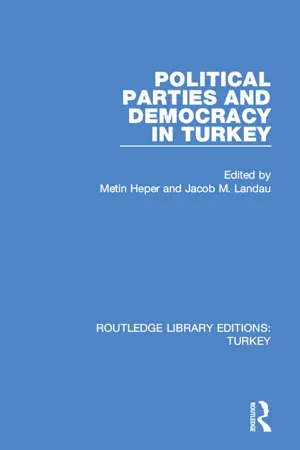
Since the establishment in 1945 of a constitutional democracy, political parties have figured prominently in Turkish politics. This book, first published in 1991, examines the role they have played. Key features of the political culture of the Turkish republic have created dilemmas for multi-party democracy: Atatürkism still exerts a powerful influence on the country's bureaucratic and military elites. With their notion of 'responsible leadership' and of democracy as rational intellectual debate in pursuit of the 'best' policy, they have expected an unrealistic degree of idealism and statesmanlike behaviour from the leaders of political parties. Three times, in 1960, 1971 and 1980, the military has intervened in politics – on the third occasion to undertake wholesale constitutional and legal restructuring aimed at producing 'sensible' politicians. Given these ambiguous circumstances, what role have the political parties themselves played in the promotion and functioning of democracy in Turkey, and what are their attitudes to the issues involved? This collection of essays discusses political parties since the foundation of the Turkish Republic in 1923 until the 1990s. With contributions from leading political scientists and historians of modern Turkey, it is indispensable reading for all those concerned with the country.
- 238 pages
- English
- ePUB (mobile friendly)
- Available on iOS & Android
eBook - ePub
Political Parties and Democracy in Turkey
About this book
Information
1
Introduction
Liberal democracy has both a horizontal and a vertical dimension. The concept calls for and, where such a regime has been consolidated, the praxis evinces a delicate balance between participation on the one hand, and responsible leadership on the other. The formula of liberal democracy is equality through liberty.1 Liberal democracy is predicated upon a reconciliation of autonomy and control.2
The ideal notion of democracy is related to its horizontal, or participatory, dimension. The approach is prescriptive. The problematic is that of bringing about ‘more democracy’. Conversely, the realistic notion of democracy strives to find ways and means of establishing a viable democracy in a given place and time. What makes democracy possible is not the same thing as what makes democracy more democratic.
Atatürk attempted to plant the seeds in Turkey for both the horizontal and the vertical dimensions of liberal democracy. He placed particular emphasis on the nation as the source of ultimate values and goals for society. It is true that during his lifetime, except for a brief experiment in 1930,3 a multi-party system was not installed. Atatürk, however, had an emphatic belief in the innate capacity of the people to develop and, in due course, impinge upon government.4
This particular approach has borne fruit in later years. A multi-party system was finally established in 1945. This was followed in the next two decades by the emergence of political parties such as the Democratic Party (DP) and the Justice Party (JP); both the DP and the JP were responsive in some measure to civil societal elements.5 In the late 1960s even the Republican People’s Party, the single party from 1923 to 1945, managed to extricate itself from its symbiotic relationship with the state, then represented by the bureaucratic and the military elites. And during the 1980s, the erosion of Atatürkism as the official ideology could be seen – 6 a development that provided far greater scope for ‘politics’. The ‘political will’ rather than the ‘bureaucratic will’ now had the upper hand, particularly in those areas that were not preserved as the ‘sphere of the state’.7 In the process – at least in theory – the political party gradually came to have greater responsibility for nurturing the vertical as well as the horizontal dimension of liberal democracy.
Concerning the functions of the political party in Turkey, Atatürk placed sole emphasis on the vertical dimension of democracy. In his view, the political party had to be a no-nonsense party. The post-Atatürk bureaucratic elites, which converted Atatürkism as a mentality8 into an ideology in the Shilsian sense, i.e. into a closed system of thought,9 expected an unrealistic degree of idealism and statesmanlike behaviour from political party leaders. The 1960 military intervention, for instance, was carried out against a political party whose leaders were considered to have acted against the best interests of the country.10 The constitutional and legal restructuring in the wake of the 1980 military intervention, too, aimed at producing sensible politicians.11
This preoccupation with recruiting by fiat political party elites, which would be more attentive to the vertical requirements of liberal democracy, was an outcome of the idea of rationalist democracy subscribed to by the state elites. The latter were engaged in the (inevitably unsuccessful) political engineering in question. The notion of the rationalist democracy adopted in Turkey considered democracy as an intellectual debate with the intention of determining the best policy, and not as an effort to reconcile and aggregate different views and interests.
The efforts throughout the Republican period (1923 to the present) of institutionalizing in Turkey both the horizontal and the vertical dimensions of democracy do not seem to have been entirely successful. If nothing else, during this period Turkey experienced three military interventions (in 1960, 1971 and 1980). The first and the last of these took as a target one (the DP) and all political parties, respectively.
This was not surprising. Given their predilection for viewing democracy as an end – i.e. promoting the general interest through debate based on reason – and not as a means to promote as well as reconcile ‘interests’ vis-à-vis the problems of liberal democracy in Turkey, the military never found fault with the regime itself, or with social groups or with themselves (after all, they intervened ‘to restructure and make democracy viable’), but with politicians who, as already implied, were accused of acting irresponsibly.12 At times, associational interest group organizations too were suppressed. But they were not perceived as culprits on their own account; they were considered to have been ‘too politicized’ by the political party elites.
Leaving aside for the moment the question of the degree to which political parties were indeed responsible for the bottlenecks the Turkish democracy had faced, it cannot be denied that parties continued to have a critical role in the Turkish polity. Political openings (aperturas) in Turkey were neither the upshot of a falling-out among themselves of the authoritarians, as has been the usual pattern in many Latin American countries,13 nor initiated by the pressure of emerging social forces, as was the case in the earlier, major revolutions.14 Rather, the openings were initiated by the alternative political party elites at the ‘centre’, which attempted to replace the state-dominant political system by a party-dominant one, i.e. by a political system largely autonomous of social groups.15
As compared with the situation in many Third World contexts, with their fairly well-developed and distinct party platforms, relatively complex organizations highly differentiated from traditional social structures as well as from the military and the Church, and with their active role in government, the Turkish political parties have had a significant impact on politics. As compared to their counterparts in the Western industrialized countries, too, political parties have figured prominently in the Turkish polity.16 Neo-corporatist arrangements, let alone their more recent complex versions, i.e. ‘networks’ between organized society and governmental actors (in both patterns the government shares responsibility for policy-making with the ‘private’ bodies) had been alien to the Turkish scene.17 Also, unlike the secular developments in the Western industrialized contexts, in Turkey the bureaucratic elites have not so far begun to dominate public policy-making on account of their expertise.18 In the event, Turkish politics have been dominated by two categories of elites – the bureaucratic and military on the one hand, and the political on the other.
Furthermore, not only the political elites, but, sometimes from behind the scenes, sometimes more openly, the bureaucratic and the military elites too have wished to play a significant role in politics. As already noted, clinging on to their concept of rationalist democracy, the state elites expected political party elites to place primary emphasis on the general interest, as the state elites themselves have defined it. During the 1950s, for instance, the state elites insisted on strictly secularist policies. Following the 1960 military intervention they managed to legislate public interest in the form of the 1961 Constitution. The latter was partly a programmatic document – a mild form of political manifesto to which political party elites were expected to conform.19 The 1961 Constitution was also a ‘mixed’ constitution in that ‘national sovereignty’ was to be exercised not only by parliament but by ‘the authorized agencies’, which, by implication, included the bureaucratically staffed agencies such as the Constitutional Court and the National Security Council. The 1982 Constitution, which in turn was written in the wake of the 1980 military intervention, was less programmatic than the 1961 Constitution, but introduced into Turkish politics a stronger state-politics duality. A strengthened National Security Council and a presidency with extensive powers took their places alongside the more ‘political’ institutions.20
It would be logical to arrive at the conclusion that the 1961 and 1982 ‘re-equilibrations’ – to use Juan Linz’s terminology – resembled the post-Second World War restructurings of democracy in such countries as France, West Germany and Austria,21 in that the rules of the democratic game were dictated by the Constitution. But in practice, the re-equilibrations in Turkey differed from the latter in one important respect: The mixed nature of the 1961 and 1982 Constitutions was overlooked, among others, by political party elites in Turkey.
The West German project of gradual democratization, for instance, was reflected in German constitutional theory as well as constitutional arrangements. Historically, the dominant schools in German political and legal philosophy placed the needs and interests of a reified, anthropomorphic state above those any of its components – particularly parties and interest groups – and asserted the overarching identity of private and public values in the German nation-state.22 West German political leaders may have acted as representatives of heterogeneous interests, but they insisted that the citizen’s first duty was to the state.23 Even many convinced democrats reluctantly came to accept the fact that the German definition of democracy tended to mean a ‘government for the people’ more than it did ‘government by the people’. They placed a premium on the leader who could keep a firm hand on the tiller.24 It is true that there were those – primarily intellectuals – who pursued ‘ultimate goals’ and who were opposed to pragmatic action and making compromises. The radical critique of the values of the political system, however, was more of a corrective than a delegitimation of the political order.25
In Turkey, despite the 1961 and 1982 re-equilibrations, the idea of the state as ‘a generalizing, integrating and legitimizing entity’26 – the particular notion of the state which informed the restructurings of democracy in continental Europe – found its way to neither political theory nor political discourse. Only a limited aspect of the idea of the state – the paternal state, which in the last resort would extend a helpful hand – came to have a niche in the political consciousness of many. Otherwise, the state we have in mind here remained an enigma. While Turkey continued to experience political instability, the attempted restructurings were not considered necessary to bolster the vertical dimension of democracy, but only as threats to its horizontal dimension.
The studies of Turkish democracy, too, were addressed to the question of what makes democracy more democratic and not to the issue of what makes democracy possible. In this vein, scholarly studies in general focused their attention on whether and to what degree Turkey came to have the ‘prerequisites’ of democracy; the less scholarly ones stressed ‘more participation’.27
For the present purpose these developments had one crucial consequence: the political party elites had to strike a balance between the vertical and horizontal dimensions of democracy and arrive at a consensus on the procedural rules of democracy all by themselves, i.e. without effective constitutional checks and balances. This they had to achieve while pursuing a rigorous opposition to the bureaucratic-military elites and, in the absence of effective linkages to social groups, that is, without the benefit of moderation such relationships might have brought about, and while constantly being...
Table of contents
- Cover
- Half Title
- Title Page
- Copyright Page
- Original Copyright Page
- Table of Contents
- Preface
- Abbreviations
- Contributors
- 1 Introduction
- 2 Political Parties in Turkey: An Overview
- 3 Atatürk and Political Parties
- 4 The Republican People’s Party, 1925-1945
- 5 The Progressive Republican Party, 1924-1925
- 6 The Free Party, 1930
- 7 The Republican People’s Party, 1945-1980
- 8 The Democratic Party, 1946-1960
- 9 The Justice Party, 1961-1980
- 10 The Motherland Party, 1983-1989
- 11 The Social Democratic Populist Party, 1983-1989
- 12 The True Path Party, 1983-1989
- 13 Conclusion
- Select Bibliography
- Index
Trusted by 375,005 students
Access to over 1.5 million titles for a fair monthly price.
Study more efficiently using our study tools.
Frequently asked questions
Yes, you can cancel anytime from the Subscription tab in your account settings on the Perlego website. Your subscription will stay active until the end of your current billing period. Learn how to cancel your subscription
No, books cannot be downloaded as external files, such as PDFs, for use outside of Perlego. However, you can download books within the Perlego app for offline reading on mobile or tablet. Learn how to download books offline
Perlego offers two plans: Essential and Complete
- Essential is ideal for learners and professionals who enjoy exploring a wide range of subjects. Access the Essential Library with 800,000+ trusted titles and best-sellers across business, personal growth, and the humanities. Includes unlimited reading time and Standard Read Aloud voice.
- Complete: Perfect for advanced learners and researchers needing full, unrestricted access. Unlock 1.5M+ books across hundreds of subjects, including academic and specialized titles. The Complete Plan also includes advanced features like Premium Read Aloud and Research Assistant.
We are an online textbook subscription service, where you can get access to an entire online library for less than the price of a single book per month. With over 1.5 million books across 990+ topics, we’ve got you covered! Learn about our mission
Look out for the read-aloud symbol on your next book to see if you can listen to it. The read-aloud tool reads text aloud for you, highlighting the text as it is being read. You can pause it, speed it up and slow it down. Learn more about Read Aloud
Yes! You can use the Perlego app on both iOS and Android devices to read anytime, anywhere — even offline. Perfect for commutes or when you’re on the go.
Please note we cannot support devices running on iOS 13 and Android 7 or earlier. Learn more about using the app
Please note we cannot support devices running on iOS 13 and Android 7 or earlier. Learn more about using the app
Yes, you can access Political Parties and Democracy in Turkey by Jacob M. Landau,Metin Heper in PDF and/or ePUB format, as well as other popular books in Social Sciences & Regional Studies. We have over 1.5 million books available in our catalogue for you to explore.