eBook - ePub
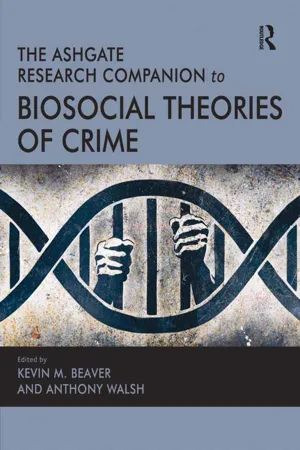
The Ashgate Research Companion to Biosocial Theories of Crime
- 464 pages
- English
- ePUB (mobile friendly)
- Available on iOS & Android
eBook - ePub
The Ashgate Research Companion to Biosocial Theories of Crime
About this book
In response to exciting developments in genetics, neuroscience and evolutionary psychology, a number of criminologists have embraced the position that criminal behaviour is the product of biological, psychological, and sociological factors operating together in complex ways. They have come to realize that if they are to capture the dynamic nature of criminal behaviour then they must span multiple levels of analysis and thus multiple disciplines. The explosion of interest in this field of biosocial criminology over the past ten years means that the time is ripe for this research companion aimed at graduate students and scholars, giving them an essential overview of the current state of research in the field. The authors are experts in a variety of disciplines (sociology, psychology, biology, criminal justice, and neuroscience), but they all have in common a strong interest in criminal behaviour. This unique book is essential and accessible reading for all students and scholars in the field.
Information
INTRODUCTION AND OVERVIEW OF BIOSOCIAL CRIMINOLOGY
1
Biosocial Criminology
Introduction
There is virtually an endless supply of criminological theories designed to explain the various factors that ultimately lead to the development of criminal, delinquent, and antisocial behaviors. These theories are remarkably different in the factors that are identified as being salient to the etiology of criminal behavior. Some theories, for example, focus on parental socialization, some focus on neighborhood-level factors, some focus on subcultures, others focus on peer group socialization, and so on. The common theme cutting across virtually every single dominant criminological theory is that social factors are the be-all and end-all when it comes to explaining crime and other forms of antisocial behavior. If theories are to be judged on their predictive ability and their ability to organize known correlates into a coherent and unified framework, then the existing mainstream criminological theories do not have much merit. For the most part, these theories are not very good at explaining crime nor are they very good at predicting who will eventually become a criminal. To illustrate, rarely do multivariate regression models reveal that a single variable derived from a criminological theory explains more than 10–20 percent of the variance, with most explaining less than 10 percent of the variance. Even when multiple indicators of a theory or of competing theories are simultaneously entered into a regression equation, the total amount of variance explained is typically far less than 30 percent. The point is that whether theoretically informative variables are examined in isolation or cumulatively, they leave most of the variance in antisocial behaviors unexplained.
Because criminological theories and research have relatively little explanatory power, it would seem reasonable that newer criminological theories should be developed that focus on a broader swath of variables other than those typically studied by criminologists. Unfortunately, this has not historically been the case. Instead, criminologists have tended to develop new theories that integrate the same old sociological variables simply packaged in a different way. Or, worse, they have argued that the empirical studies testing these theories are not measuring the key constructs correctly or that empirical studies have other flaws that make the results not believable. The bedrock of science is falsification, whereby theories and ideas that are not supported are discarded (or at least modified) and replaced with newer theories. Criminology has tended to work in an opposite way by not falsifying any theory, but continuing to add more and more theories to the existing pool. The end result is an even larger number of criminological theories, each of which is relatively weak at explaining crime, delinquency, and antisocial behavior.
What criminology needs is somewhat of a paradigm shift, where a broader array of variables is examined, where new ideas and explanations are offered, and where existing knowledge is linked to other disciplines. Enter biosocial criminology. Biosocial criminology is an emerging interdisciplinary perspective that seeks to explain crime and antisocial behavior by recognizing the potential importance of a host of factors including genetic factors, neuropsychological factors, environmental factors, and evolutionary factors (Beaver, 2009; Walsh, 2009; Walsh & Beaver, 2009). This represents a dramatic departure from mainstream criminological theories that ignore the potential explanatory power of genetics, neuropsychology, and evolutionary psychology. This departure from mainstream criminology, however, might be exactly what is needed to advance the field and, more importantly, to develop criminological theories that are much more accurate and much more powerful explanations of antisocial behaviors.
The goal of this volume is to provide an overview to biosocial criminology and the central issues related to this perspective. We have been fortunate enough to pull together some of the leading experts on the biosocial perspective to create a well-rounded, informative, and cutting-edge book on the emerging field of biosocial criminology. The contributions to this book have been organized into six different, but interrelated themes, each of which pertains to a different aspect of biosocial criminology. In the following pages, we will provide a brief overview of each section of the book and a short introduction to each chapter.
Overview of Biosocial Criminology
Biosocial criminology is an interdisciplinary perspective that is designed to integrate information across diverse fields of study to form a unified and coherent perspective from which to study crime and criminals. Although this approach to studying crime may seem relatively obvious to those in disciplines other than criminology, in fact this is quite a revolutionary and controversial idea within the confines of criminology. For the most part, criminologists view biosocial explanations to crime and antisocial behaviors as dangerous and oppressive. Environmental theories, in contrast, are seen as progressive and humane. To understand why this sentiment exists among criminologists it is essential to reflect on their academic training. Historically, most criminologists earned their undergraduate and graduate degrees in sociology programs, where they learned the ins and outs of how social institutions affect human behaviors. At the same time, most sociology programs and most sociologists despise any mention that biology could affect human behavior. The problem, however, is that sociologists know virtually nothing about biology and genetics and thus are not in an objective position to assess its influence on behavior. Van den Berghe (1990, p. 177) captured the state of sociology accurately when he noted that “[s]ociological resistance to biological thinking is in large part trained incompetence, not simply garden-variety anthropocentrism. Many sociologists are not merely oblivious about biology; they are militantly and proudly ignorant.” This “trained incompetence” has unfortunately trickled down to criminologists, where criminologists know virtually nothing about biology and genetics. To illustrate, a recent survey of criminologists revealed that the modal number of graduate-level biology courses taken by criminologists was zero, while the modal number of graduate-level sociology courses taken by criminologists was 10 (Cooper, Walsh, & Ellis, 2010). It takes no stretch of the imagination to consider the ramifications that this graduate-level training has on the way criminologists conduct research and teach their courses.
There is reason to be optimistic, however. During the past five years or so, an emerging number of empirical studies have been published by criminologists and within criminological journals that are devoted to exploring the biosocial origins of antisocial behaviors. These studies have relied on quantitative approaches to study the utility of biosocial criminology as opposed to more theoretical arguments that peppered the field prior to the 2000s. Part of the reason for the shift from a theoretical tradition to a more quantitative tradition has to do with the availability of data. Today there are a number of large, longitudinal samples that are available to criminologists that include genetic/biological markers as well as more traditional environmental markers. This advance in data has allowed criminologists to begin to explore virtually every measure of interest to criminologists. And, the results of these studies, which will be discussed in detail throughout the rest of this volume, have provided some strong support in favor of the biosocial perspective.
Criminologists employing the biosocial perspective are interested in examining the biological/genetic factors that are related to crime as well as the environmental factors that are related to crime. It should be noted that this approach is not a throwback to the outdated nature versus nurture debate. Instead, the biosocial perspective recognizes the exquisite complexity of human behavior and thus focuses on the various ways in which biological/genetic factors interface with environmental factors to produce differing propensities for antisocial behaviors. Seen in this way, the biosocial perspective is not about nature versus nurture, but more about nature and nurture (Rutter, 2006). Other fields of study, including psychology and psychiatry, have already embraced this interdisciplinary approach, largely because the evidence implicating both biology/genetics and the environment in the etiology of human behaviors is so overwhelming that it could be considered axiomatic. For criminologists, this type of approach to studying crime is relatively foreign. This book will explore the various ways in which a biosocial perspective can be used to study crime, criminals, and antisocial behavior.
Part I of this volume contains three chapters that are designed to provide an introduction and overview to the biosocial perspective. The chapter penned by Anna Rudo-Hutt and her colleagues provides a thorough review of the literature examining the biosocial interactions and correlates to criminal behavior. One of the themes that emerges from this chapter and that continually pops up in other chapters is that biological/genetic effects are frequently quite small or nonexistent unless they are paired to a criminogenic environment. The third chapter in this section was written by Todd Armstrong and explores the link between heart rate and criminal involvement. In this chapter, Armstrong provides a critical and exhaustive review of the various ways in which heart rate could ultimately lead to crime.
In the chapters that follow you will be taken on a journey through the biosocial perspective beginning with genetics then moving through the brain, environmental factors, evolutionary psychology, and finally you will end with a discussion of the implications of biosocial research. Our hope is that these chapters will inspire more criminologists to join the ranks of biosocial criminology and seek to unpack the biosocial underpinnings to antisocial behaviors.
Genetics and Crime
Of all the areas of biosocial criminology, the potential link between genetics and crime instills the most fear and the most backlash among mainstream criminologists. Mainstream criminologists, for example, worry that if genes are found to be implicated in the etiology of antisocial behaviors, then a new eugenics movement will be born. There are also concerns about whether genetic research would trickle into sentencing decisions, such that offenders who have genetic propensities for crimes will be locked away for long periods of time. Much of the opposition to studying genetics and crime, however, flows from ignorance. As the chapters in this volume make clear, genes are not deterministic nor are they fatalistic; they work in a probabilistic way that increase the likelihood of displaying certain forms of antisocial behaviors. If criminologists simply learned a bit about genetics, and the way that they could affect criminal behavior, then most of their fears would likely be laid to rest.
There are two main ways that biosocial criminologists explore the genetic foundations to antisocial behaviors. First, samples of kinship pairs (especially twin pairs) are analyzed to decompose phenotypic variance into three components: a heritability component, a shared environmental component, and a nonshared environmental component. Heritability captures the proportion of variance in a phenotype accounted for by genetic factors. The shared environment captures all non-genetic factors that make siblings similar to each other, while the nonshared environmental captures all non-genetic factors that make siblings different from each other. Together, heritability, the shared environment, and the nonshared environment account for 100 percent of the phenotypic variance.
These types of research designs—broadly referred to as behavioral genetic research designs—are frequently attacked by criminologists and other social scientists for a number of different reasons. Interestingly, though, behavioral genetic research designs actually provide the strongest evidence in favor of environmental effects on antisocial behaviors. In traditional criminological research designs, the effects that genes could potentially have on antisocial behaviors are assumed to be zero—that is, they are not measured and thus represent a potential confounder. Any statistically significant associations that are detected between measures of the environment and measures of antisocial behaviors therefore could be spurious. Indeed, empirical research tends to suggest that associations between family environments and criminal and delinquent outcomes are attenuated significantly and sometimes rendered spurious when genetic effects are modeled directly (Wright & Beaver, 2005). So, instead of fearing behavioral genetic research designs, criminologists should embrace these methodologies as they provide some of the most accurate ways to isolate environmental effects on a range of antisocial behaviors and personality traits.
The second main way that biosocial criminologists test for genetic effects on antisocial phenotypes is by employing molecular genetic association research designs. With this type of research design, biosocial criminologists go directly to the DNA and examine whether specific DNA markers that vary across people (known as genetic polymorphisms) are associated with variation in antisocial phenotypes. Molecular genetic association studies for crime and delinquency remain relatively in their infancy, but already there is a solid body of research linking specific polymorphisms, especially those involved in neurotransmission, to an array of antisocial outcomes (Gunter, Vaughn, & Philibert, 2010). As more and more molecular genetic studies are undertaken by biosocial criminologists, it is likely that our knowledge of the molecular genetics to crime will increase at an exponential rate.
One of the key findings to emerge from the molecular genetic research is that single polymorphisms tend to have relatively small effects on antisocial behaviors when examined in isolation. Single genes can have quite large effects, though, when they are paired with criminogenic environments. This finding, where genetic effects are amplified in the face of environmental liabilities, is known as a gene–environment interaction. Gene–environment interaction research represents one of the “hot topic” areas in the behavioral sciences and it has even gained attention among some social scientists. This area of research holds particular promise for criminology as it will help to add specificity to theory and research by indicating who is most likely to be affected by criminogenic environments.
The chapters included in this section of the volume elaborate on many of these issues and topics related to genetics and crime. Lisabeth Fisher DiLalla and Sufna Gheyara open this section by providing an overview of the genetics of criminality and delinquency. Their chapter covers the methodologies that are employed in genetic research and it also discuss the findings of the literature that has tested for a genetic basis to criminal and delinquent behavior. Chapter 5, written by John Paul Wright and his colleagues, expands on the gene–crime link by discussing the molecular genetics underpinnings to crime and delinquency. This chapter focuses on acquainting the reader with the basics to molecular genetics and then discussing the specific genes that have been found to be associated with criminal behavior. Christopher Ferguson follows up with a chapter devoted to examining the gene–environment interactions as they relate to antisocial behavior. Ferguson’s chapter takes the reader on a tour of some of the landmark studies that have found criminal behavior to be shaped, in part, by gene–environment interactions. Together, these three chapters provide a very detailed and informative introduction to the link between genetics and criminal involvement.
The Brain and Crime
The human brain weighs only about three pounds, but it represents the single most exquisitely complex entity known to man. Virtually every single action, thought, decision, and feeling travels through the neural highways housed in the brain. Information is processed across the brain through neurotransmission. During the process of neurotransmission, neurotransmitters are released from neurons where they cross the synapse and lock into other neurons. The type of neurotransmitter that locks into the neuron will dictate the resulting response. The process of neurotransmission is especially critical to normal human functioning and fluctuations in baseline levels of certain neurotransmitters, such as dopamine and serotonin, have been linked to an array of psychopathologies, including antisocial behaviors. The first chapter included in this section of the volume, written by Raymond Collins, explores the link between neurotransmitters and antisocial behavior by providing an overview of neurotransmitters and the research examining their association with various types of aggression.
Not all human brains, however, are created equally. Some brains are better able to arrive at rational decisions than others, some brains are better able to complete complex mathematical equations, and some brains are better able to control the innate impulses related to sexual arousal and aggression. These phenotypic differences have been mapped, in part, to variation in both the structure and the functioning of the human brain. Brain structure captures quantifiable aspects of the brain, such as the size, length, volume, and density of certain areas of the brain. Brain function, in contrast, captures the processes that are performed by the brain, such as how active the brain is when performing certain tasks.
Advanced neuroimaging machines are used to measure both brain structure and brain function. The earliest neuroimaging techniques, such as computed axial tomography (CAT) scans and magnetic resonance imaging (MRI), were used to assess brain structure. Relatively recent developments have led to the creation of imaging machines that are now able to examine the functioning of the brain. Functional magnetic resonance imaging (fMRI), positron emission tomography (PET), and single phot...
Table of contents
- Cover Page
- Half Title page
- Other
- Title Page
- Copyright Page
- Contents
- List of Figures
- List of Contributors
- Part I Introduction and Overview of Biosocial Criminology
- Part II Genetics and Crime
- Part III The Brain and Crime
- Part IV Environments and Crime
- Part V Evolutionary Psychology and Crime
- Part VI Implications of Biosocial Research
- Index
Trusted by 375,005 students
Access to over 1.5 million titles for a fair monthly price.
Study more efficiently using our study tools.
Frequently asked questions
Yes, you can cancel anytime from the Subscription tab in your account settings on the Perlego website. Your subscription will stay active until the end of your current billing period. Learn how to cancel your subscription
No, books cannot be downloaded as external files, such as PDFs, for use outside of Perlego. However, you can download books within the Perlego app for offline reading on mobile or tablet. Learn how to download books offline
Perlego offers two plans: Essential and Complete
- Essential is ideal for learners and professionals who enjoy exploring a wide range of subjects. Access the Essential Library with 800,000+ trusted titles and best-sellers across business, personal growth, and the humanities. Includes unlimited reading time and Standard Read Aloud voice.
- Complete: Perfect for advanced learners and researchers needing full, unrestricted access. Unlock 1.5M+ books across hundreds of subjects, including academic and specialized titles. The Complete Plan also includes advanced features like Premium Read Aloud and Research Assistant.
We are an online textbook subscription service, where you can get access to an entire online library for less than the price of a single book per month. With over 1.5 million books across 990+ topics, we’ve got you covered! Learn about our mission
Look out for the read-aloud symbol on your next book to see if you can listen to it. The read-aloud tool reads text aloud for you, highlighting the text as it is being read. You can pause it, speed it up and slow it down. Learn more about Read Aloud
Yes! You can use the Perlego app on both iOS and Android devices to read anytime, anywhere — even offline. Perfect for commutes or when you’re on the go.
Please note we cannot support devices running on iOS 13 and Android 7 or earlier. Learn more about using the app
Please note we cannot support devices running on iOS 13 and Android 7 or earlier. Learn more about using the app
Yes, you can access The Ashgate Research Companion to Biosocial Theories of Crime by Anthony Walsh, Kevin M. Beaver in PDF and/or ePUB format, as well as other popular books in Social Sciences & Criminology. We have over 1.5 million books available in our catalogue for you to explore.