- 502 pages
- English
- ePUB (mobile friendly)
- Available on iOS & Android
eBook - ePub
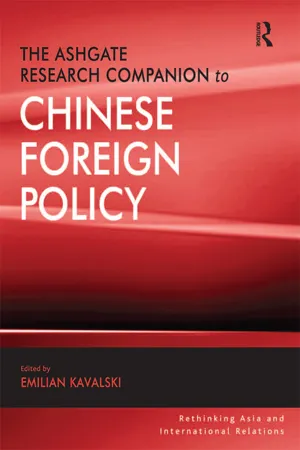
The Ashgate Research Companion to Chinese Foreign Policy
About this book
The Ashgate Research Companion to Chinese Foreign Policy draws out the full range of topics and issues that characterise China's external affairs. The volume is intended to provide an overview of Chinese foreign policy that will be relevant both to experts in the field as well as those that are just starting to grapple with Beijing's international outlook. The investigation of Chinese foreign policy offered by the volume is divided into seven parts: - Part I focuses on the historical evolution of Chinese foreign policy by detailing the specific traditions and the altering paradigms of Beijing's external outlook proffered for the explanation and understanding of Chinese foreign policy - Part II discusses the different analytical perspectives proffered for the explanation and understanding of Chinese foreign policy - Part III considers the domestic sources of Chinese foreign policy - Part IV analyses the international impact of Beijing's outreach - Part V of the volume begins the exploration of China's relations with specific international actors - Part VI investigates the regional interactions of Chinese foreign policy - Part VII of the volume draws attention to several issues impacting both the practice and the understanding of Chinese foreign policy This Companion draws a vivid picture of the full spectrum of topics, issues, and relationships that define China's international interactions. The collection therefore provides a relevant point of departure for anyone interested in learning about Beijing's external affairs. Owing to the wide range of themes and ideas, this volume is essential reading for students of Chinese foreign policy.
Information
Historical and Analytical Perspectives on China’s Foreign Policy
1
In Quest of Independence: An Unchanging Paradigm of China’s Foreign Policy
Introduction
Since 1978 there has been a sea change in China’s foreign policy and the ideology through which China’s leaders have interpreted international affairs as well as China’s national interests. China’s integration into the international community and participation in international institutions has led to claims that China is increasingly socialized into the established norms and rules of international order (Chan 2006; Johnston 2008; Kent 2007). However, it has been argued that one cannot have a proper understanding of China’s present-day international behavior without a sound grasp of its past. Thus, in understanding China’s international behavior, it is important not to overlook the underlying continuities of its foreign policy goals.
Key among them is the preservation of national independence, autonomy, and territorial integrity. This chapter begins with an examination of several developments that demonstrate China’s ongoing commitment to carve out an independent and autonomous space for security and development by challenging the domination of it by major powers ever since 1949. The second section of the chapter explores the relevance of such a historical overview for the explanation and understanding of Chinese foreign policy in the early twenty-first century. While China is emerging as a strong candidate for global power, the question that requires further exploration is whether China will continue to follow or seek to change the rules governing the prevailing Western-oriented international order?
Independence and Autonomy in China’s Foreign Policy
China’s emphasis on sovereignty and its autonomy in managing internal affairs can be traced back to the mid-nineteenth century, when it was forcibly brought into the international system by the West. In the wake of its defeat in the Opium War (1839–1842), China had to sign a number of “unequal” treaties, starting with the Treaty of Nanjing, which forced China to cede Hong Kong in perpetuity to Britain and to allow the British to reside in five Chinese cities (Guangzhou, Fuzhou, Xiamen, Ningbo and Shanghai) for mercantile purposes (Spence 1999: 160–66). This infused a profound sense of humiliation, which still underpins Beijing’s external outlook. The impact of this treaty system on Chinese contemporary history and its foreign policy is momentous. More significantly, it compelled China to reckon with and embrace the Westphalian system of international order.
Based on sovereign equality, absolute sovereignty and the doctrine of nonintervention in the domestic affairs of states, the Westphalian system had gradually come to dominate international affairs since the end of the Thirty Years’ War in 1648. Ironically, while China refused to engage with this state-centric pattern of international order during the nineteenth century, it has become one of its staunchest proponents since the founding of the People’s Republic of China (PRC) in 1949. With a deeply ingrained mistrust of external powers, Chinese leaders have also been motivated by the impulse to challenge the leadership of superpowers and to seek independence and autonomy from them. As soon as the Chinese communists came to power, they were determined to conduct the new China’s foreign policy under the principle of independence and autonomy. The following section uses four different cases from the past six decades of the PRC’s existence to demonstrate China’s willingness to challenge both the Soviet Union and the USA in order to maintain its foreign policy independence.
“Lean to one side” policy vis-à-vis independence and autonomy: The 1950s
The first case is Mao Zedong’s effort to seek independence from the Soviet Union during the early years of communist rule in the country. Owing to the Yalta Agreement and the bilateral Treaty of Friendship and Alliance between the Soviet Union and Nationalist China of 1945, the Chinese Eastern Railway and its southern branch, the South Manchurian Railway (later collectively known as the Chinese Changchun Railway), were under joint ownership and management by the Soviets and the Chinese. Dalian was internationalized and Lushun (Port Arthur) would be used by the Soviets as a naval base for 30 years until 1975. As soon as their control of the country was imminent in 1949, the Chinese communists were determined to have a new treaty with the Soviet Union in order to regain the ownership and administrative authority of the Changchun Railway and Lushun. To ease bilateral negotiations in the Northeast, Mao Zedong declared on June 30, 1949 that the PRC would “lean to one side [i.e. to the Soviet Union].” To further lure Stalin into withdrawing from Lushun, Mao emphasized the fraternal relationship with Moscow. The bargaining reached its climax when Mao visited the Soviet Union (between December 1949 and February 1950) in his first ever foreign visit after the Chinese Civil War.
With the announcement of the “lean to one side” policy, the most prominent gains for the PRC were threefold: firstly, that the Changchun Railway was returned to China; secondly, the Soviets committed to withdraw from Lushun as soon as a peace treaty with Japan was concluded, but “not later than the end of 1952” and, thirdly, there was an agreement that the question of Dalian would be further discussed upon the conclusion of the peace treaty with Japan, while the administration of the city would rest with the Chinese government (Goncharov et al. 1993: 119, 260–63).
However, the price that the PRC had to pay for these gains included the recognition of the independence of Outer Mongolia, which used to be part of Qing China, and the unequal clauses stipulated in the secret Additional Agreement and other protocols between the two countries signed alongside the formal Sino-Soviet Treaty of Friendship, Alliance and Mutual Assistance. One of the protocols was that China would not allow “the citizens of third countries to settle or to carry out any industrial, financial, trade, or other related activities in Manchuria and Xinjiang.” Only because of resistance and displeasure from Mao and Zhou Enlai did Stalin restrict his demands to Manchuria and Xinjiang and agree to a reciprocal obligation on the Soviet Far East and the Central Asian republics. Other clauses stipulated that China was required to sell a quota of strategic minerals in Xinjiang to the Soviet Union and that it would require Soviet approval to sell them to other countries. The humiliating extraterritorial treatment with which imperial China had to bear remained; Soviet citizens in China who committed crimes would be handled by the Soviet Union. The Soviet Union also attached conditions to the loans it offered to China. They included that China would be required to deliver rare metals such as tungsten, antimony, lead and tin to the Soviet Union for 14 years. During the Korean War when the West imposed an embargo against the Soviet bloc, Stalin requested China to plant rubber inside China and to acquire the material from third countries (Goncharov et al. 1993: 121–9; Zhang 2001: 66–7; Shen 2007: 141–3).
Against this background one can readily understand why China’s emphasis on and assertion of “self-reliance” grew in the wake of Stalin’s death in March 1953. China and Jawaharlal Nehru’s India in June 1954 advocated a more neutral foreign policy and agreed on the Five Principles of Peaceful Coexistence, which advocated mutual respect for territorial integrity, nonaggression, noninterference in internal affairs, equality and mutual benefit, and peaceful coexistence. By arguing that foreign aid would be most effective when it worked on the basis of national independence and self-reliance, Mao emphasized that China was in need of Soviet aid but would not excessively rely on it. Zhou Enlai reiterated that China rejected aid that was designed to foster the needs of donor countries and to deepen the dependence of recipient countries (Keith 2011: 38–47). A secret military agreement was signed in October 1957 whereby the Soviet Union promised to deliver to China a sample atomic bomb and nuclear know-how. Khrushchev regarded this agreement as part of his policy to integrate China into the Soviet military strategy (Pleshakov 1998: 232–3). However, when he pressed Beijing to construct a joint sub-marine station on Hainan, southern China during 1957–1958, Mao rejected the proposal immediately and accused Moscow of “trying to control all of our coastline” and treating the Chinese from the standpoint of “big power chauvinism” (Lüthi 2008: 93; Chen and Yang 1998: 269–70). During Khrushchev’s second visit to China between July 31 and August 3, 1958, he tried to clarify the controversies and misunderstandings about the establishment of a long-wave radio communications transmitter station on Chinese territory for Soviet submarines and a joint Sino-Soviet submarine flotilla, but to no avail (Chen and Yang 1998: 268–70; Lüthi 2008: 92–5; Zhang, 2001: 224–7).
The Sino-Soviet rift grew to an open conflict in the late 1950s. Key to Mao’s antagonism towards Khrushchev’s “peaceful coexistence” doctrine was his primary concern that the domineering Soviet Union would collude with the USA to intensify control over China when the USA was supporting the Chiang Kaishek regime in Taiwan. China’s dismay about Soviet reluctance to share nuclear weapon technology with it should be read in this context (Zhang 2001: 223–4). To demonstrate his autonomy from the Soviets, Mao did not inform Khrushchev of his plan to shell Taiwan’s Jinmen (Quemoy) in August 1958 when they met earlier in Beijing in July–August (Chen and Yang 1998: 270–71; Lüthi 2008: 98). Failing to appreciate China’s eagerness to unify the country, Khrushchev further irritated the Chinese leadership by persuading Mao to accept an independent Taiwan and to be more accommodating towards the USA during his visit to China in September–October 1959, shortly after the Camp David summit with Dwight Eisenhower. Khrushchev even gave Mao a lecture on the errors of his “Great Leap Forward” and India policy (Chen and Yang 1998: 274; Lüthi 2008: 149; Zhang 2001: 229–30).
As a result of China’s quest for independence and autonomy from the Soviet Union in the 1950s and 1960s, it became increasingly revolutionary, accusing the Soviet Union of degenerating into a revisionist state. The rupture with the Soviet Union and the subsequent withdrawal of all Soviet economic aid in 1960 forced China to put the Third World at the top of its strategic priorities in order to carve out a niche for its interests in international politics between the Soviet Union and the USA. After conciliation with Washington, Mao fine-tuned his “Three Worlds” theory and singled out the Soviet Union as the “number one enemy,” while skillfully positioning the USA as a potential ally.
China’s rapprochement with the US and Taiwan: The 1970s
The Sino-America rapprochement in the early 1970s was underpinned by China’s threat perception and uncertainty about the security of its territorial integrity in the wake of its rift with the Soviet Union. In 1968 the Soviet Union invaded Czechoslovakia and justified it by coining the “Brezhnev Doctrine,” which asserted Moscow’s right to use force to protect socialism. While the rift between Beijing and Moscow had been escalating since the late 1950s, Moscow had tried to coerce Beijing to return to the Soviet bloc and accept Moscow’s leadership. In these circumstances, China feared that it might be the next victim of a Soviet invasion. Simultaneously, Moscow was rapidly expanding its influence along the Chinese border in Asia. It provided military support to Hanoi and assisted in unifying Vietnam. Moscow also concluded a Soviet–Indian Treaty of Peace, Friendship, and Cooperation with New Delhi. Furthermore, Moscow’s increasing military deployments along the Sino-Soviet border in the 1960s had reinforced Beijing’s conviction that Soviet “social-imperialism” endangered China’s security and independence (Ross 1995: 23–9).
While China had strong incentive to normalize relations with the USA to counter the threat from the north, the Taiwan issue provided a major hurdle for such normalization. US support for the Chinese Nationalists could be traced back to its World War II alliance with Chiang Kai-shek. With Washington’s economic and military aid, the Republic of China (ROC) eventually consolidated its position in Taiwan. During the 1950s and 1960s, Taiwan served as one of the US military bases in East Asia aimed at countering the spread of communism in the region. The thorniest issue in the extensive Sino-American negotiations both before and during Richard Nixon’s historic visit to China in February 1972 was the status of Taiwan. At that time the USA still recognized the ROC as the legitimate government of China and stationed troops on the island as a result of the US–ROC Mutual Security Treaty. Initially, in May 1971 before Kissinger’s secret visit to China, Beijing demanded that American forces be removed from Taiwan within a specified period (Ross 1995: 37). Although the USA did not accept this condition in February 1972, it offered a tacit concession on the Taiwan issue. The Shanghai communiqué, signed by Nixon and Zhou Enlai, included the American acknowledgement that “all Chinese on either side of the Taiwan Strait maintain there is but one China and that Taiwan is a part of China” and the stance that “[t]he United States Government does not challenge that position,” but it also implied that the USA did not subscribe fully to that position either (Ross 1995: 268).
China’s confrontation with the USA and Taiwan: 1995–1996
Although the question of Taiwan was not fully resolved in 1979 when the USA established diplomatic relations with the PRC, cross-Strait relations had since then improved. However, the issue of Taiwan has remained the most likely flashpoint for Sino-US relations. The two countries reached a crisis point after Lee Tenghui’s trip to the USA in June 1995. The pro-independence Lee was facing his first electoral campaign in less than a year by the time he visited the USA. In a public lecture he delivered at Cornell University, he referred to Taiwan as “Republic of China on Taiwan” several times. These provocative statements, together with the support he received from members of US Congress, struck a sensitive chord in the PRC. Beijing was convinced that Washington supported Lee’s strategy of “creeping independence” by fostering wider “official” relations, tantamount to an implicit reversal of American stance on the “one China” policy (Swaine 2001; Goldstein 1999). Lee’s American trip, therefore, further deepened Beijing’s suspicions that the USA may want to “contain” China in a new Cold War.
This perception prompted a remarkably harsh response from the PRC against both the USA and Taiwan. Beijing immediately suspended the second round of Taiwan–PRC talks, which virtually halted the cross-strait dialogue. At the same time, the PLA conducted a series of exercises off the Taiwan Strait between July 1995 and March 1996, which coincided with the first presidential elections in Taiwan. The aim of these exercises was twofold. The first was to intimidate Taiwan’s population into constraining their leaders from going along the road to de jure independence and separation from China. The second purpose was to send a message to Washington about Taiwan’s ongoing position as one of China’s vital interests (Ross 2000: 104).
As a further demonstration of its displeasure, Beijing suspended its working relationship with Washington in 1995. China not only canceled a number of important dialogues with the USA, but also recalled its ambassador to the USA. The White House tried to maintain a low profile at the early stage of China’s military exercises. Such an attitude, however, reinforced Beijing’s perception that Washington had not received the message. In this respect, China decided that more provocative military exercises were needed (Ross 2000: 104). The confrontation reached its zenith in March 1996 when the PLA fired four M-9 missiles into waters about 20–30 km off the northern and southern coasts of Taiwan. Such actions clearly indicated to both Taiwan and the USA that China was serious about its territorial integrity and was ready to use force against any pro-independence movements.
This military escalation prompted a strong criticism and reaction from Washington, which immediately deployed two US carrier battle groups to the region. It was reported that this was the largest American deployment in East Asia since the Vietnam War (Ding 2003). It seemed that Washington also intended to send an emphatic signal to Beijing that the USA would not watch from the sidelines China’s military threats against Taiwan. American officials, such as the Secretary of Defence William Perry, described the Chinese military activities as “reckless and provocative.” When Liu Huaqiu, the director of the Chinese State Council’s Foreign Affairs Office, visited Washington around the same time, senior US security policy officials warned that, if China did not exercise restraint, there might be serious consequences (Sutter 1995; Swaine 2001: 325). Alarmed by Beijing’s aggressive diplomacy, the USA found that it had to handle China’s core interests with extreme care in order to reduce regional tension. Washington therefore assured Beijing that visits by Taiwan’s leaders such as that by Lee Teng-hui would not happen again (Yahuda 2004: 259). In his state visit to the PRC in June 1998, President Clinton informally corroborated American support for the “three nos” policy (Yahuda 2004: 262).
In quest for policy autonomy: The appreciation of the renminbi since 2008
The final case is about China’s currency policy (Chan et al. 2012: chapter 4). Like Japan and the newly industrializing economies of East Asia, China has relied on export-oriented industrialization to achieve and sustain high economic growth. Following the Asian financial crisis of 1997–1998, it began to accumulate foreign exchange reserves as a precautionary measure to buffer against any future financial crisis, contributing to the growth of a global saving glut (Bernanke 2005). To maintain an exchange rate that is favorable to its exports, the Chinese monetary authorities intervene in foreign exchange markets by buying the current account surplus from sellers, which leads to a growth in money supply in the Chinese economy. To offset or “sterilize” the inflationary effects from the build-up of such foreign exchange reserves on the domestic monetary base, Beijing issues domestic bonds to absorb the growing money supply and invests the foreign exchange reserves they hold into dollar-denominated assets to offset the cost of redeeming the domestic bonds.
This has generated a flow of financial capital from China into the USA, fueling the availability of cheap credit and eventually the financial crisis. Therefore the allegedly undervalued Chinese currency is believed to be one of the culprits of the global economic recession. It is argued that there should be greater international coordination ...
Table of contents
- Cover Page
- Half Title Page
- Title Page
- Copyright Page
- Table of Contents
- List of Figures and Tables
- List of Contributors
- Acknowledgements
- List of Abbreviations
- Introduction: Engaging China’s Foreign Policy
- Part I Historical and Analytical Perspectives on China’s Foreign Policy
- Part II The Domestic Sources of China’s Foreign Policy
- Part III The International Impact Of China’s Foreign Policy
- Part IV China’s Bilateral Interactions
- Part V China’s Regional Strategies
- Part VI Outstanding Issues in China’s Foreign Policy
- Epilogue: Whither China and its Foreign Policy? Future Trends, Developments, and the Logic of Relationships of China’s International Interactions
- Bibliography
- Index
Trusted by 375,005 students
Access to over 1.5 million titles for a fair monthly price.
Study more efficiently using our study tools.
Frequently asked questions
Yes, you can cancel anytime from the Subscription tab in your account settings on the Perlego website. Your subscription will stay active until the end of your current billing period. Learn how to cancel your subscription
No, books cannot be downloaded as external files, such as PDFs, for use outside of Perlego. However, you can download books within the Perlego app for offline reading on mobile or tablet. Learn how to download books offline
Perlego offers two plans: Essential and Complete
- Essential is ideal for learners and professionals who enjoy exploring a wide range of subjects. Access the Essential Library with 800,000+ trusted titles and best-sellers across business, personal growth, and the humanities. Includes unlimited reading time and Standard Read Aloud voice.
- Complete: Perfect for advanced learners and researchers needing full, unrestricted access. Unlock 1.5M+ books across hundreds of subjects, including academic and specialized titles. The Complete Plan also includes advanced features like Premium Read Aloud and Research Assistant.
We are an online textbook subscription service, where you can get access to an entire online library for less than the price of a single book per month. With over 1.5 million books across 990+ topics, we’ve got you covered! Learn about our mission
Look out for the read-aloud symbol on your next book to see if you can listen to it. The read-aloud tool reads text aloud for you, highlighting the text as it is being read. You can pause it, speed it up and slow it down. Learn more about Read Aloud
Yes! You can use the Perlego app on both iOS and Android devices to read anytime, anywhere — even offline. Perfect for commutes or when you’re on the go.
Please note we cannot support devices running on iOS 13 and Android 7 or earlier. Learn more about using the app
Please note we cannot support devices running on iOS 13 and Android 7 or earlier. Learn more about using the app
Yes, you can access The Ashgate Research Companion to Chinese Foreign Policy by Emilian Kavalski in PDF and/or ePUB format, as well as other popular books in Politics & International Relations & International Relations. We have over 1.5 million books available in our catalogue for you to explore.