The contributors to this volume, originally published in 1962, explain the raison d'être of their own specialism in history be it archaeology, political, local, economic or social history or historical geography.
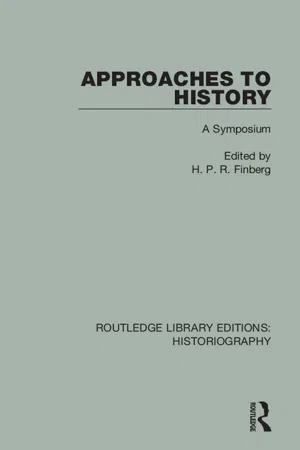
- 228 pages
- English
- ePUB (mobile friendly)
- Available on iOS & Android
eBook - ePub
Historical History
DOI: 10.4324/9781315638904-6
Geographies of the Past
The full force of the term ‘historical geography’ is borne in upon a man over the age of, say, fifty years. He can look back across a generation and recall some geographical account of an area he had read in his twenties. Maybe it described the material features of a countryside, both the natural and the man-made features; and, on the basis of these, it may have divided the area into contrasting regions, each with its own characteristic landscape. When it was written, such a description may well have been hailed as a faithful and penetrating picture, but, after the lapse of years, our reader is soon aware that it is ‘out of date’. Immediately the question arises: “In becoming history, has it ceased to be geography?” It has certainly become a historical document. The Land Utilisation Survey of Britain, made in the 1930's, was an important achievement of geographical study, yet it is on the way to becoming as much a document of history as the county reports of the Board of Agriculture in the years around 1800.1 On the other hand, it remains, not only in its factual material, but also in its conception and organization, as much a study of geography as a similar land-use survey that might be made today. In its turn, this present-day survey would be destined to take its place in the archives of the years to come. The present is but the past of some future.
It was with some such thoughts as these in mind that many geographers came to believe that the long-standing term ‘historical geography’ could logically be used to describe only one approach—the description of the geography of an area at some past time. This was the point of view outlined by the German geographer, Alfred Hettner, in 1898, and elaborated by him in many subsequent studies. “A historical geography of any region,” he wrote in 1927, “is, in principle, possible for any period of its history, and it must be written separately for each period; there is not merely one, but a multitude of historical geographies.”1 J. F. Unstead, in England in 1907, had described historical geography as the cutting of “horizontal sections through time;”2 and in 1928 Sir Halford Mackinder was speaking of “a true historical geography” involving what “literary people call the historic present.”3 One British definition in the early 1930's declared that “Historical Geography is the reconstruction of the geographical conditions of past times.”4 This is a view that may be amplified by another statement of the time: “The application of the adjective ‘Historical’ to the noun ‘Geography’ strictly speaking merely carries the geographer's studies back into the past: his subject-matter remains the same.”5 American geographers, and to a less degree French geographers, were making somewhat similar statements, and exemplifying them in a series of distinguished studies.
While the term ‘historical geography’ was thus being limited by geographers to connote only the geography of a past period, some historians had already found it necessary to attempt such reconstructions as part of particular tasks before them. Macaulay in his History of England (1848) stated clearly the necessity for some visualization of past landscapes. “If we would study with profit the history of our ancestors,” he wrote, “we … must never forget that the country of which we read was a very different country from that in which we live.” Accordingly, in his famous third chapter, he set out to describe the landscape of England in 1685 as a prelude to the history of post-Restoration times. It was with similar intent that, not quite a century later, Macaulay's kinsman G. M. Trevelyan prefaced his trilogy, England under Queen Anne (1930–33), with what he described as “a survey” of “Queen Anne's island,” based largely upon Daniel Defoe's account of it. And about this time, too, J. H. Clapham in his trilogy, An Economic History of Modern Britain (1926–38), gave two accounts of what he called “the face of the country,” in 1820 and again in 1886–7. Then, more recently, A. L. Rowse in The England of Elizabeth (1950) asked the question: “If we would think back to what the face of the country looked like then, what are the chief differences we should notice?” (p. 66). A number of chapters seek an answer to this question, and, in so doing, give us a vivid reconstruction of the geography of England in the later years of the sixteenth century. In the same year, S. T. Bindoff was describing how Tudor England “wore an appearance very different from that which the name now conjures up in our minds.”1 And not long after this, J. D. Mackie, in his study of The Earlier Tudors (1952), devoted a chapter to “The Face of England.”
It may be that these illuminating studies, and others of smaller areas within England, to say nothing of corresponding studies in other countries, are not exactly the ‘cross-sections’ that a geographer would produce, the geographer with his preoccupation with land and man and with the distribution of phenomena in space. But the difference is not one of principle. It is not difficult to envisage a historian, with an appreciation of geographical circumstances and method, writing something that would be indistinguishable from a similar study written by a geographer with an appreciation of historical evidence and method.
One of the most interesting ‘reconstructions’ yet achieved is by an American geographer, Ralph Brown. In 1938 he pointed out that “a time sequence is by no means essential in a geographical study of the past;”2 and in 1943 appeared his Mirror for Americans: Likeness of the Eastern Seaboard, 1810, in which “likeness” was used in its older meaning of image or portrait. The study is a reconstruction, but a reconstruction with a difference. Brown carried the idea of making a cross-section of the geography of a past period to a logical conclusion. He invented an imaginary author of the early nineteenth century, Thomas P. Keystone, and he wrote the book that Keystone might have written in 1810, based upon the sources that were available at the time. These sources, moreover, were used with the understanding that could be expected of a man of 1810; and the style of presentation, the maps and illustrations, even the language, are those of the period.
In appraising the method of the book, two points must be borne in mind. In the first place, the idiosyncrasy of the treatment has a limiting effect in the sense that the reconstruction does not avail itself of modern knowledge of the relief and soils and climate of the eastern seaboard. The imaginary Keystone was obviously a man who not only had something to say but who could say it well, yet a study by Ralph Brown, writing as Ralph Brown, would have given us an even clearer view of the geography of the area in 1810. Thomas P. Keystone's reconstruction, in effect, partakes of the nature of a genuine early source such as Thomas Jefferson's Notes on the State of Virginia that appeared in 1784. In the second place, the method of the Mirror for Americans is not one that can be followed generally with the likelihood of any great success. As one looks back in time, the language, the outlook, and the method of exposition, become more and more different from our own, until one reaches a point when a ‘reconstruction’ in Brown's manner could have little but antiquarian value. It is difficult, for example, to envisage a useful presentation of the geography of an area during the Middle Ages along these lines. Yet, even when the full force of these points is allowed, who would wish the Mirror for Americans to be any different? It is a tour de force and an intellectual exercise that throws light upon some of the problems involved in the creation of the “historic present.” It is, moreover, a work of great charm that must delight all who read it.
In an attempt to draw a line between geography and history, the method of cross-sections has been hailed as being essentially geographical as opposed to historical. It is true that a cross-section must be written largely with the aid of historical data, nevertheless, wrote Derwent Whittlesey (partly with Ralph Brown's study in mind), “it omits the compelling time sequence of related events which is the vital spark of history.”1 The idea of a time sequence immediately involves narrative as opposed to description, and there is a variety of opinion about the degree to which a time element should appear in the geographical description of an area, whether at the present time or at some past time. Geographers have debated this amongst themselves, and their debate is not irrelevant to one's view of the relationship between geography and history. It is not too fanciful to discern a graduation in opinion, and to recognize three attitudes.
In the first place, there are those descriptions that ignore, or seem to ignore, what has gone before, and that restrict themselves severely to ‘present-day’ geography of whatever date that may be. Paradoxically, therefore, some studies in historical geography lack a historical approach, just as do some studies in modern geography. Such descriptions certainly have a utilitarian value in presenting a body of information convenient for reference. Ironically, these accounts will provide useful material for those scholars of future generations—whether geographers or historians—who essay to describe landscapes of the past.
In the second place, some opinion would limit historical comment to those features to be seen in the landscape of the ‘present day’, i.e. to the ‘relict features’ of a past age. That is to say, a geographer should be concerned with the past only in so far as “it has left vestiges and so exists also, in effect, in the present.”2 On reflecting upon this, one can but observe that it is not always easy to separate the surviving elements of a past phase from associated phenomena that have disappeared. Moreover, the geography of a past age has frequently influenced that of the present day otherwise than by leaving souvenirs of itself. The absence of a species of tree in a forest, where soil and climate should make it dominant, might well be due to an earlier phase of utilization that has left no ‘relict features’. Or, again, the growth of a town might well have obliterated the features that played a part in its origin.
Thirdly, there are yet others who would place no restriction on the rôle of history in geographical description and would even say, in the words of Preston James: “The full perspective of the time sequence in so far as it is related to geographic patterns and processes is essential if we are to read the story of contemporary differences correctly.”2 One can envisage such a treatment broadening out into a vista of man-land relationships evolving through time. This wide view of geographical change forming part of a cultural process has been re-affirmed time and again in a series of eloquent statements by Carl Sauer. To him, the landscape of any particular age reflects the culture of the people occupying it: “Under the influence of a given culture, itself changing through time, the landscape undergoes development, passing through phases.”2 A series of reconstructions of the landscape of an area at successive periods thus forms part of the culture history of the area, leading up to its present-day geography. Sauer explicitly stated in 1941: “I wish to reckon historical geography as part of culture history.”3
Table of contents
- Cover Page
- Half-Title Page
- Title Page
- Copyright Page
- Original Title Page
- Original Copyright Page
- Table Of Contents
- Introduction by The Editor
- Political History by S. T. Bindoff
- Economic History by W. H. B. Court
- Social History by H. J. Perkin
- Universal History by G. Barraclough
- Local History by H. P. R. Finberg
- Historical Geography by H. C. Darby
- The History of Art by D. Talbot Rice
- The History of Science by A. Rupert Hall
- Archaeology and Place-Names by F. T. Wainwright
Trusted by 375,005 students
Access to over 1.5 million titles for a fair monthly price.
Study more efficiently using our study tools.
Frequently asked questions
Yes, you can cancel anytime from the Subscription tab in your account settings on the Perlego website. Your subscription will stay active until the end of your current billing period. Learn how to cancel your subscription
No, books cannot be downloaded as external files, such as PDFs, for use outside of Perlego. However, you can download books within the Perlego app for offline reading on mobile or tablet. Learn how to download books offline
Perlego offers two plans: Essential and Complete
- Essential is ideal for learners and professionals who enjoy exploring a wide range of subjects. Access the Essential Library with 800,000+ trusted titles and best-sellers across business, personal growth, and the humanities. Includes unlimited reading time and Standard Read Aloud voice.
- Complete: Perfect for advanced learners and researchers needing full, unrestricted access. Unlock 1.5M+ books across hundreds of subjects, including academic and specialized titles. The Complete Plan also includes advanced features like Premium Read Aloud and Research Assistant.
We are an online textbook subscription service, where you can get access to an entire online library for less than the price of a single book per month. With over 1.5 million books across 990+ topics, we’ve got you covered! Learn about our mission
Look out for the read-aloud symbol on your next book to see if you can listen to it. The read-aloud tool reads text aloud for you, highlighting the text as it is being read. You can pause it, speed it up and slow it down. Learn more about Read Aloud
Yes! You can use the Perlego app on both iOS and Android devices to read anytime, anywhere — even offline. Perfect for commutes or when you’re on the go.
Please note we cannot support devices running on iOS 13 and Android 7 or earlier. Learn more about using the app
Please note we cannot support devices running on iOS 13 and Android 7 or earlier. Learn more about using the app
Yes, you can access Approaches to History by H. P. R. Finberg in PDF and/or ePUB format, as well as other popular books in History & Historiography. We have over 1.5 million books available in our catalogue for you to explore.