Aimed at students of history, this volume, originally published in 1928, examines the issues of impartiality and objectivity in the study of history. It also discusses the skills necessary for any would-be historian including the knowledge of foreign languages, the use of sources and note-taking.
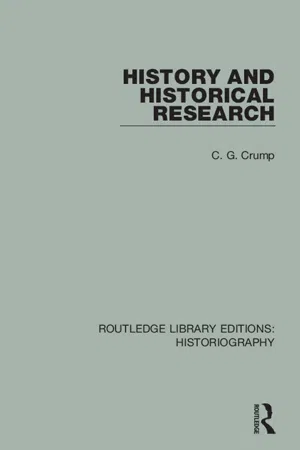
- 184 pages
- English
- ePUB (mobile friendly)
- Available on iOS & Android
eBook - ePub
History and Historical Research
History and Historical Research
By
C. G. Crump
Author of The Logic of History, etc.
LONDON
GEORGE ROUTLEDGE & SONS, LIMITED
BROADWAY HOUSE 68-74 CARTER LANE, E.C.
1928
Contents
- PREFACE
- I THE ENQUIRING MIND
- II THE DISCOVERY OF A SUBJECT
- III THE SEARCH FOR MATERIAL
- IV NOTES AND THE MAKING OF THEM
- V THE FINAL STATEMENT
Preface
I began this book in the month of January, 1926. It grew in the first place out of a suggestion made to me by Professor A. P. Newton of the University of London; and at a later stage in its history it turned into the materials for some informal talks to a small number of graduate students, which at the suggestion of Professor Wallace Notestein I was allowed to give at Cornell University in the spring of 1927. On my return from that experience, in which I learned at least as much I taught, I rewrote a part of the manuscript in consequence of criticisms received from friends, who had been kind enough to read it and suggest amendments. Among them I owe most to Professor Becker of Cornell University, to the Rev. Claude Jenkins, the Librarian of Lambeth, and to Professor Newton and Professor Notestein, whom I have already mentioned. Their suggestions have improved the plan of the book and in places enriched the matter of it. I have also thank Mr. C. Johnson of the Public Record Office for help in avoiding errors. The faults of the book are my own; the friends who have helped me will, I hope, approve the use I have made of their suggestions, and pardon if I have misused them.
C. G. Crump.
October, 1927.
I The Enquiring Mind
DOI: 10.4324/9781315638331-1
THERE are many ways of writing a book and the merits of those different ways can only be determined by the taste of the reader and the discretion of the writer. But as a matter of convenience there is much to be said for a plan which puts the conclusion of the book in the first chapter. The reader will know at once what he may hope to find, the writer will know what he has to discover for himseif and offer to the reader: what is even more important, both will get to know what the book is not meant to contain. This book, for instance, is not meant to contain any systematic account of the mechanical processes of the historian; it will not give any detailed instruction in the art of note-taking, or hints on the size or classification of slips; nor will it deal with the value of particular bibliographies or criticize the methods used by historians. Still less will it attempt to lay down canons of historical criticism or discuss the special difficulties that await those who wish to write on particular periods or subjects. Something may, indeed, be found on all these points, but they will only be discussed partially and by way of illustration of the main topic of the book, and that will be the case even in those chapters whose titles may seem to suggest that in them some systematic treatment of these matters is intended. The book, in fact, deals with one subject only, a subject easier to discuss because of its limitation, harder to define because there is about it a certain vagueness due to the manifold variations of the human mind. For it is the mind of the historical enquirer at which this book is aimed, his mental processes and his ways of thought; not indeed the mind of the accomplished scholar to whom inquiry has become a second nature, but the mind of the beginner, the tentative struggler, or even that of the worker who has never attained to any confidence in his own methods; one who like the writer himself is still wondering whether, like Lord Byron, he might not have done more, if his energies had been better or otherwise directed.
It has been said that there is a certain vagueness about this subject and that men’s minds work in many ways. It follows that the reader will find here no prescription, no patent method, by which he can become an accomplished scholar; he will not even find a description of the typical mind of the ideal student. He will only find an account of certain ways of thought, certain intellectual processes, which the writer thinks he has discovered and admired in others, and which he would have liked to possesss himself. Moreover, he will find this account expressed, not as a whole, but in an apparently fragmentary form. He will find a discussion of the process of discovering a subject for study, another on the search for materials, a third on the process by which he may master those materials, and yet a fourth on the art of constructing a narrative. This method of treatment may lead the beginner to conclude that the author supposes that this order is the order in which historical work should be done, or that at any rate his mind is expected to think in that order. A careful reader may discover at intervals passages in all those chapters which will show him that the writer has no such belief. Lest, however, these indications should escape the attention of the reader, it may be well to point out once for all that no wise man ever worked in that manner, and that any student will soon find that all the four processes here described are so interlaced and so similar that he will inevitably find that he cannot find his subject without discovering and mastering materials at the same time, or do any of these three things without being able to express his results while he does them. Little by little it will dawn upon him that the ideal student’s mind can do all these things together and yet know which of them he is doing at any given time. This last sentence is not far from being nonsense; it is only meant as a challenge to the reader to do better.
No doubt more than a mere challenge could have been attempted; but a writer is perhaps wise in refraining from doing more. The teacher who can use the actual contact of mind with mind may be able to enforce on his own pupils his own conception of the ideal habit of thought and way of work. The pupil, who is strong enough to profit by such instruction, will be the first to resent that intellectual domination and rebel against it; and the finest minds will always remember with gratitude the training which produced their eager revolt. Minds of less strength, incapable of rebellion, will not go far; to each of us character and intelligence, not to mention other factors, assign our limits. The methods of a teacher cannot be used by a writer. The teacher’s control can be resisted only by rebellion; the writer can be restrained by the simpler method of closing his book. His first duty is to persuade the reader to refrain from this peremptory form of inattention. He must appeal to the reader’s interest and remember that he is writing for unknown minds to whom he is himself unknown; and remember that dogmatic treatment of complicated matters is in itself repulsive. It would, for instance, be easy to begin this disquisition by advising all would-be researchers to practise the virtue of industry. From industry one could lightly turn to the praise of accuracy, and so to other virtues of equal importance. All these things are certainly needful to the researcher, as needful as are legs to a mountain climber or eyes to a greyhound. But by themselves they are useless. The object of this book is to discover the characteristic qualities which mark a certain habit of mind, and to that it is time to return.
No one who desires to do original work on history will begin his enquiry with a mind unformed. Methods of thought, ways of approaching a subject, convictions, dislikes and admirations, susceptibilities of interest and boredom will already be in existence and more or less powerful. Some of these habits of mind will be known to the student, others will make themselves felt by degrees, and some will only be apparent to his friends and critics. Taken together they make up the character of the individual mind, either original in it or acquired. A student need not trouble himself about these facts or try to alter them. All he has to do is to know them, so far as he can, to know where he is likely to be led astray by his mental character, and where he may let himself advance with safety.
This is not a work on mind-training and is not intended to start anyone on a futile search for self-knowledge. Yet it is necessary to point out that every mental process, every acquisition of new knowledge involves the use of a mechanism of thought and memory already trained by use and experience to take a particular view of facts submitted to them. Now it is often suggested that the student should aim at freeing himself from these fetters and endeavour to attain an intelligence déliée, and that only by such an effort can he become that impartial spectator of the past who alone has the right to call himself an historian. No one will dispute the magnificence of the ideal, but it is permissible to doubt whether even those who praise it most eloquently ever attain to it, or even know how much the impartial man must forfeit in his pursuit of that splendid virtue. In the first place he must surrender all desire to take a side in the controversies of the past, and study to conceal his own view of them, even if he dares to have one. He must judge, for impartiality means judging; he must therefore be able to award a due measure of praise and blame to the great men who struggled for the rival ideals which have distracted mankind. To do this he must understand the motives of the most diverse characters, and without adopting either side give judgement on the merits of the case. He must decide between St Dominic and the heretics whom he quelled, between Frederick the Second and the Popes with whom he contended, between Boniface the Ninth and Philip the Fair, between Leo the Tenth and Luther; on the intellectual side he must be able to assign their rightful places to St Bernard and to Abelard, and settle authoritatively the vexed question of the right of the clergy to temporal wealth. If we turn to modern times the impartial historian will have to settle the measure of blame or praise that should attach to Philip the Second of Spain; Elizabeth, Richelieu, Mazarin, Charles the First, Strafford, and Cromwell must pass under his judgement. He must appreciate Burke and Wellington, explain Napoleon and know the inmost soul of Bismarck. Nor is this all; he must fit himself to pass impartial sentence on the great movements, which draw men into the sudden fits of energy which disturb the even course of history; he must estimate the good and evil of revolutions, balance the harm of wars against their benefits, and know the motives which cause men to leave their homes to seek prosperity in strange lands. He must make his own code of law, and while he applies it can know neither affection nor dislike for the men or causes summoned before his tribunal.
He may, of course, repudiate the responsibility1 . He may say that it is not the business of an historian to be a judge, and that the question of impartiality does not arise. His business is to understand the actions and the motives of Napoleon, for instance, and express and explain them; nor need he consider or pronounce judgement upon the righteousness or even the wisdom of them. That is the duty of the reader, if indeed it is the duty of any one. That by this course the historian avoids many difficulties, is clear enough; and yet even in this way of work there are perils to encounter. In the first place such a writer must definitely avoid one part of history; the history of the development of ethical ideas. He must not say that the shooting of the Duke of Enghien was a crime or even a blunder on Napoleon’s part. He must merely describe the mental state of Napoleon which led him to order the arrest, the trial, and the execution of the man whom he desired to put out of his way. In the same way he must deal with such matters as the massacre of St Bartholomew or the persecution of the Quakers in New England. He will have to watch his style very carefully, for one of two things is likely enough to happen to him as he writes. His language will become cold, colourless and even timid, or he will become a master of irony; and the man who becomes a master of irony too often, like Gibbon, is mastered by it in the end. Nor is this the only peril to be encountered; the worker may slip into the belief that a scientific1 method of study may enable him to attain ‘objectivity’; that he can passively observe and discover facts and present them to the reader exactly as he receives them without allowing his own mind to affect the accuracy or character of the presentation in any way. Language is a difficult tool, and has its own ways of disconcerting such a scheme; and the words that come from a writer’s pen have an awkward way of defying all attempts at objectivity by expressing the subjectivity of their selecter without his knowledge. Probably the recording angel is the only example of an historian who is both impartial and objective. Again it might be urged that in the pursuit of these qualities it is easy to go too far; it would be easy to discover believers in democracy who in their zeal for democracy blindly praise Napoleon, who was not a democrat; while others, zealous supporters of authority condemn the one man, who above all others knew the value of authority, and wrecked his cause by over-insistence on it.
One thing is at least clear. Even those who believe that impartiality and objectivity are duties incumbent upon historians, must admit that they are not easy duties. Minds capable of this task are few; only those can work in those high places who can endure solitude. Only those can attain to them who have been fortified by long study and strengthened by participation in great events. For minds not so equipped the pursuit of these qualities is an adventure too high. Let anyone who doubts this, make a list of those historians to whom he would allow these merits without qualification. No such list will be attempted here. But it is easy to mention names which have no claim to be placed in it; Gibbon, Voltaire, Michelet, Macaulay, Carlyle, Mommsen, Treitschke. All are great names, and many more could be added. Nor would it be difficult to give a list of great historians who have tried the adventure and failed, or only succeeded by writing history without considering the passions of the men who lived among the events of which they write. Yet these men too have written great works. But it is the men in the first list who command the attention of their readers and their words still live. Yet if any of them had tried to write impartially or objectively, that very effort would have silenced them. The very fact that they have a definite point of view to maintain inspired them and attracts the reader whether he agrees with them or is provoked to dissent.
The beginner, who aims at impartiality and objectivity, will assuredly hamper himself and fail to achieve them; it is far better for him to put all such ideals on one side, and let his mind work freely on its own natural lines. Let him take lower levels and train himself to be an advocate before he attempts to play the part of the recording angel. To do this he must possess the virtues of an advocate1 , including above all the virtues of fairness and honesty. The task of passing final judgement he may leave to those who essay it, and to the advocates of the other side. It is his part to practise honesty and fearlessness in expressing such opinions as he may form or possess; and for this purpose he will do well to observe two rules of conduct. The first rule is that the evidence for all conclusions must be stated as it exists in the source from which it is taken, avoiding any method of statement that may alter or impair its meaning or its emphasis. The second rule is that the writer must distinguish clearly between the evidence and any criticisms or inferences made by himself. These seem simple matters, but like most rules of conduct they are s...
Table of contents
- Cover Page
- Half Title Page
- Title Page
- Copyright Page
- Frontmatter 1
- Table of Contents
- PREFACE
- I THE ENQUIRING MIND
- II THE DISCOVERY OF A SUBJECT
- III THE SEARCH FOR MATERIAL
- IV NOTES AND THE MAKING OF THEM
- V THE FINAL STATEMENT
Trusted by 375,005 students
Access to over 1.5 million titles for a fair monthly price.
Study more efficiently using our study tools.
Frequently asked questions
Yes, you can cancel anytime from the Subscription tab in your account settings on the Perlego website. Your subscription will stay active until the end of your current billing period. Learn how to cancel your subscription
No, books cannot be downloaded as external files, such as PDFs, for use outside of Perlego. However, you can download books within the Perlego app for offline reading on mobile or tablet. Learn how to download books offline
Perlego offers two plans: Essential and Complete
- Essential is ideal for learners and professionals who enjoy exploring a wide range of subjects. Access the Essential Library with 800,000+ trusted titles and best-sellers across business, personal growth, and the humanities. Includes unlimited reading time and Standard Read Aloud voice.
- Complete: Perfect for advanced learners and researchers needing full, unrestricted access. Unlock 1.5M+ books across hundreds of subjects, including academic and specialized titles. The Complete Plan also includes advanced features like Premium Read Aloud and Research Assistant.
We are an online textbook subscription service, where you can get access to an entire online library for less than the price of a single book per month. With over 1.5 million books across 990+ topics, we’ve got you covered! Learn about our mission
Look out for the read-aloud symbol on your next book to see if you can listen to it. The read-aloud tool reads text aloud for you, highlighting the text as it is being read. You can pause it, speed it up and slow it down. Learn more about Read Aloud
Yes! You can use the Perlego app on both iOS and Android devices to read anytime, anywhere — even offline. Perfect for commutes or when you’re on the go.
Please note we cannot support devices running on iOS 13 and Android 7 or earlier. Learn more about using the app
Please note we cannot support devices running on iOS 13 and Android 7 or earlier. Learn more about using the app
Yes, you can access History and Historical Research by C. G. Crump in PDF and/or ePUB format, as well as other popular books in History & Historiography. We have over 1.5 million books available in our catalogue for you to explore.