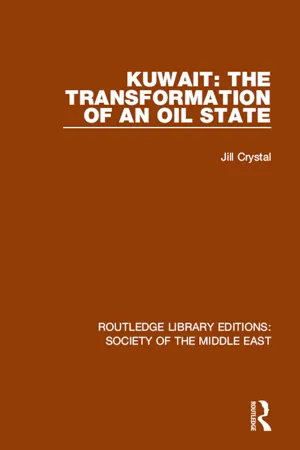
Kuwait, unlike most of its neighbours, has a well-established national identity and a long history as a nation, dating back to the eighteenth century. In this book, first published in 1992, Dr. Jill Crystal focuses on two recurring themes in Kuwaiti history: one, the preservation of a sense of community in the face of radical economic, social and political transformations; the second, internal rivalry over the conventions governing relations among members of the community. Crystal skilfully weaves these themes into a broad profile of Kuwait, analysing the nation's transformation from a pre-oil to an oil economy; its social structure and composition, including the country's tribal roots and key divisions involving class, gender and immigrant labour; political tensions resulting from the nation's sudden wealth and the accompanying changes in social structure; and its relations with other countries in the Gulf and the Middle East.
- 206 pages
- English
- ePUB (mobile friendly)
- Available on iOS & Android
eBook - ePub
Kuwait: the Transformation of an Oil State
About this book
Information
1
Introduction
One of the main themes that has dominated Kuwait’s history is the development and protection of its small community from external threats. Although oil restructured the domestic and international environment, it did not weaken either Kuwait’s sense of identity or its perceived vulnerability. Since the mid-eighteenth century Kuwait’s people have had a distinct sense of themselves as Kuwaitis. Kuwaitis have also, however, always had a larger political identity as well—as Gulfians, as Arabs, as Muslims, and as members of the world community.
The second main theme in Kuwaiti history is internal rivalry: the recurring tension over the rules governing relations among members of the community. The sense of being Kuwaiti has never been equally shared by all members of the community; community has never meant equality. Although Kuwaitis close ranks against outsiders, this front has always masked internal tension over access to power, status, and wealth. These rivalries often find expression in explicitly political debates over the conventions governing the relationship between rulers and ruled, resulting in a recurrent alternation between representation and repression in Kuwaiti politics as the extent of political space is defined and redefined. Rarely, however, have these debates been allowed to threaten the basic consensus on the larger Kuwaiti national identity.
ECOLOGY AND ECONOMY
Kuwait’s location and size have contributed to its particular identity. Kuwait is a small state. From north to south, it is about 200 km; from east to west, about 170 km. Its population is likewise small. The 1985 census, the most recent, put the number of inhabitants officially at 1,697,301—of whom less than half, only 681,288, were Kuwaitis. Kuwait’s small size makes it internally more cohesive but also more vulnerable to outside aggression. Kuwait has big neighbors: Saudi Arabia to the south, Iraq to the west and north. Only in the east does Kuwait open to the waters of the Gulf, where still other threats lie.
Kuwait has a harsh desert climate. Summers are long and hot, with temperatures ranging from 85° to 115° Fahrenheit. In July and August the daily temperature hovers around 110°. Sandstorms and humidity, especially from late July through October, add to the discomfort. Winter temperatures range from 45° to 65° Fahrenheit. Although the climate is sometimes humid, rainfall is scarce, averaging 82 mm a year. Agriculture has never thrived in this climate, and an isolated subsistence economy has never existed. Kuwaitis have had to look outward, to the desert and the sea, for food and even water (in the past, imported from Iraq). Consequently, long-distance trade and, later, pearl diving came to dominate Kuwait’s economy. Until the early 1930s the pearling industry was the heart of Kuwait’s economy. Since then, however, with the decline of the pearl industry owing to the development of cultured pearls in Japan and the rise of the petroleum industry following the discovery of oil in Kuwait in the 1930s and the export of oil following World War II, the economy shifted almost entirely toward this new commodity.
Oil soon came to dominate Kuwait’s economy, accounting for 90 percent of its export revenues. Once simply an exporter of crude, Kuwait also developed its own oil industry. By the mid-1980s it was processing 80 percent of its crude oil in local refineries and selling 250,000 barrels a day of these refined products under the logo Q8 through its recently acquired network of about 4,400 European gas stations. Kuwait also invested in oil exploration abroad. Kuwait’s efforts to manipulate its international economic environment by pushing both upstream (exploration) and downstream (refining, retailing) petroleum investments made Kuwait a leader in the oil industry, a new addition to the oil majors that historically dominated the field.
Kuwait tried to diversify away from oil in two directions. First, it invested conservatively in local industry and in banking and services. Second, it invested its oil income in overseas property and industry so effectively that by the 1980s these foreign investments brought in more revenue than did the direct sale of oil. Its overseas investments gave Kuwait a small buffer against the price fluctuations of oil and offer the best possibility for income when the oil industry eventually declines. Overseas investments alone made it possible for the Kuwaiti economy to continue to function after Iraq shut down its revenue-producing oil facilities. Nonetheless, Kuwait remains heavily dependent on oil and oil markets. It has little productive capacity outside that industry, and the damage done to the industry by the Iraqi invasion in August 1990 will be felt for some time to come.
SOCIETY
Most of the people who live in Kuwait are not Kuwaitis; they are foreign workers from Asia and the Arab world. Non-Kuwaitis formed 60 percent of the preinvasion population and over 80 percent of the work force. Slightly more than half of these foreigners were Asian. Most of the remainder were Arabs: Palestinians, Jordanians, Egyptians, and others. The national and nonnational communities are separated formally and informally. Legislation and customary practices governing economic rights (from property and business ownership to trade union activity), social rights (access to the welfare state’s education, health, housing, and other services), and civil and political rights distinguish on the basis of citizenship. Housing, socializing, and marriage patterns reinforce this distinction. Ironically, the presence of so many foreigners and the Kuwaitis’ vague fear of social and cultural inundation by these foreigners have been important factors in consolidating the strong sense of identity among the Kuwaitis. The Iraqi invasion has reinforced this sense.
Almost all Kuwaitis are Muslims—most are Sunni; about 15 percent are Shia. Because citizenship laws grant Kuwaiti nationality only to families long resident in Kuwait, most citizens are descendants of Kuwaitis resident since at least 1920. The most important divisions within Kuwaiti society are sectarian and class. The economic division between the rich and the not-so-rich (most of Kuwait’s poor are expatriates) is reinforced by the social division between the Bani Utub, those merchant families (including the ruling family) descended from the original founders of Kuwait, and the rest of the national population. The key sectarian division is between Kuwait’s majority Sunni and its minority Shia. Other social divisions—between rulers and ruled, women and men, and tribal and long-settled families—have also been important from time to time, particularly as these groups have found a political voice.
POLITY
Kuwait is unusual among its neighbors in that it has a well-established national identity and a long history as a nation, dating back to the eighteenth century. Kuwaiti law and custom draw a sharp distinction between those who belong to the Kuwaiti community, who enjoy a recognized historical right to participate in the formal life of that community, and outsiders, who do not. Oil and the recent transformations associated with it have forced Kuwait to draw this line more clearly—drawing in, for example, Kuwait’s poorest citizens, historically on the margins of Kuwaiti political life, and excluding the immigrant workers.
Kuwait has established and maintained this community only with difficulty. To sustain unity, the government and social elite have had to contain internal divisions and conflicts. Hierarchy has always existed and has always been a source of contention. Groups unequal in power, status, and wealth vie to maintain or better their position within Kuwait’s political structures. Although Kuwait closes ranks against outsiders, tension has always existed within Kuwait over the precise definition of its identity and over the rights and responsibilities held by those who share in that identity. This tension finds expression in social debates over norms of behavior governing public and private life. Women, inside the Kuwaiti national community but often outside the political community, have been one important focus for this debate. Public expressions of private faith have been another arena. Although Islam and politics have always been intertwined, Islamist politics, an explicitly political version of Islam, have become particularly important in the 1980s and 1990s.
Internal rivalry has often found expression in overtly political debates over the rules governing political life. State institutions such as the bureaucracy and National Assembly established the framework within which the Kuwaiti political identity emerged. Ideas of the state and the opposition played out inside and outside this institutional framework forged the Kuwaiti identity. Since 1962 that debate has expressed itself in the National Assembly. With the assembly’s suspension in 1976 and again in 1986, dissent appeared in the form of demands for a return to parliamentary life. Prodemocracy advocates, active in 1989 and 1990, continued to work both inside and outside the state for parliamentary restoration in an independent Kuwait after Iraq’s invasion; and following the liberation in 1991, they launched a new attack on the amir’s authoritarian tendencies. The result of this ongoing discussion between the opposition and the ruler has been a pattern of alternation between representation and repression in Kuwaiti politics, as loyal and disloyal opposition are defined and redefined.
Throughout these debates a tacit understanding remains that these disagreements will not be allowed to threaten the basic consensus on the Kuwaiti national identity. The result has been a strong national identity with workable national institutions but an identity that has involved a constant process of maintenance and reconstruction.
FOREIGN POLICY
The consolidation of national identity in Kuwait has taken place in the face of external threats. Kuwait has had to reconcile necessary interdependence with a strong sense of independence and to balance the tension between its inward-looking sense of community and its need for close ties with the outside world. Kuwait’s relations with its neighbors have historically been governed by two factors: a confidence borne of a strong national identity and a vulnerability borne of weakness—Kuwait is a small state in a big world. Long before oil, Kuwait was wholly dependent on the outside world for pearl markets and for subsistence goods. Oil did not change this basic structure of interdependence, but it raised the stakes by creating both greater constraints and greater opportunities. Confidence and vulnerability have always prompted Kuwait to try to manipulate outside forces to serve its own security needs—as it did on independence in 1961 when, threatened by Iraq, it called in Arab League and British forces and as it did in 1987 during the Iran-Iraq War when it secured U.S. reflagging for its threatened tankers. Kuwait could manipulate its environment, but being a small power, it could not control it. In 1990 its efforts failed. Unable to assess the true nature of the Iraqi threat and overconfident of the ability of its newly strengthened alliance with the United States to actually prevent Iraqi aggression, Kuwait was unable to anticipate or resist the Iraqi incursion of August 2.
The invasion had a thoroughgoing and devastating effect on all aspects of Kuwaiti life. The destruction of so many of Kuwait’s oil-producing facilities had long-term economic and environmental consequences. Financing reconstruction cut deeply into Kuwait’s foreign reserves. The social impact of the invasion was more subtle but perhaps as far-reaching. The occupation deepened one rift—that between Kuwaitis and expatriates, especially those who had supported Iraq—and created a new rift between those Kuwaitis who fled the country and those who stayed behind and endured the occupation.
Politically, the invasion restructured the relationship between the ruler and the opposition. Although the U.S.-led coalition forces restored Kuwait’s independence, a return to the political status quo ante was no longer possible. Opposition groups in exile and under occupation joined to reactivate the preinvasion prodemocracy movement, calling on the amir to hold elections. The amir’s ambivalent response—his reluctant agreement to hold future elections—satisfied neither the opposition nor the emerging hard-liners in his own family. The invasion also left Kuwait heavily and unequivocally dependent on the United States and Saudi Arabia—hence vulnerable to their interference in its domestic affairs, an interference that increasingly gave rise to the tendencies of repression rather than representation. In manipulating the international environment, Kuwait’s rulers have always tried with only limited success to keep regional powers from interfering in Kuwaiti politics. Kuwait’s leaders may again decide that to achieve harmony with their neighbors they must constrain expressions of disunity and dissent at home.
2
History
Kuwait was well on its way to becoming a nation long before it was a state. Kuwait has been an independent state only since 1961, but it has been a distinct political entity since it was founded early in the eighteenth century. Although the original families who migrated to Kuwait from central Arabia did not differ ethnically or religiously from the families they left behind, the act of migrating and establishing a new community created strong new bonds among them. From the start, Kuwait was thus set apart from its neighbors by its possession of the rudiments of a national identity. Like Kuwait, many of the Gulf states are still grappling with the issues involved in coercing or co-opting radically disparate groups into one national as well as political community, but Kuwait has had two centuries to work with these issues. Although Kuwait has not resolved its national problems, it does have a solid core with which to work.
NATIONAL FORMATION: THE ESTABLISHMENT OF A KUWAITI COMMUNITY
The town of Kuwait was built in the early eighteenth century (the historian Ahmad Mustafa Abu-Hakima put the date at 1716) by members of the Bani Khalid tribe, at that time the dominant tribe of northeastern Arabia.1 Originally called Grane, the town was known as Kuwait by the mid-eighteenth century. The name itself, the diminutive of the word kut, means small castle or fort and suggests, as Abu-Hakima noted, the town’s somewhat humble origins.
The Bani Utub, the founders of the political city-state of Kuwait, did not arrive in Kuwait until the early eighteenth century. Originally, the Bani Utub were no more than loosely bound, interrelated families who came to Kuwait together from central Arabia, where they traced their origins to the Anaizah tribal confederation. These families left Arabia as migrants in the late seventeenth century, a period when famine forced many to migrate, and traveled a roundabout route that took them through eastern Arabia, where for a while they settled in Qatar, bringing them and their descendants gradually to Kuwait. The journey of migration itself was a key formative event in establishing the sense of community by creating a new social bond among the migrant families. By the time they arrived in Kuwait, these families had begun to think of themselves not merely as members of the Arabian tribes they had left, but as members of a new tribe, the Bani Utub. Indeed, the name Bani Utub itself may have its origin in the act of migration. According to Abu-Hakima, the name Utub comes from the Arabic root ‘ataba, to travel from place to place (Bani, “people of”), and the ruling family mythology adopted this interpretation.2 Shaikh Abdallah, the ruler of Kuwait from 1950 to 1965, told H.R.P. Dickson, the long-serving British political agent, that the Bani Utub assumed that name after they had traveled to the north (in Arabic, ‘atabu ila al-shamal).3 To this day, Kuwait’s social elite traces its roots to this original Bani Utub clan.
After settling in Kuwait, the Bani Utub began to earn a living through pearl diving, boat building, and trade, taking advantage of Kuwait’s fine harbor. Their undertakings were successful, and the colony grew. Its fleet soon rivaled that of Muscat, the other large Gulf naval power. In addition to the maritime trade with India and Africa, Kuwait also became an important stop on the land trade routes that linked India, Persia, and Arabia to Europe. The nineteenth century was a period of general prosperity for Kuwait. European travelers, who began passing through Kuwait sporadically in the late eighteenth century, noted the active commerce on land and sea.4 When the British political resident visited Kuwait in the 1860s, the town had 20,000 inhabitants.5
Kuwait could enjoy prosperity and political stability in part because of the protected political space in which it developed. In the eighteenth century, when Kuwait was founded, that area of eastern Arabia enjoyed a certain peace and stability as a result of Bani Khalid rule. The Bani Khalid allowed Kuwait the space to grow and offered a measure of protection from outside threats. As Abu-Hakima notes, the late eighteenth century was also a period of rapid state formation and destruction in the region, with new forms of political rule appearing and disappearing throughout the Gulf: in Oman, Qatar, Bahrain, and central Arabia as well as in Kuwait.6
Kuwait’s location and size, however, left it vulnerable to outside powers. From the earliest days, Kuwait’s leaders could only survive by careful diplomacy and manipulation of the local balance of power. From the surrounding tribes to the Ottoman forces to the European traders, Kuwait was forced to strike a series of deals with all the regional powers. These shifting alliances allowed Kuwait to develop a surprising degree of autonomy by the mid-nineteenth century. Although most of the states in the region gradually fell under direct Ottoman or European rule, Kuwait remained independent. This preca...
Table of contents
- Cover
- Half Title
- Title Page
- Copyright Page
- Original Copyright Page
- Dedication
- Table of Contents
- List of Tables and Illustrations
- Preface
- 1 Introduction
- 2 History
- 3 The Oil Economy
- 4 Kuwaiti Society
- 5 Political Institutions and Processes
- 6 Foreign Policy
- 7 The Aftermath of the Invasion
- Appendix: Chronology
- Bibliographic Essay
- About the Book and Author
- Index
Trusted by 375,005 students
Access to over 1.5 million titles for a fair monthly price.
Study more efficiently using our study tools.
Frequently asked questions
Yes, you can cancel anytime from the Subscription tab in your account settings on the Perlego website. Your subscription will stay active until the end of your current billing period. Learn how to cancel your subscription
No, books cannot be downloaded as external files, such as PDFs, for use outside of Perlego. However, you can download books within the Perlego app for offline reading on mobile or tablet. Learn how to download books offline
Perlego offers two plans: Essential and Complete
- Essential is ideal for learners and professionals who enjoy exploring a wide range of subjects. Access the Essential Library with 800,000+ trusted titles and best-sellers across business, personal growth, and the humanities. Includes unlimited reading time and Standard Read Aloud voice.
- Complete: Perfect for advanced learners and researchers needing full, unrestricted access. Unlock 1.5M+ books across hundreds of subjects, including academic and specialized titles. The Complete Plan also includes advanced features like Premium Read Aloud and Research Assistant.
We are an online textbook subscription service, where you can get access to an entire online library for less than the price of a single book per month. With over 1.5 million books across 990+ topics, we’ve got you covered! Learn about our mission
Look out for the read-aloud symbol on your next book to see if you can listen to it. The read-aloud tool reads text aloud for you, highlighting the text as it is being read. You can pause it, speed it up and slow it down. Learn more about Read Aloud
Yes! You can use the Perlego app on both iOS and Android devices to read anytime, anywhere — even offline. Perfect for commutes or when you’re on the go.
Please note we cannot support devices running on iOS 13 and Android 7 or earlier. Learn more about using the app
Please note we cannot support devices running on iOS 13 and Android 7 or earlier. Learn more about using the app
Yes, you can access Kuwait: the Transformation of an Oil State by Jill Crystal in PDF and/or ePUB format, as well as other popular books in Social Sciences & Regional Studies. We have over 1.5 million books available in our catalogue for you to explore.