- 722 pages
- English
- ePUB (mobile friendly)
- Available on iOS & Android
eBook - ePub
About this book
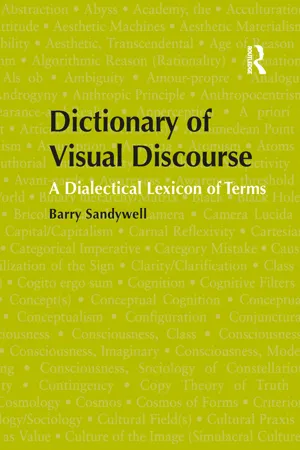
This substantial and ambitious dictionary explores the languages and cultures of visual studies. It provides the basis for understanding the foundations and motivations of current theoretical and academic discourse, as well as the different forms of visual culture that have come to organize everyday life. The book is firmly placed in the context of the 'visual turn' in contemporary thought. It has been designed as an interdisciplinary or transdisciplinary introduction to the vocabularies and grammars of visuality that inform thinking in the arts and humanities today. It also offers insight into the philosophical frameworks which underpin the field of visual culture. A central theme that runs throughout the entries is the task of moving away from a narrow understanding of visuality inherited from traditional philosophy toward a richer cultural and multi-sensorial philosophy of concrete experience. The dictionary incorporates intertextual links that encourage readers to explore connections between major themes, theories and key figures in the field. In addition the author's introduction provides a comprehensive and critical introduction which documents the significance of the visual turn in contemporary theory and culture. It is accompanied by an extensive bibliography and further reading list. As both a substantive academic contribution to this growing field and a useful reference tool, this book offers a theoretical introduction to the many languages of visual discourse. It will be essential reading for graduate students and scholars in visual studies, the sociology of visual culture, cultural and media studies, philosophy, art history and theory, design, film and communication studies.
Information
Part One: Prologues
‘Wittgenstein once said that a serious and good philosophical work could be written that would consist entirely of jokes’
Norman Malcolm, 1966: 29
‘Lexicographer. A writer of dictionaries, a harmless drudge’
Samuel Johnson, Dictionary of the English Language
‘Digressions, incontestably, are the sunshine; they are the life, the soul of reading’
Laurence Sterne, 1967, Book 1, chapter 22
Experience in a Thanatonic Age
‘A word is worth a thousand pictures’
There is a growing consensus among commentators across the sciences, arts and humanities that we live in an advanced technological-industrial age driven by an insatiable appetite for images and visual forms of knowledge. Some describe this situation as the ‘hegemony of the visual’. Others speak of a pervasive ‘ocularcentrism’ within Western culture. For yet others, ‘culture’ is tacitly understood as shorthand for visual culture or even the ‘mass culture’ promoted by the global culture industries. All of these descriptions recognize that while human beings have always created images and reflected upon their creations, today we are moving toward a global society structured around the corporate production, dissemination and conspicuous consumption of images.
Whatever our explanations of this situation – and we have no dearth of historical and sociological speculations – critical discourse is obliged to come to terms with an unprecedented condition where every social world – and perhaps every social relationship – is now image-mediated. We live in an era where the ‘imagification’ of the world and everyday life proceeds on a planetary scale. We live in societies where commodity imagineering dominates all other social relationships and institutions.
In the following introductory ‘Prologues’ I wish to take a preliminary sounding of some of the names that have been given and that might be given to articulate the visual culture of late modern societies. We need to ask: How should we reflect upon and understand the terms of vision? Is it possible to disclose the hidden order behind the new visual culture? How, in other words, should we think the visual? To understand the singularity of this cultural condition we require something like a genealogy and critique of the deep structures of Western visuality. It will soon be evident that such a genealogy will necessarily involve a history of self-reflection and its institutions; it is also a political project as we are immediately confronted by the semantic constellation of image, language and violence as these enter the flesh of ordinary life.
The first name we meet in these speculations is ‘the West’ or the older term, ‘Europe’. What contemporaries call globalization (or mondialization) is possibly one of the last phases of the Westernization of the world. The project of Westernization has its origins in the quest to build empires crafted in the images of an idealized European identity – among these, Hebraic prophecy and theocentric communality, Greek universality and cosmopolitanism, the Roman imperium and rationalized legal system, universal Christianity, scientific rationality, Cartesian reason, Enlightenment liberalism and democratic revolution. Each of these cultural forms crystallized around an image-complex – each constellation having a universalizing visual paradigm as its radiating core. A philosopher of the stature of Jan Patočka (1907–77) could thus claim that the distinctiveness of Europe lies in the fact that ‘European civilization has insight into the nature of things, while all others have tradition as their foundation’ (2002: 221). By inventing the idea of rational insight – the idea of the Idea and the disinterested pursuit of truth – Europe makes generalization and universality possible and upon this regime of truth constructs worlds of science, mathematics, physics, political philosophy, technology, literacy, universal education (the university), and so forth. The European invention of the Idea – the Platonic way of thinking – is coeval with the invention of the idea constellation we call ‘Europe’.
But clearly such an ‘image of the West’, in its sweeping generality, is an inadequate formulation – an abstract idealization – for what was in reality a disjunctive and heterogeneous series of histories constructed from discontinuous vectors that were simultaneously paths of violence and struggle as well as paths of thought. The construction of European self-images was in fact the outcome of centuries of imaginative experiments, innovations and passions that have criss-crossed the boundaries of ‘West’ and ‘East’ from the very beginning. ‘Europe’ can therefore never name a pure essence. Europe is first a matrix of questions and transformational forces. It is also a name with a thousand facets. For example, the appropriation and re-naming of non-European Others – as alterities that were either liquidated or incorporated in the long march of Western progress – was decisively determined by speculative visions of civilization, religious orthodoxies and the violent dissemination of universalist ideologies, literatures and sciences (Wallerstein, 2006). From the very beginning Europe’s war on traditions and localisms was advanced by framing the horizon of possibilities so that only Western conceptions of life and knowledge – perhaps only the European ‘love of truth’ – would be countenanced as viable and normative forms of existence (Patočka’s ‘history is the history of Europe’, op. cit.: 222 or Husserl, in the Crisis, celebrating the infinite telos of European humanity). In the history of Western philosophy this struggle is recurrently dramatized as the war against mythos conducted through logos, forgetting that logos itself harbours a new mythos. While the monopoly of truth and transcendence could never be realized, its unintended outcome is a situation where contemporary life is now saturated with images drawn from the depths of a triumphant European culture (if there is such a thing). Logos became the new mythos. But as we will see below, logos is now retreating before the new mythos of the image.
Whatever the complex antecedents of Westernization, we now inhabit a planetary society with a passion for sights and spectacles that has redefined the very landscape of modern experience. Being born into an image-saturated world, we forget how previous societies were visually impoverished – where even simple signs and visual symbols were relatively rare phenomena. In these postmetaphysical times, however, even our social identities, moral criteria and political self-understandings are largely drawn from visual media. Every possible surface is covered with representations; the plane of manifestation has itself relinquished its ontological privileges to simulacra. Coming to the end of this long process of imagification, we might justifiably call the social orders of the highly industrialized societies, videological cultures. The supreme ruse of universalization was to convince myriad others that their indigenous knowledges and sensory worlds must be surrendered in the name of progress – the idea of progress – and that once underway the ‘forces of progress’ would brook no alternatives (ancient traditions would be subsumed under one universal Culture, the galaxy of languages made subservient to the monolingual discourse of representational knowledge). And where the force of argument proved impotent, there was always the argument of force.
If not handled with great care, this picture of ‘Western hegemony’ lures us into false conclusions. Like the monolithic concepts of ‘East’ and ‘West’, the dominion of the logos was always more dream than reality. Yet the abstract image of Western universality conceals a very real history of violent destruction, colonization and imperial conquest. Each step on this path is marked by crisis. In this sense the empire of the sign preserves a series of local truths, each symbolized by a historical injustice. Non-Western space proved to be intractable and recalcitrant, ensuring that the Europeanization of the world would be deflected and disempowered in its campaigns against its manifold ‘others’ (recall that one ‘trajectory’ of Westernization was Russia’s nineteenth-century adventures into the east of the European continent). In fact European ‘visions’ (of life, politics, moral order, democracy, language, art, philosophy, and so on) had to be forcibly imposed, carved into hearts and minds through state apparatuses, and reproduced through coercive social systems. European colonization invariably resulted in a clash of cultures and the export of conflict throughout the non-Western world.
Sociologists have graced this deadly process with the title modernity (la modernité). But the word ‘modernity’ also names the epoch of world wars, ‘ethnic cleansing’ and mass slaughter carried out in the name of competing visions of a Eurocentred world order. The trail of genocides runs from Greek slave mines and Roman latifundia to the Spanish conquest of the Americas, the Black Atlantic slave trade, the ruthless elimination of native peoples in North America, Australia, Tasmania, New Zealand and beyond. The long history of these civilizing passions and global genocides prepared the way for the industrialization of death that punctuates both the beginning and the end of the twentieth century. In the aftermath of bureaucratically planned mass death, powdered cities and blasted lives, we could describe the present historical epoch as a thanatonic age. Its most visible aspect is the total militarization of life on earth. Its most threatening prospect is the death of nature itself. The growing body of historical knowledge suggests that these periodic bouts of collective self-destruction have a long history as the very engine of Western modernity.
We now understand that such ‘visions’ were also inevitably languages – rhetorics, events, discourses of power. To this day global visuality is still pervaded by the signs and languages that evolved over centuries of expansion and conquest. These symbolisms of crisis are deposited, so to speak, in the cultural unconscious of contemporary life. Martin Heidegger, for example, speaks of the end or ‘closure’ of philosophy as ‘the beginning of the world civilization based upon Western European thinking’ (‘The End of Philosophy and the Task of Thinking’, 1978: 377). But we should also note that the repressed ‘others’ created by Western rationalization remain stubbornly embedded in its most celebrated practices and discourses. The alterities that disappeared in this process are preserved like archaeological layers in language. This is what we ‘own’ when speaking of ‘our Western culture’. While the putative lords of the earth have long since vanished, their ghosts live on in our forms of thought, writing and language. We continue to speak of ‘philosophy’, ‘democracy’, ‘freedom’, and so on, and still imagine history as the actualization of thought (if, today, technoscientific thought). We still write under the auspices of scientific paradigms.
There is, then, contra Marx, more than one spectre that continues to haunt Europe. The processes which sociologists call ‘hybridization’, ‘indigenization’ and ‘syncretism’ are ineradicable effects of these ghostly machinations, as is the very idea of a tradition of critical thought, literature, political philosophy and social theorizing (the culture that made slavery its watchword also produced universalist discourses of justice, human rights and political freedom). The mind-set and thought worlds underlying these deadly processes belong to a class of terms we might call fatal concepts. It is these terministic screens that we need to deconstruct.
On a more immediate level, the visions imposed by Western technologies – and here we would include alphabetic writing, political machinery, religious apparatuses and other spiritual technologies – were inevitably bound up with other senses and with practices authorized by concrete sensory experiences. To understand the project of modernity, then, it is necessary to grasp both the creativity and the destructiveness of these sensory, social and technological mutations. For example, in the long history of European languages, the ‘masculine’ eye has fought a continuous war against the ‘feminine’ ear. In the name of reason, an idealized ‘spirit’ claimed dominion over profane ‘material’ embodiments. The life of the senses had to make way for reflections on the sense of life. Analytic reason dominated synoptic intuition. Modern scientificity, in its remarkable development, willingly sacrificed oral traditions and everyday practical reasoning for the utopia of universal legality. Formal clarity and measure – the mathematization of the world – were secured at the expense of concrete experience. Sensory doxa and phronesis would be replaced by replicable algorithms and verifiable theory. Mythos was to be overthrown by logos. By neglecting the primacy of everyday praxis and an ancient multi-sensorialism, modern science relinquished ancient languages articulating auditory, olfactory, haptic and kinaesthetic experience. Fixated upon the visual, Western culture neglected a much older dialogue of word and image. Secure in its foundations and energized by the Faustian promise to construct a ‘man-made’ civilization, modernity’s obsession with formal codes and visual closure necessarily excluded the lived experiences of women, children and other marginalized groups. Modernity’s wake takes on the appearance of a vast swathe of lost knowledge.
The Empire of the Visual
Westernization, then, was certainly no dream. Modernization operates as a machinery of forgetting. The whole earth has been materially shaped by the impress of brutal visions of order, rule and empire with European credentials. At the risk of flattening the complexities involved, we can still speak of vision-fuelled violence, the utopian fantasies that propelled Europeans across the globe, the imperial eye and the bureaucratic gaze of administrative imperatives. As the German sociologist Max Weber taught, the rationalized machine of bureaucracy is one of the most decisive exports of European culture. But Weber elided the fact that bureaucracy is itself a force of violence rather than being a neutral instrument of administration. Weber died before the epoch of industrialized world wars and bureaucratic totalitarianism swept through Europe. The European expansion into non-Western space, with all its contradictory consequences, has been the fundamental historical event of the last half millennium. Viewed retrospectively, the industrialization of the world can now be seen as a thanatonic project predicated upon the systematic exploitation of congealed ‘light’ (in the form of fossil fuels or ‘dead energy’) to liberate and harness ‘live energy’ as the material condition of capitalist social relations and expansionary production systems. While the dream of civilization was terminally wounded in the catastrophe of the ‘Great War’ of 1914–18 and effectively disintegrated after Auschwitz, Buchenwald, Treblinka and the onset of the nuclear age, the machineries unleashed by the West continue to dominate millions of lives across the globe. European modernity takes the form of a blood-drenched one-way street.
Let us provisionally accept the broad sociological thesis that we live in a global culture dominated by the ‘military-industrial-infotainment’ complex. The unholy alliance of empire, military power and industrialized culture forged in the nineteenth century is now the inescapable reality of the present age. These changes precipitated seismic shifts in social relationships and cultural forms. Centuries-old traditions were forced to mutate and re-envision themselves. Ancient status orders gave way to new class formations. The ascetic, rationalized and ideological capitalism described by Marx and Weber has long since been eclipsed. The ‘national capitalisms’ that motivated the great efforts of social theory in the nineteenth century have dissolved into air and been replaced by interlocking systems promising infinite profit-opportunities, geo-political conquest, and mutually assured destruction. Nationally bounded urbanization has been replaced by the uncontrollable sprawl of mega-cities. Old-style colonialism has given way to technological and cultural neo-colonialism. Local industrial transformations have been incorporated into networks of global industrialization. Low-tech production is displaced by high-tech electronics, computing and digital media. Hence the truth content of the adjective ‘global’ in contemporary critical discourse. But ‘global’ also signifies the violent collisions of worlds and cultures. In long-durational terms, these momentous events and unprecedented mutations cost the lives of hundreds of millions of people, a mortal audit of oppression and alienation that casts a dark shadow over contemporary history. To borrow Hegel’s observation, history – and he is primarily speaking of Western history – assumes the appearance of a slaughter-bench ‘at which the happiness of peoples, the wisdom of states, and the virtue of individuals have been victimized’ (1956: 21). And behind the bloodletting we find the visual technologies and marmoreal forms of Graeco-Latin-Christian culture. The distance between Hegel and the present generation can be measured by the fact that we can no longer meaningfully ask ‘to what principle, to what final aim these enormous sacrifices have been offered’ (1956: 21). In a world without God, the cunning of history, Spirit’s ulterior manipulation of evil, and the theodicy of a rational historical telos are simply empty phrases.
Today the imagineering industries of late modernity operate as an armature of collective forgetting on a global scale. What once passed for popular culture has been literally saturated by the products of the new culture industries (from television to digital film, gaming, mobile telephony, and so on). And it would seem that all of these media are in flight from coming to terms with the slaughterhouse of European history. The Progress of Reason and Universal Emancipation ring hollow when lined up against the imaginative forms of harm and destruction thought up by human beings over the past two centuries. While large parts of the earth have been turned into toxic dumps and war-zones, the business of finance capitalism continues as show business. Correspondingly, modern politics has become the politics of immediate visibility and staged re-presentation, a politics of managed impressions and sound bytes and, increasingly, a politics of celebrity, exposure and scandal. In reality there is no longer any meaningful separation between mediated culture, politics and everyday life. In one generation we have witnessed the almost total ‘culturalization of daily life’ (Jameson, 1994: 147). What passes for ‘history’ are distorted facsimiles and sanitized versions of an imagined past. History is laundered of its savagery and horror. Just as we live designer lives, so we have air-brushed histories, politically correct language, ‘national curricula’ and just plain-old repression of the facts.
It seems that the world has been turned upside-down. Everything ‘real’ has to be on show. What was once called reality becomes ‘other’ than itself. Everywhere we witness the recession and disappearance of the real. What was traditionally known as ‘national security’ is replaced by the balance of terror. Place proliferates into endless virtual ‘spaces’. Time itself must be abolished. Fantasy becomes a powerful force in the corporate metamorphosis of the real. The repetition engines of controlled imagination are securely in the driving seat of economic growth. Idealized body images and aspirational self-representations are modelled upon the digitally perfect air-brushed exemplars of screen beauty. The new icons of beauty have themselves become an integral part of the ubiquitous entertainment media of global capitalism. Thus one recent survey claimed that the larger part of the female population of the advanced societies actively hate their bodies and aspire to change their appearance to bring it in line with aspirational media icons. Body dissatisfaction and self-hatred lead to such pernicious ‘civilizational’ syndromes as anorexia and bulimia that rob individuals of self-respect and a sense of identity. In the interlocking markets that now constitute contemporary economic life, ‘looking good’ and fulfilling the demands of idealized beauty becomes a basic entry qualification. Susie Orbach has observed that the ‘cosmetic industry, which is nominally medical, is a growth industry. The worldwide market for cosmetic surgery and facial cosmetic rejuvenation was valued at nearly $14 billion in sales for 2007 and is growing at $1 billion a year’ (2009: 85). Body transformation is the Ovidian promise of hyperconsumerism. It is...
Table of contents
- Cover
- Dedication
- Title
- Copyright
- Contents
- Acknowledgements
- List of Lexicon Terms
- Introduction
- Part One: Prologues
- Part Two: Preview and Methodology
- Part Three: Thematic Orientations
- Select Bibliography
- Annotation Conventions and Abbreviations
- A–Z: The Dialectical Lexicon of Terms
- General Bibliography
Trusted by 375,005 students
Access to over 1.5 million titles for a fair monthly price.
Study more efficiently using our study tools.
Frequently asked questions
Yes, you can cancel anytime from the Subscription tab in your account settings on the Perlego website. Your subscription will stay active until the end of your current billing period. Learn how to cancel your subscription
No, books cannot be downloaded as external files, such as PDFs, for use outside of Perlego. However, you can download books within the Perlego app for offline reading on mobile or tablet. Learn how to download books offline
Perlego offers two plans: Essential and Complete
- Essential is ideal for learners and professionals who enjoy exploring a wide range of subjects. Access the Essential Library with 800,000+ trusted titles and best-sellers across business, personal growth, and the humanities. Includes unlimited reading time and Standard Read Aloud voice.
- Complete: Perfect for advanced learners and researchers needing full, unrestricted access. Unlock 1.5M+ books across hundreds of subjects, including academic and specialized titles. The Complete Plan also includes advanced features like Premium Read Aloud and Research Assistant.
We are an online textbook subscription service, where you can get access to an entire online library for less than the price of a single book per month. With over 1.5 million books across 990+ topics, we’ve got you covered! Learn about our mission
Look out for the read-aloud symbol on your next book to see if you can listen to it. The read-aloud tool reads text aloud for you, highlighting the text as it is being read. You can pause it, speed it up and slow it down. Learn more about Read Aloud
Yes! You can use the Perlego app on both iOS and Android devices to read anytime, anywhere — even offline. Perfect for commutes or when you’re on the go.
Please note we cannot support devices running on iOS 13 and Android 7 or earlier. Learn more about using the app
Please note we cannot support devices running on iOS 13 and Android 7 or earlier. Learn more about using the app
Yes, you can access Dictionary of Visual Discourse by Barry Sandywell in PDF and/or ePUB format, as well as other popular books in Social Sciences & Art General. We have over 1.5 million books available in our catalogue for you to explore.