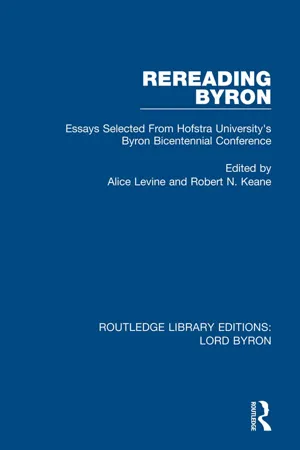
The papers collected in this volume, first published in 1993, were delivered at Hofstra University in October 1988 at a conference celebrating the bicentennial of Lord Byron's birth. The shared goal of these essays was to reassess Byron's poetry, his poetic development, and his relation to his contemporaries in light of recent scholarship and criticism. This title will be of interest to students of literature.
eBook - ePub
Rereading Byron
Essays Selected from Hofstra University's Byron Bicentennial Conference
- 273 pages
- English
- ePUB (mobile friendly)
- Available on iOS & Android
eBook - ePub
Rereading Byron
Essays Selected from Hofstra University's Byron Bicentennial Conference
About this book
Information
Byron and “The Truth in Masquerade”
Jerome J. McGann
I
Like all poets and artists, Byron is often found re-using earlier work in later circumstances—manipulating and changing it for different purposes. Normally these alterations take place as it were “in private,” and readers only become aware of the transformations when they are brought to light by subsequent academic or scholarly investigation.
But there are also cases where textual manipulations are carried out as it were half publicly and half in secret. These are the cases—they are peculiarly Byronic—which I want to discuss here. We may recall for instance the several alternative uses to which the text of “When We Two Parted” was put.1 Published in his 1816 volume of Poems, these verses were there dated 1808, with the obvious intention (we now know)—given Byron’s circumstances in 1816—of indicating that the lines had nothing directly to do with his wife or his recent domestic problems. The 1808 date would have suggested, to those with knowledge of Byron’s life, that the lines referred to Mary Chaworth. And in fact this is the way the poem was commonly read for over a century.
But the lines were not written in 1808—that was a ruse of Byron’s—they were written in 1815; and their immediate subject was Lady Frances Wedderburn Webster. Byron manipulated his 1816 text in order to hide that fact, but he did so deceptively, in a kind of code. The date “1808” printed with the poem is a diversion, but one which, once registered as a diversion (or a possible diversion), points the reader toward other dates and other contexts of reading. Byron’s London social circle—and his wife—would have been alive to those other possibilities. Lady Byron had made a copy of “When We Two Parted” for Byron in 1815, which, she well knew, had nothing to do with 1808. Furthermore, Lady Melbourne and her circle would have recognized at least some of “When We Two Parted” as a passage from an unpublished poem of 1812—a poem written to Lady Caroline beginning “Go! Triumph securely, that treacherous vow.” Several copies of that poem were in London circulation, and one or another of these copies were certainly known at least to Lady Caroline, Lady Melbourne, and Beau Brummell. Furthermore, considering the habits of the fast world of the Regency, and the market value which Byron and his poetry had in that world, we can be certain that “the knowing ones,” in this instance, were not confined to four people.
Thus that “false date” of 1808 would have signalled several very different lines of interpretation in 1816, depending upon the point of view adopted by the reader. 1808 would have been recognized as a mystification by Lady Byron and others as well, though in each case the search for “the truth” of the poem would have been conducted along different lines and from different premises. What may not have been recognized—what probably was not recognized—was the kind of deliberateness with which Byron carried out his mystification. That he anticipated and desired a disbelief in the date of 1808 by some readers is clear not merely from the circumstances of composition and publication, but from Byron’s 1823 correspondence with his cousin Lady Hardy, who was herself an intimate of Byron and his London world in the Years of Fame. In a letter to her of 10 June 1823 he told her that “the secret” of “When We Two Parted” was that it was written to Lady Frances Wedderburn Webster. But of course this only added a further level of mystification, or another direction from which the poem could be read.2
In the case of “When We Two Parted” we are dealing with a type of textual manipulation which seems to me extremely significant, and not merely for the reader of Byron’s poetry. Let us pause for a moment to reflect on what is happening here—and also on what is not happening. It is one thing—a common thing—for poets, as for all artists, to plunder and re-use their work for different purposes and under different circumstances. And it is also one thing—an equally common thing—for poets to foreground their processes of writing, to make the act of writing a subject or topic of their work. It is quite another thing—far less common—for writers to manipulate their work so as to draw out and exploit the complicity of their readers and audiences.
The case of “When We Two Parted” shows, however, how readers can be imagined by texts, how they can be caught and defined by their own expectations and preconceptions. For acts of reading are always carried out by minds prepared to read in certain ways by their determinate social, personal, and institutional circumstances. More than most poets, Byron understood this, and his understanding led him into a mode of poetry where readers, along with their various preconceptions, are drawn into the theatre of the poetry, and forced to confront, or refuse to confront, themselves. Byron manipulates “When We Two Parted” in order to call out certain lines of reading, certain interpretative options; and the poem then becomes an opportunity to learn to read—ultimately, to learn to read oneself—more self-consciously. The concrete equivalent of such a style is precisely the Byronic Hero, who
had the skill, when Cunning’s gaze would seek
To probe his heart and watch his changing cheek,
At once the observer’s purpose to espy,
And on himself roll back his scrutiny,
Lest he to Conrad rather should betray
Some secret thought, than drag that chief’s to day.
(Corsair I.217–22)
To work in this way is necessarily to develop a clear initial sense of who is—and who is not—your audience. Byron’s understanding of this necessity came to him very early, as his first five books (from Fugitive Pieces through English Bards) clearly show. In those books certain people and groups of people are addressed and others are not, and these inclusions/exclusions extend down to individual poems. Hours of Idleness, for example, has several homoerotic poems which are presented in coded forms that open and close different reading possibilities, depending on the point of view and context in which the reading occurs. And consider, for instance, a poem like the one titled in these early printings “Damaetas.” It is a descriptive sketch of a youth who has had an early education in vicious living, deceit, and hypocrisy. The title is itself a piece of code, referring back to Virgil and Theocritus. It is a cunning tide which might, or might not, have homoerotic overtones. But the title is a diversion in another sense, as one discovers with a knowledge of the poem’s MS (the autograph is no longer extant apparently). Byron’s MS title was “My Character,” not “Damaetas.”3
“Damaetas” (or “My Character”) is thus a deceitful poem, and part of its wit lies in its own deceitful execution. We cannot be absolutely certain that Byron’s close school friends were privy to these various levels of poetic equivocation, but it is difficult to believe—given the character of Byron’s school friendships—that some of them were not. Who was or was not in fact a part of the audience of this poem’s witty deceits is not, finally, the point. The point is that the poem is operating in such a rhetorical structure—even if, in fact, Byron was the only person at the time who knew what was involved in it.
This case is a nice illustration of how Byron uses different levels of poetic coding to define his audiences. It is a procedure which will be spectacularly displayed in Don Juan and its associated poems, where Byron executes a many-levelled discourse comparable—in its own unregenerate secularity—to Dante’s. As in all such writing, multiplying meanings entails playing with language, developing systems of punning and coded talk which require some kind of special knowledge to decipher. Such knowledge is both factual and procedural. “The grand Arcanum’s not for men to see all,” Byron says in a peculiarly important passage of Canto XIV, “And there is much that could not be appreciated/ In any manner by the uninitiated.” These lines are unusual only because of the way they have foregrounded this aspect of the poem at the level of conscious methodology.4 Don Juan is of course a mine of such materials. What we sometimes forget is that the Don Juan manner is precisely designed not to disguise its own procedures of mystification. Rather, flaunting its doubletalk, the poem turns human hypocrisy and deceit (those sins against the human light) toward redemption by translating them into a poetic method—which is to say, by bringing them into the open. In Byron, poetry becomes not an Aristotelian “imitation of reality”, where one side or the other of that transaction tends to be thrown into obscurity. Rather, it is what Byron calls “The truth in masquerade” (XI.290), a situation where—to borrow a Yeatsian metaphor—body is not bruised to pleasure soul. When truth appears in masquerade, medium and message are placed on a new footing with respect to each other: not reconciled, certainly, and least of all married, but, as it were, living together in sin.
Because “When We Two Parted” involves a comparable masquerade of its truth, the poem exploits and even encourages its audience’s awareness that more is being said than might at first seem apparent. In this way it begins to develop a kind of social consciousness: on one hand, contexts of reading which transcend the immediate are invoked, and on the other, the audience is made aware of itself as a participant in the construction of those contexts. The poem can be read in purely lexical space, of course, but such a reading will not merely have missed certain relevant details, it will in the end have misunderstood the poem by having misunderstood how the poem works.
We may well be reminded, in this context, of two important historical realities in the history of Byron criticism: that its dominant mode has always been heavily “biographical,” and that the text-centered procedures of twentieth-century criticism have rarely been able to read Byron’s work in interesting ways. Such criticism then simply declared Byron’s work, and especially his non-satirical work, to be unimportant and uninteresting. But the fact is that Byron’s poetry would be uninteresting by definition to this kind of criticism. The real critical task is to define the peculiar form of Byron’s procedures, on one hand, and to assess his execution of those procedures, on the other.
Thus far we have observed Byron organizing the poetical experience as a social and historical event. This is a given in nearly all his work. In the examples we shall now be turning to, however, the stakes will be higher, the issues more important, the risks far greater. Indeed, we shall be looking at cases where, I believe, Byron reached a watershed in his career as a writer, and where he first came to understand adequately the limits, the dangers, and the opportunities in a poetry of coded discourse. In the end, we may perhaps come to see Byron’s poetical methods in a different light.
II
So let me make a second beginning here. A frequent charge against Byron—it has been especially prevalent in the twentieth century—is that his work lacks authenticity because he was too preoccupied with his audiences and their reactions. His poetry aims, it is judged, at cheap and factitious effects by pandering to the (presumably debased) expectations of his reading publics (and one must say “publics” because they were, as they always are, multiple, overlapping, and distinctive).
Now this is a highly problematic argument for two reasons. In the first place, all of Byron’s universally acknowledged masterpieces—Don Juan, for example, or Beppo, or “The Vision of Judgment”—evoke and reciprocate audience expectations and reactions which are at once various and determinate. Why do those poems succeed where (let us say) Manfred and “Fare Thee Well!” are thought to fail? This is a question which Philip Martin, in his excellent recent book Byron, A Poet Before His Public, was never really able to answer.5 He was not able to answer it because his measures of critical judgment remain committed to the idea of the autonomy of the poetic event. For him, although poetry may engage its audiences, its distinctively poetical character and value have to be judged through aesthe...
Table of contents
- Cover
- Half Title
- Title Page
- Copyright Page
- Original Title Page
- Original Copyright Page
- Dedication
- Table of Contents
- Acknowledgments
- Preface
- 1 Lord Byron and “The Truth in Masquerade”
- 2 Byron, Bakhtin, and the Translation of History
- 3 Nothing So Difficult
- 4 “Man fell with apples”: the Moral Mechanics of Don Juan
- 5 Hitting the Road: Byron, Beckett, and the “Aimless Journey”
- 6 Byron and the Uses of Refamiliarization
- 7 Byron’s Flirtation with his Muses
- 8 Romantic Carnivalesque: Byron’s The Tale of Calil, Beppo, and Don Juan
- 9 Marginal Discourse: the Authority of Gossip in Beppo
- 10 Byron and the Women of the Harem
- 11 Escape from the Seraglio: Cultural Transvestism in Don Juan
- 12 A Question of Taste: Keats and Byron
- 13 Byron and the Pathology of Genius
- 14 Byron and Da Ponte
- 15 Byronic Attitudes
- Index
Trusted by 375,005 students
Access to over 1.5 million titles for a fair monthly price.
Study more efficiently using our study tools.
Frequently asked questions
Yes, you can cancel anytime from the Subscription tab in your account settings on the Perlego website. Your subscription will stay active until the end of your current billing period. Learn how to cancel your subscription
No, books cannot be downloaded as external files, such as PDFs, for use outside of Perlego. However, you can download books within the Perlego app for offline reading on mobile or tablet. Learn how to download books offline
Perlego offers two plans: Essential and Complete
- Essential is ideal for learners and professionals who enjoy exploring a wide range of subjects. Access the Essential Library with 800,000+ trusted titles and best-sellers across business, personal growth, and the humanities. Includes unlimited reading time and Standard Read Aloud voice.
- Complete: Perfect for advanced learners and researchers needing full, unrestricted access. Unlock 1.5M+ books across hundreds of subjects, including academic and specialized titles. The Complete Plan also includes advanced features like Premium Read Aloud and Research Assistant.
We are an online textbook subscription service, where you can get access to an entire online library for less than the price of a single book per month. With over 1.5 million books across 990+ topics, we’ve got you covered! Learn about our mission
Look out for the read-aloud symbol on your next book to see if you can listen to it. The read-aloud tool reads text aloud for you, highlighting the text as it is being read. You can pause it, speed it up and slow it down. Learn more about Read Aloud
Yes! You can use the Perlego app on both iOS and Android devices to read anytime, anywhere — even offline. Perfect for commutes or when you’re on the go.
Please note we cannot support devices running on iOS 13 and Android 7 or earlier. Learn more about using the app
Please note we cannot support devices running on iOS 13 and Android 7 or earlier. Learn more about using the app
Yes, you can access Rereading Byron by Alice Levine,Robert N. Keane in PDF and/or ePUB format, as well as other popular books in Literature & English Literary Criticism. We have over 1.5 million books available in our catalogue for you to explore.