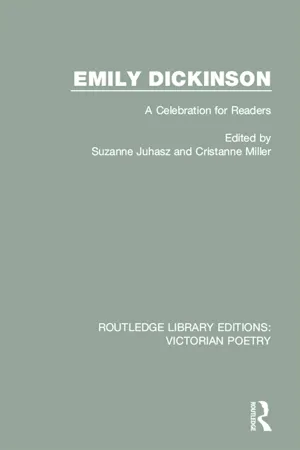
The focus of this title, first published in 1989, begins with Dickinson's poems themselves and the ways in which we read them. There are three readings for each of the six poems under consideration that are both complementary and provocative. The selected poems show Dickinson speaking of herself in increasingly wider relationships – to love, the outside world, death and eternity – and are grouped together to reveal her overlapping attitudes and feelings. Other topics discussed range from general epistemological and critical considerations to the poet's self-identification and the process of reading her poetry as a feminist critic. This title will be of interest to students of literature.
eBook - ePub
Emily Dickinson
A Celebration for Readers
- 250 pages
- English
- ePUB (mobile friendly)
- Available on iOS & Android
eBook - ePub
Emily Dickinson
A Celebration for Readers
About this book
Information
Poem 754
My Life had stood — a Loaded Gun —
In Corners — till a Day
The Owner passed — identified —
And carried Me away —
And now We roam in Sovereign Woods —
And now We hunt the Doe —
And every time I speak for Him —
The Mountains straight reply —
And do I smile, such cordial light
Upon the Valley glow —
It is as a Vesuvian face
Had let its pleasure through —
And when at Night — Our good Day done —
I guard My Master’s Head —
’Tis better than the Eider-Duck’s
Deep Pillow — to have shared —
To foe of His — I’m deadly foe —
None stir the second time —
On whom I lay a Yellow Eye —
Or an emphatic Thumb —
Though I than He — may longer live
He longer must — than I —
For I have but the power to kill,
Without — the power to die —
c. 1863
1929
Poem 754: The Unreadable Poem
Fordham University
“MY LIFE HAD stood — a Loaded Gun —,” as well as being a superb work of art, is a frustratingly enigmatic utterance — a poem that defies understanding. Its singular images and intriguing obscurity, however, render it irresistible to commentators, as is attested to by the multitude of readings given it since its first published appearance in 1929. It is my contention, however, that reading this poem to determine its meaning becomes something in the nature of an exercise in futility. Dickinson’s characteristic anxiety about expressing herself openly is at its height here, whatever her subject may be — whether it is anger, as it may well be, or ambition, as it could very well be, or sexuality, as it certainly might be, or some intertwined combination of the three. Here we see embodied both strong pressure to speak and an intense need to veil the subject. This expressive bind brings the poem to the brink of unintelligibility. As attested to by the conflicting conclusions of the many fine attempts to reconstruct it, the specific meaning of this poem is largely irrecoverable. My way of reading the poem, then, is not so much to try to understand what it “means,” per se, but rather to attempt to determine the significance of its impediments to understanding.
My Life had stood — a Loaded Gun —
In Corners — till a Day
The Owner passed — identified —
And carried Me away —
And now We roam in Sovereign Woods —
And now We hunt the Doe —
And every time I speak for Him —
The Mountains straight reply —
And do I smile, such cordial light
Upon the Valley glow —
It is as a Vesuvian face
Had let its pleasure through —
And when at Night — Our good Day done —
I guard My Master’s Head —
Tis better than the Eider-Duck’s
Deep Pillow — to have shared —
To foe of His — I’m deadly foe —
None stir the second time —
On whom I lay a Yellow Eye —
Or an emphatic Thumb —
Though I than He — may longer live
He longer must — than I —
For I have but the power to kill,
Without — the power to die —
(754)
The major problem here is not syntactical, but rather reflects disorder at the referential level. I refer to the omission of subject reference — that “omitted center” Jay Leyda finds so integral to the uniqueness of Dickinson’s poetry. Here the vacuum at the center of the text is complete. Unlike other of Dickinson’s elliptical poems, this seems impossible to reconstruct authoritatively. Even conjecture is problematic. A crucial feature of communication has been flouted; in her use of a powerful metaphor — the life that contains the explosive potential of a loaded gun — without the provision of markers to indicate its area of reference, Dickinson intrigues but does not enlighten the reader. She creates a radical disjuncture between text and meaning indicating that an experience of profound significance is being expressed, but refusing to name that experience.
Conjectures provided by Dickinson’s commentators regarding the nature of this indicated experience are illuminating as we attempt to determine the significance of this poem. Sharon Cameron sees anger as its subject, “a fury grown larger than life … [that] fantasizes its own immortality” (427). Adrienne Rich finds ambition central. She sees in the split between the active hunter and the passive gun an “ambivalence toward power which is extreme” (65). John Cody discusses a “fusion of sexuality and destructiveness” (402). Anger … ambition … sexuality … This potent trio caused debilitating anxieties for the women writers of Dickinson’s era, and “My Life had stood — a Loaded Gun” is rife with indications of all three — to the point where each of the above readers can develop his or her case convincingly and with authority. It is my proposal that the significance of this poem lies precisely here, in its embodiment of the expressive dilemma faced by any woman writer of Dickinson’s time and place. The culture taught women that certain experiences were unnameable, specifically these three: the intensely personal and “selfish” desire for a sphere of achievement outside the circuit of domestic accomplishment; active, rather than passive sexual desire; and anger directed at personal rather than altruistic concerns. David Porter says that “the gun … is the emblem of her inordinate power of language” (215) and I think he is correct. This potent symbol — this gun-voice — embodies a superb ability and a pressing need to speak, filtered through a profound culturally conditioned anxiety about the acceptability of telling what she may well have considered deviant personal experience. For Dickinson, as for other women writers of her time, articulation of the self was a venture fraught with obscure dangers.
Although it is difficult to read this poem in a conventional way, one thing we can say for certain is that it is in some sense a poem about utterance, an expression of the explosive or incendiary potential of speech. We are given enough markers to indicate that: the gun that “speaks” as it fires, the mountains that echo that articulation, the “Vesuvian” or volcanic qualities we know from other poems are sometimes associated with speech. But how is it that this poem, with its lost field of reference, communicates? How does it speak to us? Because it certainly does speak to us. Important here are the tonal implications. The speaker’s experience is one of dissociation. She is a speech object rather than a speech subject. Although she is the medium through which articulation occurs, she is not the instigator of the impulse to articulation. An extreme and compelling ambivalence characterizes the relationship between the passive “gun,” the one who speaks, and the active owner, the one who initiates the speech. The gun/speaker is devoted, smiling with the “cordial light” of a massive pleasure. But that pleasure is “Vesuvian,” in other words, volcanic and thus massively and horribly destructive. A fascinated yet horrific interplay is detailed. However, although both fascination and horror are indicated, neither predominates. The tension between them, the radical ambivalence, gives tonal articulation to a consciousness in conflict. And the concluding lines, without being specific, are imbued with a deep sense of tragic irony. To “have the power to kill / Without — the power to die,” whatever it means, communicates to us more through tone than through statement or even through analogy. What an ironic fate: allowed power, but doomed to an unending eternity of destructiveness. Ambivalence and irony predominate over statement here. As in certain other women’s writing of the era, they are extra-textual vehicles of expression that carry the communicative weight of this poem.
Is “My Life had stood — a Loaded Gun” a successful poem? Or is it a hyperbolic, convoluted, evasive failure? It all depends on how we read it. A good case for its success is going to depend heavily on awareness of the expressive impact of indirection of statement, in this case through tonal nuance, and I contend that Dickinson’s resort to this mode of expression has much to do with the fact that she was writing as a woman in nineteenth-century America. Women’s writing from that era is often faulted for being a failed literature. A knowledge of the anxiety-rife conditions under which women came to articulation, however, and of their need for indirection and selective expression, gives us both a new understanding of the debilitating omissions in the writing of most women, and a way of reading the best work of the era with increased skills of reconstruction. It also gives us new insight into how the characteristic indirection in the idiosyncratic poetry of America’s greatest woman poet is related to her cultural milieu. She was indeed a loaded gun, and there were others, but with her “yellow eye” and her “emphatic thumb” she created a body of poetry singular not only in her time, but for all time “without the power to die.”
Works Cited
Cameron, Sharon. “A Loaded Gun: Dickinson and and the Dialectic of Rage.” PMLA 93 (1978): 423–37.
Cody, John. After Great Pain: The Inner Life of Emily Dickinson. Cambridge: Belknap P of Harvard U, 1971.
Dickinson, Emily. The Poems of Emily Dickinson. 3 vols. Ed. Thomas H. Johnson. Cambridge: Harvard UP, 1955.
Porter David T. Dickinson: The Modern Idiom. Cambridge: Harvard UP, 1981.
Rich, Adrienne. “Vesuvius at Home: The Power of Emily Dickinson.” Parnassus 5.1 (1976): 49–74.
Poem 754
Ambivalent Heterosexuality in “My Life had stood — a Loaded Gun”
Ambivalent Heterosexuality in “My Life had stood — a Loaded Gun”
California State University, Fresno
POEM 754, LIKE a number of other poems and letters by Emily Dickinson, is about her ambivalence toward heterosexuality, and particularly the role of a woman in a heterosexual relationship. Dickinson presents in this melodramatic poem three female victims: the hunted doe, the eider-duck (who makes her nest from the feathers that she plucks from her own breast), and, most essentially, the speaker herself. The females of the poem are victimized always in the service of the male: the doe is hunted at his behest, the eider-duck’s feathers are a comfort only to him, and the Gun-wife speaker, who has virtually eradicated her life in order to execute her Master’s wishes, is morally destroyed by her devotion to him. The major conceit of the poem, a Gun, which can do nothing unless activated by its owner, is a bold vehicle to suggest not only her passivity but also her perniciousness once she is placed in pernicious hands. She never resists the Master, who molds her as he wishes. One is tempted to read this complicity as being potentially autobiographical if one is familiar with the last Master letter. Apparently Dickinson, like the speaker in poem 754, could at some period in her life entertain the notion of abdicating all autonomy in the service of a “Master.” Dickinson promises the recipient of that letter:
I will never be noisy when you want to be still. I will be … your best little girl — nobody else will see me but you — but that is enough — I shall not want any more. (II, 392)
But such an obliteration of self in a heterosexual relationship was at other times in her life frightening. She suggests, for example, in an early letter to Sue Gilbert, who was a major love figure in Dickinson’s life, that heterosexuality for women, though compelling, was paid for at too great a price:
… to the wife, Susie, sometimes the wife forgotten, our lives [as unmarried women] perhaps seem dearer than all others in the world; you have seen the flowers at morning, satisfied with the dew, and those same sweet flowers at noon with their heads bowed in anguish before the mighty sun; think you these thirsty blossoms will now need naught but — dew? No, they will cry for sunlight, and pine for the burning noon, tho’ it scorches them, scathes them; they have got through with peace — they know that the man of noon is mightier than the morning and their life is henceforth to him. Oh, Susie, it is dangerous, and it is all too dear, these simple trusting spirits, and the spirits mightier, which we cannot resist. (I, 210).
Just as the wife’s life is given up to the husband in this letter, so is the speaker’s life given up to the Master in poem 754 — and in the context of the poem, too, “it is dangerous, and it is all too dear.”
Dickinson maintained such ambivalence throughout her twenties and early thirties. A similar ambivalence is suggested in an 1860 poem (199), “I’m ‘Wife’ — I’ve finished that —.” Although the speaker declares that being a wife is “safer” than “that other state,” maidenhood, and she announces herself to be “Czar” through her wifehood, the second stanza of the poem makes clear that far from being a Czar, she is obliterated. The married state is described there as an “Eclipse.” Just as in poem 754, the relationship with the master seems to give power, but it is a specious power, and, after all, it is all his.
The author’s ambivalence is apparent from the first lines of 754, in which she has the Gun-wife speaker suggest that in her former single state she stood in corners, loaded with potential, though as yet undefined. “Corners,” on first reading, would seem to imply that wherever the speaker was, she felt constricted, and yet we know that Dickinson herself chose to “constrict” much of her life to a single room in a single house, which undoubtedly permitted her to write more prolifically than she could have in most other situations. Apparent constriction takes on a different meaning when we remember the story Dickinson’s niece Martha told of visiting Dickinson’s room: Dickinson is said to have made as if to lock the door with an imaginary key, then to have turned to her niece and exclaimed, “Matty: here’s freedom.” Dickinson’s room in her family home was, in fact, a corner room, which Adrienne Rich described in “Vesuvius at Home” as being “the best bedroom in the house …, sunny, overlooking the main street of Amherst …, white curtained, high ceilinged.” And in Dickinson’s poetry too “corners” seem to represent peace, comfort, freedom. Poem 1185, for example, describes “The Cat that in the Corner dwells/Her martial Day forgot.” Corne...
Table of contents
- Cover
- Half Title
- Title Page
- Copyright Page
- Original Copyright Page
- Table of Contents
- Introduction
- Locating a Feminist Critical Practice: Between the Kingdom and the Glory
- Workshop One: Poem 271, “A solemn thing — it was — I said”
- Workshop Two: Poem 315, “He fumbles at your Soul”
- Workshop Three: Poem 656, “The — name of it — is ‘Autumn’”
- Workshop Four: Poem 754, “My Life had stood — a Loaded Gun”
- Workshop Five: Poem 1581, “The farthest Thunder that I heard”
- Workshop Six: Poem 1651, “A Word made Flesh is seldom”
- Plenary Panel. Reading the Poems: Three Accounts
- Plenary Panel. Two Views of the Poet
Trusted by 375,005 students
Access to over 1.5 million titles for a fair monthly price.
Study more efficiently using our study tools.
Frequently asked questions
Yes, you can cancel anytime from the Subscription tab in your account settings on the Perlego website. Your subscription will stay active until the end of your current billing period. Learn how to cancel your subscription
No, books cannot be downloaded as external files, such as PDFs, for use outside of Perlego. However, you can download books within the Perlego app for offline reading on mobile or tablet. Learn how to download books offline
Perlego offers two plans: Essential and Complete
- Essential is ideal for learners and professionals who enjoy exploring a wide range of subjects. Access the Essential Library with 800,000+ trusted titles and best-sellers across business, personal growth, and the humanities. Includes unlimited reading time and Standard Read Aloud voice.
- Complete: Perfect for advanced learners and researchers needing full, unrestricted access. Unlock 1.5M+ books across hundreds of subjects, including academic and specialized titles. The Complete Plan also includes advanced features like Premium Read Aloud and Research Assistant.
We are an online textbook subscription service, where you can get access to an entire online library for less than the price of a single book per month. With over 1.5 million books across 990+ topics, we’ve got you covered! Learn about our mission
Look out for the read-aloud symbol on your next book to see if you can listen to it. The read-aloud tool reads text aloud for you, highlighting the text as it is being read. You can pause it, speed it up and slow it down. Learn more about Read Aloud
Yes! You can use the Perlego app on both iOS and Android devices to read anytime, anywhere — even offline. Perfect for commutes or when you’re on the go.
Please note we cannot support devices running on iOS 13 and Android 7 or earlier. Learn more about using the app
Please note we cannot support devices running on iOS 13 and Android 7 or earlier. Learn more about using the app
Yes, you can access Emily Dickinson by Suzanne Juhasz, Cristanne Miller, Suzanne Juhasz,Cristanne Miller in PDF and/or ePUB format, as well as other popular books in Literature & English Literary Criticism. We have over 1.5 million books available in our catalogue for you to explore.