Popular and multimodal forms of cultural products are becoming increasingly visible within translation studies research. Interest in translation and music, however, has so far been relatively limited, mainly because translation of musical material has been considered somewhat outside the limits of translation studies, as traditionally conceived. Difficulties associated with issues such as the 'musicality' of lyrics, the fuzzy boundaries between translation, adaptation and rewriting, and the pervasiveness of covert or unacknowledged translations of musical elements in a variety of settings have generally limited the research in this area to overt and canonized translations such as those done for the opera.
Yet the intersection of translation and music can be a fascinating field to explore, and one which can enrich our understanding of what translation is and how it relates to other forms of expression. This special issue is an attempt to open up the field of translation and music to a wider audience within translation studies, and to an extent, within musicology and cultural studies.
The volume includes contributions from a wide range of musical genres and languages: from those that investigate translation and code-switching in North African rap and rai, and the intertextual and intersemiotic translations revolving around Mahler's lieder in Chinese, to the appropriation and after-life of Kurdish folk songs in Turkish, and the emergence of rock'n roll in Russian. Other papers examine the reception of Anglo-American stage musicals and musical films in Italy and Spain, the concept of 'singability' with examples from Scandinavian languages, and the French dubbing of musical episodes of TV series. The volume also offers an annotated bibliography on opera translation and a general bibliography on translation and music.
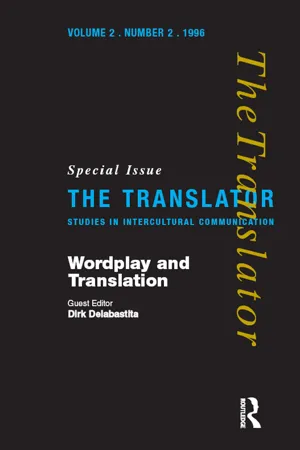
- 240 pages
- English
- ePUB (mobile friendly)
- Available on iOS & Android
eBook - ePub
About this book
Information
No-Man’s Land on the Common Borders of Linguistics, Philosophy & Sinology
Polysemy in the Translation of Ancient Chinese Texts
Abstract. This paper treats polysemy as the driving force of ancient Chinese rhetoric, inherent in the language and its system of writing, not just as an embellishment but as the very basis of discourse, and intrinsic to the multiple meanings expressed by the text; in this way, texts may represent a worldview that is radically different from the Western one and that is encoded syntactically, semantically, rhetorically, and visually (in the case of the Chinese written character) in the language. This challenges the comprehension of ancient Chinese texts by translators and their reproduction in languages that share neither the worldview nor the multiple codes involved. From the no-man’s land on the common borders of linguistics, philosophy and sinology, the translator may glimpse the horizon of understanding within which the original operates, while knowing that the readership of a translation is looking at a different horizon. Better understanding of this fact by the translator should contribute to a better interpretation of the multiple meanings contained in the original and to a translation that maintains as many meanings as possible.
This paper will present a series of considerations about the crucial role of wordplay and polysemy in the rhetorical structure of ancient Chinese texts, and the double challenge they represent for translators in relation to the comprehension of such texts and their reproduction in languages that share neither the worldview they express nor the syntactic, semantic, rhetorical or visual encodings involved. Needless to say, the subject of linguistic and cultural relativism is not far removed from these considerations. This overview of the problems of understanding and translating polysemous Chinese texts will of necessity be schematic, with many references to standard texts by acknowledged experts on Chinese linguistics, although the particular synthesis offered here is my own, as is the translation methodology proposed. It thus runs the double risk of seeming to be simplistic or self-evident to the professional sinologist, but too technical for the non-sinologist. In attempting to establish a general framework for discussing the difficulties of translating polysemous Chinese texts, it necessarily devotes more attention to the hermeneutics of reading the original than to the poetics of translating, although some attempt is made to convey both aspects of the problem. The title of the paper is taken from a leading sinologist’s description of the linguistic problems inherent in the comprehension of ancient Chinese philosophical texts (Graham 1989:392). A glossary of the Chinese originals of the romanized versions of Chinese words used in the text is appended.
1. Polysemy as an escape from the linear nature of language
I will treat wordplay/puns/polysemy as a fundamental aspect of language that has important existential and experiential ramifications, rather than an occasional (though significant) rhetorical or formal device. Polysemy implicates both the simultaneously multiple or multifarious nature of experience (that is inherently falsified by the sequential nature of language) and the co-existence of articulable and inarticulable experiences; the latter include mystical ones: “Whereof one cannot speak thereof one should be silent” (Wittgenstein 1922:par. 7).
The “inherent consecutiveness of language” (Frank 1991:passim) makes it a deficient vehicle for recording the fullness of human experience. Language is intrinsically linear and sequential because it unfolds in time – phonemes accumulate, one word follows another, and so on – while our experience of life is a complex of events, stimuli, etc., unfolding simultaneously in time and space. Along the same lines, Frederick Ahl (1985:291–92) notes that
Ovid’s [punning] attack upon sequential time, is … an attack upon language too. To undermine the sequences of language that hold us in their grip is to achieve some measure of freedom from the constraints that our societies and linguistic training impose upon us. To undermine sequential time, is to venture further – to destroy death or at least our subservience to death. And to destroy death is, in a sense, to achieve immortality. For in a world of constant change, death – and in a way time – has no absolute meaning. In that world the shape of things changes, not the nature of things.
In a process that paralleled the experiments of post-Impressionist painters seeking to overcome the inherent limitations of the two-dimensional canvas, writers taking part in the literary revolution that came to be known as Modernism tried to subvert this inherent consecutiveness of language through the creation of palimpsest-like texts, woven through with allusions and quotations which constituted cultural cross-references that were meant to be juggled in the mind of the reader; among the examples that spring to mind are Eliot’s The Waste Land (1922), Joyce’s Ulysses (1922) and Pound’s The Cantos (begun in 1917). This led to the standard statement that Modernist texts could not be read: they could only be re-read, because the reader first had to recognize and accumulate all of the cross-references embedded in the text in order for them to resonate and be played off against each other in successive readings of the text. As will be demonstrated, Classical Chinese texts already work that way; moreover, what was clearly perceived to be deliberate in Modernist texts has since been perceived to be true in general by poststructuralist and/or deconstructionist readings that make such a process of analysis extendable to any text. Along similar lines, it has been argued that metre and rhyme too are subversions of the irreversible passage of time through an effect of temporal repetition (Barjou 1995:59–79). Even imagery in poetry was defined by Ezra Pound as “that which presents an intellectual and emotional complex in an instant of time” (in Frank 1991:11); the instantaneous presentation of this complex of multiple meanings and feelings gives “that sense of freedom from time limits and space limits; that sense of sudden growth, which we experience in the presence of great works of art” (ibid).
As a specific example of polysemous discourse, the pun played a magical role in early cultures precisely because it could escape the limitations of space/time by blurring and eliminating semantic boundaries (Rees and Rees 1961: 348). Wordplay, in all of its varied forms, escapes the inherent consecutiveness of language by creating through it (at least momentarily) a simultaneity of experience (at least at the conceptual level, or at the level of reception). To some extent wordplay escapes the very concept of ‘definition’: since by its very nature wordplay blurs semantic boundaries, the fact that it can do so must raise doubts about the existence of such boundaries. When ambiguous or ambivalent, it has the force of a neither/nor statement; when paradoxical or deliberately polysemous it has the force of a both/and statement. It manifests a quality suggested by the ancient alchemical dictum “the solution is in the solution” (itself a pun), because the solution (philosophically speaking in the case of alchemy, semantically speaking in the case of words) is in the solution (chemically speaking in the case of alchemy, text in the case of words), and is therefore in solution. There cannot be a solution (philosophical answer, semantic disambiguation), because a solution (chemically, or the text) ceases to be such at the very moment that an analysis breaks it down into component parts. Analysis is not the solution (poststructuralism and deconstruction notwithstanding); nor can we hope to precipitate a solution out of the solution, because the precipitate would not be the solution, either (Golden 1981).
1.1. Polysemy as discourse: an atypical example in ‘Western’ literature
When language is used in such a way that it converts wordplay into the driving rhetorical motor of a text, a statement is being made about the nature of language and its role in our experience and understanding of the world as it is described by language. If a polysemous use of language can better capture the simultaneity of multifarious experience, then the efficacy of sequential language may be put in doubt. Perhaps the Western text that illustrates this most radically is James Joyce’s Finnegans Wake. Consider the following example:
the abnihilisation of the etym … expolodotonates through Parsuralia … amidwhiches general uttermosts confussion are perceivable mo...
Table of contents
- Cover Page
- Title Page
- Copyright Page
- Series page
- Contents
- Introduction
- Spik in Glyph? Translation, Wordplay, and Resistance in Chicano Bilingual Poetry
- Meaningful Literary Names Their Forms and Functions, and their Translation
- The Pitfalls of Metalingual Use in Simultaneous Interpreting
- Caught in the Frame A Target-Culture Viewpoint on Allusive Wordplay
- ‘Curiouser and Curiouser’: Hebrew Translations of Wordplay in Alice’s Adventures in Wonderland
- Translating Jokes for Dubbed Television Situation Comedies
- Dante’s Puns in English and the Question of Compensation
- No-Man’s Land on the Common Borders of Linguistics, Philosophy ampentity Sinology Polysemy in the Translation of Ancient Chinese Texts
- Revisiting the Classics A Question of Form The Problems of Translating Expressive Text
- Book Reviews
- Course Profile Wordplay and the Didactics of Translation
- Wordplay and Translation A Selective Bibliography
- Conference Diary
- Traductio. Essays on Punning and Translation
Trusted by 375,005 students
Access to over 1.5 million titles for a fair monthly price.
Study more efficiently using our study tools.
Frequently asked questions
Yes, you can cancel anytime from the Subscription tab in your account settings on the Perlego website. Your subscription will stay active until the end of your current billing period. Learn how to cancel your subscription
No, books cannot be downloaded as external files, such as PDFs, for use outside of Perlego. However, you can download books within the Perlego app for offline reading on mobile or tablet. Learn how to download books offline
Perlego offers two plans: Essential and Complete
- Essential is ideal for learners and professionals who enjoy exploring a wide range of subjects. Access the Essential Library with 800,000+ trusted titles and best-sellers across business, personal growth, and the humanities. Includes unlimited reading time and Standard Read Aloud voice.
- Complete: Perfect for advanced learners and researchers needing full, unrestricted access. Unlock 1.5M+ books across hundreds of subjects, including academic and specialized titles. The Complete Plan also includes advanced features like Premium Read Aloud and Research Assistant.
We are an online textbook subscription service, where you can get access to an entire online library for less than the price of a single book per month. With over 1.5 million books across 990+ topics, we’ve got you covered! Learn about our mission
Look out for the read-aloud symbol on your next book to see if you can listen to it. The read-aloud tool reads text aloud for you, highlighting the text as it is being read. You can pause it, speed it up and slow it down. Learn more about Read Aloud
Yes! You can use the Perlego app on both iOS and Android devices to read anytime, anywhere — even offline. Perfect for commutes or when you’re on the go.
Please note we cannot support devices running on iOS 13 and Android 7 or earlier. Learn more about using the app
Please note we cannot support devices running on iOS 13 and Android 7 or earlier. Learn more about using the app
Yes, you can access Wordplay and Translation by Dirk Delabastita in PDF and/or ePUB format, as well as other popular books in Languages & Linguistics & Linguistics. We have over 1.5 million books available in our catalogue for you to explore.