![]()
The Tourism Education Futures Initiative: An Introduction
PAULINE J. SHELDON
School of Travel Industry Management, University of Hawaii, Honolulu, HI, USA
DARKO PREBEŽAC
Faculty of Economics & Business, Department for Tourism, University of Zagreb, Zagreb, Croatia
DANIEL R. FESENMAIER
School of Hotel and Tourism Management, Temple University, Philadelphia, PA, USA
The impetus for this book is the need to transform tourism educational programs so as both to prepare students for a different world and to help them contribute to and create this world. Students entering the uncertain world of the future and in particular, the vulnerable tourism sector, need different skills, aptitudes and knowledge to succeed. Educational systems in general need radical change to meet the challenge of the next few decades (Wallis and Steptoe, 2006). Skills and knowledge sets must be redefined, structures and assumptions need to be questioned, and old ways of doing things must be transcended. Tourism employment in the coming decades must have a very different profile than it does today. In 2030 students will be applying for jobs that do not even exist today, and much of what we teach our students is obsolete by the time they graduate. These pressures and the increasing need for responsible stewardship of tourism destinations call out for a new paradigm of values-based tourism education. We believe that university level tourism programs must build the capacity in our graduates to lead in a new and different way.
In an attempt to address these issues, the Tourism Education Futures Initiative (TEFI) was born in 2007 by a few concerned tourism educators (Sheldon et al, 2008). This book provides a consolidation of TEFI’s work, and a framework for the future development of tourism education. Its content is based on the writings of about fifty experienced educators who have attended TEFI conferences over the last six years.
They inquire into the need for change and recommend diverse approaches that constitute a framework for a new tourism curriculum. Therefore, the vision of TEFI is to not only work to reshape tourism education worldwide, but to help the leaders of the tourism industry follow practices that are rooted in basic values. For an introduction to TEFI, please see our website: www.tourismeducationfutures.org
Perspectives of different stakeholder groups have been important to TEFI discussions. Industry members, graduate students, central university administrators and community representatives have participated in our conferences, albeit in the minority. Their presentations and opinions have informed the outcomes. The value shift that TEFI advocates must happen, and is happening, in these stakeholder groups making it easier for students upon graduation to find positions that support their education experience. For many graduates, this may not be the case and they must be the changemakers in their future work environments.
The first TEFI meeting was in 2007 at Modul University, Vienna, Austria, to discuss the status of tourism education and to assess whether there was consensus on the need to develop alternative models for tourism education. During this meeting, a process emerged that is both proactive and action oriented to create a fundamental change in tourism education. The TEFI process includes two important action settings: first, an annual conference, which brings together innovators and keynote speakers from around the world to consider issues related to the future of tourism education. Second, we have working groups, which throughout the year develop tools that can be used to affect tourism education.
The Annual Conference is generally comprised of 40 – 50 leading scholars and industry professionals and includes keynote presentations and breakout groups. Each conference has a specific theme relating to the future of tourism education. The keynote presentations stimulate thinking and challenge the status quo related to that theme. While the lectures provide the starting point of discussion, the main work of the TEFI annual conference is in the breakout groups that provide the setting for ideation, creativity, dialogue and problem resolution. The results of these breakout groups are presented to the entire TEFI body for clarification, refinement and concensus.
The Working Groups move the TEFI agenda forward between conferences by providing essential energy and direction resulting in concrete action-oriented tools that can be used by tourism educators. For example, one Working Group conducted a pre-meeting survey of participants regarding key knowledge and skill sets needed for the tourism graduate of the future. Another group developed a ‘values inventory’ which may be used as part of program assessment.
The first TEFI Conference at Modul University, Vienna explored various futuristic scenarios of society to which tourism education programs would need to adapt. Modifying tourism education programs to fit a multitude of possible world scenarios, or even a single preferred scenario was found to be a task fraught with too much specificity and uncertainty. Instead, TEFI participants concluded that whatever world scenario emerges in the future, certain values would provide the students with the foundation to meet the multitude of uncertainties presented by that the future. Given this consensus, the work of TEFI moved to define these value sets.
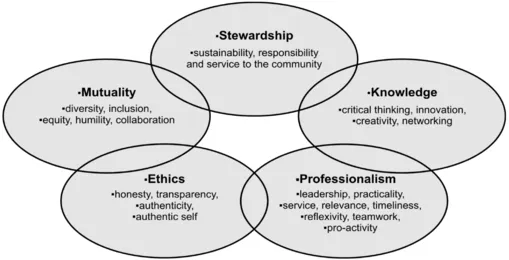
At the second TEFI Conference at the University of Hawai’i, USA, five values-based principles were identified to be embodied in tourism education programs ensuring students became responsible leaders and stewards for destinations in Figure 1 (see below)
Specifically the five values are: 1. Ethics, 2. Stewardship, 3. Knowledge, 4. Professionalism and 5. Mutuality. They are conceptually portrayed as interlocking value principles demonstrating their interconnectedness and permeability. TEFI members envisioned that educators can use subsets of the five value principles to integrate into their courses as appropriate.
During the third TEFI Conference at the University of Lugano, Switzerland, delegates considered each value in more detail and designed learning objectives and knowledge content that could be used to teach these values in a tourism context. The outcome of their work resulted in detailed descriptions of specific learning experiences and learning objectives for each value-based principle. These can be found on our website in the White Paper. We are grateful to the delegates of TEFI II and III for their contributions during the conference and after the conference ended. Another focus of TEFI III was the consideration of Outcome-Based teaching, and whether this would provide a useful resource for furthering the TEFI agenda. The group decided not to accept this approach, as the rigidity of the outcomes-based approach was too restrictive to the creative development that was required to transform tourism education.
The Theme of TEFI IV at University of Deusto in San Sebastian, Spain was “Tools for Change and New Challenges”. The delegates at this conference heard from keynote speakers about new challenges that tourism education will face in the years ahead. The working groups focused on designing new tools that could be shared with other educators wishing to provide a future oriented values-based education for their students. It was at this conference that the concept of the global online courses was developed.
The theme of TEFI V in Philadelphia was “Activating Change in Tourism Education” with the goal of implementing the changes discussed so far, and bringing them to action. In line with this thinking, TEFI V was the first meeting where delegates presented their research and initiatives. Presentations addressed how we should engage industry, communities and students in learning experiences. Complementing the presentations and discussions, very enlightening field trips forced us to imagine how student learning can benefit from field trips, internships, service learning, and other ways of interfacing with industry and community.
The theme of TEFI VI in Milan was “Transformational Leadership for Tourism Education”. During this conference the issue of leadership was central. What type of leadership is needed to change tourism programs to better reflect the future? The delegates at this conference identified four areas in which TEFI will seek to make a difference in the years ahead; they are: fostering innovative learning experiences for students at all levels, re-visioning tourism scholarship and the metrics for faculty success, advocacy for tourism as a field of study and employment, and to be a place where futures issues related to tourism are debated. A new vision statement was also crafted: TEFI seeks to be the leading, forward-looking network that inspires, informs and supports tourism educators and students to passionately and courageously transform the world for the better.
The theme of TEFI VII in Oxford was “Tourism Education for Global Citizenship: Educating for Lives of Consequence”. The conference immediately followed the Skoll World Forum on Social Entrepreneurship in Oxford and focused on issues related to the design of learning experiences for tourism and social entrepreneurship. The three keynote speakers spoke to the need to wake-up tourism to a new paradigm and recognize the significant policy shifts that are occurring at the international level. Delegates were also challenged to re-examine their understanding of global citizenship and discover ways to include new dimensions in the classroom. The proposal for a TEFI Change Conference that embodied faculty learning about social entrepreneurship in a tourism setting while walking in Nepal was proposed and eagerly received. Many new initiatives were born at this exciting meeting.
The key articles from these seven conferences have been captured in special issues of the Journal of Teaching in Travel & Tourism (JTTT), which are reprinted here in this book. Editor-in-Chief Cathy Hsu designated three thematic issues of JTTT to TEFI’s work, and the interest in this topic has been strong. An article introducing TEFI’s work published less than a year after the first TEFI Conference is still the most cited and downloaded article of the Journal indicating strong interest and concern for tourism education’s future (Sheldon, Fesenmaier, Woeber, Cooper, & Antonioli, 2008).
This book is divided into three sections and represents the work of innovative, thoughtful, and committed scholars and industry leaders, who have contributed to TEFI. The book is structured such that it first introduces the reader to TEFI and then systematically discusses the challenges facing tourism education at the university level. The focus of the book is both conceptual and pragmatic in nature, and covers a wide range of issues facing tourism education not only in the future, but also at present.
Part I entitled “TEFI PAPERS – Theoretical and Conceptual“ consists of four high quality and inspiring works seeking to provide vision, knowledge and frameworks for tourism education programs that promote global citizenship and examine critically the context of the neo-liberal university. The papers also report on different initiatives examining the future of tourism education into the years 2010 -2030, explore the leadership in tourism higher education and provide a conceptual framework for sustainable education that moves beyond current models in tourism education.
Part II entitled “TEFI PAPERS – Applications“ presents eight education-relevant applications of TEFI philosophy. The authors deal with the conceptual framework of tourism values, the creation of a TEFI values inventory, examine barriers to transformational changes of the tourism curriculum, implementation of new technology and new pedagogies, environmental attitudes, gender perspectives and the communication of role models to tourism students.
Part III entitled “TEFI PAPERS – Case Studies” provides seven interdisciplinary case studies dealing with the implementation of core values into the undergraduate curriculum, value-based teaching in the context of sustainable tourism, inter-disciplinarity and reform policies and practices in higher tourism education, students’ integration in innovative research and development projects, educational leadership, and career development of tourism graduates. The case studies illustrate important tourism education issues in a variety of English and non-English speaking countries in different parts of the world, including USA, Scandinavia, Southern Europe, the Caribbean and the Middle East.
In the last chapter “The Way Forward ” the authors synthesise the collective TEFI learnings over the past seven years in an effort to address some important shifts needed to provide an education of quality and relevance to tomorrow’s tourism industry.
It is our hope that this book will encourage the reader to reflect on the many socioeconomic, political, cultural, environmental and industry issues affecting tourism education. It is also our hope that readers will be stimulated by the book to create their own solutions to the challenge of creating real leaders and stewards for the tourism industry of the future.
References
Sheldon, P., Fesenmaier, D., Woeber, K., Cooper, C., & Antonioli, M. (2008). Tourism Education Futures – 2010–2030: Building the Capacity to Lead. Journal of Teaching in Travel & Tourism, 7(3), 61–68.
Wallis, C., and Steptoe, S. (2006). How to bring our Schools out of the 20th Century. Time, Sunday, 10th December.
![]()
Tourism Education Futures, 2010-2030: Building the Capacity to Lead
Pauline Sheldon
Dan Fesenmaier
Karl Woeber
Chris Cooper
Magda Antonioli
ABSTRACT. This paper reports on an initiative to examine the future of tourism education into the years 2010-2030. A group of 45 senior tourism educators and industry experts came together for a summit at Modul University, Vienna, Austria to discuss how tourism education needs to adapt to significant societal and industry changes. The theme of the summit was how to build the capacity for tourism students to lead the industry into the future as it faces increasing pressures for responsibility and stewardship. This paper discusses the pre-summit and summit processes and their outcomes, and explains future plans for this Tourism Education Futures Initiative (TEFI). Among other outcomes was a listing of values that could create the foundation for future tourism education programs, and also five categories of skills that participants felt would be important for students of the future to master. These are destination stewardship skills, political skills, ethical skills, enhanced human resource skills, and dynamic business skills.
... for business leaders to succeed in the global economy will require new kinds of management processes and analytical frameworks. Their decision rules will need to be more rigorous and open to a wider set of measures and realities than in the past. The old decision rules and assumptions won't do. In fact a new definition of rigor is needed.
(Samuelson, 2006, p. 356)
Logical and precise, left-bram thinking gave us the Information-Age. Now comes the Conceptual-Age—ruled by artistry, empathy, and emotion.
(Pink, 2005, p. 70)
Introduction
The world is experiencing seismic changes. We know what they are, and we know they are happening with increasing frequency. Society and tourism are being shaken by these external shocks and need to adjust to the impacts and prepare to act, think, and plan differently. Students who enter this uncertain world and, in particular, the fragile and vulnerable tourism sector, need different skills, aptitudes, and knowledge, implying that educational systems need to change radically to meet this need (Wallis & Steptoe, 2006). Tourism educational programs need to fundamentally retool and redesign—not incremental ly by adding new courses or simply by putting courses on-line—but by changing the nature of what is taught and how it is taught. Skills and knowledge sets must be redefined, structures and assumptions need to be questioned, and old ways of doing things must be transcended. Tourism employment in the coming decades will have a very different profile than it does today. For example, the key jobs in 2015 may not even exist today, and much of what we teach our students may be obsolete by the time they gra...