eBook - ePub
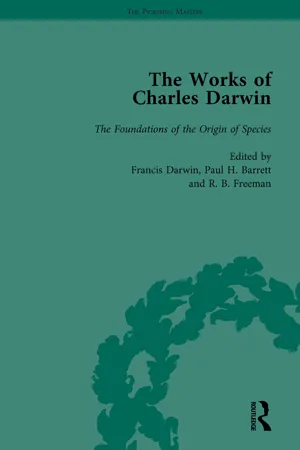
The Works of Charles Darwin: Vol 10: The Foundations of the Origin of Species: Two Essays Written in 1842 and 1844 (Edited 1909)
- 234 pages
- English
- ePUB (mobile friendly)
- Available on iOS & Android
eBook - ePub
The Works of Charles Darwin: Vol 10: The Foundations of the Origin of Species: Two Essays Written in 1842 and 1844 (Edited 1909)
About this book
The tenth volume in a 29-volume set which contain all Charles Darwin's published works. Darwin was one of the most influential figures of the 19th century. His work remains a central subject of study in the history of ideas, the history of science, zoology, botany, geology and evolution.
The Essay of 1844
PART I
CHAPTER I
ON THE VARIATION OF ORGANIC BEINGS UNDER DOMESTICATION; AND ON THE PRINCIPLES OF SELECTION
The most favourable conditions for variation seem to be when organic beings are bred for many generations under domestication:1 one may infer this from the simple fact of the vast number of races and breeds of almost every plant and animal, which has long been domesticated. Under certain conditions organic beings even during their individual lives become sighly altered from their usual form, size, or other characters: and many of the peculiarities thus acquired are transmitted to their offspring. Thus in animals, the size and vigour of body, fatness, period of maturity, habits of body or consensual movements, habits of mind and temper, are modified or acquired during the life of the individual,2 and become inherited. There is reason to believe that when long exercise has given to certain muscles great development, or disuse has lessened them, that such development is also inherited. / Food and climate will occasionally produce changes in the colour and texture of the external coverings of animals; and certain unknown conditions affect the horns of cattle in parts of Abyssinia; but whether these peculiarities, thus acquired during individual lives, have been inherited, I do not know. It appears certain that malconformation and lameness in horses, produced by too much work on hard roads — that affections of the eyes in this animal probably caused by bad ventilation — that tendencies towards many diseases in man, such as gout, caused by the course of life and ultimately producing changes of structure, and that many other diseases produced by unknown agencies, such as goitre, and the idiotcy resulting from it, all become hereditary.
It is very doubtful whether the flowers and leaf-buds, annually produced from the same bulb, root, or tree, can properly be considered as parts of the same individual, though in some respects they certainly seem to be so. If they are parts of an individual, plants also are subject to considerable changes during their individual lives. Most florist-flowers if neglected degenerate, that is, they lose some of their characters; so common is this, that trueness is often stated, as greatly enhancing the value of a variety:3 tulips break their colours only after some years’ culture; some plants become double and others single, by neglect or care: these characters can be transmitted by cuttings or grafts, and in some cases by true or seminal propagation. Occasionally a single bud on a plant assumes at once a new and widely different character: thus it is certain that nectarines have been produced on/peach trees and moss roses on provence roses; white currants on red currant bushes; flowers of a different colour from that of the stock, in Chrysanthemums, Dahlias, sweet-williams, Azaleas, etc.; variegated leaf-buds on many trees, and other similar cases. These new characters appearing in single buds, can, like those lesser changes affecting the whole plant, be multiplied not only by cuttings and such means, but often likewise by true seminal generation.
The changes thus appearing during the lives of individual animals and plants are extremely rare compared with those which are congenital or which appear soon after birth. Slight differences thus arising are infinitely numerous: the proportions and form of every part of the frame, inside and outside, appear to vary in very slight degrees: anatomists dispute what is the ‘beau ideal’ of the bones, the liver and kidneys, like painters do of the proportions of the face: the proverbial expression that no two animals or plants are born absolutely alike, is much truer when applied to those under domestication, than to those in a state of nature.4 Besides these slight differences, single individuals are occasionally born considerably unlike in certain parts or in their whole structure to their parents: these are called by horticulturalists and breeders ‘sports’; and are not uncommon except when very strongly marked. Such sports are known in some cases to have been parents of some of our domestic races; and such probably have been the parents of many other races, especially of those which in some senses may be called hereditary monsters; for instance where there is an additional limb, or where all the limbs are stunted (as in the Ancon sheep), or where a part is wanting, as in rumpless fowls and tailless/dogs or cats.5 The effects of external conditions on the size, colour and form, which can rarely and obscurely be detected during one individual life, become apparent after several generations: the slight differences, often hardly describable, which characterize the stock of different countries, and even of districts in the same country, seem to be due to such continued action.
On the hereditary tendency
A volume might be filled with facts showing what a strong tendency there is to inheritance, in almost every case of the most trifling, as well as of the most remarkable congenital peculiarities.6 The term congenital peculiarity, I may remark, is a loose expression and can only mean a peculiarity apparent when the part affected is nearly or fully developed: in the Second Part, I shall have to discuss at what period of the embryonic life connatal peculiarities probably first appear; and I shall then be able to show from some evidence, that at whatever period of life a new peculiarity first appears, it tends hereditarily to appear at a corresponding period.7 Numerous though slight changes, slowly supervening in animals during mature life (often, though by no means always, taking the form of disease), are, as stated in the first paragraphs, very often hereditary. In plants, again, the buds which assume a different character from their stock likewise tend to transmit their new peculiarities. There is not sufficient reason to believe that either mutilations8 or changes of form produced by / mechanical pressure, even if continued for hundreds of generations, or that any changes of structure quickly produced by disease, are inherited; it would appear as if the tissue of the part affected must slowly and freely grow into the new form, in order to be inheritable. There is a very great difference in the hereditary tendency of different peculiarities, and of the same peculiarity, in different individuals and species; thus twenty thousand seeds of the weeping ash have been sown and not one come up true; out of seventeen seeds of the weeping yew, nearly all came up true. The ill-formed and almost monstrous ‘Niata’ cattle of S. America and Ancon sheep, both when bred together and when crossed with other breeds, seem to transmit their peculiarities to their offspring as truly as the ordinary breeds. I can throw no light on these differences in the power of hereditary transmission. Breeders believe, and apparently with good cause, that a peculiarity generally becomes more firmly implanted after having passed through several generations; that is if one offspring out of twenty inherits a peculiarity from its parents, then its descendants will tend to transmit this peculiarity to a larger proportion than one in twenty; and so on in succeeding generations. I have said nothing about mental peculiarities being inheritable for I reserve this subject for a separate chapter.
Causes of Variation
Attention must here be drawn to an important distinction in the first origin or appearance of varieties: when we see an animal highly kept producing offspring with an hereditary tendency to early maturity and fatness; when we see the wild-duck and Australian dog always becoming when bred for one or a few generations in confinement,/mottled in their colours; when we see people living in certain districts or circumstances becoming subject to an hereditary taint to certain organic diseases, as consumption or plica polonica — we naturally attribute such changes to the direct effect of known or unknown agencies acting for one or more generations on the parents. It is probable that a multitude of peculiarities may be thus directly caused by unknown external agencies. But in breeds, characterized by an extra limb or claw, as in certain fowls and dogs; by an extra joint in the vertebrae; by the loss of a part, as the tail; by the substitution of a tuft of feathers for a comb in certain poultry; and in a multitude of other cases, we can hardly attribute these peculiarities directly to external influences, but indirectly to the laws of embryonic growth and of reproduction. When we see a multitude of varieties (as has often been the case, where a cross has been carefully guarded against) produced from seeds matured in the very same capsule,9 with the male and female principle nourished from the same roots and necessarily exposed to the same external influences; we cannot believe that the endless slight differences between seedling varieties thus produced, can be the effect of any corresponding difference in their exposure. We are led (as Muller has remarked) to the same conclusion, when we see in the same litter, produced by the same act of conception, animals considerably different.
As variation to the degree here alluded to has been observed only in organic beings under domestication, and in plants amongst those most highly and long cultivated, we must attribute, in such cases, the varieties (although the difference between each variety cannot possibly be attributed to any corresponding difference of exposure in the parents) to the indirect effects of domestication on the action of/the reproductive system.10 It would appear as if the reproductive powers failed in their ordinary function of producing new organic beings closely like their parents; and as if the entire organization of the embryo, under domestication, became in a slight degree plastic.11 We shall hereafter have occasion to show, that in organic beings, a considerable change from the natural conditions of life, affects, independently of their general state of health, in another and remarkable manner the reproductive system. I may add, judging from the vast number of new varieties of plants which have been produced in the same districts and under nearly the same routine of culture, that probably the indirect effects of domestication in making the organization plastic, is a much more efficient source of variation than any direct effect which external causes may have on the colour, texture, or form of each part. In the few instances in which, as in the Dahlia,12 the course of variation has been recorded, it appears that domestication produces little effect for several generations in rendering the organization plastic; but afterwards, as if by an accumulated effect, the original character of the species suddenly gives way or breaks.
On Selection
We have hitherto only referred to the first appearance in individuals of new peculiarities; but to make a race or breed, something more is generally13 requisite than such peculiarities (except/in the case of the peculiarities being the direct effect of constantly surrounding conditions) should be inheritable — namely the principle of selection, implying separation. Even in the rare instances of sports, with the hereditary tendency very strongly implanted, crossing must be prevented with other breeds, or if not prevented the best characterized of the half-bred offspring must be carefully selected. Where the external conditions are constantly tending to give some character, a race possessing this character will be formed with far greater ease by selecting and breeding together the individuals most affected. In the case of the endless slight variations produced by the indirect effects of domestication on the action of the reproductive system, selection is indispensable to form races; and when carefully applied, wonderfully numerous and diverse races can be formed. Selection, though so simple in theory, is and has been important to a degree which can hardly be overrated. It requires extreme skill, the results of long practice, in detecting the slightest difference in the forms of animals, and it implies some distinct object in view; with these requisites and patience, the breeder has simply to watch for every the smallest approach to the desired end, to select such individuals and pair them with ...
Table of contents
- Cover
- Half Title
- Title Page
- Copyright Page
- Introduction to Volume Ten
- Original Title Page
- Dedication
- Table of Contents
- Introduction
- The Essay of 1842
- The Essay of 1844
- Index
- Portrait
- Facsimile
Trusted by 375,005 students
Access to over 1.5 million titles for a fair monthly price.
Study more efficiently using our study tools.
Frequently asked questions
Yes, you can cancel anytime from the Subscription tab in your account settings on the Perlego website. Your subscription will stay active until the end of your current billing period. Learn how to cancel your subscription
No, books cannot be downloaded as external files, such as PDFs, for use outside of Perlego. However, you can download books within the Perlego app for offline reading on mobile or tablet. Learn how to download books offline
Perlego offers two plans: Essential and Complete
- Essential is ideal for learners and professionals who enjoy exploring a wide range of subjects. Access the Essential Library with 800,000+ trusted titles and best-sellers across business, personal growth, and the humanities. Includes unlimited reading time and Standard Read Aloud voice.
- Complete: Perfect for advanced learners and researchers needing full, unrestricted access. Unlock 1.5M+ books across hundreds of subjects, including academic and specialized titles. The Complete Plan also includes advanced features like Premium Read Aloud and Research Assistant.
We are an online textbook subscription service, where you can get access to an entire online library for less than the price of a single book per month. With over 1.5 million books across 990+ topics, we’ve got you covered! Learn about our mission
Look out for the read-aloud symbol on your next book to see if you can listen to it. The read-aloud tool reads text aloud for you, highlighting the text as it is being read. You can pause it, speed it up and slow it down. Learn more about Read Aloud
Yes! You can use the Perlego app on both iOS and Android devices to read anytime, anywhere — even offline. Perfect for commutes or when you’re on the go.
Please note we cannot support devices running on iOS 13 and Android 7 or earlier. Learn more about using the app
Please note we cannot support devices running on iOS 13 and Android 7 or earlier. Learn more about using the app
Yes, you can access The Works of Charles Darwin: Vol 10: The Foundations of the Origin of Species: Two Essays Written in 1842 and 1844 (Edited 1909) by Paul H Barrett in PDF and/or ePUB format, as well as other popular books in History & World History. We have over 1.5 million books available in our catalogue for you to explore.