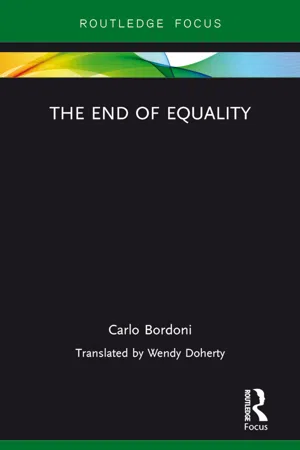
The economic crisis has brought social differences to the fore, reinventing the old question of inequality as democracy's missed opportunity. Many have attempted to find a rational explanation of the problem, tracing it back to poor economic policy and reckless liberalisation of finance, or the crisis of banks and governments, as well as the collapse of family relationships. At the same time, globalisation has reduced the differences between some nations, bringing emerging countries to the level of the more advanced, but has dangerously increased internal inequalities. In this book, the author examines the question of inequality and the social problems it is creating in societies across the world, arguing that with the crisis of modernity, the ideal of equality appears to be over. As more and more of the world's resources are concentrated in ever fewer hands, the promise of mass society as a means to grant equality and cancel the differences of classes appears to be giving way to a rising individualism. This book asks whether the apparent end of mass society will coincide with the end of equality and a re-evaluation of the worth of the individual. Are we heading towards a liquid world in which being equal is now considered less a virtue than a weakness?
- 84 pages
- English
- ePUB (mobile friendly)
- Available on iOS & Android
eBook - ePub
The End of Equality
About this book
Information
1 Inequalities
DOI: 10.4324/9781315467290-1
The peculiar and preponderant fact that marks those ages as its own is the equality of condition; the ruling passion of men in those periods is the love of this equality. Do not ask what singular charm the men of democratic ages find in being equal, or what special reasons they may have for clinging so tenaciously to equality rather than to the other advantages that society holds out to them_ equality is the distinguishing characteristic of the age they live in; that of itself is enough to explain that they prefer it to all the rest.Alexis De Tocqueville1
We are all born different and then search for equality. The social drive towards uniformity is so strong that it suppresses our primordial instinct to stand out, to the point of making us feel a sense of inferiority if our diversity is not hidden, subdued, even annihilated. Being the same becomes a primary objective, a model to pursue, because it makes us feel at ease in the community and with ourselves; it gives us a sense of security and helps keep other people's criticism at bay. It is a sort of calming passiveness and allows us, in the event, to be on the other side and criticise those who stand out from the crowd.
Perhaps the first social fear that human beings encounter in their life is the fear of their own inadequacy; that their own diversity, their “uniqueness”, their personal characteristics, which they perceive as flaws, are recognised by the others and derided, thus becoming a target for criticism and marginalisation. Education induces us to want to become like other people, presenting as the first and most concrete form of social repression, which, of course, is necessary in order to contain the many differences that coexist in the same social context.
“We are all equal” is an apparently incontrovertible statement, which has become accustomed to through education, culture, ethics and reason, an axiom that, by definition, does not need to be proven. To call the validity of this into question exposes us to considerable risks, primarily to charges of racism, the most hateful of accusations, and then, in turn, of fascism, anti-democracy, traditionalism, and stupidity.
The assertion of equality is an unquestionable principle that is the basis of all forms of coexistence, of every law and every political system that refers to democracy. And yet we only have to take a look at any street, at any time, in any city on this planet, and what we see systematically and repeatedly contradicts such a resolute statement.
Inequality is perceptible; it's proven and palpable in real everyday life, even though, in theory, it does not exist.
What causes this jarring contradiction? Hypocrisy, bad faith, cynicism? Or more simply, a historical misunderstanding, a kind of “original sin” determined by the foundations of modernity, that the Enlightenment believed it could impose through an act of presumption and rational optimism, but which three centuries of modernity have not been able to put in practice. The failure to achieve equality among men is the most serious of the promises that modernity has fallen short of, and perhaps it is the most difficult to keep.
Modernity does not go beyond the formal principle of equality, according to which “all men are equal in the eyes of the law” and enjoy the same rights, regardless of sex, social class, origins, religious and political beliefs. Embraced by the French Revolution, the recognition of formal equality has not proven conclusive, eluding that absolute principle of rationality on which it was founded and lacking in practical application, if it is not followed by real political, economic and social equality.
With regard to this, the Enlightenment has fundamental responsibilities. Freed from religious influence, the Enlightenment thinkers believe that the only way man could improve himself is through reason: a continuous process towards perfection which can only be achieved through knowledge. Progress is the new faith and takes on a universal meaning that encapsulates and carries along in its wake everything positive that can help to achieve human happiness.
From John Locke's theory of “sensationalism”, according to which all our ideas are derived from the senses, Voltaire and Condillac develop an idea of moral pragmatism that comes close to David Hume and Jeremy Bentham's utilitarianism_ all that is useful to man is good and right. The ethical principles of the Enlightenment are ready to meet the interests of capitalism, by introducing to the modern idea of progress the principle of “utility” and cost effectiveness that will carry on into the following centuries: if wealth is useful, then it is morally justified to pursue it as an ideal of life. This principle has significant similarities with the sixteenth-century Calvinist reform of Luther, and as Max Weber points out, the development of modern capitalism is connected to it.2
Nevertheless, there are two Enlightenment thinkers disassociated from the insidious charm of ethical pragmatism_ for Jean-Jacques Rousseau (1754),3 convinced that human history is characterised by a continuous regression and that the inequality is a result of the abandonment of the state of nature, the solution lies in the recovery of our natural origins (the myth of the noble savage). The other is the mathematician Marie Jean Antoine Nicolas de Caritat, Marquis de Condorcet, who like Rousseau, raises the problem of equality among men, although with a more optimistic spirit: no regression, but a continuous process of improvement through the recognition of equal rights and the redistribution of wealth.
In his posthumous work Esquisse d’un tableau historique des progres de l’esprit humain (1795), Condorcet points to the ethical principle of progress towards absolute perfection in achieving real equality between men:
The aim of the work that I have undertaken – he writes – and its results will be to show by appeal to reason and fact that nature has set no term to the perfection of human faculties; that the perfectibility of man is truly indefinite; and that the progress of this perfectibility, from now on words independent of any power that might wish to halt it, has no other limits than the duration of the globe upon which nature has cast us. This progress will doubtless vary in speed, but it will never be reversed as long as the earth occupies its present place in the system of the universe, and as long as the general laws of the system produce neither a general cataclysm nor such changes as will deprive the human race of its present faculties and its present resources.4
First, Condorcet claims equality between the sexes, followed by economic parity, equality in education and position, the latter meaning the elimination of the differences between those earn their living only from their work, and those who possess great wealth and can pass it on to their descendants. This is very topical issue, and one that is still the focus of debate among economists on the tax system and the tax on inheritance.5 It gives rise to the idea of achieving real equality among all the peoples of the earth, anticipating to some extent Socialist internationalism, as well as many ideological aspects from Marxism, such as education as an instrument of liberation from oppression.
Of course, Condorcet's ideas are utopian based with no practical implications, but their importance is significant if we are to understand how far the Enlightenment strived towards the creation of a decidedly innovative social theory with respect to the past, that would constitute one of the cardinal principles of modernity.
“We are all equal” remains a universally valid principle, but we should recognise its scope, its validity as a “social project”. The civil progress of mankind naturally aims for equality as its highest achievement, out of the need for coexistence among men, so that there might be a society founded on mutual respect, limited freedom, laws and traditions, the division of work on the recognition of cultural values.
Starting from the differences between humans, whether they are natural or induced by man himself (economic, cultural, social) – one of the major causes of inequality is down to the place where we are born – equality is sought, desired and conquered. It is a valuable asset that, once possessed, is not won over forever. It takes a great deal of effort to earn it; it is a goal that sometimes, throughout history, seems to be within reach, then moves further away and seems unattainable: a utopian desire that ends up being a label on an empty container.
Equality, therefore, is a primary objective, to which every political system, every government, every community and every social group that can be defined as civil, should make a clear commitment. It is not a starting point, but a point of arrival. For this reason it can be said that we are born different, but become equal. Only if this is what we want.
Thus, we are faced with two diametrically opposed visions: in the first, denoted by Jean-Jacques Rousseau in his most famous “speech” on the origin of inequality, all men are born equal, and inequality is generated as a consequence of the place where a person is born, of the economic and social conditions of the family and the country in which he grows up, of the type of education received, of the opportunities that are offered and the resources of the social environment in which he lives.
In this case, inequality is caused socially and maintained by the system in order to separate and exploit the less gifted (socially and economically) in favour of the privileged few, who, if they are to continue to be such, must necessarily be only a few.
It is this Enlightenment theory that modernity has made its own and promoted for centuries, focusing on the principle that, since equality is an original condition, everyone can aspire to return to that initial status by improving themselves, using their skills, putting all their efforts into work – the main instrument through which one can aspire to equal dignity with respect to other people – to increase individual well-being and that of their families, and contribute to the progress of society.
From being an initial certain condition, equality turns out to be an unstable prospect, socially erratic and highly uncertain.
Equality cannot be said to be a condition of arrival. On the contrary, it is like a continuous and exhausting race with the objective of outdoing the others, in a social competition in which the competitors are not satisfied with achieving equality, but demand its affirmation: a concept that already contains a principle of imbalance, since it tends to emphasise the individual with respect to the whole group.
In this vision, the principle of equality among men is more idealistic than substantial in nature and it leaves itself open to being regarded as the great imposture, the hypocrisy of modernity to the detriment of man.
There is a second point of view, which has its roots in popular culture, but that modernity rejects as unjust and intolerant. It is the idea that men are not born equal, that the differences are endemic and that it is wrong to try to correct them. It is the idea that diversity is a value that deserves to be recognised as such and not cancelled out.
Equality, then, rather than a natural fact, becomes a cultural one: a key feature of civilised society that society guarantees and pursues through the laws, civil rights and living conditions. A principle of social equality that puts everyone at the same level, despite the diversity, and even for the recognition of this diversity.
The push towards social equality, to compliance with the media, to feel part of the community, considering that the perception of exclusion in itself and by others is evaluated negatively, appears to be a universal constant and is probably connected to human nature itself. More than an effect mediated by culture or by a political purpose, it seems to be a natural instinct, going back to a time just prior to logos, when the individual consciousness had not yet been developed and when man, who had no sense of self-awareness, belonged to a group that was unable to distinguish themselves from the world surrounding them.
This identification with the whole (the real) then gave rise to animism, where there remain traces of a primordial condition in which equality and the lack of differentiation between human beings and all of creation are perceived as natural. We call it the Golden Age or the Age of the Bicameral Mind, as claimed by Julian Jaynes in his illuminating anthropological essay.6 It is about a primitive stage of human evolution, the conclusion of which can be dated to around two thousand years before Christ, during which there was a state of psychological fusion with everything, and therefore with the whole community/tribe where primitive man lived in perfect harmony with nature.
Such a condition can be considered ideal for those who observe it in retrospect, both because it is primitive, that is, not preceded by something else known in scientific research today, and because it is still pure and untainted by civilisation whose existential difficulties, violence, brutality and recklessness can be perceived as being “in harmony” with the world – a condition which man moved away from through evolution, the awareness of himself with respect to others, with language and signs that led to writing. The distinction of self with respect to the others (a mathematical concept which involves the understanding of the unit of measure: one in comparison to the other) is already the first aspect of diversity in which lies the principle of inequality.
In many religions, as in Christianity, the traumatic transition from the age of unawareness to that of awareness is described using metaphors and mythical representations: the apple of the Bible is called the forbidden fruit of knowledge and symbolises self-awareness and, consequently, the loss of the paradise state of unawareness, that fusion with the totality of existence to which man instinctively returns, such as inside the mother's body. Protection, safety, non-discrimination, but especially obnubilation.
This is something that has to do with the state of nature drawn from Rousseau, although we must recognise that the “myth of the noble savage” is exactly that, a myth, considering that the living conditions of a time so far away from us are not even imaginable. The fact is that inequality was born then with the birth of consciousness, and thus (metaphorically) with the fig leaf that Adam and Eve used to cover their nakedness.
Not with the first man who fenced off a piece of land and claimed it as his own: after all, this man did nothing but oppose with a “cultural” gesture (the symbolic sign of the border) the abuse perpetrated by whoever insists on removing others from that place by force. Moreover, even Alexis de Tocqueville wrote, not without i...
Table of contents
- Cover Page
- Front-Other Page
- Title Page
- Copyright Page
- Table Of Contents
- Figures
- 1 Inequalities
- 2 A crisis of modernity and of the idea of progress
- 3 From Social Darwinism to massification
- 4 Democracy of crisis
- 5 Forms of inclusion and exclusion
- 6 The perception of inequality
- 7 The measure of inequality
- 8 Economy and diversity
- 9 A false democracy
- 10 New social differences
- References
- Index
Trusted by 375,005 students
Access to over 1.5 million titles for a fair monthly price.
Study more efficiently using our study tools.
Frequently asked questions
Yes, you can cancel anytime from the Subscription tab in your account settings on the Perlego website. Your subscription will stay active until the end of your current billing period. Learn how to cancel your subscription
No, books cannot be downloaded as external files, such as PDFs, for use outside of Perlego. However, you can download books within the Perlego app for offline reading on mobile or tablet. Learn how to download books offline
Perlego offers two plans: Essential and Complete
- Essential is ideal for learners and professionals who enjoy exploring a wide range of subjects. Access the Essential Library with 800,000+ trusted titles and best-sellers across business, personal growth, and the humanities. Includes unlimited reading time and Standard Read Aloud voice.
- Complete: Perfect for advanced learners and researchers needing full, unrestricted access. Unlock 1.5M+ books across hundreds of subjects, including academic and specialized titles. The Complete Plan also includes advanced features like Premium Read Aloud and Research Assistant.
We are an online textbook subscription service, where you can get access to an entire online library for less than the price of a single book per month. With over 1.5 million books across 990+ topics, we’ve got you covered! Learn about our mission
Look out for the read-aloud symbol on your next book to see if you can listen to it. The read-aloud tool reads text aloud for you, highlighting the text as it is being read. You can pause it, speed it up and slow it down. Learn more about Read Aloud
Yes! You can use the Perlego app on both iOS and Android devices to read anytime, anywhere — even offline. Perfect for commutes or when you’re on the go.
Please note we cannot support devices running on iOS 13 and Android 7 or earlier. Learn more about using the app
Please note we cannot support devices running on iOS 13 and Android 7 or earlier. Learn more about using the app
Yes, you can access The End of Equality by Carlo Bordoni in PDF and/or ePUB format, as well as other popular books in Social Sciences & Social Classes & Economic Disparity. We have over 1.5 million books available in our catalogue for you to explore.