- 160 pages
- English
- ePUB (mobile friendly)
- Available on iOS & Android
eBook - ePub
About this book
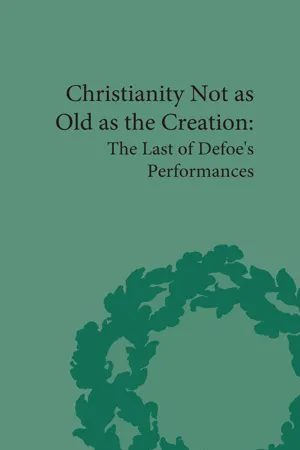
This critical edition is the first such version of Christianity Not as Old as the Creation and the first time it has been reprinted. Starr's attribution is not only a significant contribution to Defoe scholarship, but in making it he provides an excellent 'how to' guide for scholars wishing to add other non-attributed works to the Defoe canon.
Information
INTRODUCTION
I. The Case for Attributing
Christianity Not as Old as the Creation to Daniel Defoe
There seems to me good reason for thinking that Defoe wrote Christianity Not as Old as the Creation, published in May 1730,1 in answer to the Deist Matthew Tindal’s Christianity as Old as the Creation of April 1730.2 Tindal’s book came to be known as ‘the Deists’ Bible’, and it called forth dozens of replies in the 1730s,3 but various features of Deism had already been provoking debate for decades. My evidence for Defoe’s authorship of Christianity Not as Old as the Creation is entirely internal; according to Furbank and Owens’s principles, the attribution should be classified as ‘probable’ rather than ‘certain, as are many other items listed in their Critical Bibliography.4 Biographical evidence does not give us much help over the ascription. In Defoe’s letters there are suggestions that his health was bad, and that to avoid legal and financial ruin at the hands of actual or pretended creditors, he spent some of his final year on the move or in hiding, but at any rate not at home. About his domestic situation we know little, except that his protracted haggling with Henry Baker over the dowry of his daughter Sophia had been resolved; the no-longer-young couple was married, and exchanged renewed protestations of affection with Defoe. It would be natural to suppose that the more ill and harried he was, the less willing or able he would be to undertake and carry out a substantial polemical work.5 Yet he had often been productive in unpromising circumstances, and amidst his tribulations he could conceivably have found Deist-bashing an invigorating therapeutic exercise. We know that in 1730 he was still actively engaged in business;6 it seems that while there was life in him he could not give up buying and selling, and this may have been true of writing as well.7 It is not hard to imagine that the bookseller Warner, alert to the succès de scandale of Tindal’s book, approached Defoe (or that Defoe approached Warner) about producing a timely response. Christianity as Old as the Creation was published as a 432-page, 15-shilling quarto volume in April, 1730, and Christianity Not as Old as the Creation appeared as a 95-page, 1-shilling octavo in May, 1730.8 One of Defoe’s early biographers remarks that ‘When curiousness has contemplated such copiousness, such variety, and such excellence, it naturally inquires which was the last of De Foe’s performances?’ 9 Until now, a work that came out in February or March 1730 has been thought to be his final lifetime publication, A Brief State of the Inland or Home Trade.10 If accepted as Defoe’s, the present work would appear to have been the last of his performances.
The strongest single piece of internal evidence is the quotation, near the end of Christianity Not as Old as the Creation, of the following four lines of verse by Defoe:
If it should so fall out, as who can tell,
But there may be a GOD, a HEAVEN, and HELL,
Mankind had best consider well, for Fear
’T should be too late when their Mistakes appear (p. 58 below)
But there may be a GOD, a HEAVEN, and HELL,
Mankind had best consider well, for Fear
’T should be too late when their Mistakes appear (p. 58 below)
These lines are from Defoe’s poem, The Storm. An Essay, which was published in 1704 together with An Elegy on the Author of the True-Born-English-Man (see Poetry, in Satire, Fantasy and Writings on the Supernatural, vol. 1, p. 289, ll. 248–51). The same lines were quoted by Defoe in The Storm (1704), Preface, sig. [A7 ]; twice in his Serious Reflections (in Novels, Vol. 3, pp. 117 and 264), and yet again in his 1726 work, the Political History of the Devil (in Satire, Fantasy and Writings on the Supernatural, vol. 6, p. 48). It is conceivable that a writer other than Defoe came across these lines in one or more of his works, and found them sufficiently memorable and apposite to quote them here. Yet it is hard to imagine them making as powerful an impression on anyone else as on Defoe himself, who had demonstrated his fondness for them by using them in four different works between 1704 and 1726 – and twice within one work, the Serious Reflections.
At a number of points there is a close correspondence between this work and Defoe’s New Family Instructor of 1727. That book is a bold and sustained venture into controversial divinity, as its subtitle makes clear.11 The present work is less expository, and on a smaller scale, but it belongs to the same genre. Abandoning the dialogue format, omitting the debates over Christ’s status as God and Messiah, and expanding the critique of Deism beyond a vindication of Scripture, it is nevertheless the same kind of work, an attempt to defend sound belief against current fashions of unbelief. In both works, reformed Christianity is on the defensive; in both, the most immediate threat is from unbelief in its insidious modern guise of Deism, posing as a ‘religion of nature’ or a ‘religion of reason’. A New Family Instructor spells out more fully the grounds for embracing the specific doctrines it advocates, such as the divinity of Christ, but both works are chiefly polemics against religious or irreligious positions held to be false and pernicious.
The resemblance goes well beyond a shared general purpose to a frequent and exact duplication of argument and language. For instance, one of Defoe’s recurrent contentions is that the Deists aggrandize God’s mercy at the expense of his justice. In A New Family Instructor, he asserts that ‘They … bring the Deity … under such Regulations and Restrictions, that they scarce allow him to be a God at all. They will have him be so good, so merciful, so beneficent, that he cannot be Just’ (Religious and Didactic Writings, vol. 3, p. 204). ‘What kind of a God must we make of him’, the present author asks, ‘Who is so merciful, he can’t be just?’ (p. 42 below), and he declares, ‘It is evident his Vengeance against Offenders is often declared with Terror, the wrath of God is reveal’d from Heaven against all unrighteousness, Rom. i. 18’ (p. 42 below). In A New Family Instructor, to combat the Deists’view that God looks on sinners ‘with Pity … and Compassion, but no Anger and Displeasure, which is below his Infinite Greatness, and the Sovereignty of his Mercy’, Defoe cites the same verse, and insists that God is ‘angry, and will … deal in the utmost Vengeance and Resentment against the guilty Sinner, unless he repents’ (Religious and Didactic Writings, vol. 3, p. 205).
Often the two books make the same point in identical terms. Here the author claims that quibbling Deists ‘will find the very Image of God stampt upon every part of [the Bible] … with a visible Signature of the Divine Authority’; that throughout there are ‘eminent Signatures of the high Original of the Scriptures’ (pp. 46, 48 below); and he asks, ‘Are not these Marks of a Divine Impression?’ (p. 48 below). In A New Family Instructor, the Deists are said to ‘deny its [the Bible’s] being of Divine Original, and … of Divine Authority’, but the father’s response is that ‘it has all the Marks of Divine Impression upon it that can be thought of … One immediately sees the Stamp of his Divine Authority upon every Part of it’ (Religious and Didactic Writings, vol. 3, p. 207). Further similarities between the two books are detailed in the Explanatory Notes.
There are many significant parallels between Christianity Not as Old as the Creation and other works known to be by Defoe. The list that follows is arranged by page number in the present edition.
‘Men are very fond of distinguishing themselves, not into good Principles but out of them’ (p. 6 below):
Compare A Letter to Mr. How (1701), p. 15: ‘such is the Subtilty and Nicety of Sophistical Reasonings, that Men may almost Distinguish themselves into, and out of any Opinion; and some People … too often lose both Themselves and their Religion in the Labyrinths of Words’. In The Consolidator, in Satire, Fantasy and Writings on the Supernatural, vol. 3, p. 94, Defoe mocks those whose casuistical ‘distinguishing Power’ enables them to ‘distinguish themselves into or out of any Opinion, either in Religion, Politicks or Civil Right’. Compare also A New Family Instructor, in Religious and Didactic Writings, vol. 3, p. 203: ‘It is an unhappy Pleasure some People take in endeavouring to argue themselves not into good Principles, but out of them’; ‘A Vision of the Angelick World’, in Serious Reflections, in Novels, vol. 3, p. 260: ‘instead of Reasoning themselves into good Principles of Religion, they really reason’d themselves out of all Religion’. Moll Flanders says that her old ‘Governess’ ‘reason’d me out of my Reason’: see Moll Flanders, in Novels, vol. 6, p. 150.
‘to say Natural Religion is indeed to say nothing, or nothing to the Purpose’ (p. 7 below); see also p. 36 below, ‘To say … is saying Nothing’; p. 61 below, ‘To say … is to say nothing’:
This expression is found often in Defoe’s works. See The Manufacturer (22 December 1720), ‘to say … is to say nothing, or nothing to the purpose’. In the Review, Defoe says that ‘to talk of … had been to say nothing to the purpose’ (1 January 1706); that ‘To say … is to say nothing, or at least to say nothing, but what shall further illustrate what I am upon’ (28 March 1706); that ‘To say … is saying nothing’ (4 May 1706); that if you do … ‘you have ...
Table of contents
- Cover
- Half Title
- Title Page
- Copyright Page
- Table of Contents
- Acknowledgements
- Abbreviations
- Introduction
- Christianity Not as Old as the Creation
- Explanatory Notes
- Textual Notes
Trusted by 375,005 students
Access to over 1.5 million titles for a fair monthly price.
Study more efficiently using our study tools.
Frequently asked questions
Yes, you can cancel anytime from the Subscription tab in your account settings on the Perlego website. Your subscription will stay active until the end of your current billing period. Learn how to cancel your subscription
No, books cannot be downloaded as external files, such as PDFs, for use outside of Perlego. However, you can download books within the Perlego app for offline reading on mobile or tablet. Learn how to download books offline
Perlego offers two plans: Essential and Complete
- Essential is ideal for learners and professionals who enjoy exploring a wide range of subjects. Access the Essential Library with 800,000+ trusted titles and best-sellers across business, personal growth, and the humanities. Includes unlimited reading time and Standard Read Aloud voice.
- Complete: Perfect for advanced learners and researchers needing full, unrestricted access. Unlock 1.5M+ books across hundreds of subjects, including academic and specialized titles. The Complete Plan also includes advanced features like Premium Read Aloud and Research Assistant.
We are an online textbook subscription service, where you can get access to an entire online library for less than the price of a single book per month. With over 1.5 million books across 990+ topics, we’ve got you covered! Learn about our mission
Look out for the read-aloud symbol on your next book to see if you can listen to it. The read-aloud tool reads text aloud for you, highlighting the text as it is being read. You can pause it, speed it up and slow it down. Learn more about Read Aloud
Yes! You can use the Perlego app on both iOS and Android devices to read anytime, anywhere — even offline. Perfect for commutes or when you’re on the go.
Please note we cannot support devices running on iOS 13 and Android 7 or earlier. Learn more about using the app
Please note we cannot support devices running on iOS 13 and Android 7 or earlier. Learn more about using the app
Yes, you can access Christianity Not as Old as the Creation by G A Starr in PDF and/or ePUB format, as well as other popular books in Literature & English Literary Criticism. We have over 1.5 million books available in our catalogue for you to explore.