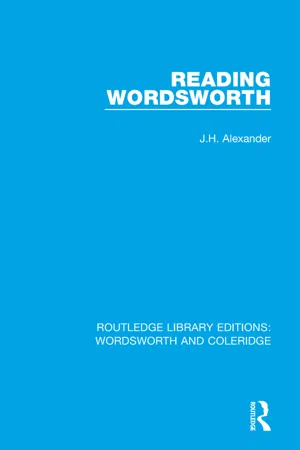
First published in 1987, this book is written for those who are encountering Wordsworth for the first time and for those familiar with his works that are at a loss to understand his reputation or why his work has impressed them. The strength of the author's approach is that it unravels the poet's true meaning and the process by which he all too frequently lost the voice of inspiration — working and reshaping his poems until the original freshness disappeared. It concentrates on helping the reader appreciate Wordsworth's distinctive and daring way with words and poetic structure. By showing Wordsworth's failures, the author demonstrates by contrast the achievements of his greatest works.
- 160 pages
- English
- ePUB (mobile friendly)
- Available on iOS & Android
eBook - ePub
Reading Wordsworth
About this book
Information
Chapter 1 Introduction
DOI: 10.4324/9781315617749-1
Wordsworth’s three supreme achievements are the Lyrical Ballads of 1798 and 1800 (together with The Ruined Cottage’ and ‘Peter Bell’), The Prelude as first completed in 1805, and the Poems, in Two Volumes published in 1807. Reading these works sympathetically and attentively is one of the most exciting of literary experiences, and one of the most demanding. Many people, however, find Wordsworth both unremarkable and dull, as they do his contemporary John Constable. For them Constable’s Cornfield (or reproductions of it on chocolate boxes) and Wordsworth’s ‘Daffodils’ (or memories of it from schooldays) are at best pleasant trifles, pallid banalities. Such objections to the poet are not of recent origin. The extensively revised Prelude was not published until 1850, shortly after Wordsworth’s death, but the original reviewers of the Lyrical Ballads generally found them unremarkable, and within a few years, led by the Edinburgh critic Francis Jeffrey, they or their colleagues were mocking the 1807 Poems for their alleged puerility. From the outset, though, there were also a few readers who responded with a more appropriate fervour, among them William Hazlitt, Thomas De Quincey, and John Wilson (’Christopher North’):
It had to me something of the effect that arises from the turning up of the fresh soil, or of the first welcome breath of Spring. (Hazlitt)
… I may say in general, without the smallest exaggeration, that the whole aggregate of pleasure I have received from some eight or nine other poets that I have been able to find since the world began – falls infinitely short of what those two enchanting volumes have singly afforded me. (De Quincey)
Lyrical Ballads is … the book which I value next to my Bible. (Wilson)1
The present study is offered in the conviction that one can learn to read Wordsworth with a perception and enthusiasm like theirs, and that his best work deserves all the effort which can be brought to bear upon it.
The first requirement for reading Wordsworth well is suggested by a characteristic which, allowing for the difference between their respective arts, he shares with Constable. Viewed from a distance, paintings such as The Cornfield or The Hay-Wain may indeed be thought pleasant but dull (one has seen that sort of thing a thousand times before), but the spectator who approaches more closely and begins to look rather than merely see will observe that every inch of the canvas is thoroughly alive. It becomes clear that the overall repose is made up of a host of intense local excitements. So it is with Wordsworth, for example with ‘Daffodils’ (the popular title is half-sanctioned by the poet himself).2
When a friend of Wordsworth’s patron Sir George Beaumont misread the earlier and simpler version of this poem in the 1807 volumes (printed on page 104 below), the poet was polite but firm in his correction:
Thanks for dear Lady B.’s transcript from your Friend’s Letter, – it is written with candour, but I must say a word or two not in praise of it. ‘Instances of what I mean,’ says your Friend, ‘are to be found in a poem on a Daisy’ (by the bye, it is on the Daisy, a mighty difference). ‘and on Daffodils reflected in the Water’ Is this accurately transcribed by Lady Beaumont? If it be, what shall we think of criticism or judgement founded upon and exemplified by a Poem which must have been so inattentively perused? My Language is precise, and, therefore, it would be false modesty to charge myself with blame.
– Beneath the trees,
Ten thousand dancing in the breeze.
The waves beside them danced, but they
Outdid the sparkling waves in glee.
Can expression be more distinct? And let me ask your Friend how it is possible for flowers to be reflected in water where there are waves. They may indeed in still water – but the very object of my poem is the trouble or agitation both of the flowers and the Water. I must needs respect the understanding of every one honoured by your friendship; but sincerity compels me to say that my Poems must be more nearly looked at before they can give rise to any remarks of much value, even from the strongest minds.3
Wordsworth’s reaction makes it quite clear, as do many other comments,4 that he is very conscious of what he is doing, that he is a very precise poet, and that an apparently slight misreading can result in the reader missing the imaginative and conceptual core of a poem. To peruse Wordsworth quickly and carelessly is equivalent to viewing Constable from a distance in casual perambulation, or in a poor reproduction.
Byron called the long poem The Excursion, published in 1814, a ‘drowsy, frowsy’ piece,5 and there are readers who find even Wordsworth’s greatest works of a decade earlier decidedly soporific. (Charles Lamb, in general a sympathetic and acute reader of Wordsworth as of most authors, once pronounced the Lyrical Ballads ‘but drowsy performances’.)6 Such misgivings, it may be felt, are reinforced by an entry dated 29 April 1802 in the exquisite journal kept for short periods by Wordsworth’s sister Dorothy, who gave him, or renewed in him, an acute sense of the details of the natural world:
We then went to John’s Grove, sate a while at first. Afterwards William lay, and I lay in the trench under the fence – he with his eyes shut and listening to the waterfalls and the Birds. There was no one waterfall above another – it was a sound of waters in the air – the voice of the air. William heard me breathing and rustling now and then but we both lay still, and unseen by one another. He thought that it would be as sweet thus to lie so in the grave, to hear the peaceful sounds of the earth and just to know that our dear friends were near.7
Much of Wordsworth’s poetry seeks a repose, an extreme quietness, which approaches a timeless nirvana, and which may strike some readers as sepulchral. One can rarely quite say of him as one can of, and with, Blake that ‘Energy is Eternal Delight’.8 Something of the deep attraction which peace held for him is evident in his anguished exclamation to Robert Southey in 1805, shortly after the death of his beloved brother John Wordsworth:
Oh! it makes the heart groan, that, with such a beautiful world as this to live in, and such a soul as that of man’s is by nature and gift of God, we should go about on such errands as we do, destroying and laying waste; and ninety-nine of us in a hundred never easy in any road that travels towards peace and quietness!9
The causes of the decline in Wordsworth’s highest creative powers after 1807 are complex and still only very imperfectly understood, but one of them was certainly this seeking a ‘repose which ever is the same’ as the ‘Ode to Duty’ of 1807 has it. James Averill, linking Wordsworth with the sentimental tradition, says that in his poetry ‘guilt, fear, grief, remembered terror, or intense response to nature, – virtually any powerful emotion it would seem – is able to move the mind to profound tranquillity… . The subsequent calm is the result of a mind made self-conscious by the presence of emotion.’10 But for the sympathetic reader, to succumb too quickly to the quietness, the trancelike state, which Wordsworth can induce is to be in danger of missing the very considerable energy of his creative powers at their peak. It may indeed be that the poet of the great decade exhausted himself for ever in the fierce intellectual and emotional throes of composition – and, particularly stressful for him, of revision. In many of his best works energy and repose coexist, and are experienced simultaneously rather than successively. ‘They have a stillness which does not deny movement, and movement which contains stillness.’11
From Nature doth emotion come, and moods
Of calmness equally are Nature’s gift,
This is her glory; these two attributes
Are sister horns that constitute her strength;
This twofold influence is the sun and shower
Of all her bounties, both in origin
And end alike benignant. Hence it is,
That Genius, which exists by interchange
Of peace and excitation, finds in her
His best and purest Friend, from her receives
That energy by which he seeks the truth,
Is rouzed, aspires, grasps, struggles, wishes, craves,
From her that happy stillness of the mind
Which fits him to receive it, when unsought.
(Prelude, XII, 1–14)
There are obvious and attractive vigours in such poems as ‘Goody Blake and Harry Gill’ from the 1798 Lyrical Ballads or ‘Written in March’ from the 1807 Poems, but Wordsworth’s energy is often more subtly put forth. Frequently, one of the best ways of discerning such manifestations is to compare the original version of his poems with later revisions, for although he remained a fine craftsman and sometimes improved his early poems in later life, he also lost contact to a distressing extent with the imaginative vigour of his prime. The notorious review of the 1807 Poems in the Edinburgh Review by Francis Jeffrey,12 who recognised Wordsworth’s genius but thought that it was seriously misdirected towards low or unimportant subjects presented in childish language, had a disastrous effect on Wordsworth’s reputation (and his purse) for the next fifteen years or so. Extraordinary to relate, in the course of time Wordsworth altered almost every line to which Jeffrey had taken exception in accordance with the critic’s strictures, so that the original distinguishing energy seeped out and was lost. One of the most striking casualties of this sorry process was the poem ‘Beggars’, in which Wordsworth describes his encounter with a striking gypsy woman. Jeffrey pronounced this poem ‘a very paragon of silliness and affectation’ and quoted the third stanza, in which Wordsworth originally wrote in 1802, and printed in 1807, this description of her:
Before me begging did she stand,
Pouring out sorrows like a sea;
Grief after grief; – on English Land
Such woes I knew could never be.
In the 1827 revision this became:
Her suit no faltering scruples checked;
Forth did she pour, in current free,
Tales that could challenge no respect
But from a blind credulity.
In rev...
Table of contents
- Cover Page
- Half Title Page
- Title Page
- Copyright Page
- Original Title Page
- Original Copyright Page
- Dedication
- Table of Contents
- Preface
- 1 Introduction
- 2 Lyrical Ballads (1798 and 1800)
- 3 The Prelude (1805)
- 4 Poems, in Two Volumes (1807)
- 5 Conclusion
- Abbreviated References
- Notes
- Suggestions for Further Reading
- Index
Trusted by 375,005 students
Access to over 1.5 million titles for a fair monthly price.
Study more efficiently using our study tools.
Frequently asked questions
Yes, you can cancel anytime from the Subscription tab in your account settings on the Perlego website. Your subscription will stay active until the end of your current billing period. Learn how to cancel your subscription
No, books cannot be downloaded as external files, such as PDFs, for use outside of Perlego. However, you can download books within the Perlego app for offline reading on mobile or tablet. Learn how to download books offline
Perlego offers two plans: Essential and Complete
- Essential is ideal for learners and professionals who enjoy exploring a wide range of subjects. Access the Essential Library with 800,000+ trusted titles and best-sellers across business, personal growth, and the humanities. Includes unlimited reading time and Standard Read Aloud voice.
- Complete: Perfect for advanced learners and researchers needing full, unrestricted access. Unlock 1.5M+ books across hundreds of subjects, including academic and specialized titles. The Complete Plan also includes advanced features like Premium Read Aloud and Research Assistant.
We are an online textbook subscription service, where you can get access to an entire online library for less than the price of a single book per month. With over 1.5 million books across 990+ topics, we’ve got you covered! Learn about our mission
Look out for the read-aloud symbol on your next book to see if you can listen to it. The read-aloud tool reads text aloud for you, highlighting the text as it is being read. You can pause it, speed it up and slow it down. Learn more about Read Aloud
Yes! You can use the Perlego app on both iOS and Android devices to read anytime, anywhere — even offline. Perfect for commutes or when you’re on the go.
Please note we cannot support devices running on iOS 13 and Android 7 or earlier. Learn more about using the app
Please note we cannot support devices running on iOS 13 and Android 7 or earlier. Learn more about using the app
Yes, you can access Reading Wordsworth by J.H. Alexander in PDF and/or ePUB format, as well as other popular books in Literature & English Literary Criticism. We have over 1.5 million books available in our catalogue for you to explore.