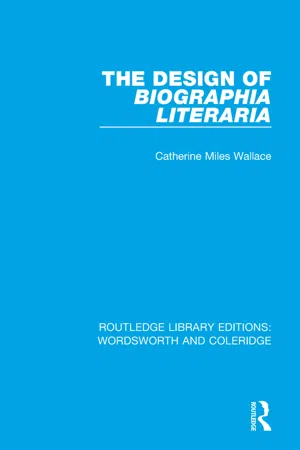
First published in 1983, this book examines a work whose intricacies have baffled and infuriated generations of readers and proposes a theory of Coleridge's writing habits that "explain(s) his explanation". The author painstakingly analyses the Biographia's organising structure distinguishing between the daring conception and often inept execution of Coleridge's idea of critical discourse. It is argued that Coleridge's autobiographical format present a richly metaphorical "self" whose literary life has led to the now-famous doctrine of secondary imagination. The author's command of Coleridge scholarship will shed new light on the Biographia for specialists and non-specialists alike.
- 170 pages
- English
- ePUB (mobile friendly)
- Available on iOS & Android
eBook - ePub
The Design of Biographia Literaria
About this book
Information
1 The Chamois Hunter
DOI: 10.4324/9781315617862-1
The musician may tune his instrument in private, ere his audience have yet assembled: the architect conceals the foundation of his building beneath the superstructure. But an author’s harp must be tuned in the hearing of those, who are to understand its after harmonies; the foundation stones of his edifice must lie open to common view, or his friends will hesitate to trust themselves beneath the roof.The Friend, I, 14
A man’s principles … are the life of his life.The Friend, I, 97
In this half of the century, the familiar portrait has been redrawn: we no longer see Samuel Taylor Coleridge as a genius helplessly mired in addictions, neuroses and morbid Christianity. Growing numbers of scholars have demonstrated the depth and subtlety of Coleridge’s thought. His originality has been re-evaluated; his reputation has grown. Biographia Literaria deserves a new look as well. Like Coleridge himself, it is not a rambling, foggy, inconsistent traveler toward isolated, cryptic insights. It is a formal and rhetorical whole designed to engage the reader not simply as a philosopher-critic, but as a person, as a union of intellectual, emotional and moral powers. Its design reveals a coherent and genuinely imaginative vision of the necessary character of modern discourse.
Yet it is a difficult book. At first glance, there is ample evidence that Biographia Literaria is a fragmented disaster whose difficulties can neither be resolved nor understood: the ‘missing’ transcendental construction in chapter XIII; the incorporations from Schelling; its origin as a preface to Sibylline Leaves. Such evidence appears to justify Carlyle’s malefic description:
… instead of answering [a question], or decidedly setting out towards an answer of it, he would accumulate formidable apparatus, logical swim-bladders, transcendental life-preservers and other precautionary and vehiculatory gear, for setting out; perhaps did at last get under way, – but was swiftly solicited, and turned aside by the glance of some radiant new game on this hand or that, into new courses; and ever into new; and before long into all the Universe.1
‘Solicited’ is the central word here: seduced, enticed, led astray. The Victorians said Coleridge lacked ‘will power’; the moderns that he was hopelessly ‘neurotic’.2 Yet the principle remains the same: the formal disorder of the works reflects the personal disorder of the man.
But the evidence for Biographia Literaria’s formal disorder shrivels abruptly if examined in strong light. The infamous chapter XIII, for example, culminates an extensive pattern of reference to the intellectual powers of Englishmen; it is an elaborately planned appeal to the philosophic reader. Philosophic readers have been appropriately disappointed: the strategy succeeds at least in part. But such readers err in judging this chapter a neurotic break, or a failure of nerve, or a change in plan literally unexpected by its author. There is substantial evidence to the contrary.3 In a parallel way, the Biographia’s origin as a preface reflects no reprehensible spontaneity on Coleridge’s part: one finds plans for the Biographia in letters and notebook entries dating back at least to the autumn of 1803.4 The plagiarisms from Schelling have been evaluated in general by Thomas McFarland, and in painstaking detail by Elinor Stoneman Shaffer, both of whom conclude that the literal appearance of plagiarism is misleading.5 In the light of recent scholarship, this traditionally prima facie evidence loses its impressive appearance.
But the reputation of Biographia Literaria has also rested on the experience of many attentive and informed readers. For a text so often described as unreadable, it has been read more often and valued more highly than quite makes sense. The paradox is revealing: there is no frustration quite the equal of intuiting a coherence that refuses to emerge into the full daylight of objectifying comprehension. There are, in fact, many brief descriptions of the Biographia’s general thematic unity. Shawcross is exemplary. He attributes ‘the miscellaneous character of the book’ to the poor state of Coleridge’s ‘health and spirits’, but goes on to say:
It is with this end in view [‘the desire … to state clearly, and defend adequately, his own poetic creed’] that, in the autobiographical portion of the book, he describes the growth of his own literary convictions; that, in the philosophical, he seeks to refer them to first principles; and that, in the criticism of Wordsworth’s poetry and poetic theory, he emphasizes the differences which, as he imagines, exist between Wordsworth and himself. (BL, I, xcii)
Coleridge’s complaint seems to the point:
Now surely a [work] the contents and purposes of which are capable of being faithfully and compleatly ennumerated in a sentence of 7 or 8 lines, and where all the points treated of tend to a common result, cannot justly be regarded as a motley Patch-work, or a Farrago of heterogenous Effusions! (LS, 114 n)6
This general thematic unity is seldom denied.7 Yet it is one thing for an attentive reader to perceive the relations among the topics Coleridge discusses; it is something altogether different to perceive that Coleridge so manages his discourse as to define exactly how ‘all points treated of tend to a common result’. A sympathetic reader can link the parts to a postulated common result, but this does not prove that Biographia Literaria, as a discourse, generally succeeds in establishing these relations through various formal and rhetorical strategies. Such strategies comprise what I call ‘design’: the blueprint of the whole, regarded both as a governing structure, and as the intent or governing idea implicit in and enacted by this structure.
The generations of scholars and critics succeeding Shawcross have explicated Coleridge’s literary convictions’ and his ‘first principles’ to reveal a thinker known to very few in 1907: a Coleridge who is erudite, philosophically acute, and humanly profound. As we have more and more fully seen how his intricacy of mind engages complex human questions, it becomes less possible to believe that so great a thinker could have been so fundamentally incompetent a writer. Common sense questions whether such extraordinary powers of concentration and synthesis could have been so entirely suspended when he sat down to compose. He himself often insisted that genius and command of language vary together. His books are not perfectly written – whose are? – but their difficulty resides primarily in the complexity of his ideas, and in the complexity of design these ideas require for their intelligible presentation. Coleridge knew he would be charged with obscurity; he often tried both to defend himself, and to preclude the charge through elaborate explanations of his principles in writing. Understanding these principles alleviates much of the confusion and frustration that so many readers experience.
Coleridge’s desire to make his readers think, to make them engage genuine ideas, underlies the design of Biographia Literaria. It also accounts in part for the book’s reputation as excessively difficult reading. In what he regarded as ‘the finest passage in the Friend’, Coleridge acknowledges the problems he creates for his readers.
Alas! legitimate reasoning is impossible without severe thinking, and thinking is neither an easy nor an amusing employment. The reader, who would follow a close reasoner to the summit and absolute principle of any one important subject, has chosen a Chamois-hunter for his guide. Our guide [Coleridge himself, as The Friend] will, indeed, take us the shortest way, will save us many a wearisome and perilous wandering, and warn us of many a mock road that had formerly led himself to the brink of chasms and precipices, or at best in an idle circle to the spot from whence he started. But he cannot carry us on his shoulders: we must strain our own sinews, as he has strained his; and make firm footing on the smooth rock for ourselves, by the blood of toil from our own feet. (F, I, 55, and n. 2)
Feet that are sticky with blood – it is a lurid image, but all too often it has struck me as entirely apt. Owen Barfield grants that the relation between subject and object is no doubt the pons asinorum of Coleridge’s philosophic endeavor, but then argues that ‘the concept, and perhaps the experience, of thinking as an act, or as an “act and energy,” are the toll-gate in the middle of the bridge, the barrier that has to be opened before we can get across’.8 Barfield demonstrates how thoroughly this central concept influences all of Coleridge’s thought; my major concern is the way in which it shapes his composition.
Coleridge’s compositions are designed to make the reader engage a particular problem or issue in ways that will lead him to the conclusions that Coleridge has already reached. He wants to make us think things through for ourselves, under his tutelage. To the extent that his particular interests are all versions of a predominant interest in thinking itself, one can say that he writes in ways designed to help us think about thinking. That is no small ambition. Further challenges to the reader emerge from the fact that Coleridge seldom accommodates to lesser energies or lesser talents than his own. He may lead us away from precipices, but he does not hesitate to lead us up rough and steep paths if these take us where he wants to go.
Some of the reader’s troubles derive from Coleridge’s lack of skill in the fine art of enticing tired minds to further and further effort. But often the reader stumbles because the way is genuinely and irreducibly difficult. As Sara Coleridge notes, the original thinker cannot rely on ‘known ways and smooth well-beaten tracks’: he forces his readers into unaccustomed mental exercise.9 Both contemporary and modern readers have echoed this image of a difficult path to describe the effort Coleridge’s discourse requires.10 The image is particularly apt: as Coleridge often observed, the Greek word we translate as ‘method’ translates literally as ‘way’ or ‘path’ or ‘mode of transit’. The ‘Essays on Method’ in The Friend claim that valid method demands powerful imagination. So does reading the Biographia. As Bishop C. Hunt, Jr, observes, ‘what we might call the “dramatic” element in philosophy, the process of search and its written reenactment, assumes a larger significance. Much of Coleridge’s best writing can be read as a kind of dramatic monologue in prose, a mimetic representation of the mind in the act of thinking something through.’11 Thinking along with Coleridge as he thinks something through demands more than energy or learning. It requires that we read his prose with the same use of the same skills we engage when we read his poetry.
When Coleridge asserts that he wants his readers to think, he means that we must develop and exercise the ability to observe our own minds. We must acquire the self-consciousness that is secondary imagination’s most basic act. His clearest statement of this requirement is the distinction between thinking and attending in Aids to Reflection:
It is a matter of great difficulty, and requires no ordinary skill and address, to fix the attention of men on the world within them, to induce them to study the processes and superintend the works which they are themselves carrying on in their own minds; in short, to awaken in them both the faculty of thought* and the inclination to exercise it. For alas! the largest part of mankind are nowhere greater strangers than at home.* Distinction between thought and attention. – By thought is here meant the voluntary reproduction in our minds of those states of consciousness, or … of those inward experiences, to which, as to his best and most authentic documents, the teacher of moral or religious truth refers us. In attention we keep the mind passive: in thought, we rouse it into activity. In the former, we submit to an impression – we keep the mind steady, in order to receive the stamp. In the latter, we seek to imitate the artist, while we ourselves make a copy or duplicate of his work. We may learn arithmetic, or the elements of geometry, by continued attention alone; but self-knowledge, or an insight into the laws and constitution of the human mind and the grounds of religion and true morality, in addition to the effort of attention requires the energy of thought. (AR, 69 and n)
He who would explicate creativity itself requires a thinking audience no less than he who would explicate ‘moral or religious truth’. Whether the critic’s ‘inward experiences’ be those of reading or of writing, his reader needs the imaginative power of self-consciousness as a prior condition to understanding imagination itself in rigorous theoretical terms. The primary facts essential to the intelligibility of my principles I can prove to others only as far as I can prevail on them to retire into themselves and make their own minds the objects of their stedfast attention’ (F, I, 21).
Alone and unbalanced, this requirement provides nothing less than a license for solipcism. But, despite what has been asserted in his name, Coleridge was no advocate of an ‘autonomous’ imagination.12 His many explanations of the relation between ideas (the content or object of thinking) and experience reveal how his method excludes the irresponsible and the eccentric. Ideas and laws are correlative terms, strictly defined.13 An idea is a subjectively originating set of relations exactly echoed by relations observable in experience. An idea whose counterpart is a law of the natural world can be ‘objectively’ or physically demonstrated. One who understands will be compelled to assent. An idea whose counterpart is a law of the mind cannot be physically demonstrated, because it has a psychic not physical referent. Furthermore, assent cannot be logically compelled because the spirit itself is essentially free: it cannot be coerced into generating the confirming mental experience. None the less, ‘At the annunciation of principles, of ideas, the soul of man awakes, and starts up, as an exile in a far distant land at the unexpected sounds of his native language, when after long years of absence, and almost of oblivion, he is suddenly addressed in his own mother-tongue’ (LS, 24). The imaginative person intuitively and immediately grasps the truth of a valid idea.
Experience confirms – although it cannot demonstrate – the validity of ideas about non-physical realities. For instance, experience illustrates but does not prove the existence of God:
Assume the existence of God, – and then the harmony and fitness of the physical creation may be shown to correspond with and support such an assumption; – but to set about proving the existence of a God by such means is a mere circle, a delusion. It can be no proof to a good reasoner. … (TT, 22 February 1834)
Historians face the same situation as theologians:
If you ask me how I can know that this idea – my own invention – is the truth, by which the phenomena of history are to be explained, I answer, in the same way exactly that you know that your eyes were made to see with; and that is, because you do see with them … this idea, not only like a kaleidoscope, shall reduce all the miscellaneous fragments into order, but shall also minister strength, and knowledge, and light… . (TT, 14 April 1833)
As Biographia Literaria explains in detail, the same is true of literary critics. They must illustrate their ideas by particular reference to texts, while yet remembering that criticism is not an empirical science.14
Coleridge’s intent to make his readers think, to make them engage ideas, accounts for the oft-lamented ‘digressive’ texture of his works, especially the Biographia. In The Friend, he cites Plato approvingly: ‘“It is difficult, excellent friend! to make any comprehensive truth compleatly intelligible, unless we avail ourselves of an example. Otherwise we may as in a dream, seem to know all, and then as it were, awakening find that we know nothing”’ (F, I, 148). His ‘examples’ seem digressive in part because they are lengthy, and in part because he obviously enjoys them for their own sake; but primarily they seem so because they form no part of an induction. They relate not to each other, but to the ideas they illustrate. They are not particulars...
Table of contents
- Cover Page
- Half Title Page
- Title Page
- Copyright Page
- Original Title Page
- Original Copyright Page
- Table of Contents
- Prefaee
- Abbreviations
- Acknowledgments
- 1 The Chamois Hunter
- 2 Starting-Points
- 3 The Associative Faney
- 4 Imagination’s Synthesis ofBeing and Knowing
- 5 Imagination, Philosophie Consciousness and the ‘True and Original Realism’
- 6 Poetry
- 7 Wordsworth and Poetie Dietion
- 8 Wordsworth and the Imaginative Partieular
- 9 Conclusion
- Notes
- Index
Trusted by 375,005 students
Access to over 1.5 million titles for a fair monthly price.
Study more efficiently using our study tools.
Frequently asked questions
Yes, you can cancel anytime from the Subscription tab in your account settings on the Perlego website. Your subscription will stay active until the end of your current billing period. Learn how to cancel your subscription
No, books cannot be downloaded as external files, such as PDFs, for use outside of Perlego. However, you can download books within the Perlego app for offline reading on mobile or tablet. Learn how to download books offline
Perlego offers two plans: Essential and Complete
- Essential is ideal for learners and professionals who enjoy exploring a wide range of subjects. Access the Essential Library with 800,000+ trusted titles and best-sellers across business, personal growth, and the humanities. Includes unlimited reading time and Standard Read Aloud voice.
- Complete: Perfect for advanced learners and researchers needing full, unrestricted access. Unlock 1.5M+ books across hundreds of subjects, including academic and specialized titles. The Complete Plan also includes advanced features like Premium Read Aloud and Research Assistant.
We are an online textbook subscription service, where you can get access to an entire online library for less than the price of a single book per month. With over 1.5 million books across 990+ topics, we’ve got you covered! Learn about our mission
Look out for the read-aloud symbol on your next book to see if you can listen to it. The read-aloud tool reads text aloud for you, highlighting the text as it is being read. You can pause it, speed it up and slow it down. Learn more about Read Aloud
Yes! You can use the Perlego app on both iOS and Android devices to read anytime, anywhere — even offline. Perfect for commutes or when you’re on the go.
Please note we cannot support devices running on iOS 13 and Android 7 or earlier. Learn more about using the app
Please note we cannot support devices running on iOS 13 and Android 7 or earlier. Learn more about using the app
Yes, you can access The Design of Biographia Literaria by Catherine M. Wallace in PDF and/or ePUB format, as well as other popular books in Literature & English Literary Criticism. We have over 1.5 million books available in our catalogue for you to explore.