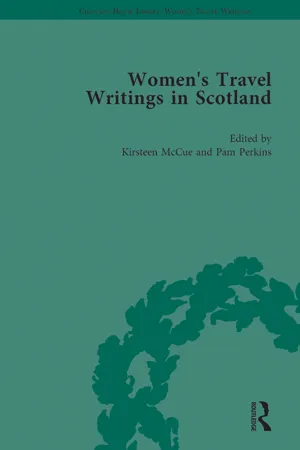
This volume contains the second volume of Anne Grant's Letters from the Mountains (1806), one of the Romantic era's most successful non-fictional accounts of the Scottish Highlands. It is part of a four volume set, edited by Kirsteen McCue and Pam Perkins, which is accompanied by new editorial material including a new general introduction and headnotes to each work.
- 129 pages
- English
- ePUB (mobile friendly)
- Available on iOS & Android
eBook - ePub
About this book
Information
Letters from the Mountains;
BEING THE REAL CORRESPONDENCE OF A LADY, BETWEEN THE YEARS 1773 AND 1807.
—— “Memory swells With many a proof of recollected love.”
THOMSON.
IN THREE VOLUMES.
VOL. II.
THE SECOND EDITION.
LONDON:
Printed by Luke Hansard & Sons, For LONGMAN, HURST, REES & ORME, Paternoster-row; J. HATCHABD, Piccadilly; and Mrs. COOK, Bury-street, St. James’s. 1807.
Letters from the Mountains
Letter I.a
To Miss Ewing.
Fort Augustus, June 10, 1774.
MY DEAR BELL,
I WILL make no excuses for having your two entertaining letters so long unanswered; but rather shew my gratitude, by giving you, as well as I can, some account of my late excursion, which has helped a little to divert the chagrin I felt at my ever dear Miss Ourry’s departure. But I must thank you for your sincere sympathy with a grief, that to many would appear romantic or exaggerated, or might at best be considered as the result of a retired life, little acquaintance with the world, and the necessity which a weak mind feels of having some thing, or some body, to lean upon. She made my sorrow more excusable by seeming to feel, nay, really feeling, as much herself. Mine might be accounted childish, because I was, as you well know, womanly in appearance, while a mere child in years and judgment. But this was by no means the case with her. Had you but known her, you would be convinced that it is not merely the pleasure of agreeable society that I mourn over; but that her mind was firm, rational, and enlightened, and her friendship a real benefit as well as honour to me. I know I tire you, but you must have patience, for you will hear a great deal more on this subject, if you indulge me in saying, as usual, what is nearest my heart, and uppermost in my fancy.
This is the best place in the world for cultivating friendship; and therefore, in spite of all the privations to which it condemns me, I will love it; because there is little to scatter the recollection of the days I wish to live over again, or to divert me from self-culture, the only object that now remains to me. Do you remember my mentioning an agreeable neighbour in one of my former letters, who lives a mile off, in a situation equally singular and beautiful? I mean Miss Christina Macpherson. She is an acquisition in her way, sensible and sincere, though uncultivated. She possesses a fund of genuine humour; and I believe has a regard for me. With this agreeable companion I went down to Inverness in May, making a very pleasant and picturesque voyage down our fine lake in the galley.
I got your kind letter just as I was coming away, but delayed answering it till I could tell you something of my travels. We meant to stay but a few days; but, betwixt kindness and contrary winds, were detained three weeks. Your extreme delicacy with regard to your Dunbar jaunt might be an example to me; but I resolve to do good for evil, and carry you north, though you would not give me an ideal jaunt to the south. Come with me then to the capital of the Highlands. The town is most agreeably situated at the very threshold of this rugged territory; the mountains of which rise with abrupt grandeur to bound the prospect on one hand, the plain being of four or five miles extent, while a large bay of the sea limits it on the other. From the odd looking hill of Tom-min-a-heurich, which rises in the middle of this plain, the fertile shires of Ross and Murray indulge the eye with a boundless view of gentlemen’s seats, seated generally under the shelter of eminences, and surrounded with wood plantations, (for the gentry here are great improvers,) whence we overlook extensive fertile plains, and
“Softly swelling hills,
On which the power of cultivation lies,
And joys to see the wonders of his hand.”1
On which the power of cultivation lies,
And joys to see the wonders of his hand.”1
Yet, over and above the partiality which we are apt to contract for our place of abode, we found a sameness in that extent of lowland that did not compensate for the variety afforded by our wild hills and winding glens. Besides, its north-east situation exposes it to such chilling blasts, as made us reflect with pleasure on the shelter we receive from our mountains; which are like some lofty and revolting characters, who appear stern and awful to strangers, but are all warmth and kindness to their own family. Yet I should like none of these climates, where
“Winter lingering chills the lap of May,”2
if I could help myself.
But to return to the said capital. It is somehow a cheerful looking place, because the people look cheerful; yet not flourishing, though no situation can be better adapted for the purposes of commerce. It has, however, a genteel society; and one meets with many well-bred, agreeable people. They have assemblies every fortnight, gayer than your Glasgow ones; which may be accounted for by their being attended by the neighbouring gentry, who are numerous and polite. These gentry too have many of them been abroad, in the army or otherwise, and thus add liberal notions and polished manners to the acute and sprightly genius of the country. Their great distance from the capital often makes their provincial town the scene of their winter amusements. Nothing took my fancy so much there as the ladies. They are really, in general, showy, handsome women, excellent dancers, and have the best complexions I ever saw. Indeed you can scarce meet a young lady who does not remind you of the beauties in old romances. They have a great deal of flaxen hair, a skin transparently fair, and cheeks like the opening rose. Yet their features are seldom regular or delicate, and their beauty is of that kind which vanishes with the bloom of youth. Their persons are large, and they are fat as heart could wish; yet, on the whole, they look cheerful and innocent. They certainly speak better English than most Scots do, but with a sharp imperative tone. They are very frank, and full of professions of kindness. But I tease you with what perhaps loses all interest in my dull description. We had our share of adventures in coming home, some of them abundantly ludicrous; but the minutiæ would be more tiresome than Clarissa’s,3 without being compensated by the same interest and fancy. We moralized, and wandered by ourselves in a most beautiful wood for two or three days, lodging at night in a great old chateau, where the servants were ordered to give us all we wanted. All this while we waited for a fair wind; we had no book or work. Christina sung like a syren to me, and I caught young wild ducks, which she tried to tame, while I gathered wild flowers. We began at last to suffer
“The pains and penalties of idleness.”4
I held out better than she, having more rural taste, and taking more interest in trifles. We came up at last, by moonlight, in a boat. In the morning we landed at the sweetest place imaginable, the Laird of Glenmoriston’s* seat; which delighted me so much with quietness and wildness, and romantic environs, and hospitable easy people, and beautiful children, that I would describe it to you if I thought Inverness were not more than enough at once. I should need to have the Princess Schehersade’s talents,5 before I could give you half our adventures. They ended, however, in the laird and lady kindly coming up with us, and spending a most agreeable day at my father’s. I have only time to tell you, that I have heard four times from Miss Ourry, that I thought many times of you every day in the wood, and that I am proud of being two letters in your debt.
I am most affectionately yours, &c
Notes
1 the wonders of his hand: James Thomson, The Seasons, ‘Summer’, 1435–7 (slightly misquoted).
2 chills the lap of May: Oliver Goldsmith, The Traveller (1764), 172. The Traveller, a long philosophical and descriptive poem about the state of nations, was very popular at the time.
3 more tiresome than Clarissa’s: an allusion to the famously detailed letters that the titular heroine of Samuel Richardson’s (1689–1761) epistolary novel Clarissa (1748) writes about the persecutions that she undergoes. As Grant’s later letters indicate, this was one of her favourite novels.
4 penalties of idleness: Alexander Pope, The Dunciad, IV. 341.
5 Princess Schehersade’s talents: Scheherazade is the main story-teller in the Thousand and One Nights. The first English version of the tales, taken from Antoine Galland’s French translation (or adaptation) of the Arabic originals, appeared in 1712 as Arabian Nights Entertainments and remained popular throughout the century.
* Grant, of Glenmoriston: a family respectable for its antiquity, and estimable for genuine worth and simple manners; in whose hospitable mansion the spirit of true Highland cordiality loved to linger, surrounded by its attendant graces – ease, courtesy, and cheerfulness.b
Letter II.a
To Miss Ewing, Glasgow.
Fort Augustus, March 15, 1777.
MY DEAR BELL,
THE last hasty lines you had from me were so rapidly scrawled, that you would hardly make out the little meaning they contained. The sage bearer was on the fidget at my elbow the whole time I was writing it. I have been a good deal indis-posed, great part of the winter, with colds, and your old enemy the tooth-ach.b Now that I am better, I have a double enjoyment of every thing. You, who have the bustle of a crowded town, and a succession of amusements, to steal away the long dark evenings, must need wonder how we manage to get quit of them. Exiles as we are from the gay and fashionable walks of life, we fall upon wondrous contrivances to soften the rigour of the season, and
“Twine a garland round dark winter’s brow.”1
You can form no idea of our multiplied resources, unless you were to pass a month among us. Reading, walking, and all speculative and solitary amusements, you well know, can be enjoyed here as well as in town. But you have no notion how townified folks are, in all these little garrisons; and how these small circles, which necessity has driven together, ape the manners of the great world that they have reluctantly left behind. We too have our visits, our scandal, brought from thirty miles distance; our tittle-tattle, our jealousies, our audible whispers, and secrets that every body knows. When any one marries within the county-bounds, we all sit in judgment, and are sure to find some fault with either party, as if it were our own concern; and when any one dies within twenty miles, we are all very busy in sounding their praises, and contrive to rake a great many virtues from among their ashes, for which we never gave them credit till they were out of the reach of our envy. Then when Mrs. N.*, or Madame le Commandant, receives any new article of dress, we all fly to admire it, and then hurry away to wash gauzes, or in some other imperfect manner to contrive a humble imitation of it. Not to dwell on each minute particular, believe that our handful of antiquated beaux and rusticated belles just do every thing in the country that your’s do in town, only with more languor and ill humour. People habituated to that manner of life, carry its follies and impertinences into the very bosom of tranquillity. When they walk, ’tis on the hard gravel road, to get an appetite; when they read, ’tis some periodical matter, to dose away time till the stated card-party begins. These people always give me pain. They appear like fish out of water, gasping and struggling in a strange element. It provokes me, in a place where nature seems to reign paramount, enthroned in the centre of her sublimest retreat, and surrounded by her genuine children, to see these insipid aliens insult her with their ennui. I mean no reflection on a town life, but merely to observe, that people, who have no resources within themselves, and aspire at no improvements, can hide their defects best in a crowd. I have been talking all the while of we and us, without telling you whom I meant to comprehend under these terms. We have, besides the old immovable set, an Officer of Invalids, and his wife and daughter from Edinburgh, who are ever pining for want of company they could ill afford to keep, and public places, which it would ruin them to frequent. They strive much to exalt our idea of their fo...
Table of contents
- Cover
- Half Title
- Title
- Copyright
- CONTENTS
- VOLUME II Letters from the Mountains, Volume II
Trusted by 375,005 students
Access to over 1.5 million titles for a fair monthly price.
Study more efficiently using our study tools.
Frequently asked questions
Yes, you can cancel anytime from the Subscription tab in your account settings on the Perlego website. Your subscription will stay active until the end of your current billing period. Learn how to cancel your subscription
No, books cannot be downloaded as external files, such as PDFs, for use outside of Perlego. However, you can download books within the Perlego app for offline reading on mobile or tablet. Learn how to download books offline
Perlego offers two plans: Essential and Complete
- Essential is ideal for learners and professionals who enjoy exploring a wide range of subjects. Access the Essential Library with 800,000+ trusted titles and best-sellers across business, personal growth, and the humanities. Includes unlimited reading time and Standard Read Aloud voice.
- Complete: Perfect for advanced learners and researchers needing full, unrestricted access. Unlock 1.5M+ books across hundreds of subjects, including academic and specialized titles. The Complete Plan also includes advanced features like Premium Read Aloud and Research Assistant.
We are an online textbook subscription service, where you can get access to an entire online library for less than the price of a single book per month. With over 1.5 million books across 990+ topics, we’ve got you covered! Learn about our mission
Look out for the read-aloud symbol on your next book to see if you can listen to it. The read-aloud tool reads text aloud for you, highlighting the text as it is being read. You can pause it, speed it up and slow it down. Learn more about Read Aloud
Yes! You can use the Perlego app on both iOS and Android devices to read anytime, anywhere — even offline. Perfect for commutes or when you’re on the go.
Please note we cannot support devices running on iOS 13 and Android 7 or earlier. Learn more about using the app
Please note we cannot support devices running on iOS 13 and Android 7 or earlier. Learn more about using the app
Yes, you can access Women's Travel Writings in Scotland by Kirsteen McCue,Pamela Perkins in PDF and/or ePUB format, as well as other popular books in Literature & Literary Criticism. We have over 1.5 million books available in our catalogue for you to explore.