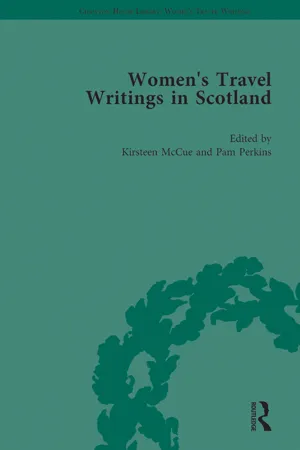
This volume contains the first volume of Anne Grant's Letters from the Mountains (1806), one of the Romantic era's most successful non-fictional accounts of the Scottish Highlands.
- 103 pages
- English
- ePUB (mobile friendly)
- Available on iOS & Android
eBook - ePub
About this book
Information
Headnote on Letters from the Mountains, Volume I
Letters from the Mountains
When Letters from the Mountains was first published in 1806, it received relatively little critical attention, but it almost immediately began to attract an admiring and sympathetic readership. By the time that The Eclectic reviewed the second edi tion in 1807, the writer was able to assume that ‘a considerable number’ of the journal’s readers would be ‘already acquainted with these volumes’,1 a claim supported in some measure by surviving comments by some of Grant’s literary-minded contemporaries. In October 1806, Lady Louisa Stuart was recommending the book to the Duchess of Buccleuch, mentioning that both she and the Countess of Ailesbury had read and enjoyed it; six months later, Maria Josepha Stanley was on at least her second reading, commenting to her sister that she liked it ‘better and better every time’ she ‘open[ed] the volumes’. A future sister-in-law shared her admiration: in 1809, when she was still only 17, Catherine Leycester (Stanley), was already treating Letters from the Mountains as a treasured classic, ranking it at the forefront of the very few books that ‘have the same sort of effect upon your mental frame that a fine day has upon your outward frame’; that is, ‘leading your mind to an exalted or a pleasing train of thought’ that continues long after the book is finished.2 Although coming a little later than those of Stuart and Stanley, Leycester’s comments point towards a significant factor in Grant’s initial reception: readers saw the book more as an uplifting self-portrait of an admirably strong and high-minded woman than as a source of information about Scotland. Stanley declared that she would be ‘wretched’ if she were to discover that Grant had ‘any unpleasant qualities’ while Stuart praised Grant for possessing ‘a mind above the common run’. This focus on autobiography might help explain why the book never established a secure place among the literature of Romantic-era Scottish travels, as in focusing so strongly on her place in and engagement with the landscape and cultures around her, Grant was also pushing at the generic boundaries of the travel narrative. Yet just as importantly, this reception might also illuminate some of the literary choices that Grant made as she revised her book for the second edition, the version through which she moved from a word-of-mouth success to an author with a significant degree of cultural and critical respect.
Most twenty-first-century readers of Letters from the Mountains will know the work mainly or exclusively through either Grant’s revised version of 1807 or through the 1845 edition prepared for a Victorian readership by Grant’s son. These are the editions that are most easily available through Google Books, and the ones used both in electronic databases such as British and American Women’s Letters and Diaries and for the copies provided by Kessinger and other print-on-demand companies.3 There is good reason for this. Grant’s main revision in 1807 was the substantial reorganization of the letters in volumes two and three so that they are more-or-less chronological, rather than grouped mainly by correspondent, as they had been in 1806. The result is a much clearer presentation of Grant’s life, from her initial girlish enthusiasm through contented early married life, on to the deaths of four children and her husband then, finally, to her late-blooming career as an author. Rather than building towards the letters about Grant’s move from Laggan and the publication of her volume of poems, as do all the editions from 1807 on, the first edition ends with the 26 January 1801 letter to Jane (Ewing) Brown. At this time James Grant was still alive and Anne Grant was presenting herself as increasingly settled into comfortable family life on her remote Highland farm. Any dramatic irony implicit in the reader’s knowledge of how soon this idyll was to be shattered remains latent in the first edition, but from 1807 on Grant heightens the pathos of the letter by following it with the 17 December 1801 letter to Mrs Macintosh (not in 1806) and the 1 January and 12 January 1802 letters to Miss Dunbar and Anne Furzer (the first of which had been printed thirteen letters earlier in 1806, while the second appeared in the second volume). In effect, Grant diffuses her grief and mourning throughout the first edition, whereas in the second she creates a compelling narrative arc.
Somewhat ironically, then, given that Grant also decided in 1807 to print her name and those of her correspondents in full in order to make clear that this was a work of non-fiction, the second edition offers readers a smoother and more artfully constructed narrative of her life in the late eighteenth-century Highlands. This move towards aesthetic polish is also reinforced by what Grant calls the ‘judicious pruning’4 of the text that she undertook for the 1807 edition. As well as trimming some passages from individual letters, she also cut in their entirety nearly a quarter of the letters that had been printed in 1806 (although since many of the ones she cut were quite brief, and she added a number of new letters in 1807, the first edition is not a significantly longer book). The bulk of the letters that were cut were addressed to Mary Macintosh, and, in many cases, it is not difficult to see why Grant felt the book would be stronger without them, filled as they are with family news that remains obscure because of initials and omissions and with jokey references to pets, household matters, or mutual acquaintances. The second edition loses nothing by the almost total omission of, for example, an obscure and apparently long-running joke about one of Mrs Macintosh’s turkeys.
Yet the other main focus of Grant’s cuts is more interesting. One of the signifi-cant running themes of the original edition that is obscured by the severe truncation of the correspondence with Mrs Macintosh – and by the major abridgement of the 26 July 1778 letter to Isabella Ewing – is Grant’s pursuit, through manuscript exchange, of her own development as a poet. Traces of social authorship remain in the later editions, most explicitly in the discussions that Grant has about publication in her correspondence with Miss Dunbar and others following the death of her husband, and in allusions to a few poems that she wrote on particular occasions and that were later published in her 1803 Poems on Various Subjects. What is missing are the pervasive if underdeveloped allusions to the sharing of poetry that run through Grant’s letters, especially those of the 1790s, in the original edition. The long poetic Journal addressed to Anne Furzer, for example, receives some attention towards the end of the second edition, as Grant worries about the way that it appears in print. Readers learned somewhat more about it in 1806, however, as in her (later omitted) letters of March and April 1794, Grant alludes to the process of transcribing and circulating it among Mrs Macintosh, Mrs Smith, and its addressee, Mrs Furzer. Other references to reading poems by an anonymous Miss J. C. of Glasgow and to the pleasure of knowing that Mrs Macintosh had shown Grant’s poetry to Burns’ patron Frances Dunlop (Letters LXIV and LII, 1806) provide glimpses both of Grant’s active pursuit of an audience for her own work and her immersion, if only by correspondence, in a feminized literary world. Likewise, even if it is difficult to dissent from the literary judgement that led Grant to excise the doggerel verses about a gull that she sent Isabella Ewing in 1778, the simple existence of the poem in 1806 underscores the point that Grant’s self-fashioning as an (unpublished) author was a lifelong process.5 The choice to drop many of those traces of her ambitions as a writer from subsequent editions both quietly plays down that ambition and strengthens the picture of Grant as an artless child of nature growing into a devoted wife and mother, namely the version of her that seemed to appeal most powerfully to her original readers.
That said, Grant is far from completely ‘artless’, in any strict sense, in either version of the book; her letters are intensely, self-consciously literary. For one thing, she was strongly engaged with contemporary intellectual debates: in some of her most provocative letters of the 1790s, she dips a toe into the raging Jacobin and anti-Jacobin disputes of the period, taking what is probably, to a twenty-first-century audience, a disappointingly dismissive attitude towards the work of Mary Wollstonecraft. She was also following more specifically Scottish debates, as she shows in her allusions to John Pinkerton’s vituperative attacks on Celtic culture. Indeed, since the first of her references to Pinkerton is in a letter dated 14 November 1778, nearly a decade before the publication of Pinkerton’s most controversial work, it appears that Grant was either following literary arguments, as well as exchanging poems, in manuscript or was revising her letters to play up her interest in the subject.
Yet the literary debts of Letters from the Mountains are most strongly marked not in Grant’s participation in public debates but, more generally, in the way that she sees the world around her. She offers her readers an account of life in the Scottish Highlands from the perspective of a writer who, even as she claims to speak from the ‘primitive’ or ‘savage’ margins of the British world, remains steeped in the standard cultured tastes of the metropolitan centre.6 By sprinkling her letters with quotations from and paraphrases of writers such as Shakespeare, Pope, Thomson, Milton, and Young, Grant demonstrates the extent to which the ‘modern’ literary canon of educated, metropolitan eighteenth-century Britons has provided the idiom through which she structures her responses to the very non-urban world around her. Most obviously, James Macpherson’s Ossian poems permeate Grant’s accounts of the Highland landscape (especially in the first volume), highlighting her tendency to filter her representations of the natural world as much through her reading as through her own observations.7 Somewhat more subtly, when Grant turns to Edward Young’s Night Thoughts and Antony and Cleopatra as a way of framing her grief at the death of her 4-year-old son, or when she describes her relationship with her husband in terms borrowed from an account of a rural idyll in Thomson’s Seasons, she implies that the inner landscape of her emotions is as thoroughly shaped by her reading as by the outer landscape of the Highlands.
Grant’s decision to mediate her experience of Scottish culture and landscape through a sort of intellectual and cultural self-portrait makes Letters from the Mountains stand out from much of the other travel writing on Scotland from this era. Indeed, it is perhaps telling that so many of her early readers, and particularly other women readers, wanted to read the book more as autobiography than as travel narrative or proto-ethnography. Twenty-first-century criticism has tended to place the book back in the context of the burgeoning Romantic-era literature of Highland travels (see the general introduction), but it is useful to remember, in reading it today, that Grant’s focus is as much on her own experiences and emotions as it is on the landscape and culture in which she spent the first three decades of her adult life. The result is a picture of the Highlands not (or not just) as the site of a picturesque, dying culture, but also as a place in which a young woman from outside that culture could cultivate her skills as a thoughtful, sophisticated observer, able to mediate effectively between the remote world in which she lived and the ‘modern’ British readership that she was addressing in her writing.
Notes
1 The European Magazine, vol. 49 (1806), p. 370; The Eclectic Review, vol. 3, part 2 (1807), p. 1064.
2 See, respectively, A. Clark (ed.), Gleanings from an Old Portfolio, 3 vols (Edinburgh: Privately Printed, 1898), vol. 3, p. 173; J. Adeane (ed.), The Early Married Life of Maria Josepha Lady Stanley (London: Longmans, Green & Co, 1899), p. 290; and A. P. Stanley (ed.), Memoirs of Edward and Catherine Stanley (London: John Murray, 1879), pp. 131–2.
3 The Hathi Trust is the only major electronic resource that includes all the major editions, including the first, in its databases.
4 J. P. Grant (ed.), Memoir and Correspondence of Mrs. Grant of Laggan, 3 vols (London: Longman & Co., 1844), vol. 1, pp. 80–1.
5 This poem is included in full in the present edition within the listing of significant textual variants from the first (1806) edition of Letters from the Mountains, II, pp. 102–5.
6 See, in particular, for much more detailed discussion of this point K. McNeil, Scotland, Britain, Empire: Writing the Highlands 1760–1806 (Columbus: Ohio State UP, 2007) and B. Hagglund, Tourists and Travellers: Women’s Non-fictional Writing about Scotland, 1770–1830 (Bristol: Channel View Publications, 2010).
7 Grant later said as much herself in a letter to the music publisher George Thomson (dated 15 September 1802), first published in Letters on the Superstitions of the Highlanders (1811) and then reprinted in the sixth edition of Letters from the Mountains by her son John Peter.
Note on the Text
Letters from the Mountains was published anonymously in 1806. It was an immediate success, and by November 1806 Grant was at work on revisions. The 1807 2nd edition, which appeared with Grant’s name on the title page, was the basis for all subsequent British editions printed in Grant’s lifetime (3rd edition 1807, 4th edition 1809, and 5th edition 1813; there were also two American editions, both 1809, printed from the third London edition). Aside from a few very minor changes – some of the remaining initials expanded to full names and some corrections of minor typographical errors, for example – the 2nd through 5th editions were unrevised.
The first edition of 1806, however, is a very different book from these later versions of Letters from the Mountains. The major changes are as follows:
- 1) Names: as Grant explains in her 1807 preface, she was revising in part to put an end to speculation that the letters were fiction, and so, in many cases, she replaces blanks and initials with full names. While she continues to avoid identifying some of the people mentioned in the letters themselves – particularly her children – the later editions print in full the names of all of the correspondents, with the single exception of Anne Ourry, whose married name, Furzer, continues to be written as F—r.
- 2)Spelling and punctuation: 1806 is heavily punctuated with dashes, as the letters printed in the appendix of the present edition indicate. Grant also tended to use spellings that were becoming slightly old-fashioned at the time (‘teaze’ for ‘tease’, for example); or that were non-standard in Britain, such as ‘favorite’ for ‘favourite’ (though she is inconsistent about preferring -or to -our in 1806). Subsequent editions are more formally punctuated and follow conventional British spelling.
- 3) Content: in 1807 Grant cut thirty-five of the originally published letters and added sixteen new ones, as well as a number of explanatory notes. In 1806 there is a total of 154 letters, numbered consecutively across the three volumes, but only 135 letters in the later editions. In addition, she cut a number of passages from the letters that she did retain and occasionally reworded some phrases.
- 4) Organization: 1806 tends to group together letters by correspondent rather than chronologically. In the first edition, all of the letters to the Ewing sisters, (except for the letter to Isabella Ewing that opens Volume I of both versions) appear in the third volume; and all the letters to Mrs. Macintosh (including twenty-five letters cut from the second edition) appear in the second volume. The letters to Anne Ourry are divided between volumes one and two in the first edition, with twelve letters dated between 1774 and 1791 appearing at the end of volume one, while seventeen more letters, dated from 1791 to 1805, fill out the second volume after the letters to Mrs. Macintosh.
In 1845 Grant’s younges...
Table of contents
- Cover
- Half Title
- Title
- Copyright
- CONTENTS
- Acknowledgements
- General Introduction
- Bibliography
- List of Anne Grant’s Correspondents and Close Friends
- Headnote on Letters from the Mountains, Volume I
- Note on the Text
- VOLUME I Letters from the Mountains, Volume I
Trusted by 375,005 students
Access to over 1.5 million titles for a fair monthly price.
Study more efficiently using our study tools.
Frequently asked questions
Yes, you can cancel anytime from the Subscription tab in your account settings on the Perlego website. Your subscription will stay active until the end of your current billing period. Learn how to cancel your subscription
No, books cannot be downloaded as external files, such as PDFs, for use outside of Perlego. However, you can download books within the Perlego app for offline reading on mobile or tablet. Learn how to download books offline
We are an online textbook subscription service, where you can get access to an entire online library for less than the price of a single book per month. With over 1.5 million books across 990+ topics, we’ve got you covered! Learn about our mission
Look out for the read-aloud symbol on your next book to see if you can listen to it. The read-aloud tool reads text aloud for you, highlighting the text as it is being read. You can pause it, speed it up and slow it down. Learn more about Read Aloud
Yes! You can use the Perlego app on both iOS and Android devices to read anytime, anywhere — even offline. Perfect for commutes or when you’re on the go.
Please note we cannot support devices running on iOS 13 and Android 7 or earlier. Learn more about using the app
Please note we cannot support devices running on iOS 13 and Android 7 or earlier. Learn more about using the app
Yes, you can access Women's Travel Writings in Scotland by Kirsteen McCue,Pamela Perkins in PDF and/or ePUB format, as well as other popular books in Literature & Literary Criticism. We have over 1.5 million books available in our catalogue for you to explore.