THE spiritual content in the life of Israel springing from three main sources—the Bible in Judæa, the Talmud in Babylon, and the Zohar in Spain—made of the Jew the spiritual entity in the material world.
In a self-imposed seclusion which seemed to shut him into a narrow passageway, where he was ruled by the rational laws of Torah and of Talmud—rather than by their mystical concepts—to such an extent that the mystical elements were lost sight of, the Jew suddenly found a door that let in a stream of dazzling light on his grey world. This light rekindled the sparks that always lay at the heart of his two great books, so that he found the justification for, and the understanding of, the laws that ruled his life, by finding the deep, hidden meaning underlying his belief. The light came from a world which, in contradistinction to his own, was ruled by the feelings and the emotions. And the door that opened to let in the light was that of the Kabbala and Zohar, come to fruition in the fullness of Jewish spiritual life in the Spanish Peninsula. The home of great mystics.
After the exile, Ashkenazi and Sepharadi communities reacted to the new spiritual message, and in distinctive ways. Within both, special groups who gave themselves up entirely to the practice of mystical faith were formed—known respectively as Chassidim and Kabbalists. But the new faith penetrated all phases of Sepharadi life. And that special Sepharadi trait—the mystical approach to all spiritual subjects—dominated every group, reaching its highest form in the Sepharadi communities of Palestine: first, in Safed, where congregated at one time the most distinguished of the mystical teachers and masters of the art of mystical revelation, but which afterwards declined; later, in Hebron, and then, more especially, in Jerusalem, where the group found its home in Beth-El, where it is now struggling for its last breath of life.
The Zohar is also impregnated with the colour and beauty that tinged Jewish life in the Spanish Peninsula, strengthening the belief that its last revision occurred in that country, where three great faiths—the Jewish, the Christian and the Mohammedan—developed and brought forth some of the finest fruits of their mystical inspiration. Warmed by the same sun, nourished by the same original source of Faith, they grew side by side, resembling and influencing each other on the spiritual plane, even as children of one family resemble and influence each other on the physical plane.
That beautiful page of Jewish history, written during the five centuries of domicile in the Spanish Peninsula, could be set to music. The stately rhythm of a wedding march, through which runs a thread of joy. The joy of a living creativeness. Second only to their great spiritual creativeness in the old Homeland in Judæa. Greater than the other, if we do not reckon the spiritual messages of the Prophets and the Psalmists.
The Arabs—brother-race to the Jews—also made one of the most significant contributions to artistic and cultural life during their residence in Spain. The flowering of the Moslem genius, during their comparatively short sojourn in Spain, was greater than anything they were able to achieve in any one of the many countries they call their own, and where Arab national life has the freest chance to develop. Their creations in stone—the Alhambra in Granada, the Mosque in Cordoba, and the Giralda in Seville, to mention the greatest—were the outward symbols of the spiritual and intellectual flowering that came to them in the Peninsula, while the mystical and literary creations are an even more surprising evidence of the sort of offspring that may come from a happy marriage. The mating of an Oriental people with a land abounding in Oriental seductiveness.
The physical charms of Spain are those of an Eastern land, in spite of the fact that to the Greeks it was Hesperia, Land of the West, Canaanite wanderers, fifteen centuries before the Christian era, had given it the more appropriate Hebrew name, Hispania. The dazzling white light of the Orient is here, even as there, transformed every day to flaming tones of gold under a fiery sky. You cross the Pyrenees and feel you are in a world that belongs to the Sons of the East. It is not surprising that here the exiles from Judæa felt at home.
This land, which made the Jew welcome, recalled the well-loved beauties of his old Homeland. The great white sun of Judæa. The mystery-laden sky of Galilee. The encompassing mountains of Jerusalem. The magic of moonlight-bathed nights, and star-crowded, low-lying heavens. Terraces overlooking valleys drenched in silver mist, when Nature becomes Master of mystical revelation. The natural phenomena which greeted the Jewish arrivals in Spain were the same to which they had bidden a reluctant farewell on leaving Judæa. And the fruits and the wines, and “the seven things for which the Land of Israel was praised as a good land,” were also to be found here. With the minimum of difficult adjustments of body and of spirit the Jew from Judæa found himself at home.
And the Jew who visits the Peninsula to-day feels something of that elegiac spirit of desolation that has been stalking through the Land of Israel during the centuries of his exile from it. For this was a land that he understood better than anyone else. An East melted and transformed in the crucible of the West. Here many cultures had met and been blended together. Here Orient and Occident had lived together, worked together, and meditated on the eternal mysteries under the same blue sky. Here they created the eternal values born of the different cultures which they brought with them, and which were here fused together and harmonized into a distinctive whole.
Cordoba, Granada, Seville, Toledo, Barcelona—all are haunted by the ghosts of their splendid past. Toledo bears humbly to-day the royal seal of the memorable meeting of East and West. You feel, rather than see, the legendary Toledo, for which it is claimed that “God created His beloved city of Toledo before He created the world. He created the sun and set it first as a crown over the city. He made Adam its first King.” Also that, “Toledo was founded by Jews after the destruction of the First Temple at Jerusalem. That Jews came there together with the Babylonian King Nebuchadnezzar, and gave the city the Hebrew name Toledot, which means generations.” A spiritual atmosphere hangs over Toledo that is reminiscent of Jerusalem, the Holy City.
At a time when spiritual creativeness in the rest of the world was at a low ebb, three great cultures—the Jewish, the Christian and the Mohammedan—flowered and rose to supreme heights in the Peninsula. In close proximity they influenced and stimulated each other. Yet each made a distinct contribution of its own. It is with the special contribution of Israel that this book is to occupy itself. With the growth of Jewish mysticism, which, with the creation of the Zohar, added the third great source to the spiritual treasure of Israel. In the course of our study we shall see the influence exerted by this Jewish mysticism on both Jews and non-Jews. Also the influence exerted upon it by Christian and Moslem mystics. And particularly the influence exerted upon them by the Zohar.
Spain became the repository of the message once come forth from Judæa, and Cordoba and Toledo took the place of Jerusalem. The spiritual centre in Babylon, looked to for guidance after the exile from Judæa, had disappeared. The great authorities in religious and Talmudic matters were the Spanish Jews. But they were something more. Their religious leadership, as authoritative as that of Babylon, was richer in breadth of vision, in poetry and in beauty. Stimulated by finding itself under the best social, political and economic conditions, Jewish genius flowered and rose to the highest achievement of which it was capable. From the garden of its blooming came forth values, both holy and profane, both temporary and eternal, that served Israel and humanity. Creations of religion, poetry and philosophy. Creations of style in the language of the Prophets. Forms of art: epic, lyric, satiric, humoristic. Religion and philosophy walked hand in hand. Science pursued its enquiring way, unmolested. Music was heard once again: the cymbals, the lyre and the stringed instruments, silent since the exile from Zion.
PLATE I
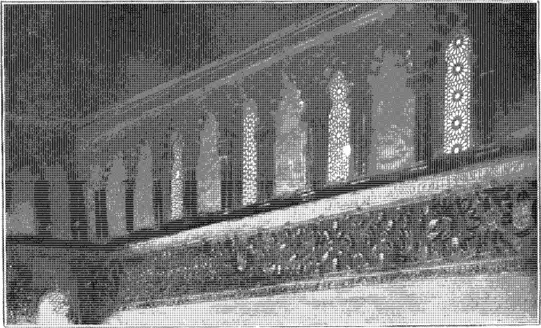
INTERIOR OF THE SYNAGOGUE OF SAMUEL HALEVI IN TOLEDO, BUILT DURING THE GLORIOUS PERIOD OF JEWISH LIFE IN SPAIN, NOW KNOWN AS THE CHURCH OF EL TRANSITO
[face p. 4
In contrast to the rest of Europe of the period, Iberia honoured her poets more than her heroes and raised the leaders in science and in art to the highest places in the land. This contrast is best illustrated in the spiritual centres of Cordoba and Carbona. Spanish Jewry had already stepped out of the abysmal ignorance of the time. At the court of Alfonso III.—a patron of the arts—were to be found the outstanding figures in world Jewry. Frederick II. of Germany sought the scientific and cultural opinion of the Jews of Toledo in a long correspondence. In Italian Jewry there was some cultural progress, but France and Germany were poor in great Jews, their communities being made up of manual labourers and petty traders, getting what freedom from persecution they could bargain for.
The great centres of learning set up by Spanish Jews in Cordoba, Granada, Seville, Losina, Toledo, Barcelona, became the guide for the Jewish world. Each community had its great diplomatic figure in the service of the ruling Prince, who might, at the same time, be high in the world of letters and as much admired for his literary and spiritual talents as for his skill in diplomacy. Through Solomon ben Hadereth the spiritual tone of the community of Barcelona was raised to such a height that it came to be regarded as an authority on spiritual matters even in Palestine, and was known as the Community of Princes. And Sheshat Benveniste, poet, philosopher and diplomat, adviser of King Alfonso, had the title of Prince conferred on him.
But it was in Toledo that the centre of Jewish life was focussed and whence went forth the authoritative word to the Jews of the whole world. Spiritual leadership came from there. For, although the High Schools of Babylon were still in existence in the eleventh century, and the first germ of science and religious philosophy had already made its appearance, yet was their influence on the wane. Those who succeeded to the spiritual leadership after the death of Hai Gaon, and the disappearance of his followers, were persecuted and obliged to fly to Spain, bringing with them both their spiritual heritage and the family glory.
Oppressed Jews flocked to find refuge in the Peninsula from all parts of the world. It was, strangely enough, due to the influx of newcomers—fanatical and bigoted, incapable of understanding that spirit of tolerance that is the Sepharadi’s chief charm—that a certain intolerance crept into Jewish religious thought. Religion and science had heretofore flourished side by side in the greatest harmony. A harmony rudely interrupted by the coming of the great Ashkenazi Talmudic authority, Asheri, a refugee from persecution by the Germans. He was made Rabbi of Toledo. Unfortunately, he introduced the idea that religion is opposed to scientific research. That the Talmud alone is to be taken as the dominant authority. That scholars occupying themselves with the reconciliation of religion and philosophy were to be condemned. On the defensive, they were obliged to excuse or explain their scientific works as not being harmful to religion. Dire punishment was meted out to those who appeared to stray from the path of a rigid orthodoxy. A spirit of intolerance that put limitations on creative activity.
Nevertheless, all the currents and streams of Judaism flowed together here and were deepened into new forms. Men of great wisdom, each one able to lead a school of thought, followed each other, their names as familiar to the great outside world as to their own countrymen. A nostalgia very akin to modem Zionism found its protagonist in the great Chasdai Ibn Chaprut, Minister for Foreign Affairs in Cordoba. And in the poetry of Yehuda Halevi it found its passionate and eternal expression. The exiles from Judæa created both a garden of poetry permeated with the joy of life and a temple for serious research. In Babylon the spiritual treasures brought by the exiles from Judæa had, with the time, suffered a decline. In Spain both language and literature were perfected.
A new type of Jew was he of the Peninsula. A light, graceful figure, charming, elegant, tactful. With pleasing manners and that suave politeness that distinguished his fellow-countrymen. Different from those brethren who, stubborn and stiff-necked, had set up the hard stone walls of ritual and ceremonial in Babylon. Different, too, from his contemporary in Eastern Europe: the furtive, cringing ghetto type.
What the country did to the Jew it also did to the Arab who settled there. In Tetuan and in Fez, whither the Arab exiles went, the type is more agreeable and refined, more pleasing to the eye, more charming in manner and prouder in bearing than is the Arab anywhere else. In his home life, too, there is a dignity and a charm that is rarely found in Arab life elsewhere.
Judaism had already established itself in a position of classical importance in the Peninsula when mysticism made its startling appearance from the eleventh to the thirteenth centuries. A period of life and creation. After more than a thousand years of seeming silence, Jews again took up the broken thread of that high visionary poetry, torn asunder with the uprooting of the nation from Judæa. The ...