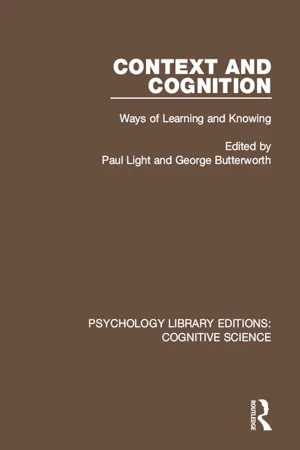
Originally published in 1993, the study of cognitive development in children had moved from a focus on the intellectual processes of the individual studied in relative isolation, as in the classic work of Piaget, to a concern in the 1970s and 1980s with social cognition characterized by Vygotsky's views. In the years following, the trend toward an understanding of the situated nature of cognition had evolved even further and the extent to which thinking and knowing are inextricably linked to contextual constraints was at last being defined.
Experts of international repute, the authors of this important book examine the recent literature on situated cognition in children. They explain contextual sensitivity in relation to ecological theories of cognition, and contrast intuitive reasoning in mathematical and other scientific domains with the failure of such reasoning in formal school contexts. Centrally concerned with the question of generalizability and transfer of knowledge from one situation to another, the contributors point to practical implications for understanding how intellectual competence can be made to generalize between "informal" and "formal" situations.
- 186 pages
- English
- ePUB (mobile friendly)
- Available on iOS & Android
eBook - ePub
About this book
Information
Chapter 1
Context and cognition in models of cognitive growth
Introduction
The study of cognitive development in children has moved through three identifiable phases in the last twenty years. First, there was a shift from a focus on intellectual processes within the individual child, as in the classic research of Piaget, to a concern with social cognition in the 1970s and 1980s very much influenced by the resurgence of interest in Vygotsky. This shift reflects a move away from attempting to explain cognition as a process located solely within the individual, towards an understanding of the interpersonal context of cognitive growth. The shift from ‘cold blooded’ to ‘warm blooded’ cognition drew attention to the ways in which thought processes and cognitive growth are socially situated but contextual factors were for the most part seen only as moderators of cognitive growth. Work on cognitive development has recently entered a third phase, in which theorists are beginning to stress an inextricable link between contextual constraints and the acquisition of knowledge. Moreover, the physical context is being reunited with the social, within the thought process. The contemporary view tends to be that cognition is typically situated in a social and physical context and is rarely, if ever, decontextualized.
How can we explain this movement towards an analysis in terms of situated cognition? Two important trends may be discerned in the recent literature. First, work on the relation between perception and cognition in young children has drawn our attention to the extent to which perception enters into the development of thought. Second, work on language and thought, especially in relation to the social foundations of knowledge, has drawn our attention to the child’s need to understand what adults mean when they pose questions designed to reveal children’s reasoning capacities.
Our intention in editing this volume was to update our book on social cognition (Butterworth and Light, 1982) with respect to recent trends in the literature on social cognitive development and to show how thinking is situated in the physical, social and cultural context which gives it its form. The aim is to illustrate, through reviews of theory and empirical research, various aspects of this recent trend to situate accounts of cognitive development. The chapters in this volume focus on the contextual sensitivity of reasoning in mathematical and other scientific domains, in everyday life and in the school. The chapters examine contextual sensitivity in relation to ecological theories of perception and cognition, and they contrast intuitive reasoning in mathematical and other scientific domains with the child’s difficulty with reasoning in formal contexts, such as the school. A central concern is the generalizability of knowledge and its transfer from one context to another.
Perception and situated cognition
Two lines of research in the 1970s and 1980s gave a particularly strong impetus for a focus on the relation between perception and cognition in development. The first of these was the study of reasoning in pre-school children which revealed greater cognitive competence than had previously been acknowledged. Peter Bryant (1974) offered an influential critique of Piaget’s theory, based on the argument that reasoning in pre-school children depends on their perception of the relationships among the elements of a task. He showed that for simple Piagetian tasks, such as making inferences, or making judgements about numerosity, and for perceptual problems such as perceiving the orientation of an oblique line, the pre-school child makes judgements relative to the perceived context. Bryant’s analysis drew attention to the context or framework on which the young child relies to make relative (rather than absolute) judgements. It was argued that young children depend on deductive inferences in such perceptually based tasks, and of course, this was contrary to the received Piagetian view. A great debate ensued on the nature of the competence revealed by experimental modifications of Piagetian tests, such as in the ‘transitive inference’ task, in pre-operational children (see for example Chapman, 1988, pp. 348 ff.).
The second contribution to an emphasis on the relation between perception and cognition came from the discovery of the perceptual competence of babies. This work was influenced by the ‘direct realist’ ecological theory of J.J. Gibson, whose ideas motivated so many of the demonstrations that perception may have an influence in structuring thought (see Butterworth, 1990, for a review). The implication is that if the infant’s perception of reality is adequate (rather than a buzzing, blooming confusion as had long been assumed) then the Piagetian, constructionist programme needs to explain how babies may perceive objective properties of reality before they have had the opportunity to construct this competence. On the ecological view, perception is necessarily situated within the ecology since it consists in obtaining information from the active relation between the organism and a structured environment. Indeed, it is the process of perception that situates the organism in the environment. The evidence from infancy suggests that perception is a ‘module’ or component of the cognitive system that is antecedent to thought and language and that may contribute to the mastery of reasoning.
These programmes of research served to draw attention to the relationship in development between perceiving and knowing. They did not directly implicate contextual factors in cognitive growth. But as even the slightest acquaintance with Gestalt psychology will reveal, what is perceived as ‘figure’ in reversible visual illusions depends entirely on what is perceived to be ‘ground’. Perception presupposes context in deriving meaning from experience. The recent emphasis on the importance of perception in cognitive development draws our attention to the ecological frameworks for experience. When perception is construed as an aspect of cognition, as has recently begun to be the case, this naturally contributes towards a new understanding of thinking as ‘situated in the world’. This contrast with the Piagetian account of thinking as gradually approximating formal logical operations, as the child slowly overcomes deficits in basic reasoning abilities.
Language and situated cognition
The recent focus on the social basis of cognition also helps explain how language itself is understood through the social context. Margaret Donaldson (1978) published a series of influential studies that purported to show that versions of Piaget’s tasks which were socially intelligible to pre-school children revealed a previously unsuspected competence in perspective-taking, conservation and class inclusion. In Donaldson’s terms, her situated tasks make ‘human sense’ because they draw on everyday social experience, with which the child is very familiar. Both Donaldson and more recently Michael Siegal (1991) take the view that much of the pre-school child’s difficulty in reasoning arises because the child cannot comprehend the adult’s specialized language. The argument is quite subtle. It is not just that the child lacks knowledge of language, rather the child’s errors arise in an active attempt to discover what the adult actually means by the questions being asked. We shall see this issue arising at a number of points in the present volume. As Donaldson (1978, p. 38) puts it:
It may turn out to be a very long journey from the primary understanding of what people mean by the words they speak and by their concomitant acts to the ultimate and separate understanding of what words mean. Perhaps the idea that words mean anything – in isolation – is a highly sophisticated notion, and a Western adult notion at that.
Various examples of the interpenetration of language, context and reasoning, some taken from Piagetian psychology, such as the conservation problem, proportional reasoning, and class inclusion are discussed in different chapters in this volume (Roazzi and Bryant, Chapter 2; Mercer, Chapter 3; Goodnow and Warton, Chapter 9). Just one well-known example will help to make clear the subtle interplay of perception, language and social interaction which is involved.
McGarrigle and Donaldson (1974) reported a beautiful experiment, which has become known as the ‘naughty teddy’ study, a variant of Piaget’s traditional number conservation task. First of all, the child is asked whether two rows of counters arranged in parallel lines contain the same or a different number. The child readily agrees that the number of counters is the same when the length of the rows is identical and each counter is opposite another. Then, under the control of the experimenter, a glove puppet known as ‘naughty teddy’ rushes in and lengthens one of the rows of counters, just as in the conservation test. The child is then asked whether the longer row contains the same or a different number of counters than the shorter one. Most children between 4 and 6 years now ‘conserve’, that is, they give the correct answer that the number of counters has not changed, even though they fail to conserve under the standard testing conditions of the conservation task.
Light (1986) has questioned whether the child really demonstrates the logical requirements of conservation when giving the right answer. Just as the child may be (mis)led by the adult’s behaviour in the standard test into supposing that length is relevant to number, they may equally be led by the social interaction taking place around the accidental transformation into supposing that the number of counters remains the same. He suggests that children may be giving the right answer for the wrong reasons. What really matters is what cues are available in the interaction as to the relevance or irrelevance of the transformation. What determines the child’s apparently correct (or incorrect) response is whether the child’s attention is drawn by the adult to transformations that are relevant for understanding conservation of number (or volume or weight) or to irrelevant cues.
On this view, the child’s problem in understanding the adult’s language becomes one of ascertaining the referent of the adult’s utterance. In other words, the problem for the child is one of determining the object of joint attention with the adult. When the adult deliberately rearranges the display and asks questions about number, the child reasonably takes it that perhaps a change in length may have something to do with what the adult means by ‘number’. The implicit message given by the adult is, Take notice of this transformation, it is relevant to questions about whether the number is the same or different.’ When the rearrangement is made to happen accidentally, then the child interprets the adult’s question, in relation to the whole context, as merely a check to establish agreement that the number has not changed. Light argues that the child is discovering the meaning of the language through social interaction in the testing situation. This applies both when the wrong answer is given and to the situation where the right answer is volunteered. The child learns about quantity terms by interpreting their meaning in relation to socially intelligible contexts. We might add that the task shows how attention and perception are inextricably linked with the child’s judgements about number.
These demonstrations therefore suggest that the child’s difficulties with conservation tasks, at least in part, arise in achieving an understanding of what the adult means. The child in discourse with the adult enters into a relationship of unequal power, where the child takes the adult’s behaviour in context as a means to understand what is required. As Goodnow and Warton (Chapter 9) point out, the particular class of problems often involved in Piagetian tasks are those amenable to criteria of scientific proof, where a correct answer exists. Different criteria for validation may actually apply to understanding socially relevant events. Typical cognitive developmental testing situations, where experimenters are seeking exact answers, may nevertheless depend on how the child applies judgemental criteria to the social interaction.
These new insights into pre-operational reasoning do not rule out entirely Piaget’s theory that development also involves a change in the child’s underlying logic. By the age of 8 or 9 years, the answer to conservation questions is obvious to the child who has entered the concrete operational stage. It is still possible for Piagetians to argue that the context sensitivity of reasoning, revealed by these recent studies of the pre-school child, gives way to a more generalized understanding, at least with respect to the classic Piagetian tasks. On the other hand, as Girotto and Light point out (Chapter 8), even adults may perform poorly on tasks of hypothetico-deductive reasoning, when the contents of the premises are remote from everyday experience. A completely deductive system of reasoning, context-free and independent of any particular content, seems never to be fully achieved. What may be being highlighted in the current phase of cognitive developmental research is the progressive reintroduction of the ecology into Piaget’s evolutionary epistemology (Piaget, 1971).
In summary, the perceptual, cognitive and social threads in recent explanations of cognitive development have been relatively distinct, but they seem now to be merging. The focus on the Chomskyan distinction between competence and performance, so prevalent in the early attempts to evaluate Piagetian theory in the 1970s and 1980s (when the search was still on for a context-free cognitive substrate), is giving way to the question as to whether cognition is always situated? The recent trend is in favour of a situated analysis in which cognitive competence is defined as a function of the context and content of knowledge structures. The question of whether and how reasoning even proceeds in the direction of a fully hypothetico-deductive system is still open, and needs to be assessed in the light of recent evidence for the context dependency of thinking.
Before turning to these issues it will be useful to consider two points in more detail. The first is the definition of ‘context’ and the second concerns how recent trends in developmental research may relate to the nature of explanation in cognitive developmental theory.
Defining context
It is surprising how often the definition of ‘context’ is left implicit in developmental theory and indeed some of the contributors to this volume are content to rely on implicit definition. A commonsense approach might focus on the physical, social or cultural setting of a particular intellectual task. Beyond such general statements, what is meant by context often remains unanalysed. It is possible, however, to proceed through a series of definitions, from the most general to the more specific, in an attempt to establish what different theorists may hold in common.
Cole and Cole (1989) elaborate what they call a ‘cultural-context’ view of development. They point out that the word comes from the Latin contexere meaning ‘to weave together’, ‘to join together’ or ‘to compose’. The context in their definition is the interconnected whole that gives meaning to the parts. Variations in the cultural context may give different meanings to otherwise identical behaviours, through the historical experience of the different cultural groups. Cole and Cole particularly emphasize the manner in which social contexts are differentially ‘scripted’ in different societies. That is, cultures transmit, through their language and their material structure, generalized guides to action. These are sometimes known as ‘pragmatic action schemes’ (Cheng and Holyoak, 1985).
Cole and Cole describe several ways in which the culture influences the child’s development: they suggest that cultures influence development by arranging the occurrence of specific contexts. To give their example, the Bushmen of the Kalahari Desert are unlikely to learn about conservation by taking baths or pouring water from one glass to another; nor are the children growing up in Western cities likely to encounter many contexts which will foster skills in tracking animals. The relative frequency with which particular contexts are encountered will foster different skills, such as skiing in snowy countries, or making pottery or weaving in simple subsistence societies (Childs and Greenfield, 1980). These relatively culturally specific activities may be associated with other contexts, and with different responsibilities, such as selling products, which will in turn foster further culturally specific types of number skills. Furthermore, as Goodnow and Warton (Chapter 9) argue, contexts can coexist in such a way that individuals may participate simultaneously in several culturally constrained modes of knowing. Children may be adept at mathematics in the streets and they may also need to perform at maths in the schools. Not only mathematics but also botany, biology, physics and medicine are practised in everyday contexts and these forms of traditional knowledge impact on formal methods of tuition (George and Glasgow, 1988). A pluralist perspective on contextual effects enables an understanding of when approximation is a sufficiently accurate method of reasoning, as when cooks solve problems of quantiti...
Table of contents
- Cover
- Half Title
- Title Page
- Copyright Page
- Original Copyright Page
- Table of Contents
- 1 Context and cognition in models of cognitive growth
- 2 Social class, context and cognitive development
- 3 Culture, context and the construction of knowledge in the classroom
- 4 Proportional reasoning in and out of school
- 5 Word problems: a microcosm of theories of learning
- 6 Sociocultural processes of creative planning in children’s playcrafting
- 7 Desituating cognition through the construction of conceptual knowledge
- 8 The pragmatic bases of children’s reasoning
- 9 Contexts and cognitions: taking a pluralist view
- Index
Trusted by 375,005 students
Access to over 1.5 million titles for a fair monthly price.
Study more efficiently using our study tools.
Frequently asked questions
Yes, you can cancel anytime from the Subscription tab in your account settings on the Perlego website. Your subscription will stay active until the end of your current billing period. Learn how to cancel your subscription
No, books cannot be downloaded as external files, such as PDFs, for use outside of Perlego. However, you can download books within the Perlego app for offline reading on mobile or tablet. Learn how to download books offline
Perlego offers two plans: Essential and Complete
- Essential is ideal for learners and professionals who enjoy exploring a wide range of subjects. Access the Essential Library with 800,000+ trusted titles and best-sellers across business, personal growth, and the humanities. Includes unlimited reading time and Standard Read Aloud voice.
- Complete: Perfect for advanced learners and researchers needing full, unrestricted access. Unlock 1.5M+ books across hundreds of subjects, including academic and specialized titles. The Complete Plan also includes advanced features like Premium Read Aloud and Research Assistant.
We are an online textbook subscription service, where you can get access to an entire online library for less than the price of a single book per month. With over 1.5 million books across 990+ topics, we’ve got you covered! Learn about our mission
Look out for the read-aloud symbol on your next book to see if you can listen to it. The read-aloud tool reads text aloud for you, highlighting the text as it is being read. You can pause it, speed it up and slow it down. Learn more about Read Aloud
Yes! You can use the Perlego app on both iOS and Android devices to read anytime, anywhere — even offline. Perfect for commutes or when you’re on the go.
Please note we cannot support devices running on iOS 13 and Android 7 or earlier. Learn more about using the app
Please note we cannot support devices running on iOS 13 and Android 7 or earlier. Learn more about using the app
Yes, you can access Context and Cognition by Paul Light,George Butterworth in PDF and/or ePUB format, as well as other popular books in Psychology & Cognitive Psychology & Cognition. We have over 1.5 million books available in our catalogue for you to explore.