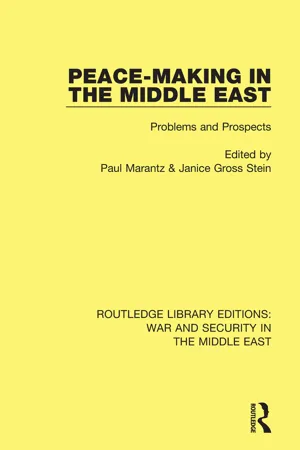
This book, first published in 1985, examines the whole problem of peacemaking in the Arab-Israel conflict. It considers the different countries involved, the changing positions they have adopted over time and the range of opinion within each country. It looks at the role of the superpowers and shows how their vacillations and their viewing of the conflict in simple terms as part of the global superpower rivalry have been unfortunate. It examines how a typical uncommitted medium power – Canada – can contribute to peace in very many ways though it may not achieve a breakthrough.
- 288 pages
- English
- ePUB (mobile friendly)
- Available on iOS & Android
eBook - ePub
About this book
Information
"The View from Inside"
Chapter 1
The Egypt-Israel Relationship: an Anatomy of Wasted Decades
Salim Mansur
We must tread carefully when we enter the debate that surrounds more than three decades of tragic political conflict which make up the contemporary history of the Middle East. But depending on where we locate ourselves, both in time and space, we can see different dimensions of the same historical reality. In the study of the Middle East, where more often happens in less time, re-examining deeply held convictions is more than an academic exercise; it is, rather, a political imperative. The peoples of the region, Arabs and Israelis, Muslims, Christians and Jews, if they revise their historical perspectives, may begin to build an alternative relationship among themselves. The Egyptians and the Israelis have begun to create that alternative relationship. Although it is still fragile and marked with quarrels and grievances, its redeeming quality is the discovery by both peoples of their common humanity that binds them together regardless of the secular differences that separate them. It remains a hope, one which was inscribed in the Camp David Accords, that the example of Egypt and Israel will be emulated in the Middle East.
It may be difficult to generalize the Egyptian-Israeli experiment. The central thesis of this paper is that the Egyptian-Israeli conflict was not organic. By this I mean, that the conflict was not derived from any intrinsic or core value, which threatened the survival of either Egypt or Israel. If we accept this proposition then the question follows, why was the Egyptian-Israeli relationship marked by four wars in three decades of hostility? Before I look at the Egyptian-Israeli conflict from the Egyptian perspective, I submit that insofar as Israel was concerned it would have entered into a peace treaty with Egypt at any time between 1948 and 1977. The return of Sinai- occupied as a result of the 1967 war- as part of the settlement with Egypt demonstrated that even the most hard-line Israeli leadership would be willing to make considerable concessions to achieve peace with its principal Arab neighbour. That a settlement between Cairo and Jerusalem was reached only after thirty years of hostility, and not at any time earlier, cannot be explained only by the miscalculations and misperceptions of Egyptians as well as those of other Arab leaders including the Palestinians. It is a tragic story, as we look back through history to the birth of the state of Israel and the beginning of the Egyptian revolution, of commitments and policies which once undertaken had to be exhausted before a new course could be charted. In effect, I am suggesting that the causes and circumstances of the July revolution of 1952 in Egypt, the rhetoric that surrounded it, the expectations that it aroused among the Egyptian people, and its symbolic meaning to the masses in the Arab world, locked the destiny of Egypt onto a particular trajectory of sociopolitical development. Egypt's leaders became captive of the currents that flowed from the events of that fateful day in July 1952. In terms of the Egyptian-Israeli relationship, it meant that Egypt could not avoid confrontation with Israel.
There is a strong element of determinism in arguing that the politics of Egypt were structurally determined by the internal and external constraints of its revolution. This is not to deny, however, the influence of leadership on events, and the capacity of leaders to shape their environment. Both Nasser and Sadat were men of exceptionally strong personalities, and their individual character, perceptions, ambitions, wisdom, and hubris gave meaning to their political choices in the context of Arab politics and Egypt's role in the Arab world. Yet to read the history of Egypt, and in particular that of Egypt and Israel, from the perspective of the two men who personified Egypt is to exaggerate their impact and diminish those socio-economic constants whose weight had always to be part of the calculus of any decision. As Fouad Ajami has observed,
to go after the personalities of the two •kings' in order to explain Egypt's path must be checked, for there were constants that both men had to deal with: (1) an unacceptable military defeat that both men had to try to break out of; (2) a revolutionary legacy that had generated a great deal of noise and that now had to come to terms with the world.1
While I do not discount leaders and their roles,2 the analysis in this paper will focus on the Egyptian state post-1952. But it is also necessary to consider the larger Arab dimension within which the July revolution of 1952 unfolded. For it was regional pressures that locked Egypt into the ArabIsrael conflict. Consequently, though the thesis of this paper is argued using a political economy approach, it is in order that we take a brief measure of the Arab state system as it took shape in the first half of this century and the contradictions which have savaged the putative aspirations of the Arabs for a transcendent political unity. Thus we will seek an explanation of the origin of the Egyptian-Israeli conflict, its persistence and settlement, in the interaction between the regional constraints and the domestic socioeconomic pressures on the Egyptian state.
II
The Arab state system, like other subordinate state systems in Africa and Asia, began to take shape in the years following the end of the anti-fascist struggle.3 During the interwar years, nationalist politics in the Fertile Crescent were largely concerned with the betrayal of the promise by the Allied Powers to the forces of the Arab Revolt, and the increasing Jewish immigration into Palestine. In Egypt, the quest for political independence dominated the national agenda and was centred around the politics of the nationalist party (the Wafd) of Sa'ad Zaghlul Pasha, In North Africa, the Maghreb (west) of the Arab world, Libya was occupied by Italy, and Algeria, Morocco and Tunisia ruled by France.
It was in the Arab east {the Mashreq), between the Nile and the Fertile Crescent, that nationalist politics took shape. It was here that the demand for Arab unity was first conceived and given voice, and politics defined in opposition not only to the foreign powers that occupied Arab lands but also to the old order of the dynasts. These two currents, which at times flowed together and at times were mutually opposed, shaped the parameters of Arab politics.
When the Sharif of Mecca, Husayn, and his sons, driven by conflicting motives of dynastic interests, hatred for the Young Turks, long simmering opposition to the domination of the Arabs by the Ottoman Sultans, and the tacit pressures of the British, raised the banner of the Arab Revolt in 1916, the nationalist forces in the Fertile Crescent actively supported the rebellion. The politics of the nationalists, organized in secret cells, had been shaped by the writings of al-Kawakibi {1849-1903) and Negib Azoury {d. 1916). Their writings extolled the virtues of the Arabs over the Turks, and instilled the demand for an independent Arab homeland in the minds of those Arabs who had already been stirred by the antiimperialist polemics of al-Afghani. The Arab nationalists who joined forces with the Hashemite interests of Husayn, might be viewed as the heirs of those who had participated in the Nahda, the nineteenth century attempt at the renaissance of culture in the context of Western influence, and the tragic attempt at resistance to the domination of Arab lands by foreign powers.
At the end of the war, the nationalists were denied the fruit of their struggles against the Ottomans. Lebanon and Syria were handed to France under the League Mandate. In Iraq, and the newly created Transjordan, the sons of Husayn, Feisal and Abdullah,· were installed as king and emir under the protection of Britain. In the interwar years, dynastic interests opposed the nationalists' striving for complete political independence. Given the nationalists' demand for political independence tied to an undefined agenda of change in the socio-economic order, the dynasts, whose regimes were based on narrow political foundations and fragile legitimacy, felt compelled to seek closer ties with external powers. While the contradiction between the nationalists and the dynasts was still not well defined during the interwar years, during the years between the first Arab-Israel war in 1948 and the June war in 1967 it split the Arab state system into two competing orders of the nationalists and the conservatives.
To the south of the Fertile Crescent, in the Arabian peninsula, local tumult eventually altered the balance of power among tribes which had so long prevented the domination of the territory by one chieftain. In 1924, Sharif Husayn of Mecca, threatened by the collapse of his army under siege by the Ikhwans allied to Ibn Saud, betrayed and abandoned by the Allied Powers, and destroyed by his own over-reaching ambition, went into exile. Soon after Husayn's departure Ibn Saud entered Mecca, joined the kingdom of Hejaz and Nejd into one, and declared himself the King of Saudi Arabia. This arid peninsula, the birthplace of the Prophet Muhammed and the cradle of Islam, was united under one flag and name of a tribal dynasty emerging from the heart of its barren soil. However, the discovery of oil on its northeastern coastline had already brought it to the notice of the western capitalist enterprises and governments. In the years to come, this kingdom dominated by a feudal house, would come to play a role that would far exceed its demographic weight, both within the Arab state system and in the calculations of great powers with their interests in oil and their geostrategic needs.
It was Egypt that became the lynchpin of the emergent Arab state system during the interwar years. Egyptian nationalism, initially inspired by the abortive arabi revolt of 1882, was fuelled by different currents of ideas. There were the Muslim reformist ideas of Muhammed Abduh, the great Egyptian scholar and one time disciple of al-Afghani, who reiterated the strength of Egyptian culture based on its Islamic heritage which, he counselled, needed to be reinterpreted, not abandoned, as Egypt sought its role in modern history. In contrast, there was the ideology of the Nationalist Party of Mustafa Kemal, who sought to open Egypt to the ideas of the modern European bourgeoisie, to the ideals of the French Revolution and the Rights of Man.4 The man who arrived in Paris at the head of the Wafdist delegation, Sa'ad Zaghlul, to represent Egypt at the Peace Conference of 1919, carried with him the tendencies of both the secular modernists and religious reformers. Sa'ad Zaghlul obtained an understanding from the British that Egypt would be given independence under guarantees that British investments be protected. In 1922, the British High Commissioner issued a four point declaration which granted Egypt independence while reserving for Britain the rights to imperial communications, the defence of Egypt, the protection of foreign interests and minorities, and the control of Sudan. In the subsequent treaty of 1936, the command of the Egyptian army would be transferred to the Egyptians.
The location of Egypt - spanning two continents, yet centred at the axis of the Arab state system - its demographic weight, its cultural heritage and civilization and its early opening to Europe, made Egypt the leader of the Arabic-speaking people. Thus it seemed only natural that the Charter of the League of Arab States was signed in Cairo, in March 1945, and that the headquarters of the League be located in the capital of Egypt. The idea of Arab unity had gathered strength in the Mashreq following the partition of Arab territory by Allied Powers. This aspiration for unity flowed from the J:"eality of fragmented Arab political power. It was potentially democratic in its conception, premised on the cultural unity of the Arab people manifested in common language, as the foundation for political unity. Arab nationalists felt that the obstacle to unity came from two sources, the presence of foreign powers in occupation of Arab lands and the narrow regional interests of the dynasts. Some conceived of Arab unity as a force rising imminently from below, as the irrepressible wishes of the Arab masses that would dismantle the artificial boundaries that divided them and their land into regional compartments. From this perspective, the formation of the League was contradictory to the ideals of Arab unity. The League was engineered at the top, and while it expressed at one level the notion of Arab unity, it institutionalized at another level the reality of Arabs divided into regional states. And yet, despite this apparent contradiction, it was a significant political act; it was a recognition by the Arab leaders of the need to create an institution to co-ordinate their policies against both the challenge of domestic forces and the pressures of external powers.
In 1945, the Arab state system was still governed largely by a combination of dynastic and feudal interests. Egypt's nominal political independence was compromised both by the powers of the monarchy buttressed by Britain and by comprador and feudal interests. The collapse of the French in 1940 helped the Lebanese and the Syrians gain early independence. Elsewhere in the Arab world, from Iraq to Morocco, European powers and dynasts governed.
The formation of the League in 1945 was the first tangible expression of the emergent Arab state system. It also dates the beginning of contemporary Arab history. Across the four decades of strife and change, militancy and defeat, the issues that have defined the politics of the Arab state system may be categorized around four issue areas. These are: (i) Arab response to, first the Jewish immigration into Palestine and later the creation of the state of Israel and the consequent problem of the Palestinian refugees and their demand for a homeland; (ii) the relationship of the Arab world to the two opposing blocs of east and west; (iii) the issue of Arab unity, and the role of the Arab states; and (iv) the nature of the socio-political system, socialist, freeenterprise, or Islamic, that Arabs sh...
Table of contents
- Cover
- Half Title
- Title
- Copyright
- Original Title
- Original Copyright
- Contents
- Dedication
- Acknowledgements
- INTRODUCTION Peacemaking in the Arab-Israel Conflict: Diagnosis and Prognosis
- PART I: THE VIEW FROM INSIDE
- PART II: THE VIEW FROM OUTSIDE
- CONCLUSION The Fundamentals of Peacemaking: A Retrospective Analysis
- INDEX
Trusted by 375,005 students
Access to over 1.5 million titles for a fair monthly price.
Study more efficiently using our study tools.
Frequently asked questions
Yes, you can cancel anytime from the Subscription tab in your account settings on the Perlego website. Your subscription will stay active until the end of your current billing period. Learn how to cancel your subscription
No, books cannot be downloaded as external files, such as PDFs, for use outside of Perlego. However, you can download books within the Perlego app for offline reading on mobile or tablet. Learn how to download books offline
Perlego offers two plans: Essential and Complete
- Essential is ideal for learners and professionals who enjoy exploring a wide range of subjects. Access the Essential Library with 800,000+ trusted titles and best-sellers across business, personal growth, and the humanities. Includes unlimited reading time and Standard Read Aloud voice.
- Complete: Perfect for advanced learners and researchers needing full, unrestricted access. Unlock 1.5M+ books across hundreds of subjects, including academic and specialized titles. The Complete Plan also includes advanced features like Premium Read Aloud and Research Assistant.
We are an online textbook subscription service, where you can get access to an entire online library for less than the price of a single book per month. With over 1.5 million books across 990+ topics, we’ve got you covered! Learn about our mission
Look out for the read-aloud symbol on your next book to see if you can listen to it. The read-aloud tool reads text aloud for you, highlighting the text as it is being read. You can pause it, speed it up and slow it down. Learn more about Read Aloud
Yes! You can use the Perlego app on both iOS and Android devices to read anytime, anywhere — even offline. Perfect for commutes or when you’re on the go.
Please note we cannot support devices running on iOS 13 and Android 7 or earlier. Learn more about using the app
Please note we cannot support devices running on iOS 13 and Android 7 or earlier. Learn more about using the app
Yes, you can access Peacemaking in the Middle East by Paul Marantz,Janice Gross Stein in PDF and/or ePUB format, as well as other popular books in Social Sciences & Regional Studies. We have over 1.5 million books available in our catalogue for you to explore.