Originally published in 1983, this book reviews trends in the small-firm sector. The areas chosen cover the full spectrum of economic development. Part 1 deals with case studies from the USA, Japan, the UK, Australia, Germany and Sweden. In Part 2 Singapore, Philippines, Malaysia, Indonesia, Thailand and Africa are surveyed. In all cases the authors review the variety of definitions used for the small-firm sector and present such data as are available on the changing importance of the sector. This is followed by a review of the roles of small firms in each of the economies.
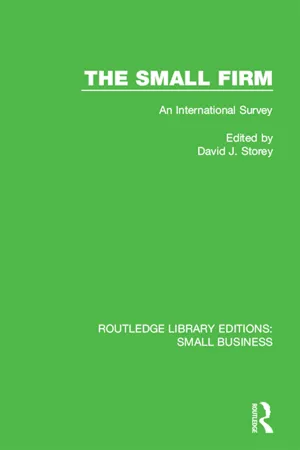
- 274 pages
- English
- ePUB (mobile friendly)
- Available on iOS & Android
eBook - ePub
1 | INTRODUCTION: ADVANCED INDUSTRIAL ECONOMIES |
In Chapter 2 Thompson and Leyden state that small business – like motherhood and apple pie – has always occupied a specific place of esteem in the United States. The other chapters, notably those by Cross on the United Kingdom, Johns on Australia and Lindmark on Sweden, shows this to be less true for other developed economies. Johns show that in Australia governments have made only modest efforts to assist the small-firm sector, primarily through attempts to eliminate certain obvious disadvantages, rather than to discriminate positively in its favour. Public financial assistance to the small firm sector in Sweden is documented by Lindmark. He shows that although the amount has grown markedly during the decade of the 1970s there is still a tendency to provide loans to small firms whereas large enterprises are more likely to receive grants. In the United Kingdom, Cross also notes that interest in small firms by government is very recent, and that public expenditure in the form of direct assistance is modest.
The contrast with the USA and Japan is stark. The US Small Business Agency, founded in 1953, has thirty years of experience in providing, directly or indirectly, financial assistance to small firms. It has a substantial programme of management education and has been the vigorous mouthpiece of the small business community during that time. It has succeeded in obtaining statutory positive discrimination in favour of small firms, particularly in the area of tendering for public contracts. Similarly, Japan has a long tradition of interest in maintaining the well-being of the small business sector. Anthony, in Chapter 3, clearly demonstrates that small business is part of the social as well as the economic fabric of Japan, and it is for these reasons that legislation such as the 1965 Law for the Prevention of Delay in Payments to Subcontractors is of such importance. As Anthony shows, such laws are actively enforced and in fact were further strengthened in 1972 and 1973.
The quality of the statistical information on small firms seems to be directly related to the esteem in which the sector is held in the country concerned, with the USA and Japan having the most comprehensive data and the poorest data being in the UK and Sweden. The Federal Republic of Germany and Australia occupy intermediate positions. In all countries the variety of definitions of small firms are outlined and it is clear that there are major problems in making comparisons of the importance of small firms in each of these advanced economies. A further source of complication is that data are reported for a variety of different years, with some referring to establishments and some to enterprises. In some cases the upper limit to the number of employees is 500 whereas in others it is only 100. Finally, some of the data refer only to manufacturing establishments whilst some refer to all sectors.
Despite this complexity, it seems clear that, generally, the small-firm sector has provided a reduced proportion of manufacturing jobs over time in most countries. The largest proportionate reduction occurs in the Federal Republic of Germany, where Hull shows that in 1950, 51.4 per cent of manufacturing employment was in firms with fewer than 100 workers. This fell continuously so that by 1977 Hull estimated that only 29.9 per cent of manufacturing employment was in such firms. A similar reduction took place in the importance of small firms in the service sector in the Federal Republic, at least until 1970. Continuous decline in the importance of the small manufacturing firm sector is also shown to have occurred in Australia, Sweden and the USA. Johns shows that in Australia between 1969 and 1979 the proportion of manufacturing employment in manufacturing in small firms employing fewer than 100 workers fell from 32 per cent to 29.4 per cent. In Sweden small (defined as having fewer than 200 workers) firms provided 35.3 per cent of employment in manufacturing in 1969, but by 1979 this had fallen to 32.5 per cent. Similarly, United States enterprise statistics also indicate a small reduction in the relative importance of very small enterprises employing fewer than 20 workers in the period 1958 to 1977.
The exceptions to the above trends are in the UK and Japan. The UK has the lowest proportion of manufacturing employment in small firms of any developed country, with UK small firms providing a decreasing share of employment in manufacturing from the 1930s until the late 1960s, since when the trend has been reversed. In the case of Japan small and medium-sized firms provided a higher proportion of manufacturing employment in 1978 than in 1963, although there appears to have been a sharp drop between 1969 and 1972.
The difficulties which face small firms also vary interestingly between countries. Anthony shows that the importance of small firms as subcontractors in Japan means that they are subject to a powerful financial squeeze when credit is tight. Small Japanese firms are not alone in encountering this problem and financial problems are mentioned by most authors. The one exception is Hull who, quoting the work of Geiser, shows that finance problems for firms in the Federal Republic of Germany were less important than obtaining suitable skilled labour, and lack of space for expansion.
In general however, finance, particularly the inadequate provision of risk capital, is remarked upon by Johns for Australia, Cross for the UK and Lindmark for Sweden. Thompson and Leyden for the USA on the other hand stress that the main problem is the high interest rates at which small companies are required to borrow, although they point out that the high cost and limited availability of capital forces small firms to adopt sub-optimal policies in many aspects of management.
Another problem which is remarked upon by several authors is shortage of suitable premises (Cross, Hull), but the main source of complaint by the small business sector itself is the role of government, particularly with respect to its taxation policy and state regulations. These issues are stressed in the chapters on Australia, USA and the Federal Republic of Germany, and it is the editor’s experience that much the same opinions are voiced by small firms in the United Kingdom.
Bearing in mind this lack of empathy between small business and the government bureaucracy it may appear surprising that, in most countries under study, there is a complex web of financial, managerial and other assistance provided by the public sector. As noted earlier this programme of assistance and support varies between the countries, being strongly related to the social status of small businesses within each community.
Each country, however, has its own variations on these themes. One of the features of small firm development in Sweden and in the UK has been the emphasis upon local initiatives particularly in areas of either high unemployment or where substantial reconstruction has taken place in basic industries. The Swedes have also encouraged the formation of new forms of business such as employee-owned firms and co-operatives.
The main thrust of government initiatives has been to assist the financing of small firms. In the USA the Small Business Agency was established primarily to provide finance to those entrepreneurs unable to obtain monies elsewhere. Thompson and Leyden show there are currently seven different Loan Programmes including those specifically designed to assist racial or ethnic minorities, and three different types of loans including a Loan Guarantee Scheme. The Swedes have created special credit institutions, such as the Industrial Credit Bank, owned jointly by government and the Swedish commercial banks to provide loans to small firms primarily for fixed capital. In the UK the Industrial and Commercial Finance Corporation, a subsidiary of the main private banks, has a long history of success in lending to relatively few small firms, and in 1981 the UK Government initiated a pilot Loan Guarantee Scheme. In Germany the assistance programme to small firms is also administered jointly by government and the private banks. Loans to small firms made under the ERP Programme generally have a duration of 10 to 15 years and offer rates of interest about two percentage points below market rates. Significantly, this rate is then fixed for the period of the loan. The Germans have since 1979 reduced the contribution of capital required by an individual in starting his own business. These loans, for twenty years’ duration, give capital repayment holidays for ten years and interest payment holidays for two years. Not surprisingly, Hull reports they have been in great demand by the small business sector. In Australia there have been fewer small firm initiatives, with concessional loans being made by the Commonwealth Development Bank (CDB) only being extended to the service sector generally since 1978. Indeed, at the time of writing, it seems that the Australian Government is debating whether loans through the CDB are the most effective means of providing financial assistance to small firms.
The following chapters illustrate the considerable diversity of performance of the small firm sector in these six developed countries. They also show the difference in terms of approach by government to the sector. Perhaps the only consistency is the cautious optimism expressed by most contributors about the future of the small firm sector.
2 | THE UNITED STATES OF AMERICA |
2.1. Introduction
Small business – like motherhood and apple pie – has always occupied a special place of esteem in the United States. ‘A business of my own’ has been the recurring dream of generations of wage earners. Only in recent years, however, has the idea taken hold that small business is a special entity which has some serious, distinctive problems that require governmental assistance if this sector is to survive and prosper.
Identification of small business as a separate entity began with the establishment of the Small Business Administration (SBA) in 1953, though problems of definition persist. The 1960s and 1970s saw a gradual expansion of the lending and counselling activities of this agency. More recently, growing concern about the future of small business led to Congressional hearings on this subject in 1978 and to a White House conference in the following year. These two important sources of small business data will be tapped, along with others, in this chapter. Our purpose is to provide a comprehensive view of the nature, trends, current status, problems and prospects of small business in the United States.
2.2. Definition
An adequate definition of small business is necessary for understanding the sector’s role in the economy and for establishing appropriate public policy. Conceptually, small businesses can be characterised in the same way as other businesses, i.e. as entities engaged in the production, distribution and sale of products or services in which land, labour and capital are combined to bring the product or service into existence. Attaching the qualifier ‘small’, however, leads to the problem of deciding how small is small – a very significant problem for those concerned with the formulation and exercise of public policy. Spokesmen for small business argue that it does not fit well into the broader definition of business and should therefore be treated differently. The problem is compounded by the fact that the types and size of firms eligible for the advocated different treatment may vary with the policy area under consideration. Among these policy areas are: government loans, management assistance, economic development, minimum wages, taxation, anti-trust law, venture capital, employment and research and development.1 The result is that different agencies, and different departments within those agencie...
Table of contents
- Cover
- Half Title
- Title Page
- Copyright Page
- Original Copyright Page
- Table of Contents
- List of Tables
- List of Contributors
- Introduction
- PART ONE
- PART TWO
- Index
Trusted by 375,005 students
Access to over 1.5 million titles for a fair monthly price.
Study more efficiently using our study tools.
Frequently asked questions
Yes, you can cancel anytime from the Subscription tab in your account settings on the Perlego website. Your subscription will stay active until the end of your current billing period. Learn how to cancel your subscription
No, books cannot be downloaded as external files, such as PDFs, for use outside of Perlego. However, you can download books within the Perlego app for offline reading on mobile or tablet. Learn how to download books offline
Perlego offers two plans: Essential and Complete
- Essential is ideal for learners and professionals who enjoy exploring a wide range of subjects. Access the Essential Library with 800,000+ trusted titles and best-sellers across business, personal growth, and the humanities. Includes unlimited reading time and Standard Read Aloud voice.
- Complete: Perfect for advanced learners and researchers needing full, unrestricted access. Unlock 1.5M+ books across hundreds of subjects, including academic and specialized titles. The Complete Plan also includes advanced features like Premium Read Aloud and Research Assistant.
We are an online textbook subscription service, where you can get access to an entire online library for less than the price of a single book per month. With over 1.5 million books across 990+ topics, we’ve got you covered! Learn about our mission
Look out for the read-aloud symbol on your next book to see if you can listen to it. The read-aloud tool reads text aloud for you, highlighting the text as it is being read. You can pause it, speed it up and slow it down. Learn more about Read Aloud
Yes! You can use the Perlego app on both iOS and Android devices to read anytime, anywhere — even offline. Perfect for commutes or when you’re on the go.
Please note we cannot support devices running on iOS 13 and Android 7 or earlier. Learn more about using the app
Please note we cannot support devices running on iOS 13 and Android 7 or earlier. Learn more about using the app
Yes, you can access The Small Firm by David J. Storey in PDF and/or ePUB format, as well as other popular books in Business & Business General. We have over 1.5 million books available in our catalogue for you to explore.