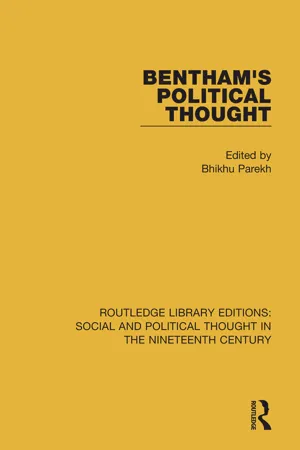
In this book, first published in 1973, the editor has drawn heavily on Bentham's manuscripts and has tried to provide a coherent statement of Bentham's legal and political thought. Unlike Plato, Aristotle, Hobbes or Mill, Bentham did not write one single work containing the basic principles of his legal and political philosophy. This titles presents Bentham's work in a systematic manner, and will be of interest to students of philosophy, politics and history.
- 338 pages
- English
- ePUB (mobile friendly)
- Available on iOS & Android
eBook - ePub
Bentham's Political Thought
Chapter 1
Ontology1
[Although, for reasons of space, I have omitted a few passages, those selected present a balanced picture of Bentham's ontology, especially of his theory of reality and fiction which he considered to be the basis of his moral and political theory, Bentham has drawn a thin line over the first few sentences (from 'An entity ...' to '... really meant to be ascribed'), but he had not crossed them out. Strictly speaking, perhaps, these few sentences should have been omitted. However, as they form a necessary introduction to his ontology and express his basic ideas crisply and accurately, they have been included here. Incidentally, Bowring retains them as well.]
An entity is a denomination, in the import of which every subject matter of discourse, for the designation of which the grammatical part of speech called a noun-substantive is employed, may be comprised.
Entities may be distinguished into perceptible and inferential.
A perceptible entity is every entity the existence of which is made known to human and other beings by the immediate testimony of one or more of senses.
An inferential entity is an entity which, at this time of day at least, is not made known to human beings in general, by the testimony of sense, but is inferred from a chain of reasoning.
An entity, whether perceptible or inferential, is either real or fictitious.
A real entity is an entity to which, on the occasion and for the purpose of discourse, existence is really meant to be ascribed.
A fictitious entity is an entity to which, though by the grammatical form of the discourse employed in speaking of it, existence be ascribed, yet in truth and reality existence is not meant to be ascribed.
Every noun-substantive which is not the name of a real entity, perceptible or inferential, is the name of a fictitious entity.
Every fictitious entity bears some relation to some real entity, and can not otherwise be understood than in so far as that relation is perceived—a conception of that relation is obtained.
Reckoning from the real entity to which it bears relation, a fictitious entity may be styled a fictitious entity of the first remove, a fictitious entity of the second remove, and so on.
A fictitious entity of the first remove is a fictitious entity, a conception of which may be obtained by the consideration of the relation borne by it to a real entity, without need of considering the relation borne by it to any other fictitious entity.
A fictitious entity of the second remove is a fictitious entity, for obtaining a conception of which it is necessary to take into consideration some fictitious entity of the first remove.
Considered at any two contiguous points of time, every real entity is either in motion or at rest.
Now when a real entity is said to be at rest, it is said to be so with reference to some other particular real entity or aggregate of real entities; for so far as any part of the system of the universe is perceived by us, we at all times perceive it not to be at rest, Such, at least, is the case not only with the bodies called planets, but with one or more of the bodies called fixed stars; and, by analogy, we infer this to be the case with all the rest.
This premised, considered with reference to any two contiguous points of time past, every perceptible real entity was, during that time, either in motion or not in motion; if not in motion, it was at rest.
Here, then, we have two correspondent and opposite fictitious entities of the first remove, viz. a motion and a rest.
A motion is a mode of speech commonly employed; a rest is a mode of speech not so commonly employed.
To be spoken of at all, every fictitious entity must be spoken of as if it were real. This, it will be seen, is the case with the abovementioned pair of fictitious entities of the first remove.
A body is said to be in motion. This, taken in the literal sense, is as much as to say, here is a larger body called a motion; in this larger body, the other body, namely, the real existing body, is contained.
So in regard to rest. To say this body is at rest is as much as to say, here is a body, and it will naturally be supposed a fixed body, and here is another body, meaning the real existing body, which is at that first-mentioned body, i.e. attached to it, as if the fictitious body were a stake, and the real body a beast tied to it.
To language, then—to language alone—it is that fictitious entities owe their existence; their impossible, yet indispensable, existence.
In language, the words which present themselves, and are employed in the character of names, are, some of them, names of real entities; others, names of fictitious entities: and to one or other of these classes may all words which are employed in the character of names be referred.
What will, moreover, be seen, is that the fiction—the mode of representation by which the fictitious entities thus created, in so far as fictitious entities can be created, are dressed up in the garb, and placed upon the level, of real ones—is a contrivance but for which language, or, at any rate, language in any form superior to that of the language, of the brute creation, could not have existence.
Of fictitious entities, whatsoever is predicated is not, consistently with strict truth, predicated (it then appears) of anything but their respective names.
But for as much as by reason of its length and compoundedness, the use of the compound denomination, name of a fictitious entity, would frequently be found attended with inconvenience; for the avoidance of this inconvenience, instead of this long denomination the less long, though, unhappily, still compound denomination, fictitious entity, will commonly, after the above warning, be employed.
Of nothing that has place, or passes, in our minds can we give any account, any otherwise than by speaking of it as if it were a portion of space, with portions of matter, some of them at rest, others moving in it. Of nothing, therefore, that has place, or passes in our mind, can we speak (or so much as think) otherwise than in the way of fiction. To this word fiction we must not attach either those sentiments of pleasure, or those sentiments of displeasure which, with so much propriety, attach themselves to it on the occasion in which it is most commonly in use. Very different in respect of purpose and necessity, very different is the fiction of logic from the poetical and political; very different the fiction of the Logician from the fictions of poets, and those of priests, and lawyers.
For their object and effect, the fictions with which the Logician is conversant, without having been the author of them, have had neither more nor less than the carrying on of human converse; such communication and interchange of thought as is capable of having place between man and man. For this object and effect the fictions of the poet, whether in his character of historic fabulist or dramatic fabulist, putting or not putting the words of his discourse in metrical form, are pure of insincerity, and, neither for their object nor for their effect have anything but to amuse, unless it be in some cases to excite to action—to action in this or that particular direction for this or that particular purpose. By the priest and the lawyer, in whatsoever shape fiction has been employed, it has had for its object or effect, or both, to deceive, and, by deceipt, to govern, and, by governing, to promote the interest, real or supposed, of the party addressing, at the expense of the party addressed. In the mind of all, fiction, in the logical sense, has been the coin of necessity—in that of poets, of amusement—in that of the priest and the lawyer, of mischievous immorality in the shape of mischievous ambition; and too often both priest and lawyer have framed or made in part this instrument.
Classification of Fictitious Entities
A. Names of Physical Fictitious Entities
To this class belong all those entities which will be found included in Aristotle's list—included in his Ten Predicaments, the first excepted.
I. Quantity. Quantity cannot exist without some substance of which it is the quantity. Of substance, no species, no individual can exist, without existing in some certain quantity.
2. Quality. Quality cannot exist without some substance of which it is the quality. Of substance, no species can exist without being of some quality; of a multitude of qualities, of which the number is, in every instance, indeterminate, capable of receiving increase, and that to an indefinite degree, according to the purposes for which, and the occasions on which the several substances of which they are qualities, may come to be considered.
3. Place. Of place, the notion cannot be entertained without the notion of some substance considered as placed, or capable of existing, or, as we say, being placed in it.
Expressive of the notion of place, taken in their original, physical, archetypal signification, are the several words termed prepositions of place and adverbs of place. These are—In; on, or upon; at; above; below; round; around; out, out of; from above; from under; from.
4. Time. Time is, as it were, on an ulterior and double account, a fictitious entity; its denominations so many names of fictitious entities.
To be capable of being spoken of, time itself must be, cannot but be, spoken of as a modification of space. Witness the prepositions in and at: in such a portion of time—at such a portion of time; in an hour—at 12 o'clock; in such a year, month, day, at such an hour, at so many minutes after such an hour, at so many seconds after such a minute in such an hour.
Witness again, the common expressions, 'a short time', 'a long time', 'a space of time'.
By a line it is that every portion of time, every particular time, is conceived, represented, and spoken of;—by a line, i.e. a body, of which the length alone, without breadth or depth, is considered.
5. Motion. 6. Rest. 7. Action. 8. Passion. 9. Relation.
B. Political and Quasi-Political Fictitious Entities
I. Effects. 1. Obligation; 2. Right; 3. Exemption; 4. Power; 5. Privilege; 6. Prerogative; 7. Possession, physical; 8. Possession, legal; 9. Property.
II. CAUSES, 1. Command; 2. Prohibition, Inhibition, etc.; 3. Punishment; 4. Pardon; 5. License; 6. Warrant; 7. Judgement; 8. Division.
All these have for their efficient causes pleasure and pain—but principally pain—in whatsoever shape and from whichsoever of the five sanctions or sources of pleasure or pain derived or expected, viz. 1. The physical sanction; 2. The sympathetic sanction, or sanction of sympathy; 3. The popular or moral sanction; 4. The political, including the legal sanction; 5. The religious sanction.
Obligation is the root out of which all these other fictitious entities spring.
Of all the sanctions or sources of pleasure and pain above brought to view, the political sanction being susceptible of being the strongest and surest in its operation, and, accordingly, the obligation derived from it the strongest and most effective, powerful and efficient, this is the sanction which it seems advisable to take for consideration in the first instance; the correspondent obligations of the same name which may be considered as emaning from these other fictitious entities being, in the instance of some of these sanctions, of too weak a nature to act with any sufficient force capable of giving to any of those other productions any practical value.
An obligation—understand here that sort of obligation which, through the medium of the will, operates on the active faculty—takes its nature from some act to which it applies itself; it is an obligation to perform or to abstain from performing a certain act.
A legal obligation to perform the act in question is said to attach upon a man, to be incumbent upon him, in so far as in the event of his performing the act (understand both at the time and place in question) he will not suffer any pain, but in the event of his not so performing it he will suffer a certain pain, viz. the pain that corresponds to it, and by the virtue of which, applying itself eventually as above, the obligation is created.
Chapter 2
Exposition2
[Benthara uses the term exposition to refer to what we wo...
Table of contents
- Cover
- Half Title
- Title
- Copyright
- Original Title
- Original Copyright
- Contents
- PREFACE
- INTRODUCTION
- 1. Ontology
- 2. Exposition
- 3. Phenomena of the Human Mind
- 4. Springs of Action
- 5. Of the Principle of Utility
- 6. Virtue
- 7. Value of a Pain or Pleasure
- 8. The Idea of a Political Society
- 9. Of Subjects
- 10. What a Law Is
- 11. Source of a Law
- 12. Force of a Law
- 13. Power and Right
- 14. Leading Principles of a Constitutional Code
- 15. The People
- 16. Legislature
- 17. Prime Minister and Ministers
- 18. Sublegislature and Local Headman
- 19. Fallacies
- 20. Declaration of Rights
- 21. Nature of Political Reasoning
- 22. Summary of Basic Principles
- APPENDICES
- NOTES
Trusted by 375,005 students
Access to over 1.5 million titles for a fair monthly price.
Study more efficiently using our study tools.
Frequently asked questions
Yes, you can cancel anytime from the Subscription tab in your account settings on the Perlego website. Your subscription will stay active until the end of your current billing period. Learn how to cancel your subscription
No, books cannot be downloaded as external files, such as PDFs, for use outside of Perlego. However, you can download books within the Perlego app for offline reading on mobile or tablet. Learn how to download books offline
Perlego offers two plans: Essential and Complete
- Essential is ideal for learners and professionals who enjoy exploring a wide range of subjects. Access the Essential Library with 800,000+ trusted titles and best-sellers across business, personal growth, and the humanities. Includes unlimited reading time and Standard Read Aloud voice.
- Complete: Perfect for advanced learners and researchers needing full, unrestricted access. Unlock 1.5M+ books across hundreds of subjects, including academic and specialized titles. The Complete Plan also includes advanced features like Premium Read Aloud and Research Assistant.
We are an online textbook subscription service, where you can get access to an entire online library for less than the price of a single book per month. With over 1.5 million books across 990+ topics, we’ve got you covered! Learn about our mission
Look out for the read-aloud symbol on your next book to see if you can listen to it. The read-aloud tool reads text aloud for you, highlighting the text as it is being read. You can pause it, speed it up and slow it down. Learn more about Read Aloud
Yes! You can use the Perlego app on both iOS and Android devices to read anytime, anywhere — even offline. Perfect for commutes or when you’re on the go.
Please note we cannot support devices running on iOS 13 and Android 7 or earlier. Learn more about using the app
Please note we cannot support devices running on iOS 13 and Android 7 or earlier. Learn more about using the app
Yes, you can access Bentham's Political Thought by Bhikhu Parekh in PDF and/or ePUB format, as well as other popular books in History & 19th Century History. We have over 1.5 million books available in our catalogue for you to explore.