This title, first published in 1987, is a study of the appeals of socialism for the educated middle and lower classes in the nineteenth century, and explores the role of the educated middle classes during this formative period for major modern socialist organisations and movements. This title will be of interest to students of history and politics.
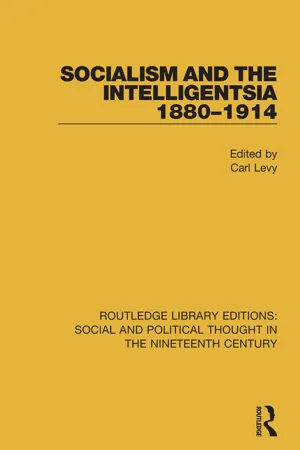
- 314 pages
- English
- ePUB (mobile friendly)
- Available on iOS & Android
eBook - ePub
Socialism and the Intelligentsia 1880-1914
1
Introduction: Historical and Theoretical Themes
Carl Levy
The expansion of the European middle classes of the late nineteenth and early twentieth centuries, together with their political significance, have recently been increasingly studied by social historians. Much of this, however, has been concerned with the propertied middle classes.1 At the same time students of contemporary social structures have devoted increasing attention to the role of the highly educated but unpropertied strata, East and West.2 Within the literature and its debate the relations between the educated middle classes and the origins and development of modern socialist organisations during the era of the Second International (circa 1880-1914) have been frequently commented upon, and occasionally examined in more detail in particular periods and contexts. There has never been a study examining the role of the educated middle classes generally' during this formative period for major modern socialist organisations and movements. While socialist intellectuals of the period have been widely studied, this has largely been in biographical treatments or as the l'rincipals in doctrinal disputes and institutional histories. A study of the appeals of socialism for the educated middle and lower middle classes has been lacking.
The essays in this volume address this theme. They originate from a seminar held at the Open University's London centre in November 1982, but in their final version they have been greatly revised and supplemented by entirely new contributions.
In this introductory essay I shall set the problem in its historical context. This will be followed by a discussion of the theoretical questions the contributors raise. In my conclusion I will discuss the particular problems raised by the Russian case.
A New Project
The history of an idea seems an appropriate place to commence. Using points raised in Wolfgang Mommsen's and Royden Harrison's contributions to this volume, we might start by a comparison of the Webbs and Weber.
Both shared strikingly similar intellectual preoccupations, firstly in their elitest sociologies, and secondly in their hankering after social imperialist solutions to the 'social' question. Increasingly they considered state intervention in the economy and social life as a way to regulate industrial disputes and eradicate urban or rural pauperism. Stephen Yeo, in his contribution, quite rightly quotes Stefan Collini's contention that in Britain, amongst the highly educated public before 1914, the ideological fault-line was individu alism vs collectivism as socialism rather than capitalism vs socialism. 3 However, I would argue that particular idioms influenced different national educated middle classes, and each nation's civil society set limits to, or opened opportunities for collectivist or reformist liberal intellectuals' participation in popular socialist or labour movements, in contrast to their reformers from above.
It is certainly the case that the Webbs always felt less distant from the British labour movement than Weber did from the German Social Democratic Party (SPD). The Fabians shared marginalist economics and an explicit quest to justify economically the higher salaries of the educated with the Verein fur Sozialpolitik. But because of local conditions the Fabians succeeded in affecting both Independent Labour Party (ILP) political propaganda and the political education of trade-union officials, whilst the Verein were more or less excluded from SPD politics, although they evinced sympathy for reforms not very different from those which the SPD proposed.4
The remainder of this essay will place Collini's field of force within a broader European context. In the first half I shall highlight the various differences within states which heightened or lessened the importance of educated middle-class socialists. Throughout this introduction I shall also raise the distinct problems of the self-made party bureaucrat and lower middle-class white-collar worker within party structures. However, first I turn to the external pressures which shaped socialist parties' relationships to the broader middle-class electorate.
Suffrage
One of the most important yardsticks for measuring educated middle-class participation in socialist movements was the constraints of suffrage.5 Almost from their debut on the national scene socialist parties were pitching their propaganda at middle-class voters. Until about 1910-1914 the effects of plural voting, rigging and literacy requirements restricted suffrage significantly. In Britain and France residential requirements disenfranchised many workers. In Germany the three-class Prussian voting system weakened Bismarckian male suffrage, and in any case the Reichstag's power was limited by the Junker bureaucracy, the military and the Kaiser himself. In most cases women were excluded from electoral participation on the national level. Because none of these parties, with the exception of the SPD, acquired a mass membership for a considerable period before 1914, the Italian, French and British, to cite important examples, sought votes from non-party members. Such constituencies might include smallholders, independent artisans, white-collar public sector workers and the professionals.
Following upon the inherent logic of these tactics, socialist 'election machines' frequently instituted formal or informal alliances with radical liberal groups or parties which possessed collectivist programmes and were usually populated by the educated middle classes. These alliances sought, rather optimistically on the whole, to fuse elements of what were seen as 'modernising productive bourgeoisies' with mass constituencies of industrial and rural proletariats through variations upon the theme of 'gas-and-water socialism'. These programmes promised the renovation of urban infrastructures and housing as well as the expansion and partial democratisation of educational opportunities. We certainly need to know a great deal more about these phenomena. A typology of European municipal socialism, a form of socialism when it was put into practice which affected the daily lives of ordinary people to a greater extent than parliamentary politics, remains to be devised.
My own admittedly preliminary survey suggests that both municipal and national approaches encountered enormous difficulties, and its intentions must, I believe, be weighed against actual implementation. In France, for example, the non-socialist Radicals were on the whole deeply suspicious of social programmes and far more comfortable with shared Radical/Socialist anti-clerical legislation. In Britain, the Liberals were divided, but even those collectivists were not above stealing Labour's thunder, and increasing tensions between the labourist and the socialist currents within its erstwhile partner's constituent organisations. On the whole, the SDP is a quite different matter. Except for southern alliances, national and Prussian attempts were unsuccessful. The National Liberals, and even the more radical anti-Junker Hansabund, were firmly attached to the anti-socialist coalition. Attempts at creating electoral pacts with the Progressives in 1912, for example, merely drove their supporters into the arms of this bloc. Only in Sweden and Denmark do effective socialist-liberal intelligentsia alliances appear before the World War. And it is interesting to note that in Norway, where suffrage had been granted by 1905, a polarisation of the working class and liberal intelligentsia was so much more evident. 6
To sum up, voting restrictions causing the uneven profile of the manual-worker socialist vote, and a low degree of party organisation in most of Europe, heightened the potential importance of the educated as electoral allies, but the outcomes are far from clearcut and we need more cross-national studies of political behaviour to determine their influence.
Intellectuals and Social Movements
If the external, electoral influence of the educated middle class was a complex, negotiated relationship, what of the undoubted importance of their representatives within party organisations and leadership? It seems to me that Stedman Jones's recent sketches for a possible history of the Labour Party might be incorporated into the project outlined in this book. Perhaps we should imagine party structures as contested terrains where various knowledges validate the power and status of members, but where no single discourse (even the much studied 'scientific socialism') is capable of direct translation into power. To paraphrase Stedman Jones, agendas arise from a 'vacant centre' where various 'groups possessing different and sometimes incompatible political languages of widely varying provenance' establish 'a changing balance of forces' which is informed by 'their discursive self-definition primarily from without'.7
These observations affect the way we examine the nature of socialist parties, particularly their class composition, an essential prerequisite in assessing the weight of the educated middle classes within them. Elsewhere I have written at length on the social class composition of socialism during the Second International. Here I will summarise my findings in order to introduce a broader discussion of how the educated middle classes influenced party organisation and ideology.
In my previous work I demonstrated that not only was the intervention of the educated white-collar or entrepreneurial middle classes determined by specific national factors (a point which I will expand on), but that socialism appealed to a wide variety of workers and peasants who were as affected by the peculiarities of local conditions as their middle-class comrades. Certainly all socialist parties' mass base derived from the manual working class. But this in itself says little. The variety was as interesting as the qualifying adjective manual. There was no essential link between the socialism of these parties and the factory proletariat.
First, there were skilled textile workers, printers, locksmiths and other artisans; including a smattering of pre-industrial political shoemakers. They were the respectable self-educated workers who carried with them an older craft-based radicalism. But they shaded into a new wave of machine operatives (turners, precision tool makers, engineers and engine drivers) who were attracted to the scientistic and technocratic socialisms synthesised by various educated scientific socialisms. (And I say socialisms advisably because revolutionary and anarcho-syndicalists in Italy or Spain were as attracted to the idiom as socialist engineers in Germany.)
But socialism could also appeal to certain working-class or rural communities where communitarian feelings outlived the collapse of older paternalist hierarchies. When industrial organisation or the cruel logic of the world capitalist marketplace disintegrated their older world, these peasants and workers could become rapidly radicalised. Thus, and this example is particularly significant for the numbers supplied to pre-war socialism, the landless labourers of the Po Valley; the peasants of the Var; or the proto-proletarians of the Urals, the worker-peasants, entered socialist politics. In all of these cases communitarian socialism rather than technocratic or scientific socialism was an important ideological ingredient.
On the other hand, 'well-suited' candidates for socialist or even labourist conversion from older loyalties were not always so forth-coming. In the Ruhr's mines and steel mills paternalism reigned until the arrival of immigrants around 1910; Lib-Lab miners federations represented Northumberland colliers until the courts threatened their very existence; and in France the 'yellow unions' had more members than the vastly overestimated syndicalists, and only the World War and the Popular Front government of the 1930s stimulated a shift away from this powerful and little studied paternalism.
To sum up our argument so far: working and lower-class attraction to socialism was varied, inconsistent and unpredictable. Equally, when we turn to the educated middle classes, socialism was embraced for a variety of reasons. Romantic and communitarian impulses are discernible amongst artists and literati. However, scientific or technocratic arguments increasingly gained more attention in the late nineteenth century. This can be demonstrated by focussing on the 1880s, a crucial decade in which the ideology of the Second International is first formulated. Indeed, this ideology precedes the actual formal organisation of many modern socialist parties.
Older types of popular radicalism are criticised and overturned by self-defined 'scientific socialists'. This is not merely a shift associated with 'Marxism after Marx', rather Marxism is the most elegant and intellectually engaging version of a wider discursive practice. Thus Marxist vulgarisations by Engels or Kautsky, the Fabian anti-Marxist Essays, and works by various French and Italian positivist professors all proclaim the birth of scientific socialism. These works all praise modernity, particularly the modernity of science, the scientist, the professional, but also that other symbol of the new era: the industrial proletariat of the first gigantic modern factories. In all of these texts 'the people' is replaced by the proletariat. For scientific socialists the urban, propertyless, factory operator, especially skilled male engineers, possessed the skill, muscle and discipline to transform the capitalist system into a s...
Table of contents
- Cover
- Half Title
- Title
- Copyright
- Dedication1
- Original Title
- Original Copyright
- Dedication2
- Contents
- Acknowledgments
- 1 Introduction: historical and theoretical themes
- 2 Sidney and Beatrice Webb
- 3 Max Weber and German Social Democracy
- 4 Reformism and the 'bourgeoisification' of the labour movement
- 5 Education and self-education: staffing the early ILP
- 6 Socialism and the educated working class
- 7 Notes on three socialisms - collectivism, statism and associationism - mainly in late-nineteenth- and early-twentieth-century Britain
- 8 Conclusion: Historiography and the new class
- Index
Trusted by 375,005 students
Access to over 1.5 million titles for a fair monthly price.
Study more efficiently using our study tools.
Frequently asked questions
Yes, you can cancel anytime from the Subscription tab in your account settings on the Perlego website. Your subscription will stay active until the end of your current billing period. Learn how to cancel your subscription
No, books cannot be downloaded as external files, such as PDFs, for use outside of Perlego. However, you can download books within the Perlego app for offline reading on mobile or tablet. Learn how to download books offline
Perlego offers two plans: Essential and Complete
- Essential is ideal for learners and professionals who enjoy exploring a wide range of subjects. Access the Essential Library with 800,000+ trusted titles and best-sellers across business, personal growth, and the humanities. Includes unlimited reading time and Standard Read Aloud voice.
- Complete: Perfect for advanced learners and researchers needing full, unrestricted access. Unlock 1.5M+ books across hundreds of subjects, including academic and specialized titles. The Complete Plan also includes advanced features like Premium Read Aloud and Research Assistant.
We are an online textbook subscription service, where you can get access to an entire online library for less than the price of a single book per month. With over 1.5 million books across 990+ topics, we’ve got you covered! Learn about our mission
Look out for the read-aloud symbol on your next book to see if you can listen to it. The read-aloud tool reads text aloud for you, highlighting the text as it is being read. You can pause it, speed it up and slow it down. Learn more about Read Aloud
Yes! You can use the Perlego app on both iOS and Android devices to read anytime, anywhere — even offline. Perfect for commutes or when you’re on the go.
Please note we cannot support devices running on iOS 13 and Android 7 or earlier. Learn more about using the app
Please note we cannot support devices running on iOS 13 and Android 7 or earlier. Learn more about using the app
Yes, you can access Socialism and the Intelligentsia 1880-1914 by Carl Levy in PDF and/or ePUB format, as well as other popular books in History & 19th Century History. We have over 1.5 million books available in our catalogue for you to explore.