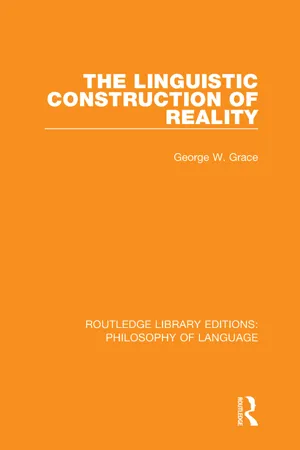
This book, originally published in 1987, considers how the science of linguistics creates its own objects of study. It argues that language is the one essential tool in the 'social construction of reality' – the way in which our environment as we perceive and respond to it is actually created by the cultural constructs we bring to bear on it – and that it is also the means by which this reality, once constructed, is preserved and transmitted from person to person and from generation to generation. Hence it is entirely appropriate to refer to the linguistic construction of reality.
- 156 pages
- English
- ePUB (mobile friendly)
- Available on iOS & Android
eBook - ePub
The Linguistic Construction of Reality
About this book
Information
Part I
Views of Language
1
The Mapping and Reality-construction Views of Language
It has been said that sciences create their own objects of study. There is an important sense in which that is true, and in this book we will be considering how it is true specifically of the science of language — linguistics. But this creation of their objects by the sciences is only one aspect of the more general phenomenon which has been referred to as ‘the social construction of reality’.1 Those who speak of our reality as socially constructed are emphasizing the part played by cultural constructs in our effective environment — our environment as we perceive it and respond to it (as contrasted with the part played by the actual characteristics of the external environment itself). The point is that the effective environment of human beings is more cultural than natural.
The human species — and no other — possesses the one essential tool which makes a social construction of reality possible. That tool is language. Not only is language the means by which this kind of reality construction is accomplished, it is also the means by which the realities, once constructed, are preserved and transmitted from person to person and from generation to generation. Hence, it is entirely appropriate to refer more specifically to the linguistic construction of reality.
The point here is that any group of humans discussing any subject matter quickly arrives at a way of looking at — and talking about — that subject matter which very much influences everything they subsequently do or say about it. Both the isolation of particular objects of investigation as objects and the characteristics which are attributed to them once they are isolated are aspects of this creation of objects, of this ‘reality construction’. Both the definition of the subject matter in the first place and the way in which it is viewed (what it is perceived as being like) once it has been defined are products of reality construction.
It would seem apparent that since our reality construction — the creation of our views of things — is carried out by means of language, our best prospect for understanding how reality construction is accomplished must be through studying how language works.
Unfortunately, at this point we encounter an obstacle; our acknowledged science of language, i.e. linguistics, is committed to a view of language which makes it very difficult to study this aspect of the way in which language works. In fact, not only does this accepted view of language make it difficult to design and carry out research on the reality-constructing function of language, it makes it difficult even to acknowledge that such reality construction occurs at all.
This brings us to a key point. It is particularly important to keep constantly in mind that our customary way of viewing language is itself the product of such reality construction. That is, our society has a particular perspective on language, a particular way of looking at it and talking about it. This view of language is represented quite clearly in linguistics, the acknowledged ‘science of language’, but our society at large seems to hold essentially the same view. Because this view so permeates our institutions, it is important to emphasize that there is nothing necessary about it — that there is nothing in the nature of language itself which compels us to this view of it. To give a name to this view of language, let us call it the mapping view. The reasons for this choice of name will become clear later.
The title of this book, The Linguistic Construction of Reality, implies a quite different view of language, a quite different conception of what kind of thing language is and of how it works. The book will be devoted to developing that view, which may appropriately be called the reality construction view.
I will try to show that the differences between the mapping and the reality-construction views of language are fundamental ones with far-reaching implications. In fact, it is difficult to imagine any conception of the nature of language, unless it is so shallow as not to be worthy of the name, which does not have far-reaching implications. It is difficult, in short, to imagine a view of language which does not carry with it epistemological assumptions — assumptions about the nature of the world, or at least of our access to knowledge of the world.
Although the mapping view (in one form or another) seems clearly to be the standard view of language today, the reader should not get the impression that the reality-construction view is something which was just made up for the purpose of this book and which is without historical antecedents. On the contrary, its roots go back a very long way, and there are numerous important historical figures who could reasonably be reckoned as having contributed to its development.2 Names which might be mentioned include Etienne Bonnet de Condillac (who said that every science is a well-made language), Destutt de Tracy and the idéologues, Wilhelm von Humboldt, and most recently Benjamin Lee Whorf (although even a very superficial historical review would yield many other names).
How fundamentally incompatible the two views are was illustrated by the revival of the reality-construction view through the reprinting of some of the writings of Whorf in 1950 and 1956.3 There was simply no way for them to be discussed from the standpoint of standard linguistic theory.
(The ultimate disposition of Whorf’ s ideas was approximately as follows. Within a short time, linguistics seemed to settle upon a common position with regard to Whorf’ s writings, a position which was widely accepted beyond the confines of the linguistic profession as well. The crux of that position is that what Whorf was actually proposing was some kind of hypothesis about a relation between language and perception (or world view, or thought, or culture), but that he had given no clear formulation of this supposed hypothesis and that no one else has ever been able to do so either. That is, no one else has been able to figure out how to formulate it so that it can be tested. As a consequence, it is in terms of hypothesis formulation and testing that Whorfianism is now conventionally discussed. Thus, the unofficial position of the profession is essentially that Whorf had some challenging ideas, but that there is no way to subject them to a scientific test, and that, therefore, unless some unforeseeable breakthrough occurs, there is nothing further which can be done with them.)
Two Views of Language
The principal differences between the mapping and reality-construction views of language all seem to be traceable to different conceptions of the way in which languages represent reality —different conceptions of the relation between a language and external reality. Thus, it may be said that the basic differences between the two views are attributable to the different epistemological assumptions underlying them.
The basic epistemological assumption of the mapping view might be stated as follows: there is a common world out there and our languages are analogous to maps of this world. Thus, this common world is represented or ‘mapped’ (with greater or less distortion) by all languages.4 Advocates of the mapping view acknowledge that each language provides a somewhat different mapping. However, the differences are assumed to be due at least in part to the fact that, since our access to knowledge of this world is imperfect, different peoples (speaking different languages) have arrived at slightly different understandings of it. The differences in details from the mapping of one language to that of another may be thought of as differences in the way they ‘divide the common world up’ — in the way they ‘classify’ its phenomena.
In the reality-construction view, the imperfectness of our access to knowledge of the real world assumes central importance. Emphasis is placed upon the fact that we do not have direct access to the real world itself, but only to the data about it provided by our senses. And these senses provide very incomplete information. Our eyes, for example, respond only to a very narrow band of wavelengths within the electromagnetic spectrum, our ears only to a certain limited range of vibratory frequencies in the air or some other medium, etc.
Thus, in the reality-construction view, our sensory data are regarded as falling seriously short of constituting an adequate picture of the real world. They are considered to be very incomplete and unsystematic, are seen as not adding up to anything like a representative sample of what is out there. On the contrary, all we can do (according to this view) is invent explanations for the sensory data which are attempts to make sense of the whole of the sensory input. To put it differently, all we can do is to theorize about reality, or to put it more precisely still, to construct models of it. These models are our constructed realities, and they are reflected in the languages we speak.
Of course, these constructed realities are not assumed to be fabricated out of the whole cloth. The real world imposes some constraints. The experiences of people in different cultures are not assumed to be totally random with respect to one another.
However, once this concession has been made, it might seem that there is really no significant difference between the mapping view and the reality-construction view. In the mapping view, although what languages are regarded as ultimately representing is a real world — an objective reality the existence of which is independent of any observers — it is nevertheless acknowledged that different languages do have a great deal of latitude as to how they divide up and interpret that world. And in the reality-construction view, although the representations provided by our languages are regarded as nothing more than models which serve as surrogates for the real world, it is nevertheless acknowledged that these models are constrained by the nature of the real world as we encounter it. It might seem, therefore, that there is no disagreement about the facts and that the only difference is a difference of emphasis.
However, in reality, differences of emphasis can be most important — fully as important as differences of empirical fact and even much more so. What is really important is what questions are effectively askable by those who take a particular view as their point of departure. The important differences between basic views of language (or of any other subject matter) are in what is regarded as problematic and what is taken for granted. The most basic assumptions of any such view are, in effect, incorrigible (i.e. not subject to correction in the light of subsequent experience). The reason for this is that there is no natural way in which they could be disconfirmed since the question of their truthfulness could not naturally arise within the framework in question.
The Mapping View
But there is one key assumption, in particular, which may be thought of as containing in a nutshell the essence of the entire mapping view of language. That is the assumption that ‘anything can be said in any language’ — that is, that any content that can be expressed in one language can be expressed in any other language. We may refer to this assumption as the intertranslatability postulate.5 It is easy to see how this postulate arises out of the mapping view’s assumption that all languages are mappings of a common world, and that anything that can be said in any language ultimately refers back to this common world. Given this assumption, all languages and all things that can be said in any of them must be commensurable because this universally-shared world is their common measure.
The intertranslatability postulate has important implications for the nature of language and of individual languages. It implies, for example, that each language is an empty code — a code which is entirely uncommitted as to content and for which any conceivable subject matter constitutes potential content. Each language is thus by its nature a universal encoder.
The mapping view seems to lead inevitably to a quite surprising conclusion — the conclusion that languages, or at any rate their individual features, are irrelevant to anything except other features of the same languages. It seems surprising, to say the least, that the science of language should willingly have embraced a view which so belittles the role of language in human life. This seeming antipathy of the profession to its own best interests traces back, I believe, to its deep commitment to establishing and maintaining its autonomy.
In its pursuit of autonomy, linguistics (through its spokesmen) has insisted upon the independence of language from everything else. In pursuing this strategy it has willingly embraced the assumption that the features of a particular language — those features of which a linguistic description is constituted — are non-adaptive with respect to everything in the extra-linguistic environment. That is (except for vocabulary, which (nota bene) is not regarded as a central part of the language system), it is assumed that no feature of any language is better adapted to any aspect of the extra-linguistic environment than would be any different feature which might have occurred in its place.
Because of this presumed non-adaptiveness, linguistics can analyze the synchronic structure of a language without considering anything extra-linguistic — without considering anything beyond the kinds of features which figure in linguistic descriptions. Likewise, they can comfortably pursue the study of linguistic change without regard to anything except the languages themselves (as these languages are represented by their linguistic descriptions). The linguistic features of a language, then — those features which are reported in linguistic descriptions — must be non-adaptive. And non-adaptive means irrelevant as far as any considerations beyond those which are regarded as linguistic in the strict sense are concerned. Linguistics, in other words, has become committed to the irrelevance of what it studies (except for whatever universal principles emerge from these studies) to anything external to language, and reciprocally, to the irrelevance of anything external to language to what linguistics studies.
But this ‘mapping’ view of language has further ramifications. The intertranslatability postulate and the assumption that languages are universal encoders lead naturally to several further assumptions about the nature of language. I will describe some of them.
First of all, unless, we want to deny that different cultures exhibit differences in their concepts, beliefs, and values, we must conclude that cultures (since they exhibit such differences) are sharply distinguished from their associated languages (since in the universal-encoder view, languages cannot be subject to any differences of that kind).
Thus we are led to the assumption that a language and its accompanying culture are quite separate and distinct entities.6
Secondly, to say that all languages can represent exactly the same range of content seems to be just another way of saying that all languages can express the same range of thoughts. Once that is assumed to be true, then it seems to follow that the basic processes of thought are clearly separated from language (or at the very least from those characteristics of languages which are not universal but which can differ from one language to another).
Thus we are led to the assumption that the basic processes of thought are quite independent of our languages.
Thirdly, it seems to follow almost nec...
Table of contents
- Cover
- Half Title
- Title Page
- Copyright Page
- Original Title Page
- Original Copyright Page
- Table of Contents
- Part I: Views of Language
- Part II: Saying Things: Conceptual Events
- Part III: Conceptual Worlds
- Part IV: Further Implications
- Concluding Remarks
- References Cited
- Index
Trusted by 375,005 students
Access to over 1.5 million titles for a fair monthly price.
Study more efficiently using our study tools.
Frequently asked questions
Yes, you can cancel anytime from the Subscription tab in your account settings on the Perlego website. Your subscription will stay active until the end of your current billing period. Learn how to cancel your subscription
No, books cannot be downloaded as external files, such as PDFs, for use outside of Perlego. However, you can download books within the Perlego app for offline reading on mobile or tablet. Learn how to download books offline
Perlego offers two plans: Essential and Complete
- Essential is ideal for learners and professionals who enjoy exploring a wide range of subjects. Access the Essential Library with 800,000+ trusted titles and best-sellers across business, personal growth, and the humanities. Includes unlimited reading time and Standard Read Aloud voice.
- Complete: Perfect for advanced learners and researchers needing full, unrestricted access. Unlock 1.5M+ books across hundreds of subjects, including academic and specialized titles. The Complete Plan also includes advanced features like Premium Read Aloud and Research Assistant.
We are an online textbook subscription service, where you can get access to an entire online library for less than the price of a single book per month. With over 1.5 million books across 990+ topics, we’ve got you covered! Learn about our mission
Look out for the read-aloud symbol on your next book to see if you can listen to it. The read-aloud tool reads text aloud for you, highlighting the text as it is being read. You can pause it, speed it up and slow it down. Learn more about Read Aloud
Yes! You can use the Perlego app on both iOS and Android devices to read anytime, anywhere — even offline. Perfect for commutes or when you’re on the go.
Please note we cannot support devices running on iOS 13 and Android 7 or earlier. Learn more about using the app
Please note we cannot support devices running on iOS 13 and Android 7 or earlier. Learn more about using the app
Yes, you can access The Linguistic Construction of Reality by Gerald W. Grace,George W. Grace in PDF and/or ePUB format, as well as other popular books in Filosofía & Lenguaje en filosofía. We have over 1.5 million books available in our catalogue for you to explore.