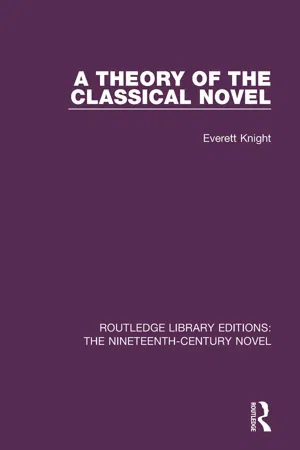
First published in 1969, this book asserts that two concepts, structure and praxis, make it impractical for scholars to ignore the necessity of a theory of the novel — with the term 'classical novel' used to cover western fiction. The author argues that the novel is fundamentally an 'enterprise' — an aspect of the praxis of a particular social class — and that the ways of orthodox scholarship are also a praxis. The investigator must enquire into the nature of their questions as those traditionally put to literature are inspired by 'irrelevant' nineteenth century positivism. In the author's view the book is necessarily a theory of the classical novel and a manifesto for the student movement.
- 162 pages
- English
- ePUB (mobile friendly)
- Available on iOS & Android
eBook - ePub
A Theory of the Classical Novel
About this book
Information
1 Some preliminary notions
DOI: 10.4324/9781315617237-1
I’m sure there are many reasons why we study these things but I missed it due to absence. I brought a note.Up the Down Staircase
If student agitation persists, and if it manages to organize itself, we may witness the birth of a new ‘social class’—the world’s youth—a ‘class’ with every right to be concerned about what is being done on the planet it is going to have to inhabit.
The university campus, like the nineteenth-century mill village, is the only considerable community in our part of the world which has not yet been scattered. Here people can be quickly called together to discuss, decide and, on occasion, show violence. But while we can understand perfectly how workers during the last century were driven to rioting and revolution, we may be puzzled by the students’ unhappiness since they are, in the main, from the material point of view, highly privileged.
The answer, in part, is that the student is informed—informed of the incredible barbarisms for which his culture has made itself responsible since the turn of the century. He knows that the present-day working class is to be found in the underdeveloped countries where it is still starving, and he knows further that the hunger of two-thirds of the world’s population is not an act of God, but of men; that it is directly related to the way in which our western science, economy and military machine are made to function. In these circumstances student violence (like that of the American Negroes) is counter-violence, far more legitimate than the hidden, hypocritical violence of racism and of the ‘impersonal’ operation of ‘economic law’.
Of course the nineteenth-century student must have had a fair idea of what conditions were in the factory towns, and if he did not demonstrate against them it was largely because there were so many ‘higher things’ to fix one’s mind upon—the moral law, the iron necessities of a positivistic universe, aestheticism, and so on. But the higher things have all vanished, and where the university teacher tries to interest his students in them he will—or should—meet with mistrust, resentment, boredom.
Until recently the worker was a wage-earner who did not receive a wage sufficient to feed and clothe himself, and his interest in socialism and revolution derived from this immediate daily concern. Such is the case also with the student except that the ‘wage’ he has a right to expect takes the form not of money but of the means of making sense of the world he lives in.1 However, in exchange for his labour the student is offered on the one hand a mess of facts (either meaningless or confirming what he already knows), on the other, access to the realms of appreciation in a world seething with revolution or sunk in a misery which—since we know now how to abolish it—immemorial religions can no longer satisfactorily explain.
Not only is the student not told how he might make sense of the world and hence of his own life, it is a matter of principle that this should not be done. He is, instead, left free to consider and to judge systems or ideas which have been ‘impartially’ set before him. The student is given the means, and is encouraged to find out for himself; no one will attempt to push him where he might not want to go. He is free. The opportunity is there if he wishes to take it. What could be more fair?
This is what befuddles the student. He is made to feel like a child rebelling against a kind parent, until one day he is sent to some Vietnam to rain napalm upon people engaged in one of history’s great revolutionary ventures. He may then, given the necessary courage, begin to see that he had been closed up within a specific political and economic system, that talk of ‘pluralism’ and of the ‘end of ideology’ has been a monstrous mystification of which not only the newspapers, but the universities have been guilty. The ‘free choice’ he had been invited to make on the basis of information ‘objectively’ submitted to him by his teachers emerges as an aspect of the way in which his particular society functions. The real choice had already long since been made for him. Let me explain what I mean by the ‘real choice’.
A South African government official being interviewed about the nature of the regime he represented tried to make his position clearer by holding up a board which had been divided equally into two parts, one black, one white. The official explained that what they wanted was a society in which neither the black nor the white square would be on top, but one in which they would be on the same level, side by side. Where are we to look for the ‘real choice’ of the people who support the present South African government; in the words of this official or in the lives of the black part of the population (which should have been symbolized by a square far larger than the white one)? There can be no doubt about the answer; but then it follows that the real choice of any westerner who is informed but who, unlike some students, does not demonstrate, is to be sought in the eyes of the world’s starving. Students learn that western democracy abhors totalitarianism whether Fascist or Communist; but then if they are in the least attentive to events they know that no regime can be too cynically Fascist to sacrifice western support, while talk of land reform or nationalization is a threat to the ‘free world’. Where is the real choice; in the immaculate intentions of our western spokesmen, or in their governments’ recognition of the Greek democracy recently instituted by a group of moronic colonels?
It is this gulf which has existed in our culture since 1789 between our protestations of liberty, equality and fraternity on the one hand and what we allow to happen on the other which makes it impossible for the student or anyone else to make sense of our world. And yet if the student has an inalienable right, comparable to the workman’s right to a living wage, it is that his teachers be prepared to explain why there is talk of humanism but a practice of racism, talk of the wonders and beauties of Nature along with a systematic defilement of it, talk of sexual freedom and a practice of guilt and frustration, talk of human dignity while the vast majority of the population is condemned to eight hours a day of meaningless wasteful labour….
The inability of our society to accord what it actually does with its noble talk2 has not (with the exception of Marx and, today, of Sartre) given much concern to philosophers and intellectuals who have in general devoted themselves to the pursuit of one or another of the higher things, leaving the messier questions to novelists.
It is in the novel3 that our culture has most consistently and profoundly examined itself: why then should we not use it in somewhat the way a psychoanalyst uses the talk of a patient, to get at what I have been calling the real choice, a choice to which the patient may cling even though it is keeping him from making any sense of his life, even though it could lead him to suicide?
It is important to mention some of the difficulties not of executing such a project, but merely of attempting to do so.
One may not be able to follow an argument for one of two radically different reasons. First, because what is being discussed is beyond one’s competence: present-day atomic physics, for example, cannot be really grasped without long and arduous preparation. The second difficulty is one which arises rarely, only at times (like our own) of profound cultural reorientation, and it consists in not seeing the relevance of the ideas being presented. Thus Galileo’s physics were not difficult in the first, but in the second sense of the word, for the schoolmen of the time. They simply could not see the interest or importance of what Galileo was doing. It is like trying to pronounce the sounds of a foreign tongue; they are not difficult ‘in themselves’, but only because our mouths have through long practice become so formed that only our own vowel system comes ‘naturally’. The difficulty is not so much acquiring the new as getting rid of the old.
What the scholastics must have found disconcerting was the fact that the early scientists were not proposing a new body of truths, but, essentially, a method for arriving at the truth. That the earth should revolve around the sun rather than the reverse, was less important in itself than for what it was hoped this discovery would lead to, and the work of Newton seemed to confirm once and for all the validity of this startling notion of a truth arrived at only progressively.
If progress were to be uninterrupted then men would have to accept the discipline of remaining uncommitted to any conclusion not scientifically verified. Such has been the ‘morality’ of the western intellectuals to the present day: a kind of ‘waiting’ associated with an objective, dispassionate gathering of information (the facts) insignificant and meaningless at the moment perhaps, but destined to be needed for the great Tabulation, the reward of centuries of patient waiting. In his Discours de la Méthode, Descartes announced that he intended to abide by the laws and customs of his country until such time as science could pronounce definitively upon these matters. We are still waiting, but of course the ‘laws and customs’ have not waited. On the first page of J. K. Galbraith’s book The Great Crash—1929 there occurs this sentence: ‘It would be good to know if we shall someday have another 1929. However, the much less pretentious task of this book—the only task which social science in its present state allows—is to tell what happened in 1929.’ Who will be so pretentious as to decide when all the information is in? Such a moment cannot coincide with the discovery of a ‘natural law’, since we would then have to decide what action to take in respect to it, and this of course is incompatible with the notion of natural law. Would it be wise to wait, if not for the great Tabulation, then at least until we know more? But while we are waiting the nature of the problems will have changed, and quite apart from any will of ours. In brief, in the century of the Russian, Chinese, Cuban and Vietnamese revolutions, in a century which has demonstrated so conclusively that man’s fate is one he alone determines, we in the West are waiting for the scientific millennium, waiting for Godot.
We are at one of those exceptional moments in history during which long-standing mental attitudes produce a reality which, with another part of our being we are obliged to find absurd or horrifying. The schoolmen Rabelais made fun of must have known, however obscurely, that they were survivors, pathetically trying to cope with what we have come to call the Age of Discovery, pathetically mistaking one reality for another. In the same way, in our Age of Revolution it is possible for an ‘illustrious representative of logical positivism’ to maintain that: ‘A knowledge of chemistry is more important to a philosopher than a knowledge of history’.4 One need not be familiar with the development of contemporary thought from Hegel to Sartre to feel compassion for a ‘philosopher’ given to such remarks. But when one considers that we are dealing here less with a philosophy than with what I called a moment ago a ‘mental attitude’, compassion turns justifiably into something like hatred; for when a political scientist or sociologist goes to, say, Guatemala to research into conditions there, and when he notes objectively the existence of starving children, he treats his fellow creatures as the chemist dispassionately treats the substances he investigates in his laboratory; he becomes a cultural freak, not comic as were the schoolmen for Rabelais, but sinister. In chemistry one makes discoveries; but when the sociologists, after long investigation, announce that Negro rioting in America is caused by white racism, they discover what everyone already knows; so that what needs investigation is the investigators themselves. The Negroes, after long patience, are meeting violence with counter-violence. This requires no explanation, they are performing a task which has been forced not only upon them, but upon all of us; except, of course, in so far as we can persuade ourselves that impartial recording of the facts is all that ‘social science in its present state allows’. In short, what needs to be investigated, because it is irrational, is that ‘mental attitude’ which transforms a self-evident task, a summons, into the dead matter which is the domain of the physical sciences. Such conduct can be understood only if we assume that the logical positivist, the social scientist, the literary historian, the English-speaking intelligentsia almost in its entirety is waiting for the discovery of a Given in which, nevertheless, no one any longer believes! The ‘scientific waiting’ of the eighteenth century which was in part scepticism and tolerance, has become the calculated apathy of a privileged class.
It is difficult to see how anyone today could seriously reject the view that philosophy and the history of philosophy are one and the same thing; that philosophy in other words is not after an elusive Truth which, hopefully, it will one day attain. It follows then that philosophy is an aspect of those ‘mental attitudes’ which, as was said a moment ago, produce a reality which is nevertheless out there and can be profitably investigated (just as a literary masterpiece is the ‘product’ of a given mentality, yet susceptible to diverse interpretations, each valid as far as it goes). So that however dull and dangerous the reality produced by Anglo-Saxon positivism, it is there, and it is not always easy to adjust our vision to new possibilities. And yet although Galileo and Descartes were ‘irresponsible adventurers’ in the sense that their reality was not yet visible, there was no alternative. The scholastics did not essentially choose for sound reasons to ignore science, they ignored the times they lived in. It is the same with today’s intellectuals trying to deal with twentieth-century reality with nineteenth-century vision, one of the most important manifestations of which was the omniscience of the nineteenth-century novelist. We know that this omniscience (or the objectivity of the scholar, or the fixed point of view of the classical artist) does not capture Reality, it indistinguishably produces and reveals a specific reality, that characteristic of western culture during a certain stage of its evolution. Yet the knowledge that we are culturally and historically situated, that positivism is a metaphysic like any other, does not shake the conviction that we are ‘non-committed’; so that whether it is an American soldier fighting to enable the Vietnamese to ‘freely choose their own government’, or a scholar telling me this book is ‘personal and polemic’, we encounter this strange objective vantage point which is somehow not a particular point of view, but one from which all other conceivable points of view may be judged (a striking example of the ethnocentrism we find so amusing in primitive people).
It is true that this book is a personal one; the result of discovering that I was passing my life as a teacher with absolutely nothing to teach. I...
Table of contents
- Cover Page
- Half-Title Page
- Title Page
- Copyright Page
- Original Title Page
- Original Copyright Page
- Dedication
- Table of Contents
- 1 Some preliminary notions
- 2 Further preliminaries
- 3 The classical novel as an art form
- 4 Balzac, Flaubert, Zola, Stendhal
- 5 The case of Dickens
- 6 Conclusion
- Index
Trusted by 375,005 students
Access to over 1.5 million titles for a fair monthly price.
Study more efficiently using our study tools.
Frequently asked questions
Yes, you can cancel anytime from the Subscription tab in your account settings on the Perlego website. Your subscription will stay active until the end of your current billing period. Learn how to cancel your subscription
No, books cannot be downloaded as external files, such as PDFs, for use outside of Perlego. However, you can download books within the Perlego app for offline reading on mobile or tablet. Learn how to download books offline
Perlego offers two plans: Essential and Complete
- Essential is ideal for learners and professionals who enjoy exploring a wide range of subjects. Access the Essential Library with 800,000+ trusted titles and best-sellers across business, personal growth, and the humanities. Includes unlimited reading time and Standard Read Aloud voice.
- Complete: Perfect for advanced learners and researchers needing full, unrestricted access. Unlock 1.5M+ books across hundreds of subjects, including academic and specialized titles. The Complete Plan also includes advanced features like Premium Read Aloud and Research Assistant.
We are an online textbook subscription service, where you can get access to an entire online library for less than the price of a single book per month. With over 1.5 million books across 990+ topics, we’ve got you covered! Learn about our mission
Look out for the read-aloud symbol on your next book to see if you can listen to it. The read-aloud tool reads text aloud for you, highlighting the text as it is being read. You can pause it, speed it up and slow it down. Learn more about Read Aloud
Yes! You can use the Perlego app on both iOS and Android devices to read anytime, anywhere — even offline. Perfect for commutes or when you’re on the go.
Please note we cannot support devices running on iOS 13 and Android 7 or earlier. Learn more about using the app
Please note we cannot support devices running on iOS 13 and Android 7 or earlier. Learn more about using the app
Yes, you can access A Theory of the Classical Novel by Everett Knight in PDF and/or ePUB format, as well as other popular books in Literature & Literary Criticism. We have over 1.5 million books available in our catalogue for you to explore.