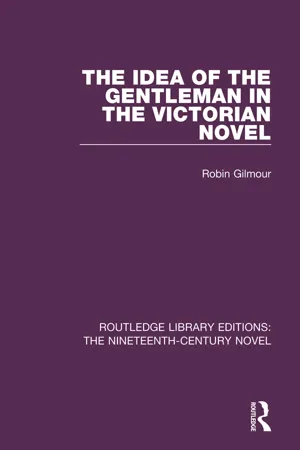
First published in 1981, this book represents the first comprehensive examination of Victorian society's preoccupation with the 'notion of the gentleman' and how this was reflected in the literature of the time. Starting with Addison and Lord Chesterfield, the author explores the influence of the gentlemanly ideal on the evolution of the English middle classes, and reveals its central part in the novels of Thackeray, Dickens and Trollope. Combining social and cultural analysis with literary criticism, this book provides new readings of Vanity Fair and Great Expectations, a fresh approach to Trollope, and a detailed account of the various streams that fed into the idea of the gentleman.
- 198 pages
- English
- ePUB (mobile friendly)
- Available on iOS & Android
eBook - ePub
The Idea of the Gentleman in the Victorian Novel
About this book
Information
CHAPTER 1The Legacy from the Eighteenth Century
DOI: 10.4324/9781315617268-4
For manners are not idle, but the fruitOf loyal nature, and of noble mind.(Tennyson, ‘Guinevere’, 1859)
Wherever it is spoken, there is no man that does not feel, and understand, and use the noble English word ‘gentleman’. And there is no man that teaches us to be gentlemen better than Joseph Addison.(Thackeray, ‘Charity and Humour’, 1852)
I
It is tempting to say that what the Victorians most disliked in the eighteenth-century attitude to manners is epitomised by Lord Chesterfield's Letters to his Son (1774). Certainly the Letters were fatal to Chesterfield's reputation, and probably fatal to the reputation of the aristocratic fine gentleman ideal which he exemplified and tried to impose upon his illegitimate son. Looking back on Chesterfield at the end of the nineteenth century, the Victorian critic John Churton Collins had no doubt that to most of his countrymen ‘his name is little more than a synonym for a profligate fribble, shallow, flippant, heartless, without morality, without seriousness, a scoffer at religion… Even among those who do not judge as the crowd judges there exists a stronger prejudice against Chesterfield than exists with equal reason against any other Englishman.’1 Collins did his best to dispel the prejudice, but it is easy to see how it came about. The following comments from the Letters indicate what it was that stuck in the throat of posterity:
When you go into good company (by good company is meant the people of the first fashion of the place) observe carefully their turn, their manners, their address, and conform your own to them. But this is not all, neither; go deeper still; observe their characters, and pry, as far as you can, into both their hearts and their heads. Seek for their particular merit, their predominant passion, or their prevailing weakness; and you will then know what to bait your hook with to catch them. (5 September 1748)
The height of abilities is, to have volto sciolto and pensieri stretti; that is, a frank, open, and ingenuous exterior, with a prudent and reserved interior; to be upon your own guard, and yet, by a seeming natural openness, to put people off theirs…A prudent reserve is therefore as necessary as a seeming openness is prudent. (19 October 1748)
I recommended to you in my last an innocent piece of art — that of flattering people behind their backs, in presence of those who, to make their own court, much more than for your sake, will not fail to repeat, and even amplify, the praise to the party concerned. This is, of all flattery, the most pleasing, and consequently the most effectual. (22 May 1749)
Every man is to be had one way or another, and every woman almost any way. (5 June 1750)
These examples, and many more could be chosen, show Chesterfield at his very worst: the low opinion of human nature, the cynical attitude to women, the cold, calculating approach to human relations — this is Chaucer's ‘smylere with the knyf under the cloke’. Dr Johnson's famous epigram about the Letters teaching the morals of a whore and the manners of a dancing-master catches the violence of the divorce between manners and morals in Chesterfield, as well as the shallowness with which he conceived of both. Less well known but if anything more pungent is Keats's comment in a letter of 1820: ‘I would not bathe in the same River with lord C. though I had the upper hand of the stream. I am grieved that in writing and speaking it is necessary to make use of the same particles as he did.’2 For Keats, and for the middle-class writers who came after him, Chesterfield's ‘fine gentleman’ was not fine or gentleman enough. In the contrast between the high polish of the ‘modes’ of civility and the low estimate of human nature which these concealed, they saw the cynicism of aristocracy and the heartless materialism of the previous century — both repugnant to people who had been touched by the twin influences of Evangelicalism and Romanticism, with their stress on the serious, the natural and the sincere. Dickens created a version of Lord Chesterfield in the character of Sir John Chester in Barnaby Rudge (1841), who is described as ‘of the world most worldly, who never compromised himself by an ungentlemanly action, and never was guilty of a manly one’ (ch. 25).
Between what Dickens understood by ‘manly’ and what Lord Chesterfield would have accepted as ‘gentlemanly’ an important change in attitudes has taken place. ‘Manliness’ is a key Victorian concept, as we shall see, and it connotes a new openness and directness, a new sincerity, in social relations. By the standards of manliness, Lord Chesterfield appears secretive, hypocritical, cold — and also comic. If his insidious cynicism could not be altogether laughed away, then his finicking regard for ‘the Graces’ could. The man who could write that ‘there is nothing so illiberal, and so ill-bred, as audible laughter’ because of ‘the disagreeable noise that it makes, and the shocking distortion of the face that it occasions’ (9 March 1748) was especially ridiculous to Dickens and Carlyle, who had encountered the same thing in the Regency dandies and responded to it with the cult of the hearty laugh, an essential feature of manliness. The criterion of sincerity, however, was a more tricky one to apply to Chesterfield, for as Churton Collins pointed out, he was nothing if not sincere; indeed the really unsettling - and interesting - aspect of the Letters is the contrast between the superficiality of the ‘modes’ and the earnestness with which they are recommended. They are unsettling because, uniquely in courtesy-book literature, they were not written to be published and therefore take us behind the scenes (the theatrical metaphor is appropriate) of aristocratic politeness in a way that the conventional manual of parental advice does not. In doing so they reveal something of the uncertainty at the heart of Augustan polite manners, and perhaps of all highly developed codes of manners.
Chesterfield was not, of course, the hypocritical villain that nineteenth-century mythology made him out to be, nor does a careful reading of his letters quite confirm the popular image. He was an aristocrat, a courtier, an admirer of French moeurs, and his letters to his son have a specific purpose: to educate him for a career in European diplomacy. Moreover, there is a good deal of sensible advice mixed up with all the fussing about ‘the Graces’. The son is advised to use his time well, form regular habits, avoid dissipation, learn French, German and Italian, study modern history, pay attention to business. The Victorians were wrong to see Chesterfield as a fop and a snob. He had no pride in his birth as such, and he worked hard, ludicrously so, at the ‘art of pleasing’. And if there is something comic in the spectacle of the Augustan ‘great man’ labouring away obsessively at the minor graces, there is also a certain pathos arising from our knowledge in reading them of the disappointment that lay in store for Chesterfield, when despite all the polishing the cherished son failed to shine. This makes for a disquieting directness of relation with Chesterfield and puts his Letters into a different category from the usual manual of parental advice got up for the market, like Dr John Gregory's popular and pietistic Legacy to his Daughters (1774). The Letters may advise ‘dissimulation’, the baited hook behind the ‘pleasing address’, but they are appallingly frank about recommending it. The message is the importance of not being earnest, but it is preached with insistent earnestness.
Chesterfield's real offence was twofold. He gave a handle to those who believe that manners are necessarily a system of insincerities, who share Mark Twain's view that ‘good breeding consists in concealing how much we think of ourselves and how little we think of other persons’. The violence of the reaction against the Letters can be seen as in part a subconscious attempt to deafen such suspicions. And secondly, he may be said to have given the game away about the Augustan ‘art of pleasing’. The disproportion between the triviality of the recommended modes and the seriousness of their recommendation reveals the enormous importance of sociability in eighteenth-century society. Urbanity, politeness, a‘pleasing address’, were not vague social ideals; in a society run on the system of patronage they were the means by which influential ‘friends’ were attached and their ‘interest’ secured. Chesterfield's Letters revealed how manipulative the atttitude to social behaviour might be, how weak the links between manners and morals or between manners and sincerity, in a society which made dissimulation in some form necessary to self-advancement. ‘Chesterfield caught the ambivalence within Georgian polite education’, Sheldon Rothblatt writes: ‘His own greatest vice was to reveal unequivocably how easily civilised behaviour could be reduced to the lowest common denominator. The public that read his posthumous writings neither applauded his candour nor forgave him for disclosing a cultural secret.’3
Dissimulation was the serpent among the flowers of polite manners. In calling Chesterfield a hypocrite it is as well to remember the derivation of the term from the Greek word for actor and the extent to which, in eighteenth-century fashionable life, all the world really was a stage. ‘My anxiety for your success increases in proportion as the time approaches of your taking your part upon the great stage of the world’, he wrote to his son on 29 October 1748. ‘The audience will form their opinion of you upon your first appearance … and so far it will be final, that, though it may vary as to the degrees, it will never totally change.’ He was in effect training an actor, and here too the Letters raised one of the unspoken dilemmas of polite society. To quote Professor Rothblatt again: ‘The Georgians realized that in order for their educational theory to succeed they must all be actors. They also realized that acting was a corruption of the values they wanted to profess.’4 The high premium put upon manners as social performance meant that a successful but dishonest performance was always in danger of being mistaken for the real thing. No one was more aware of this problem than Jane Austen. All her villains are in this sense actors, young men of ‘pleasing address’ and masters of what Chesterfield called ‘those lesser talents, of an engaging, insinuating manner, an easy good breeding, a genteel behaviour and address’ (6 March 1747). Willoughby, Wickham, Henry Crawford, Frank Churchill – her novels progress towards an increasingly subtle registration of the ways in which plausible manners can mask moral realities, until in Emma (1816) the whole novel turns upon a sustained act of dissimulation by the ironically named Frank. It is interesting, too, that amateur theatricals should play such an important part in Mansfield Park (1813), her most ambitious exploration of late eighteenth-century landed society and the modern challenge to its values. The theatricals are introduced by outsiders who have caught the fashion from a Whig aristocracy flirting with dangerous radical ideas, but the enemy is within as well, where the prospect of acting exerts a fatal fascination over a bored gentry. In the symbolic absence of the father, ‘Lovers’ Vows’ offers exciting rather than routine role-playing, an anarchic extension of the social performance which is polite manners. By contrast, the quietude of Fanny Price, her obstinate insistence on the integrity of heart and manner, looks forward to the criterion of sincerity that dominates Victorian notions of conduct.
The most famous Victorian portrait of Lord Chesterfield is that by Dickens in Barnaby Rudge. Sir John Chester is usually seen in his rooms in the Temple, sitting in bed or lolling on his sofa, sipping chocolate and reading Chesterfield's Letters – ‘upon my honour, the most masterly composition, the most delicate thoughts, the finest code of morality, and the most gentlemanly sentiments in the universe!’ (ch. 23). When challenged by his son Edward to be sincere — ‘Let me pursue the manly open part I wish to take, and do not repel me by this unkind indifference’ – Chester replies: ‘Go on, my dear Edward, I beg. But remember your promise. There is great earnestness, vast candour, a manifest sincerity in all you say, but I fear I observe the faintest indications of a tendency to prose’ (ch. 15). Appealed to later in the name of father, Chester affects to be shocked:
‘My good fellow,’ interposed the parent hastily, as he set down his glass, and raised his eyebrows with a startled and horrified expression, ‘for Heaven's sake don't call me by that obsolete and ancient name. Have some regard for delicacy. Am I grey, or wrinkled, do I go on crutches, have I lost my teeth, that you adopt such a mode of address? Good God, how very coarse!’ (ch. 32)
Churton Collins protested at ‘the unspeakable vulgarity and absurdity of Dickens's caricature and travesty’,5 and the ironies here do seem heavily obvious. But as is often the case with Dickens, there is a less obvious point about fatherhood being made as well. His deeper insight is that a concept of gentility which has divorced itself from morality and the life of feeling leads not simply to the obvious vices of dissimulation and hypocrisy, but is itself subversive of the civilisation to which it lays claim. Barnaby Rudge is set in the late eighteenth century at the time of the Gordon Riots, and it is a nice moral and historical irony that Sir John Chester, who like Chesterfield disdains natural affection (Chesterfield thought the idea ‘nonsense’), should father a ‘natural’ son, Hugh, an unkempt gipsy who is the antithesis of his well-bred father and becomes a ringleader of the riots. The heartless decorum of the eighteenth-century gentleman is seen to father anarchy, the exquisite manners when divorced from the moral life become brutalising.
The terms of Dickens's critique of Chesterfield set out the contrary values of a reforming middle-class approach to manners. The key words are frank, open, manly, earnest, sincere – acknowledging the possibility of a bridge between manners and morals, feeling and social form. ‘As a man may be wise without learning,’ one popular Victorian courtesy book put it, ‘so one may be polite without etiquette; true politeness arises from the heart, not the head’.6 The manly gentleman was felt to be above the petty rules of ‘etiquette’, which was what the flexible formality of Augustan manners had declined to by the mid-nineteenth century: ‘what is good-breeding at St. James's would pass for foppery or banter in a remote village; and the homespun civility of that village, would be considered as brutality at court’, Chesterfield wrote in his essay on ‘Civility and Good-breeding’.7 The Victorians tended to repudiate this ‘sliding scale of manners’, as one reviewer of a contemporary book of etiquette put it in the Saturday Review in 1862: ‘The true gentleman is absolutely and unalterably the same in the cottage and in the palace, simply out of respect for himself and a noble scorn of appearing for a moment other than he is.’8 They reached for something more constant than the Chesterfieldian modes of civility, free from affectation at court or foppery in the village, and involving (in Dickens's case at least) a reciprocal recognition of the natural courtesy of the humble. Stephen Blackpool, the Coketown workman in Hard Times (1854), is ‘neither courtly, nor handsome, nor picturesque, in any respect’, and yet his manner of accepting a gift of money from Louisa Gradgrind ‘had a grace in it that Lord Chesterfield could not have taught his son in a century’ (bk II, ch. 6). But by 1800 the Chesterfieldian courtier was a figure of history. If the Victorians failed to do him justice, mistaking his stoicism for simple hardness of heart and his educated worldliness for foppery, it is largely because his kind of fine gentlemanliness had merged for them into that of another — the Regency dandy. And as one contemporary reviewer re...
Table of contents
- Cover Page
- Half Title Page
- Title Page
- Copyright Page
- Original Title Page
- Original Copyright Page
- Table of Contents
- Preface and Acknowledgements
- Dedication
- Note on Main Texts
- Introduction: The Idea of a Gentleman
- 1 The Legacy from the Eighteenth Century
- 2 Thackeray and the Regency
- 3 The Mid-Century Context
- 4 Dickens and Great Expectations
- 5 Trollope and the Squires
- Epilogue
- Additional Bibliography
- Index
Trusted by 375,005 students
Access to over 1.5 million titles for a fair monthly price.
Study more efficiently using our study tools.
Frequently asked questions
Yes, you can cancel anytime from the Subscription tab in your account settings on the Perlego website. Your subscription will stay active until the end of your current billing period. Learn how to cancel your subscription
No, books cannot be downloaded as external files, such as PDFs, for use outside of Perlego. However, you can download books within the Perlego app for offline reading on mobile or tablet. Learn how to download books offline
Perlego offers two plans: Essential and Complete
- Essential is ideal for learners and professionals who enjoy exploring a wide range of subjects. Access the Essential Library with 800,000+ trusted titles and best-sellers across business, personal growth, and the humanities. Includes unlimited reading time and Standard Read Aloud voice.
- Complete: Perfect for advanced learners and researchers needing full, unrestricted access. Unlock 1.5M+ books across hundreds of subjects, including academic and specialized titles. The Complete Plan also includes advanced features like Premium Read Aloud and Research Assistant.
We are an online textbook subscription service, where you can get access to an entire online library for less than the price of a single book per month. With over 1.5 million books across 990+ topics, we’ve got you covered! Learn about our mission
Look out for the read-aloud symbol on your next book to see if you can listen to it. The read-aloud tool reads text aloud for you, highlighting the text as it is being read. You can pause it, speed it up and slow it down. Learn more about Read Aloud
Yes! You can use the Perlego app on both iOS and Android devices to read anytime, anywhere — even offline. Perfect for commutes or when you’re on the go.
Please note we cannot support devices running on iOS 13 and Android 7 or earlier. Learn more about using the app
Please note we cannot support devices running on iOS 13 and Android 7 or earlier. Learn more about using the app
Yes, you can access The Idea of the Gentleman in the Victorian Novel by Robin Gilmour in PDF and/or ePUB format, as well as other popular books in Literature & Literary Criticism. We have over 1.5 million books available in our catalogue for you to explore.