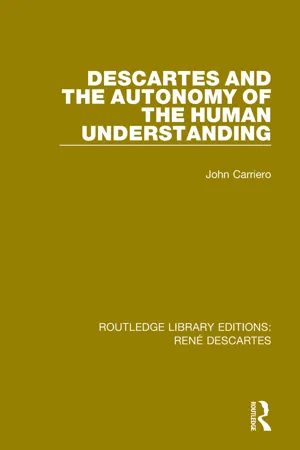
This volume, originally published in 1990, delineates the transition Descartes effects from a prevalent medieval conception of understanding to a modern conception of it. Through the examination of the continuities and discontinuities between Descartes' account of the understanding and that of high scholasticism, a characterization emerges of two way in which the understanding is autonomous in Descartes' view. These two sorts of autonomy shed light on the origin of a set of related concerns that give modern philosophy its coherence, setting it apart from medieval philosophy as a distinct tradition. The first sort – the independence of the understanding of the senses – creates the modern problem of scepticism with regard to the external world. The second sort, concerning the ontological status of the mind, provides the background against which modern discussions of the mind/body problem take shape.
- 258 pages
- English
- ePUB (mobile friendly)
- Available on iOS & Android
eBook - ePub
Descartes and the Autonomy of the Human Understanding
About this book
Information
Part One
THE DOCTRINE OF ABSTRACTION AND THE WITHDRAWAL FROM THE SENSES
The First request I press upon my readers is a recognition of the weakness of the reasons on account of which they have hitherto trusted their senses, and the insecurity of all the judgments they have based upon them. I beg them to revolve this in their minds so long and so frequently that at length they will acquire the habit of no longer reposing too much trust in them. For I deem this is necessary in order to attain a perception of the certainty of metaphysical truths [not dependent on the senses]. [HR II, 54; AT VII, 162]1
1 Introductory Remarks
Descartes’s scholastic predecessors held that all human understanding is abstracted from sensory experience--thus their famous dictum nihil est in intellectu, nisi fuerit prius in sensu. In sharp contrast with his predecessors’ abstractionist account of human understanding, Descartes came to believe that God stocks the human understanding with a certain number of innate ideas at its creation. Descartes’s rejection of the scholastic abstractionist account is no doubt connected with his understanding of the superiority of the new sciences over Aristotelian natural philosophy. The Aristotelians saw the world as populated by many kinds of substances, each with its own characteristic principle of operation. Through experience, they believed, the natural philosopher comes to learn the ways of magnets, plants, animals, and so on. A view of cognition that emphasizes the role played by the senses is clearly well suited to this conception of the natural philosopher as someone who is constantly discovering new natures of things through sensory experience with them. Descartes’s early work in geometrical physics2 taught him that genuine explanations of natural phenomena are mathematical in character; he was soon convinced that all genuine understanding of the natural world takes place through notions like extension and its modes, notions that are mathematical in nature. Descartes’s innatism provided him with a conception of the mind that grounded his insight that all understanding of the corporeal world should proceed through mathematical categories. Mathematical notions have their special character not because they involve a special sort of abstraction, as St. Thomas Aquinas taught; rather, they have this character because they belong innately to the human understanding; they are purely intellectual; they are the only ideas concerning corporeal things that we genuinely understand. Descartes’s innatism allowed him to transform “mathematical character” into “intellectual character.” Having thus demarcated the intelligible as what belongs to the pure understanding, Descartes was then in a position to accuse his scholastic predecessors of fundamentally misunderstanding the contribution of sensation to human knowledge and to dismiss their physical principles, supposedly derived from sensory experience, as literally unintelligible confusions of the sensory and the intellectual.
Descartes’s rejection of the doctrine of abstraction was also intimately connected with his philosophical achievement. The rejection of the doctrine enabled him to conceive and execute a new way of laying the foundations for the sciences. If the intellect no longer needs to look to the senses for its ideas, and, therefore, no longer depends on the possession of corporeal organs for its ideas, then it becomes possible to offer an account of the intellect that is in principle independent of an understanding of the corporeal world; the way thus became open for Descartes to lay the foundations for the sciences through an independent understanding of the nature of the faculty of knowledge. The rejection of the doctrine of abstraction was an important first step on the road to Descartes’s conception of a first philosophy that begins with an investigation of knowledge, or, more precisely, with an investigation of the organ of human knowledge, the human mind.3
The Meditationes de prima philosophia is the work in which Descartes executed his central philosophical project of grounding the sciences in an understanding of the mind. His earlier philosophical work the Discourse on Method looked ahead to the Meditations; his later philosophical work the Principles of Philosophy referred back to the Meditations.4 It is, I claim, the main task of the Meditations to take a reader who begins with scholastic abstractionist sensibilities and bring him or her to Cartesian nativism. One would expect, then, that it would be useful to keep the doctrine of abstraction in mind as one tries to understand the Meditations, especially the First Meditation, which “sets out a very simple way by which the mind may detach itself from the senses” (HR I, 140; AT VII, 12). Indeed, we shall see that reading the First Meditation in the light of the doctrine of abstraction not only illuminates sections of the Meditation that are almost wholly ignored by modern commentators, but also, what is more important, permits one to track the development of Descartes’s argument. The First Meditation is not simply a rehearsal of a series of skeptical considerations, culminating in one especially powerful skeptical consideration, the worry that there might exist an all-powerful evil deceiver. By always keeping Descartes’s systematic aims in clear view, we will be able to see exactly how the major moments of the First Meditation--the meditator’s initial observation that he or she has always taken all of his or her most secure knowledge as dependent on the senses, the dreaming argument, the analogy with painting, and, finally, the evil genius hypothesis--all go to make up a single, sustained argument, each moment building on the what has gone before and contributing to what comes after.
2 Sensory Foundations
In the First Meditation, Descartes targets the following as the principle “upon which all my former opinions rested”:
All that up to the present time I have accepted as most true and certain I have learned either from the senses or through the senses. [HR I, 145; AT VII, 18]
What is this sensory foundation upon Descartes has always taken his beliefs to have depended? His remark does not give us much to go on beyond the suggestion of some sort of empiricism. But what sort of empiricism? The principle that he seems to have in mind is unlike modern empiricism in at least two respects. Most modern empiricists would concede that (1) mathematical and logical truths are not acquired through sense experience, at least to the extent that the justification of such truths depends on proof rather than empirical observation, and (2) one’s knowledge of mathematical and logical truths is more certain than one’s knowledge of empirical truths. Moreover--and this is what is especially troublesome--those thinkers who would want in some way to deny (1) or (2) would not take their position on these issues for granted, that is, would not simply presume that the principle cited from the First Meditation is a natural and commonly shared starting point from which to begin an investigation into the foundations of one’s beliefs.
Fortunately, Descartes comes to offer in the Sixth Meditation a somewhat fuller account of “those matters which I have hitherto held to be true and the foundation on which my beliefs rested”:
And because the ideas which I received through the senses were much more lively, more clear, and even, in their own way, more distinct than any of those which I could of myself frame in meditation, or than those I found impressed on my memory, it appeared as though they could not have proceeded from my mind, so that they must necessarily have been produced in me by some other things. And having no knowledge of those objects excepting the knowledge which the ideas themselves gave me, nothing was more likely to occur to my mind than that the objects were similar to the ideas which were caused. And because I likewise remembered that I had formerly made use of my senses rather than my reason, and recognised that the ideas which I formed of myself were not so distinct as those which I perceived through the senses, and that they were most frequently even composed of portions of these last, I persuaded myself easily that I had no idea in my mind which had not formerly come to me through the senses. [HR I, 188; AT VII, 75–76]
Descartes’s account of the genesis of the (precritical) foundation of his beliefs involves three stages. First, presumably early in life, the vividness of his sensory ideas when contrasted with his nonsensory ideas contributes to the conviction that sensations come from without. Second, as his intellectual faculties are not yet sufficiently developed to provide a competing view of material objects, nothing prevents him from sliding to the further conclusion that his sensory ideas faithfully resemble their causes. Third, the senses’ hegemony over his attention brings him to try to understand everything--even the nature of the mind (recall Descartes’s answer to the question “What did I formerly believe myself to be?” in the Second Meditation [HR I, 150–51; AT VII, 25–26])--in terms of his sensory ideas. And so he naturally arrives at the conclusion that all of his ideas come through the senses. Notice that it is not until one has made the transition from the second to the third stage that one can be said to adhere to a principle similar in scope to that of the First Meditation principle cited on p. 5: in particular, the principle that sensory ideas are like their causes, although perhaps a necessary precondition for the acceptance of the First Meditation principle, does not have sufficient scope to be considered the ground of all of one’s beliefs.
There is no doubt that Descartes intends the Sixth Meditation passage to be an account of the intellectual development of the vulgar. But there also can be no doubt that this account of the development of the world view of the untutored is theory laden. The putative foundation which the untutored person is depicted as having been seduced into taking as the source of his or her beliefs, viz., “nullam plane me habere in intellectu, quam non prius habuissem in sensu,” unmistakably echoes the Aristotelian/scholastic commonplace: nihil est in intellectu, nisi prius fuerit in sensu. Further, the other troublesome aspect of the First Meditation principle, that the senses provide one with what is “most true and certain,” also finds a home in scholastic thought. Witness, for example, this passage from Aquinas’s commentary on Aristotle’s Physics:
The individual sensible things themselves … are better known to us because of the knowledge of sense, which is of singulars, does precede in us the knowledge of the intellect, which is of universals. [In I Phys., Lect. 1, n. 8]
If all ideas somehow originate in the senses (we will flesh this out shortly), it would seem that the sensible has some claim to be what is best known to us--what is most true and certain for us.
It should come as little surprise that Descartes finds a rather intimate connection between the views of the vulgar and Aristotelianism, which is, after all, according to Descartes, the philosophy of the vulgar. Indeed, in his Reply to the Sixth Set of Objections, he gives a similar, and equally flattering, account of the genesis in childhood experience of the scholastic notions of substantial form and real quality. I leave open the question of whether Descartes accurately depicts the views of the plain person and the further question of whether the views of the plain person of Descartes’s day would be the same as those of the plain person of our day. Be that as it may, what is important here is not only that a large segment of Descartes’s audience actually subscribed to the First Meditation principle, but also that any educated person could reasonably be expected to be familiar with the position. Further, Descartes has a personal stake in dealing with that part of his audience which subscribed to the principle, the Aristotelian side of scholasticism, as his Jesuit teachers at La Fleche were included in that tradition.5 Thus, Descartes shows a special interest in finding acceptance for his philosophy within the Aristotelian/Thomistic tradition in general, and the Jesuit order in particular. The historical context accounts for, then, what appeared so puzzling about Descartes’s introduction of the First Meditation principle, that is, why Descartes takes as his starting point in the First Meditation a principle which seems at first blush quite controversial when read with modern sensibilities.
It appears, then, that the “attachment to senses” that Descartes seeks to eliminate includes at least the dependence of the understanding on the senses found in Thomism. But this just pushes the question back: Exactly how, according to Descartes’s teachers, did the intellect depend on the senses? Further progress here requires a basic understanding of the Aristotelian/scholastic noetic6 to which to we now turn.
3 High Scholastic Teaching on Cognition
Divine and angelic cognition
In Aquinas’s view, there are three sorts of relationships between knower and known, depending on the nature of the intellect in question. Let’s consider first God’s knowledge of creation. Since God is absolutely uncaused, his creatures cannot act on him in any way. Therefore, divine knowledge of creation cannot be understood in terms of some sort of action by the object known on the divine intellect; thus, Aquinas has to find some other way of explaining God’s intimate knowledge of his creation. Thomas accounted for divine knowledge through God’s knowledge of his own nature. Since God is the creator of everything else, in his knowledge of his divine nature lies the knowledge of the cause of everything else: “…so God, knowing Himself as the principle of being, knows the nature of being, and all other things in so far as they are beings” (ST I, Q. 14, A. 6).
The second sort of intellect recognized by Aquinas belongs to the purely spiritual creatures, angels. Angels, being created, are limited and so cannot know the whole of creation through the contemplation of their finite essences. So that their knowledge may extend to all of created reality, God endows angelic intellects with certain connatural species, that is, certain principles or likenesses in virtue of which they can contemplate and understand other creatures. Gradations within the angelic mode of knowledge result from the fact that some angels, having more powerful intellects than others, are able to understand through fewer and more universal intelligible species, and, consequently, arrive at a more comprehensive and unified conception of creation.
Two aspects of angelic cognition deserve special notice. First, to claim that angels know through connatural species is to claim that angels do not owe their ability to cognize the objects which they know through some sort of causal interaction with those objects. For example, the angel Michael’s ability to contemplate the essence of the angel Gabriel does not result from some sort of action on Michael’s intellect by Gabriel. This aspect of angelic cognition comes out especially forcefully when Thomas resolves a difficulty that he raises concerning the thesis that one angel is able to understand another. The difficulty he poses is this:
Further, if one angel did understand another, this would be either by an innate species; and so it would follow that, if God were now to create another angel, such an angel could not be known by the existing angels; or else he would have to be known by a species drawn from things; and so it would follow that the higher angels could not know the lower, from whom they receive nothing. Therefore in no way does it seem that one angel knows another. [ST I, Q. 56, A. 2, Obj. 4]
After arguing that the one angel does in fact understand another through a connatural intelligible species, Aquinas turns to the first disjunct of the difficulty:
God made every creature proportionate to the universe which He determined to make. Therefore had God resolved to make more angels or more natures of things, He would have impressed more intelligible species in the angelic minds; as a builder who, if he had intended to build a larger house, would have made larger foundations. Hence, for God to add a new creature to the universe, means that He would add a new intelligible species to an angel. [ST I, Q. 56, A. 2, ad 4]
Aquinas’ s response shows how much emphasis he is willing to put on the way that God sets things up at creation, at the expense of any sort of post-creative interaction between knower and known. It is God who would have added the new intelligible species, had he decided to create another angel; the new intelligible species would not have been naturally generated, say, in accordance with some sort of intellectual mechanism. Thus, in the case of angelic cognition, the connection between knower and known crucially depends on the fact that God is creator of both knower and known.
A second aspect of angelic understanding that merits special attention is the angels’ comprehension of material essences and individuals. Although innate species might offer a plausible account of angelic comprehension of purely intelligible objects, the comprehension of material reality seems to pose special problems. Since material creatures are not inherently intelligible, it seems that such creatures must be rendered intelligible through faculties especially suited for this task, such as the human sensitive power and active intellect (see below, pp. 12–16). But the possession of a sensitive faculty is impossible without the possession of a body, which the angels, being purely spiritual, lack. A similar difficulty seems to stand in the way of angelic comprehension of material individuals: how could an angel, lacking the sort of interaction with material individuals afforded by the possession of materially individuated corporeal organs, achieve more than a very general understanding of those material individuals? Aquinas responds to the first of these concerns by holding that the angels do not know material natures by working backward from effects to causes as humans do, but rather are able, like God, to discern material natures through very general causal principles that are involved in their creation:
Consequently, all material things pre-exist in the angels more simply ...
Table of contents
- Cover
- Half Title
- Title Page
- Copyright Page
- Original Title Page
- Original Copyright Page
- Preface to the Garland Edition
- Table of Contents
- Preface
- Part One: The Doctrine of Abstraction and the Withdrawal from the Senses
- Part Two: A Mind Better Known than Body
- Bibliography
Trusted by 375,005 students
Access to over 1.5 million titles for a fair monthly price.
Study more efficiently using our study tools.
Frequently asked questions
Yes, you can cancel anytime from the Subscription tab in your account settings on the Perlego website. Your subscription will stay active until the end of your current billing period. Learn how to cancel your subscription
No, books cannot be downloaded as external files, such as PDFs, for use outside of Perlego. However, you can download books within the Perlego app for offline reading on mobile or tablet. Learn how to download books offline
Perlego offers two plans: Essential and Complete
- Essential is ideal for learners and professionals who enjoy exploring a wide range of subjects. Access the Essential Library with 800,000+ trusted titles and best-sellers across business, personal growth, and the humanities. Includes unlimited reading time and Standard Read Aloud voice.
- Complete: Perfect for advanced learners and researchers needing full, unrestricted access. Unlock 1.5M+ books across hundreds of subjects, including academic and specialized titles. The Complete Plan also includes advanced features like Premium Read Aloud and Research Assistant.
We are an online textbook subscription service, where you can get access to an entire online library for less than the price of a single book per month. With over 1.5 million books across 990+ topics, we’ve got you covered! Learn about our mission
Look out for the read-aloud symbol on your next book to see if you can listen to it. The read-aloud tool reads text aloud for you, highlighting the text as it is being read. You can pause it, speed it up and slow it down. Learn more about Read Aloud
Yes! You can use the Perlego app on both iOS and Android devices to read anytime, anywhere — even offline. Perfect for commutes or when you’re on the go.
Please note we cannot support devices running on iOS 13 and Android 7 or earlier. Learn more about using the app
Please note we cannot support devices running on iOS 13 and Android 7 or earlier. Learn more about using the app
Yes, you can access Descartes and the Autonomy of the Human Understanding by John Carriero in PDF and/or ePUB format, as well as other popular books in Philosophy & Philosophy History & Theory. We have over 1.5 million books available in our catalogue for you to explore.