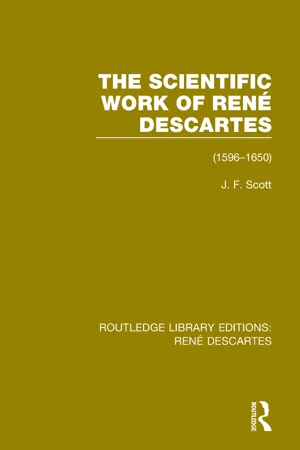
When originally published in 1952, this book filled a gap in the history of philosophy and science and remains an important work today, because it puts the main mathematical and physical discoveries of Descartes in an accessible form, for the benefit of English readers. Descartes is acknowledged to be the founder of modern mathematics, through his invention of analytical geometry and this volume charts Descartes' role in bringing a unity into algebra and geometry and the development of mathematics into a discipline which could be properly analysed. Carefully paraphrasing the Géométrie, this volume retains much of Descartes' original notation as well as the original diagrams. The volume also discusses the considerable contribution that Descartes made to the physical sciences which involved accurate work in optics, light, sight and colour.
- 222 pages
- English
- ePUB (mobile friendly)
- Available on iOS & Android
eBook - ePub
About this book
Information
CHAPTER I
EARLY LIFE AND TRAINING
RENÉ DESCARTES was born at La Haye, in Touraine, on 31st March 1596. His father was Joachim Descartes, a lawyer by profession, and a Counsellor of the local parliament of Bretagne. This assembly held its sessions in Rennes, the capital of the province, and it was there that the family resorted when the parliament was sitting. Descartes was delicate at birth and in his early years, and it was feared that he would never attain maturity.
At the age of eight years he was sent to the newly established Jesuit College at La Flèche, in Anjou. In 1603 the Jesuits had obtained from Henry IV authority to establish themselves in several cities in France, including La Flèche. Here the Collège Royal was opened in January 1604 and the Society spared no pains to make the establishment famous as a centre of learning. Its first Rector was Father Chastellier; he was soon succeeded by Father Charlet, a man who had already attained distinction in the Society, and one to whom Descartes afterwards referred affectionately as “un second père”. Its staff was chosen with the greatest care, and for many years no other city, not even Paris, could boast of an establishment comparable with that of La Flèche. It was therefore not without reason that Descartes later referred to it as l’une des plus célèbres écoles de l’Europe. Descartes was admitted at Easter 1604, and for eight years he followed the traditional course which embraced classics, logic and ethics, mathematics and physics, and metaphysics. Even at that early age he showed unusual talent for mathematical studies. It is recorded that although his health gradually improved he was never robust, and on that account he was allowed some relaxation from the rigours of school life. He was permitted to rise late, and in that way he acquired, or rather developed, those habits of meditation which were to remain with him all his life.
But in spite of the soundness of the education which he had received, and to which he frequently paid tribute, he confessed that after eight years he had derived no advantage beyond the realisation of his own ignorance and the sterility of the current systems of philosophy. He therefore resolved to put away his books and seek no science other than that which he could acquire from a study of himself and the world about him. At the age of sixteen he left La Flèche. A year later he went to Paris, retiring to the Faubourg Saint-Germain where he lived more or less in solitude; Baillet records that he had sufficient strength of character to hold himself aloof from the distractions of the capital. He left Paris however after a brief stay and after spending a year or two (1615–16)at the University of Poitiers he crossed into Holland where he enlisted as a volunteer in the Military School at Breda, then under the command of Prince Maurice of Nassau. It was at Breda that chance brought him, in November 1618, into contact with Isaac Beeckman, Rector of the College at Dordrecht, and a mathematician of ability. Beeckman provided the young Descartes with a translation of a problem which had been set as a challenge, and from this circumstance arose a friendship which was both long and fruitful. After a stay of barely two years Descartes left Holland and travelled through Europe and was present at the coronation of the Emperor Ferdinand II at Frankfort in 1619. Our knowledge of his activities over this period is somewhat fragmentary; the scant information we have has, however, been augmented by the discovery in 1905 at Middelburg of some manuscript notes compiled by Beeckman during the period of his acquaintance with Descartes*. Still anxious to study men and manners he took service in the same year (1619) with the army which the Duke of Bavaria had gathered against the Protestant princes at Frankfort. It was during the latter part of this year that, reduced to inactivity by the severity of the climate, he locked himself in a room heated by a stove and gave himself up to his reflections. That was at Neuberg on the Danube on 10th November 1619, a date which he afterwards regarded as the most significant of his life, for as a result of his meditation he conceived the idea of a complete reform of philosophy.
Descartes had left school perplexed by innumerable doubts. Of all the subjects to which he had devoted so much time, one alone, namely mathematics, had seemed worth while. Mathematics alone seemed to carry any certainty, and this, he noted, was due to the method it employed. Starting from a few fundamental ideas which are self-evident, the mathematician erects a structure of interlocked knowledge which is unshakable. Now, argued Descartes, if an equally sure and certain starting point could be found in other branches of knowledge, the same method might well lead to conclusions as sound as are those of mathematics. It was his search for this which led him to the famous Cogito, ergo sum, a proposition which expresses the inseparable union between consciousness and existence, between the act of thinking and him who thinks. This conclusion, being beyond all doubt, could therefore serve as the starting point which he was seeking, and since the guarantee of its truth lies solely in the fact that it is clear and distinct, so he was led to a criterion of certainty : what is clearly and distinctly conceived must necessarily be true. Once he had established this principle Descartes resolved to spend the next few years amassing a variety of experiences which would enable him to lay the foundations of a new system of philosophy.
The following year he resumed his wanderings. For the next eight years (1620–28) he travelled over Europe. In 1620 he was with the army in Bohemia; the following year saw him in Hungary. Then, having abandoned the profession of arms, he returned to France by way of northern Germany and Holland. He was at Rennes during the winter of 1622–23, and in the following spring he was again in Paris. It is probable that his association with Father Mersenne, a former pupil of La Flèche, and seven years his senior, dates from this time. After a brief stay, Descartes left Paris and went to Italy and was in Rome for the Jubilee celebrations of that year (1623). He spent some time meandering over Italy, visiting Venice for the carnival there, and it is probable that he made a pilgrimage to Loreto to fulfill a vow he had made four years earlier. He does not appear to have made any effort to meet Galileo, whose reputation was now firmly established in Europe. Returning from Italy, he is reputed, on very slender authority, to have assisted at the siege of Gavi. In 1625 he was back with his family at Rennes; 1626 saw him once more in Paris and he was there at frequent intervals between 1626 and 1628. He is said also to have taken part in the siege of La Rochelle (1628) but the evidence for this is doubtful*.
It is clear from the pages of the Discours de la Méthode (1637) that Descartes was growing weary of these aimless wanderings. Nine years have now elapsed, he there confesses, since his resolve to devote his life to the establishing of a system of philosophy free from the blemishes of the ancient philosophies, yet in that time he had not succeeded in laying even the foundations of any system which could satisfy his exact and orderly mind. These years, however, had not been entirely barren. To render his mind more receptive of truths which had been established by the most careful scrutiny, he first of all strove to banish from it all his former opinions. This done, he applied himself to the task of unravelling the difficulties of mathematics, that by this means he might acquire a certain critical faculty which would enable him to distinguish what was true from what was false or even doubtful. Not until he had learned to recognise and isolate what was true from the maze of opinions which were still in dispute among the learned did he feel competent to undertake those philosophical reforms which he had at heart. To accomplish this dual task he resolved (1628) to abandon his nomadic way of living and seek out a retreat where he could pursue his researches in tranquillity. His choice fell upon Holland, which at that time offered more advantages to the serious student than any other country. Central Europe was still distracted by the internecine battles of the Thirty Years War, and in England civil as well as religious discord was rife. Holland, under the Stadholder, Prince Frederic Henri, had just won her independence after her protracted struggle with Spain and already she had begun to enjoy the blessings of peace. Her army was the great military school, to which were drawn the young nobility of many lands. Commercially, she was at the peak of her prosperity, and in many of her cities—Leyden, Utrecht, Breda, Amsterdam —universities and academies were rapidly springing up. Further, as a consequence of the Synod of Dordrecht (1619), which encouraged religious freedom, she had acquired a reputation for toleration unusual at that time, and there were many parts of the country where the Catholic faith still flourished. Considerations such as these, therefore, induced Descartes again to cross over into Holland, and so well did the country suit his temperament and his plans, that for nearly twenty years, that is, almost to the time of his death, it was his home. These twenty years proved the most productive period of his life. Within a few months of his arrival he was at work on his Rules for the Direction of the Mind†; before he left he had made notable contributions to almost every branch of human knowledge.
It is difficult to find evidence for the popular view that Descartes spent these twenty years, or indeed any considerable portion of them, in solitude. On the contrary, during his stay in Holland he made many friends, and visitors to his house were by no means rare. These include, to name but few : Isaac Beeckman, whose friendship with Descartes dates from 1618 ; Claude Mydorge, a geometer of note; Hortensius, friend of Snell and Professor of Mathematics at the Athenœum Illustre, Amsterdam; Golius, Professor of Oriental Languages at the University of Leyden; Constantyn Huygens, Seigneur de Zuylichem, father of Christian, and Secretary to the Prince of Orange; Van Schooten (the elder), who occupied the Chair of Mathematics at the University of Leyden, as well as several others of note from the same university. Mention must also be made of H. Reneri, Professor of Philosophy, first at Deventer, and later at Utrecht, who was one of the first to embrace the Cartesian philosophy. But it was not only among the learned that Descartes sought his acquaintances. His friendship with Princess Elizabeth, daughter of the Elector Palatine, Frederick V, is well known. Mersenne continued to ply him with letters by almost every courier, and it is from these letters that we learn much of Descartes’ activities over this very fruitful period. Mersenne seems to have been a sort of clearing house for all the scientific enquiries that were addressed to Descartes. Descartes on his part took considerable pains in dealing with the questions raised, and his replies, some of which deserve to rank as miniature treatises, would, even if they stood alone, be enough to mark him out as a thinker of sound and mature judgment. But apart from living in tranquillity, Descartes with the passing years steadily acquired a surprising capacity for controversy; moreover, he appears to have shown no reluctance to enter the controversial arena. “He had a special talent for dividing scholars among themselves,” says Baillet, “and for prolonging the disputes he had aroused.” A perusal of Descartes’ correspondence amply confirms Baillet’s assertion.
Despite the position he had attained among the learned, Descartes had meanwhile published nothing. For four years (1629–33) he had been occupied with the compilation of a vast treatise on physics which was to present his system to the world. This work, which bore the title Le Monde, ou Traité de la Lumière, was on the eve of publication when Descartes heard of the condemnation of Galileo (23rd June 1633) and this decided him to suspend the publication of the work. The treatise was never published in its entirety, neither during Descartes’ lifetime nor subsequently, but its main features are outlined in the Discours de la Méthode and further developed in the Principia Philosophiœ (1644). His correspondence over that period, too, helps to fill in the gaps. In this work Descartes attacked the errors of the current philosophies; their qualités réelles and their formes substantielles are only sensations which we have in us. Scholastic philosophy he disparaged as nothing more than a traduction en langage pédantesque, de croyances erronées. Despite this, his system of vortices, which from his letters he had been elaborating for some years, compelled him to accept doctrines which were part of the heritage of the scholastic philosophers, among them the denial of a void and of action at a distance. Clearly such notions could have no place within the framework of a scheme which postulated a universe full of matter all moving at the same time. The absence of a void led Descartes further to postulate the existence of a fine subtle matter to fill the gaps between the larger moving particles. In this work Descartes recognised three forms which the primary matter of the universe could assume; these were the elements of fire, air and earth, which in the Principia Philosophiœ were to become the three elements of the visible world, the sun and the fixed stars, the heavens, and the earth, planets and comets. Once this introduction is finished Descartes leaves the world in which we live and proceeds to describe an imaginary world created in the vast spaces beyond us. To the matter already described Descartes adds motion, which like matter is created by God and conserved by Him. On these assumptions Descartes explains the origin of the world and of everything in it. Then follows a description of the nature and properties of light, but before proceeding very far, the treatise comes to an abrupt end, and apparently it was never resumed.
But although Descartes remained firm in his resolve not to publish the projected treatise, he had no intention of withholding from the world the fruits of his labours. He was far too conscious of their value. It was therefore with no great reluctance that he yielded to the importunities of his friends who for some time had been urging him to publish. In 1637 there appeared at Leyden the Discours de la Méthode*, together with its accompanying essays, La Dioptrique, Les Météores, and La Géométrie. These important works will be described in due course, meanwhile it is enough to mention that their publication made it abundantly clear that an unusually gifted scholar had arisen. Not everyone agreed with Descartes’ conclusions, and in some quarters their appearance provoked fierce opposition, which however was not displeasing to Descartes, convinced as he was of the soundness of his method and the strength of his position. But in spite of these distractions Descartes found time to compile the second of his great works. This was his Meditationes de Prima Philsophia which appeared in 1641. This, too, did not lack critics; among them were Arnauld, Hobbes and Gassendi. Descartes’ replies to their criticisms appeared in his Résponses, published in the latter part of the same year.
Still, his system of the world had not yet been made public. To fulfil his earlier designs Descartes compiled his monumental Principia Philosophiœ, the most comprehensive of all his works. It appeared in Amsterdam in 1644 and was dedicated to the Princess Elizabeth. The three treatises mentioned embraced the whole of his philosophy with the exception of the moral. Upon this Descartes never ventured to publish a dogmatic treatise; he merely contented himself by showing that the method he had evolved might be applied to questions of that nature. This was the purpose of his Traité des Passions de l’Ame which was written following the earnest solicitations of the Princess Elizabeth, and which appeared in 1649.
During his stay in Holland, Descartes seems to have shown little desire to return to his native land. However, on 28th October 1640 he wrote expressing a wish to return to France in order to see again his father, now in his seventy-seventh year. The desire was never fulfilled, for the father died in that same month. About the same time, Descartes lost his sister. Earlier in the year his daughter Francine, to whom he was devoted, died at the age of five. Descartes, who was busy upon his Meditationes, postponed his visit to France, and it was not until 1644 that he made the journey. He was at La Haye about May of that year, but by November he was back in Holland. Meanwhile he had visited Paris, and it is important to note that during this visit he made his peace with the Jesuits, with whom his relations appear to have become somewhat strained.
Descartes made a second journey to France in 1647. It has been suggested, and possibly not without reason, that Descartes was beginning to find Holland, after all, too distracting. He had many enemies in Leyden, particularly the Protestant divine, Gisbert Voët, and it is not unlikely that he was feeling a desire for that serenity which he had enjoyed in his youth. Whatever the reason, Descartes went to France in the summer of 1647, and the most significant event of his visit appears to have been his meetings with Pascal on 23rd and 24th September, for it is suggested that it was on these occasions that Descartes recommended to his younger contemporary the experiment of noting the variation in the height of the barometer with altitude. Descartes’ stay was a short one, however, and he was soon back in Holland. The next year he was again on his way to France. Towards the end of 1647 a pension of 3,000 livres was accorded to him “en considération de ses grands mérites, et de l’utilité que sa Philosophie et les recherches de ses longues études procuraient au genre humain; comme aussi pour l’aider à continuer ses belles expériences qui requéraient de la dépense”*. He arrived at La Haye on 7th May 1648, but his stay was a short one. France was on the eve of civil war (Le Fronde) and Descartes thought that the air of Holland might yet be more wholesome. He was back in his retreat in the September of the same year. It is probable that he returned empty-handed, save for the parchment, “le plus cher”, he afterwards declared, “et le plus inutile qui eût jamais entre les mains”.
He was not, however, to remain in Holland for long. Among his friends and admirers was M. Chanut, French Ambassador to the Swedish Court, where Queen Christina, herself no mean patroness of learning, had drawn to her Court from the four corners of Europe some of the most illustrious men, both in arts and in letters. She had conceived the design of encouraging learning throughout her realm; it was but natural that Chanut should bring the name of his distinguished fellow-countryman to her notice. Descartes received his command in due course and he accepted with reluctance. He left Holland in the autumn of 1649, arriving at the Swedish capital in t...
Table of contents
- Cover
- Half Title
- Title Page
- Copyright
- Original Title
- Original Copyright
- Table of Contents
- Foreword.
- Preface.
- Chapter I. Early Life and Training.
- II. Brief Survey of Descartes’ Scientific Work.
- III. The Discours de La Méthode.
- IV. La Dioptrique.
- V. Les Météores.
- VI. Introduction to La Géométrie.
- VII. La Géométrie. Book I. Problems which can be Constructed by means of Circles and Straight Lines only.
- VIII. La Géométrie. Book II. On the Nature of Curves.
- IX. La Géometrie. Book III. The Construction of Solid and Super-solid Problems.
- X. The Principia Philosophiæ. I. The Principles of Human Knowledge. II. The Principles of Material Things.
- XII. The Principia Philosophiæ. III. Of the Visible World.
- XII. The Principia Philosophiæ. IV. The Earth.
- XIII. Conclusion. Importance of Descartes’ Work in the History of Science.
- Appendix. Brief Biographical Notes on some of the Less Important Persons mentioned in the preceding pages.
- List of Works Consulted.
- Index.
Trusted by 375,005 students
Access to over 1.5 million titles for a fair monthly price.
Study more efficiently using our study tools.
Frequently asked questions
Yes, you can cancel anytime from the Subscription tab in your account settings on the Perlego website. Your subscription will stay active until the end of your current billing period. Learn how to cancel your subscription
No, books cannot be downloaded as external files, such as PDFs, for use outside of Perlego. However, you can download books within the Perlego app for offline reading on mobile or tablet. Learn how to download books offline
Perlego offers two plans: Essential and Complete
- Essential is ideal for learners and professionals who enjoy exploring a wide range of subjects. Access the Essential Library with 800,000+ trusted titles and best-sellers across business, personal growth, and the humanities. Includes unlimited reading time and Standard Read Aloud voice.
- Complete: Perfect for advanced learners and researchers needing full, unrestricted access. Unlock 1.5M+ books across hundreds of subjects, including academic and specialized titles. The Complete Plan also includes advanced features like Premium Read Aloud and Research Assistant.
We are an online textbook subscription service, where you can get access to an entire online library for less than the price of a single book per month. With over 1.5 million books across 990+ topics, we’ve got you covered! Learn about our mission
Look out for the read-aloud symbol on your next book to see if you can listen to it. The read-aloud tool reads text aloud for you, highlighting the text as it is being read. You can pause it, speed it up and slow it down. Learn more about Read Aloud
Yes! You can use the Perlego app on both iOS and Android devices to read anytime, anywhere — even offline. Perfect for commutes or when you’re on the go.
Please note we cannot support devices running on iOS 13 and Android 7 or earlier. Learn more about using the app
Please note we cannot support devices running on iOS 13 and Android 7 or earlier. Learn more about using the app
Yes, you can access The Scientific Work of René Descartes by J. F. Scott in PDF and/or ePUB format, as well as other popular books in Philosophy & Philosophy History & Theory. We have over 1.5 million books available in our catalogue for you to explore.